
Table of Contents
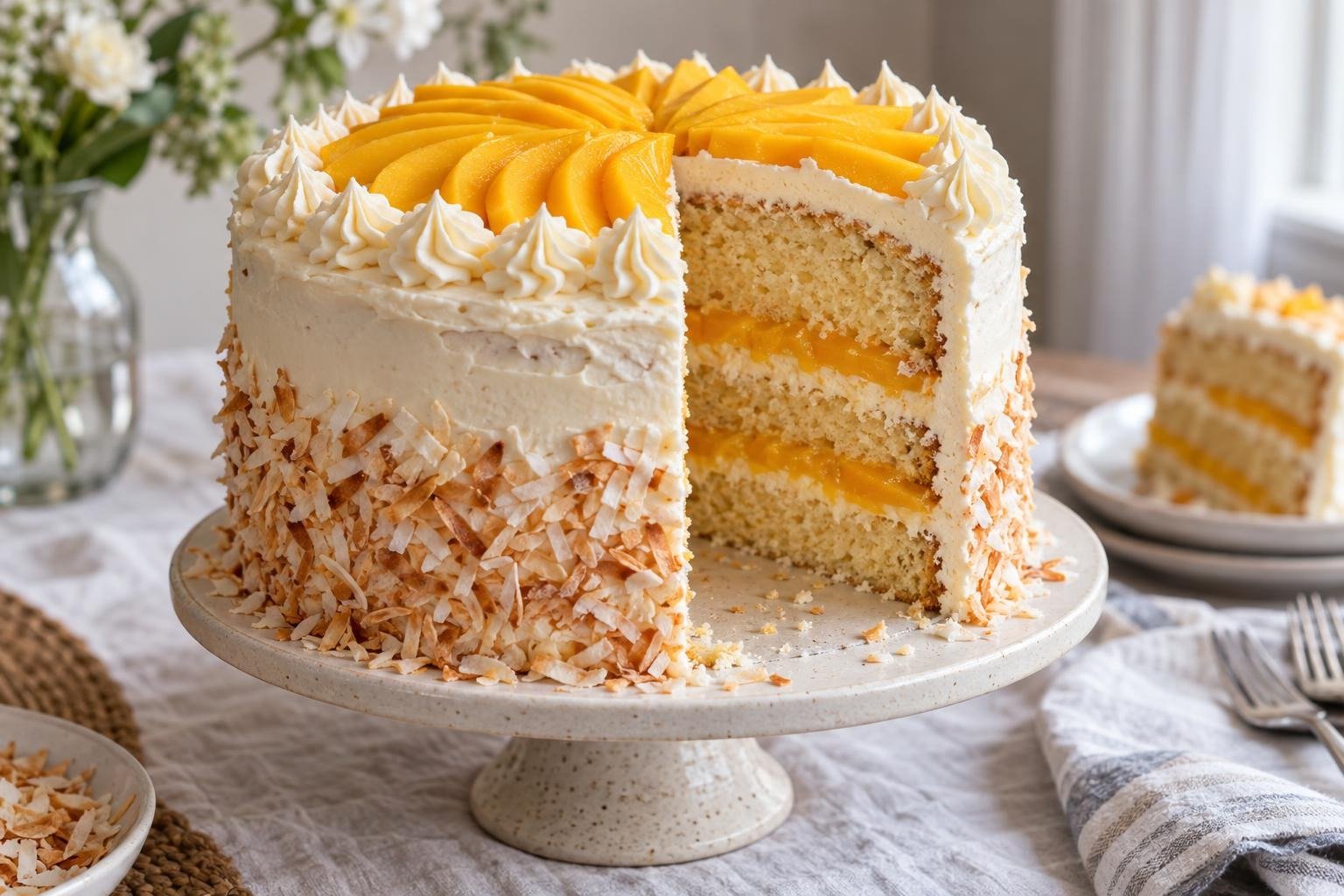
Tender coconut crumb, fragrant toasted flakes, silky buttercream, and a bright mango center give this mango coconut birthday cake a clean tropical flavor without turning the layers heavy or soggy. The cake has enough structure for tall slices, while the tangy mango filling keeps the sweet coconut and vanilla notes from tasting flat.
I keep the mango concentrated in a cooked filling rather than loading the batter with watery puree. For the cake, I combine butter for flavor with oil for softness, then use full-fat coconut milk and finely shredded coconut for a distinct but balanced coconut profile. The important cues are a filling that bubbles and holds a trail, batter mixed only until smooth, completely cool layers, and buttercream that feels silky rather than greasy or stiff.
Why You’ll Frickin’ Love This Recipe
- Butter supplies rich flavor while neutral oil remains fluid after refrigeration, helping the coconut cake layers stay soft when the assembled cake is chilled.
- Full-fat coconut milk provides moisture, fat, and coconut flavor without introducing the coarse texture that would come from using a large quantity of shredded coconut.
- Cooking mango puree with cornstarch produces a concentrated filling that can be sliced cleanly instead of soaking into the cake or pushing the layers sideways.
- Swiss meringue buttercream creates a smooth, moderately sweet finish with enough stability to contain the mango filling and support a three-layer birthday cake.
- Toasted coconut adds crisp texture and deeper roasted flavor, while fresh mango is added shortly before serving so the finished cake stays neat and fresh.
Ingredient Notes for Bakery-Style Mango Coconut Birthday Cake
- Cake flour: Its lower protein content limits gluten development, producing a finer and more tender crumb. Weigh it rather than packing it into cups, which can make the layers dry and dense.
- Full-fat coconut milk: Use canned coconut milk, not a refrigerated coconut beverage. Stir the coconut cream and liquid together thoroughly before measuring so every layer receives the same balance of fat and water.
- Unsweetened shredded coconut: Finely shredded coconut disperses through the batter without creating heavy pockets. Unsweetened coconut also gives better control over the cake’s sugar level.
- Mango puree: Blend ripe fresh mango or fully thawed frozen mango until smooth, then strain away stubborn fibers. A smooth puree cooks evenly and creates a cleaner filling.
- Egg whites: Carton whites may be used only when the package states that they are suitable for whipping. Any fat or yolk residue can prevent the Swiss meringue from reaching full volume.
- Unsalted butter: Softened butter for the cake should yield to gentle pressure without appearing oily. Buttercream butter should be cool and pliable, around 18 to 20°C, so it emulsifies instead of melting.
- Fresh mango garnish: Choose ripe but firm fruit that can be sliced cleanly. Very soft mango releases juice onto the buttercream and is better reserved for making the puree.
Expert Baking Tips
- Weigh the batter into the pans instead of estimating by eye. Even layers bake at the same rate and make the finished cake easier to stack without aggressive trimming.
- Cool the mango filling in a shallow container with covering directly on its surface. A cold, fully set filling is less likely to escape through the buttercream dam.
- If the Swiss meringue buttercream looks soupy, the mixture is too warm. Chill the bowl for 10 minutes, then beat again. If it looks curdled and feels cold, gently warm the bowl’s exterior for a few seconds while mixing.
- Do not spread mango filling directly to the cake’s edge. Keep the filling inside a complete buttercream ring and avoid pressing down on the stacked layers, which can force the filling outward.
- Decorate with fresh mango close to serving time. Pat the slices dry first, and keep them away from the outer edge so juice does not run down the finished buttercream.
Ingredients for Mango Coconut Birthday Cake
- 360 g cake flour (Sift if visibly lumpy.)
- 12 g baking powder (Use fresh double-acting baking powder.)
- 4 g fine sea salt (For the coconut cake layers.)
- 170 g unsalted butter (Softened to about 20°C for the cake.)
- 80 g neutral oil (Use canola, sunflower, or another neutral baking oil.)
- 330 g granulated sugar (For the coconut cake layers.)
- 200 g large eggs (About 4 large eggs without shells, at room temperature.)
- 10 g vanilla extract (For the coconut cake layers.)
- 2 g coconut extract (For the coconut cake layers.)
- 300 g full-fat canned coconut milk (Stir until completely uniform and bring to room temperature.)
- 75 g finely shredded unsweetened coconut (Break apart any compacted clumps before using.)
- 400 g mango puree (Made from ripe fresh or thawed frozen mango, blended and strained.)
- 80 g granulated sugar (For the mango filling.)
- 25 g fresh lime juice (Strained to remove seeds and pulp.)
- 24 g cornstarch (For thickening the mango filling.)
- 25 g cool water (For dissolving the cornstarch.)
- 15 g unsalted butter (Cold and cubed for the mango filling.)
- 1 g fine sea salt (For the mango filling.)
- 200 g large egg whites (About 6 large whites, with no trace of yolk.)
- 340 g granulated sugar (For the Swiss meringue buttercream.)
- 454 g unsalted butter (Cut into tablespoon-size pieces and held at 18 to 20°C.)
- 10 g vanilla extract (For the Swiss meringue buttercream.)
- 2 g coconut extract (For the Swiss meringue buttercream.)
- 2 g fine sea salt (For the Swiss meringue buttercream.)
- 100 g unsweetened coconut flakes (For toasting and decorating the cake.)
- 150 g fresh mango (Ripe but firm, peeled and thinly sliced shortly before serving.)
How to Make Mango Coconut Birthday Cake
- STEP 1). Prepare the pans and mango puree Grease three 8-inch round cake pans lightly, line the bottoms with parchment, and grease the parchment. Blend ripe or thawed mango until completely smooth, then press it through a fine-mesh sieve into a bowl and weigh 400 g. This removes fibers that could interfere with the filling’s clean texture. Keep the prepared pans at room temperature while you cook the filling, which needs the longest cooling time.
- STEP 2). Cook and chill the mango filling Combine the mango puree, 80 g sugar, lime juice, and 1 g salt in a medium heavy-bottomed saucepan. Whisk the cornstarch with the cool water until smooth, then whisk it into the puree. Cook over medium heat, stirring continuously with a silicone spatula, until the mixture bubbles throughout and a drawn line briefly holds, about 6 to 9 minutes. Boil gently for 1 minute, remove from the heat, and stir in 15 g cold butter. Transfer to a shallow container, cover the surface, and refrigerate until cold and firm.
- STEP 3). Preheat the oven and combine the dry ingredients Position a rack in the center of the oven and preheat to 175°C. Whisk the cake flour, baking powder, and 4 g salt in a medium bowl for at least 30 seconds so the leavener is evenly distributed. In a separate jug, stir the coconut milk until no solid cream remains. Confirm that the eggs, coconut milk, and cake butter are at room temperature, since cold ingredients can break the emulsion and produce uneven, compact layers.
- STEP 4). Cream the butter, sugar, and oil Fit a stand mixer with the paddle attachment. Beat the 170 g softened butter and 330 g sugar on medium speed for 3 to 4 minutes, stopping once to scrape the bowl and paddle. The mixture should look pale, expanded, and slightly fluffy rather than greasy. With the mixer on medium-low, drizzle in the oil over about 30 seconds, then mix for another minute. This aeration supports the cake’s rise while the oil helps the chilled crumb remain soft.
- STEP 5). Add the eggs and finish the coconut batter Beat the eggs together with the vanilla and coconut extracts. Add the mixture to the creamed butter in four additions on medium-low speed, mixing until each addition disappears before adding the next and scraping the bowl as needed. On low speed, add the dry ingredients in three portions, alternating with the coconut milk in two portions, beginning and ending with flour. Stop when only a few flour streaks remain, then fold in the shredded coconut by hand until the batter is smooth and uniform.
- STEP 6). Divide, bake, and cool the cake layers Divide the batter evenly among the prepared pans, using about 580 g per pan, and level the surfaces with a small offset spatula. Bake for 23 to 28 minutes, rotating the pans once if the oven browns unevenly. The centers should spring back lightly, the edges should just pull from the pans, and a skewer should show moist crumbs without wet batter. Cool in the pans for 15 minutes, then invert onto wire racks, remove the parchment, turn upright, and cool completely before assembly.
- STEP 7). Toast the coconut and heat the meringue base Spread the coconut flakes on a rimmed baking sheet and toast at 160°C for 6 to 9 minutes, stirring every 2 minutes, until mostly pale gold with a few deeper edges. Cool completely. For the buttercream, combine the egg whites and 340 g sugar in a spotless heatproof mixer bowl. Set it over barely simmering water without letting the bowl touch the water, whisking constantly until the sugar dissolves and the mixture reaches 71°C, about 6 to 8 minutes.
- STEP 8). Whip and emulsify the coconut buttercream Transfer the hot egg-white mixture to the stand mixer and whip with the whisk attachment on high speed until the meringue forms glossy, stiff peaks and the bowl feels neutral rather than warm, about 8 to 12 minutes. Reduce to medium speed and add the 454 g butter one piece at a time. Continue beating until the buttercream becomes thick and silky, even if it briefly looks curdled. Mix in the vanilla, coconut extract, and 2 g salt, then switch to the paddle and mix on low for 2 minutes to reduce air bubbles.
- STEP 9). Fill and crumb-coat the cake Level the cake layers with a serrated knife only if they have noticeable domes. Place one layer on a cake board and spread a thin film of buttercream over it. Pipe a sturdy buttercream dam around the edge, then add half of the cold mango filling, keeping it below the dam. Repeat with the second layer and remaining filling, then place the final layer cut-side down. Apply a thin crumb coat over the top and sides, and refrigerate the cake for 30 minutes until the coating feels firm.
- STEP 10). Finish, decorate, and serve the cake Reserve about 150 g buttercream for piping, then coat the chilled cake with the remaining buttercream. Smooth the sides with a bench scraper while turning the cake, and refine the top with an offset spatula. Press the cooled toasted coconut onto the lower sides, then pipe a border around the top. Refrigerate for at least 30 minutes to stabilize the layers. Add the fresh mango slices shortly before serving, then let the cake stand at room temperature for 25 to 35 minutes before slicing with a hot, dry knife.
Storage and Freezing
- Refrigeration: Store the assembled cake in a covered cake box or airtight container for up to 4 days. Do not leave it at room temperature for more than 2 hours because of the cooked fruit filling.
- Freezing cake layers: Wrap completely cool, unfrosted layers twice in plastic wrap and once in foil.
- Freeze for up to 2 months.
- Freezing assembled cake: Freeze individual slices without fresh mango until firm, then wrap airtight and freeze for up to 1 month. The toasted coconut may soften slightly.
- Thawing: Thaw wrapped cake layers overnight in the refrigerator before unwrapping.
- Thaw assembled slices in the refrigerator for several hours.
- Serving: Remove the refrigerated cake 25 to 35 minutes before serving so the buttercream softens and the coconut crumb loses its chilled firmness. Add fresh mango after thawing, not before freezing.
Frequently Asked Questions
Why is my mango cake filling runny?
Mango filling remains loose when the starch has not reached a full bubble or has not cooked for the final minute. It should visibly thicken, bubble across the entire saucepan, and briefly hold a trail when the spatula is drawn through it.
The filling also needs to cool completely before assembly. Warm filling relaxes the buttercream dam and may soak into the cake, while properly chilled filling should be spoonable but firm enough to hold a soft mound.
What kind of mango is best for a mango coconut layer cake?
Ripe, aromatic mangoes with deep orange flesh make a flavorful puree. Ataulfo and Kent mangoes are suitable examples, but ripeness matters more than the named variety. The flesh should yield gently and smell fruity near the stem without tasting fermented.
Frozen mango also works in the cooked filling when thawed completely. Blend it smooth and strain it before weighing. For the garnish, use fresh mango that is ripe but still firm enough to hold a clean slice.
How do I stop the cake layers from sliding during assembly?
Begin with completely cool cake layers, cold mango filling, and buttercream that holds a firm ridge. Pipe an unbroken dam around each layer and keep the filling slightly below it. Too much filling or a gap in the dam creates a slippery pressure point.
After stacking, apply the crumb coat and chill the cake until its surface feels firm. This pause stabilizes the buttercream and filling before the pressure of the final coat and decorations is added.
Can I make this mango coconut birthday cake ahead of time?
The cake layers and mango filling can be prepared one day before assembly. Wrap the cooled layers airtight and keep them at room temperature overnight, while the covered mango filling must stay refrigerated. Prepare the buttercream on assembly day for the smoothest handling.
The fully assembled cake can be refrigerated for up to 4 days, although the toasted coconut gradually softens. Add fresh mango shortly before serving so it remains glossy and does not release juice onto the frosting.
Does mango puree belong in the coconut cake batter?
This formula keeps mango puree out of the batter because it contributes water, acidity, fiber, and sugar in variable amounts. Adding it without rebalancing the flour, fat, eggs, and leavening could make the layers dense, gummy, or unevenly baked.
Concentrating the mango in a cooked filling provides a clearer fruit flavor and a controlled texture. The coconut cake remains tender and structurally strong, while every slice still receives mango between both layers.
More Ridiculously Delicious Cakes
- Coconut Sheet Cake Baked in a Sheet Pan
- Bakery-Style Caramel Popcorn Birthday Cake Recipe
- Chocolate Fudge Birthday Cake With Whipped Ganache Recipe
- Bakery-Style Peanut Butter Cup Birthday Cake Recipe
- Bakery-Style Chocolate Malt Birthday Cake Recipe
Bakery-Style Mango Coconut Birthday Cake
Ingredients
Equipment
Method
- Grease three 8-inch round cake pans lightly, line the bottoms with parchment, and grease the parchment. Blend ripe or thawed mango until completely smooth, then press it through a fine-mesh sieve into a bowl and weigh 400 g. This removes fibers that could interfere with the filling’s clean texture. Keep the prepared pans at room temperature while you cook the filling, which needs the longest cooling time.
- Combine the mango puree, 80 g sugar, lime juice, and 1 g salt in a medium heavy-bottomed saucepan. Whisk the cornstarch with the cool water until smooth, then whisk it into the puree. Cook over medium heat, stirring continuously with a silicone spatula, until the mixture bubbles throughout and a drawn line briefly holds, about 6 to 9 minutes. Boil gently for 1 minute, remove from the heat, and stir in 15 g cold butter. Transfer to a shallow container, cover the surface, and refrigerate until cold and firm.
- Position a rack in the center of the oven and preheat to 175°C. Whisk the cake flour, baking powder, and 4 g salt in a medium bowl for at least 30 seconds so the leavener is evenly distributed. In a separate jug, stir the coconut milk until no solid cream remains. Confirm that the eggs, coconut milk, and cake butter are at room temperature, since cold ingredients can break the emulsion and produce uneven, compact layers.
- Fit a stand mixer with the paddle attachment. Beat the 170 g softened butter and 330 g sugar on medium speed for 3 to 4 minutes, stopping once to scrape the bowl and paddle. The mixture should look pale, expanded, and slightly fluffy rather than greasy. With the mixer on medium-low, drizzle in the oil over about 30 seconds, then mix for another minute. This aeration supports the cake’s rise while the oil helps the chilled crumb remain soft.
- Beat the eggs together with the vanilla and coconut extracts. Add the mixture to the creamed butter in four additions on medium-low speed, mixing until each addition disappears before adding the next and scraping the bowl as needed. On low speed, add the dry ingredients in three portions, alternating with the coconut milk in two portions, beginning and ending with flour. Stop when only a few flour streaks remain, then fold in the shredded coconut by hand until the batter is smooth and uniform.
- Divide the batter evenly among the prepared pans, using about 580 g per pan, and level the surfaces with a small offset spatula. Bake for 23 to 28 minutes, rotating the pans once if the oven browns unevenly. The centers should spring back lightly, the edges should just pull from the pans, and a skewer should show moist crumbs without wet batter. Cool in the pans for 15 minutes, then invert onto wire racks, remove the parchment, turn upright, and cool completely before assembly.
- Spread the coconut flakes on a rimmed baking sheet and toast at 160°C for 6 to 9 minutes, stirring every 2 minutes, until mostly pale gold with a few deeper edges. Cool completely. For the buttercream, combine the egg whites and 340 g sugar in a spotless heatproof mixer bowl. Set it over barely simmering water without letting the bowl touch the water, whisking constantly until the sugar dissolves and the mixture reaches 71°C, about 6 to 8 minutes.
- Transfer the hot egg-white mixture to the stand mixer and whip with the whisk attachment on high speed until the meringue forms glossy, stiff peaks and the bowl feels neutral rather than warm, about 8 to 12 minutes. Reduce to medium speed and add the 454 g butter one piece at a time. Continue beating until the buttercream becomes thick and silky, even if it briefly looks curdled. Mix in the vanilla, coconut extract, and 2 g salt, then switch to the paddle and mix on low for 2 minutes to reduce air bubbles.
- Level the cake layers with a serrated knife only if they have noticeable domes. Place one layer on a cake board and spread a thin film of buttercream over it. Pipe a sturdy buttercream dam around the edge, then add half of the cold mango filling, keeping it below the dam. Repeat with the second layer and remaining filling, then place the final layer cut-side down. Apply a thin crumb coat over the top and sides, and refrigerate the cake for 30 minutes until the coating feels firm.
- Reserve about 150 g buttercream for piping, then coat the chilled cake with the remaining buttercream. Smooth the sides with a bench scraper while turning the cake, and refine the top with an offset spatula. Press the cooled toasted coconut onto the lower sides, then pipe a border around the top. Refrigerate for at least 30 minutes to stabilize the layers. Add the fresh mango slices shortly before serving, then let the cake stand at room temperature for 25 to 35 minutes before slicing with a hot, dry knife.
Notes
- Weigh the batter into the pans instead of estimating by eye. Even layers bake at the same rate and make the finished cake easier to stack without aggressive trimming.
- Cool the mango filling in a shallow container with covering directly on its surface. A cold, fully set filling is less likely to escape through the buttercream dam.
- If the Swiss meringue buttercream looks soupy, the mixture is too warm. Chill the bowl for 10 minutes, then beat again. If it looks curdled and feels cold, gently warm the bowl’s exterior for a few seconds while mixing.
- Do not spread mango filling directly to the cake’s edge. Keep the filling inside a complete buttercream ring and avoid pressing down on the stacked layers, which can force the filling outward.
- Decorate with fresh mango close to serving time. Pat the slices dry first, and keep them away from the outer edge so juice does not run down the finished buttercream.