
Table of Contents
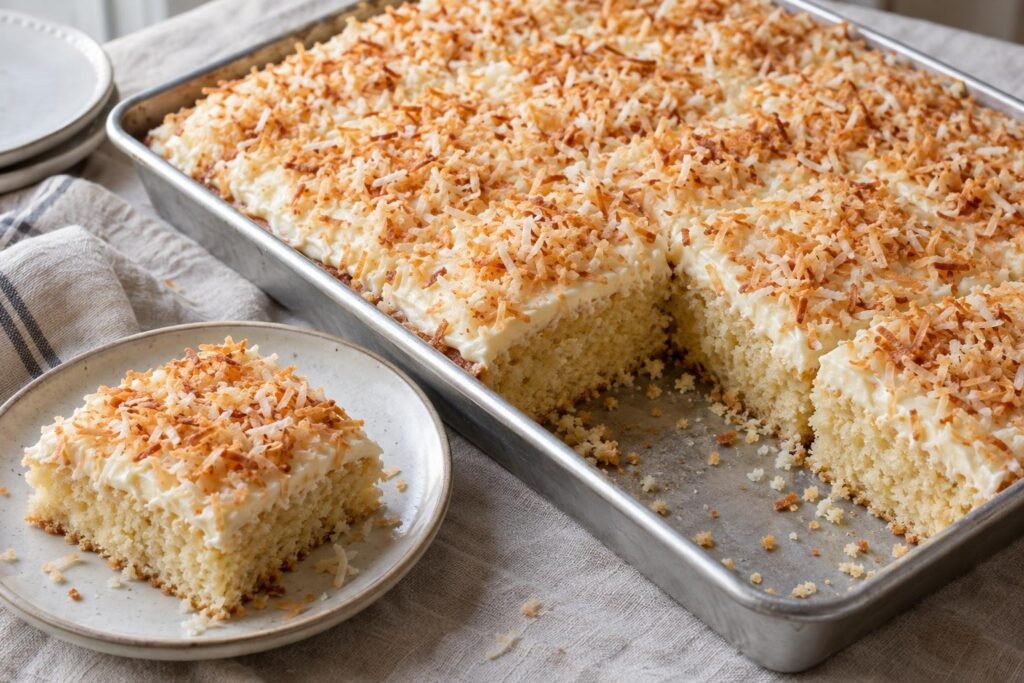
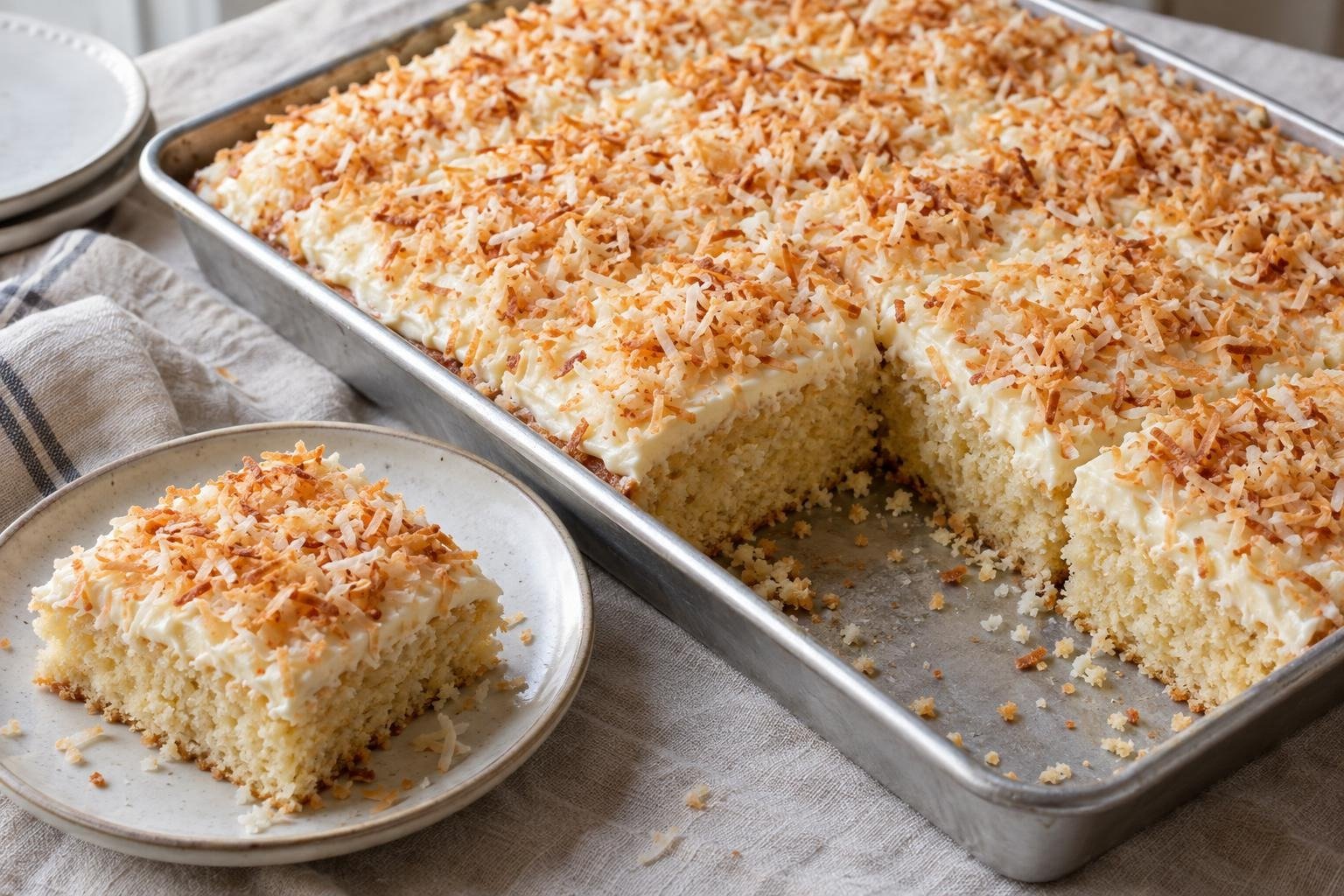
If I’m making coconut cake, I want to taste coconut in every bite, not just in the handful sprinkled over the frosting! For this coconut sheet cake recipe, I use full-fat coconut milk in the batter to give it a rich, nutty flavor and a soft, buttery crumb. A little neutral oil helps keep the cake tender, while the cream cheese frosting adds just enough tang to balance the sweetness. And I have to admit, the toasted coconut on top might be my favorite part. It brings a delicate crunch and that wonderful roasted aroma that makes coconut desserts so tempting. One little detail I never skip is stirring the coconut milk thoroughly before measuring, since the cream and liquid tend to separate in the can. Best of all, there’s no stacking or elaborate decorating involved. Just a generous sheet pan of coconut cake, ready to cut into squares and share!
Why This Coconut Sheet Cake Frickin’ Works
- Coconut flavor that goes all the way through: I use full-fat canned coconut milk in the batter because coconut cake should actually taste like coconut! It brings richness and moisture, while a little coconut extract helps bring out that wonderful nutty aroma. You get plenty of flavor without needing to pack the cake with shredded coconut.
- Butter for flavor, oil for that soft crumb: Creaming the butter with sugar incorporates air into the batter, giving the cake a fine, tender texture. I add a little neutral oil because it helps the crumb stay soft even after refrigeration. That combination is especially useful for a sheet cake topped with cream cheese frosting.
- A half-sheet pan that makes life easier: Baking in a 13 × 18-inch pan gives the cake a shallow, even layer that cooks relatively quickly. I particularly like how every square gets a good helping of cake and frosting without needing to build or decorate multiple layers. Sometimes simple really is the better choice!
- Cream cheese frosting keeps the sweetness in check: The cake has a generous amount of coconut flavor and sweetness, so I use tangy cream cheese frosting to balance it. Full-fat block cream cheese gives the frosting a smooth, creamy texture that spreads easily over the cooled cake without becoming watery.
- Toasted coconut is worth the extra few minutes: I toast the coconut separately until it’s golden and fragrant, then sprinkle it over the frosting. That little bit of roasting brings out a deeper, nuttier flavor and gives every bite a contrast between soft cake, creamy frosting, and crisp coconut. Just keep an eye on the oven because coconut can go from golden to burnt surprisingly quickly!
Ingredient Notes for Coconut Sheet Cake Baked in a Sheet Pan
- All-purpose flour: Its moderate protein level gives this thin cake enough structure for clean slices while keeping the crumb tender. Weigh it rather than packing it into cups, which can make a shallow sheet cake dry.
- Butter and neutral oil: Softened butter supports aeration during creaming, while canola, grapeseed, or another neutral oil improves moisture retention. The butter should bend easily but should not look shiny or partially melted.
- Full-fat coconut milk: Use canned coconut milk, not refrigerated coconut beverage. Stir the separated cream and liquid together until completely smooth before weighing so fat and moisture are distributed evenly through the batter.
- Eggs: Room-temperature eggs emulsify more readily with the butter mixture. Add them gradually and scrape the bowl so the batter does not retain a greasy layer along the bottom.
- Sweetened shredded coconut: Coconut inside the cake contributes chew and moisture, while the topping is toasted for contrast. Keep the two portions separate so the coconut intended for the crumb remains soft.
- Coconut extract: A small quantity sharpens the coconut aroma that heat can mute. It may be omitted if unavailable, although the finished cake will have a milder coconut flavor.
- Cream cheese: Use full-fat block-style cream cheese rather than whipped or tub-style spread. Block cream cheese contains less free moisture and produces frosting that holds cleanly on the shallow cake.
- Confectioners’ sugar: This sweetens and thickens the frosting without granulated texture. Sift it if visibly lumpy, especially if the package has been open in a humid kitchen.
A Few Baking Tips
- Measure the inside of the pan if its size is uncertain. A 13 x 18-inch half-sheet pan is larger than a 10 x 15-inch jelly-roll pan, and using the smaller pan can make the batter too deep for the stated baking time.
- Bring the eggs and coconut milk to room temperature while the butter softens. Similar ingredient temperatures help the fat and liquid form a stable emulsion, which supports an even, fine crumb.
- Scrape the mixing bowl all the way across the bottom after creaming and after adding the eggs. Unmixed butter hiding beneath the paddle can leave greasy, dense patches in the finished sheet cake.
- Begin checking the center at 22 minutes, not only the edges. The perimeter sets first in a wide metal pan, while the middle must lose its wet shine and spring back before the cake leaves the oven.
- Chill the frosted cake briefly before portioning, then use a long knife wiped clean between cuts. This prevents cream cheese frosting and toasted coconut from dragging through the tender crumb.
Ingredients for Coconut Sheet Cake
- 110 g sweetened shredded coconut (reserved for toasting and topping)
- 360 g all-purpose flour (weighed, then whisked to remove compacted lumps)
- 12 g baking powder (about 1 tablespoon)
- 5 g fine sea salt (about 1 teaspoon)
- 170 g unsalted butter (softened to 65 to 68°F)
- 400 g granulated sugar
- 120 g neutral oil (such as canola or grapeseed oil)
- 200 g large eggs (4 large eggs, at room temperature)
- 10 ml pure vanilla extract (2 teaspoons)
- 2.5 ml coconut extract (1/2 teaspoon)
- 400 g full-fat canned coconut milk (stirred completely smooth and brought to room temperature)
- 85 g sweetened shredded coconut (for folding into the cake batter)
- 340 g full-fat block cream cheese (softened but still slightly cool)
- 170 g unsalted butter (softened to 65 to 68°F)
- 420 g confectioners’ sugar (sifted if lumpy)
- 5 ml pure vanilla extract (1 teaspoon)
- 2.5 ml coconut extract (1/2 teaspoon)
- 1 g fine sea salt (about 1/4 teaspoon)
How to Make Coconut Sheet Cake
- STEP 1). Prepare the pan and toast the coconut Set an oven rack in the center and heat the oven to 350°F. Lightly grease a 13 x 18-inch rimmed half-sheet pan, line the bottom with parchment, and grease the parchment. Spread the 110 g topping coconut on a second unlined baking sheet. Toast it for 5 to 7 minutes, stirring every 2 minutes, until evenly golden rather than dark brown. Transfer the coconut immediately to a cool plate so residual pan heat does not burn it.
- STEP 2). Combine the dry ingredients In a medium bowl, whisk the flour, baking powder, and 5 g salt for at least 30 seconds. Break up any visible pockets of leavening against the side of the bowl. This distribution matters in a shallow cake because concentrated baking powder can produce tunneling or bitter spots. In a separate jug, stir the coconut milk until the solid cream and watery portion form one smooth, pourable liquid, then keep it at room temperature.
- STEP 3). Cream the butter, sugar, and oil Place the 170 g softened butter and granulated sugar in the bowl of a stand mixer fitted with the paddle. Beat on medium speed for 3 minutes, stopping once to scrape the bowl and paddle, until the mixture is visibly paler and fluffy. With the mixer on medium-low, stream in the oil over about 30 seconds. Continue mixing for 1 minute, until glossy and uniform. The mixture should look aerated, not melted or greasy around the bowl.
- STEP 4). Add the eggs and flavorings Beat the eggs lightly in a small bowl. Add them to the butter mixture in four portions on medium-low speed, allowing each addition to disappear before adding the next. Scrape the bowl after the second and final additions, reaching across the bottom where dense butter can collect. Mix in the vanilla and 2.5 ml coconut extract. The emulsion should look thick and creamy; slight curdling is acceptable, but large slippery clumps indicate that the ingredients were too cold.
- STEP 5). Finish and spread the batter Run the mixer on low and add one-third of the flour mixture, followed by half of the coconut milk. Repeat, then add the remaining flour. Mix only until narrow flour streaks remain, about 15 seconds after the final addition. Remove the bowl and fold with a flexible spatula, scraping the bottom while adding the 85 g shredded coconut. Spread the batter evenly in the prepared pan and work it into the corners without repeatedly compressing the aerated mixture.
- STEP 6). Bake and cool the cake Bake at 350°F for 22 to 27 minutes, rotating the pan after 16 minutes if the oven browns unevenly. The center should spring back after a light touch, the edges should be pale gold, and a tester inserted in the middle should carry a few moist crumbs but no wet batter. An instant-read thermometer will generally register about 200 to 205°F. Cool completely in the pan on a wire rack for at least 60 minutes before frosting.
- STEP 7). Mix the frosting and finish the cake Beat the softened 170 g butter with the paddle on medium speed for 2 minutes until creamy. Add the cream cheese and beat on medium-low just until smooth, about 1 minute. Add the confectioners’ sugar in three additions on low speed, then mix in the vanilla, remaining coconut extract, and 1 g salt. Beat for 30 seconds until spreadable, not loose. Frost the cooled cake in the pan, scatter with toasted coconut, chill for 30 minutes, and cut into 24 pieces with a clean knife.
Storage and Freezing
- Refrigeration: Cover the frosted cake tightly in its pan or transfer slices to an airtight container.
- Refrigerate for up to 4 days because the frosting contains cream cheese.
- Freezing: Freeze unfrosted cake pieces wrapped in plastic and placed in an airtight container for up to 2 months. Frosted pieces may also be frozen, although the toasted coconut will lose some crispness.
- Thawing: Thaw wrapped cake overnight in the refrigerator. Unwrap after thawing to limit condensation on the cake or frosting.
- Serving: For a softer crumb and creamier frosting, let refrigerated slices stand at room temperature for 20 to 30 minutes. Do not leave the cream cheese-frosted cake unrefrigerated for more than 2 hours.
Frequently Asked Questions
What pan size is best for coconut sheet cake?
Use a 13 x 18-inch rimmed half-sheet pan with sides approximately 1 inch high. Its broad surface keeps this quantity of batter shallow enough to bake through before the edges become dry.
A 10 x 15-inch jelly-roll pan has substantially less surface area and is not a direct swap. If your pan is labeled only as a sheet pan, measure the inside dimensions before mixing the batter.
How do you know when the center of coconut sheet cake is done?
The center should look set rather than glossy, spring back after a gentle fingertip press, and remain level when the pan is carefully moved. A tester should emerge with a few moist crumbs, never liquid batter.
Check several inches away from the edges because those areas bake first. An instant-read temperature around 200 to 205°F can support the visual checks, but texture and the absence of wet batter remain the practical indicators.
Why did my coconut sheet cake turn out dense or greasy?
Dense or oily patches usually point to insufficient creaming, cold ingredients, or incomplete bowl scraping. The butter and sugar need enough mixing to become pale and aerated before the oil and eggs are incorporated.
Add room-temperature eggs gradually and scrape beneath the paddle where dense butter collects. Once the flour enters, mix minimally because prolonged mixing develops gluten and knocks out the air established during creaming.
Can you make coconut sheet cake ahead of serving?
The cake can be baked one day ahead, cooled completely, and covered tightly in its pan at room temperature. Frost it the next day, then refrigerate it because the finished frosting contains cream cheese.
For the best serving texture, let the chilled cake stand for 20 to 30 minutes before slicing. Toasted coconut is crispest when added after frosting or within several hours of serving.
What coconut sheet cake ingredient substitutions are appropriate?
Canola or grapeseed oil can be used interchangeably because both have a neutral flavor and remain fluid when chilled. Coconut extract may be omitted, although the flavor will rely more heavily on the coconut milk and shredded coconut.
Refrigerated coconut beverage should not replace full-fat canned coconut milk in this formula. It contains much less fat and more free water, which changes the batter’s balance and can produce a weaker, less flavorful crumb.
Still Craving Something Sweet?
- Pumpkin Sheet Cake with Cream Cheese Frosting for a Crowd
- Apple Fritter Sheet Cake with a Cinnamon-Sugar Finish
- Red Velvet Sheet Cake with Soft, Tender Crumb
- Chocolate Peanut Butter Sheet Cake with Soft, Tender Crumb
- Texas Chocolate Sheet Cake with Rich Chocolate Icing
Coconut Sheet Cake with Cream Cheese Frosting
Ingredients
Equipment
Method
- Set an oven rack in the center and heat the oven to 350°F. Lightly grease a 13 x 18-inch rimmed half-sheet pan, line the bottom with parchment, and grease the parchment. Spread the 110 g topping coconut on a second unlined baking sheet. Toast it for 5 to 7 minutes, stirring every 2 minutes, until evenly golden rather than dark brown. Transfer the coconut immediately to a cool plate so residual pan heat does not burn it.
- In a medium bowl, whisk the flour, baking powder, and 5 g salt for at least 30 seconds. Break up any visible pockets of leavening against the side of the bowl. This distribution matters in a shallow cake because concentrated baking powder can produce tunneling or bitter spots. In a separate jug, stir the coconut milk until the solid cream and watery portion form one smooth, pourable liquid, then keep it at room temperature.
- Place the 170 g softened butter and granulated sugar in the bowl of a stand mixer fitted with the paddle. Beat on medium speed for 3 minutes, stopping once to scrape the bowl and paddle, until the mixture is visibly paler and fluffy. With the mixer on medium-low, stream in the oil over about 30 seconds. Continue mixing for 1 minute, until glossy and uniform. The mixture should look aerated, not melted or greasy around the bowl.
- Beat the eggs lightly in a small bowl. Add them to the butter mixture in four portions on medium-low speed, allowing each addition to disappear before adding the next. Scrape the bowl after the second and final additions, reaching across the bottom where dense butter can collect. Mix in the vanilla and 2.5 ml coconut extract. The emulsion should look thick and creamy; slight curdling is acceptable, but large slippery clumps indicate that the ingredients were too cold.
- Run the mixer on low and add one-third of the flour mixture, followed by half of the coconut milk. Repeat, then add the remaining flour. Mix only until narrow flour streaks remain, about 15 seconds after the final addition. Remove the bowl and fold with a flexible spatula, scraping the bottom while adding the 85 g shredded coconut. Spread the batter evenly in the prepared pan and work it into the corners without repeatedly compressing the aerated mixture.
- Bake at 350°F for 22 to 27 minutes, rotating the pan after 16 minutes if the oven browns unevenly. The center should spring back after a light touch, the edges should be pale gold, and a tester inserted in the middle should carry a few moist crumbs but no wet batter. An instant-read thermometer will generally register about 200 to 205°F. Cool completely in the pan on a wire rack for at least 60 minutes before frosting.
- Beat the softened 170 g butter with the paddle on medium speed for 2 minutes until creamy. Add the cream cheese and beat on medium-low just until smooth, about 1 minute. Add the confectioners’ sugar in three additions on low speed, then mix in the vanilla, remaining coconut extract, and 1 g salt. Beat for 30 seconds until spreadable, not loose. Frost the cooled cake in the pan, scatter with toasted coconut, chill for 30 minutes, and cut into 24 pieces with a clean knife.
Notes
- Measure the inside of the pan if its size is uncertain. A 13 x 18-inch half-sheet pan is larger than a 10 x 15-inch jelly-roll pan, and using the smaller pan can make the batter too deep for the stated baking time.
- Bring the eggs and coconut milk to room temperature while the butter softens. Similar ingredient temperatures help the fat and liquid form a stable emulsion, which supports an even, fine crumb.
- Scrape the mixing bowl all the way across the bottom after creaming and after adding the eggs. Unmixed butter hiding beneath the paddle can leave greasy, dense patches in the finished sheet cake.
- Begin checking the center at 22 minutes, not only the edges. The perimeter sets first in a wide metal pan, while the middle must lose its wet shine and spring back before the cake leaves the oven.
- Chill the frosted cake briefly before portioning, then use a long knife wiped clean between cuts. This prevents cream cheese frosting and toasted coconut from dragging through the tender crumb.



