

Table of Contents
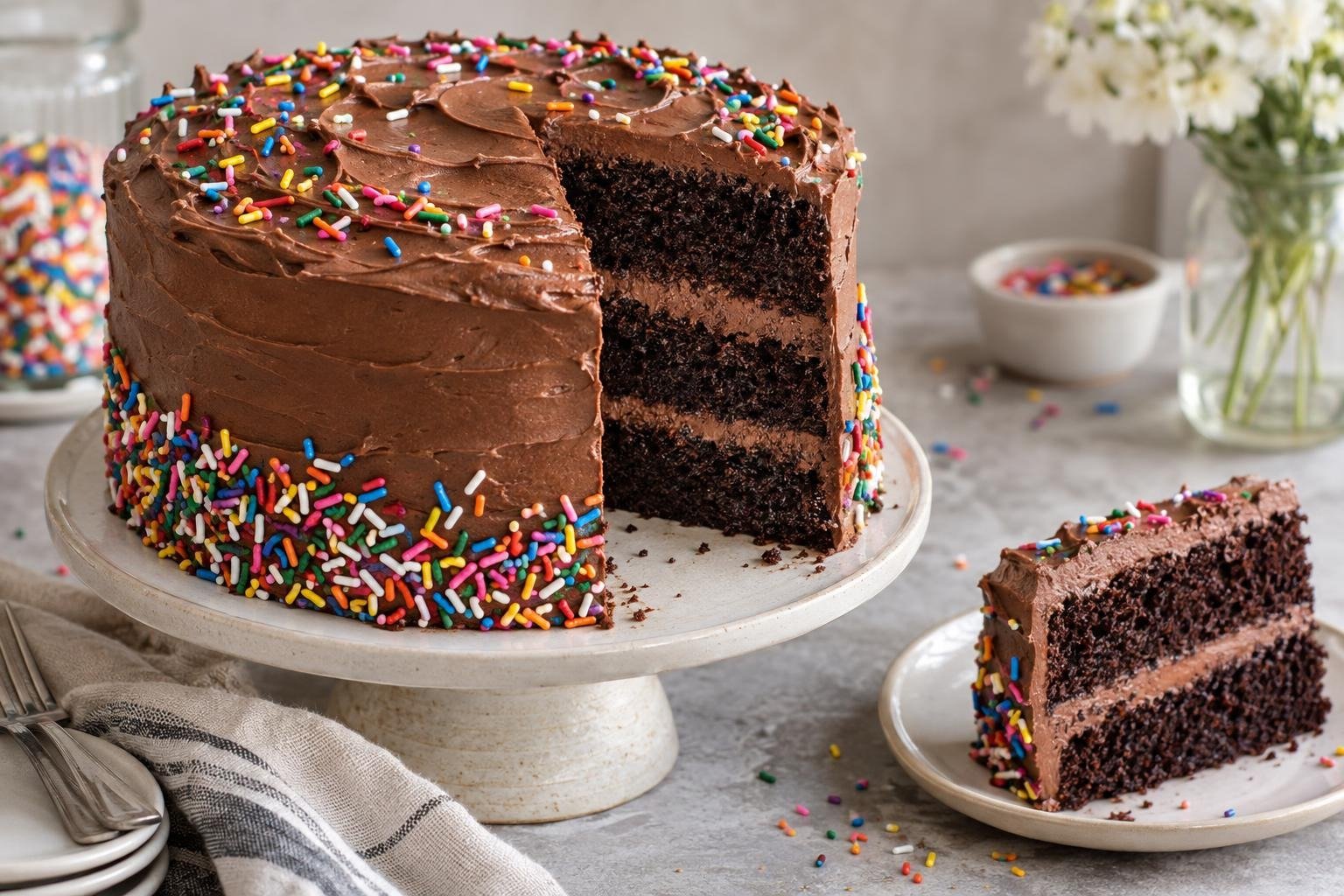
Deep cocoa aroma, tender fudge-like layers, and cloud-soft chocolate frosting give this chocolate fudge birthday cake with whipped ganache recipe its full birthday-cake energy. The crumb stays moist from buttermilk and oil, while melted dark chocolate adds richness without turning the layers heavy. Whipped ganache brings a silky finish that is less sugary than buttercream, and rainbow sprinkles supply the necessary bit of cheerful chaos.
I bloom the cocoa and chopped chocolate with hot coffee, then combine that mixture with the liquid ingredients before adding the flour. This distributes the chocolate evenly and limits unnecessary mixing once the flour is hydrated. Watch the observable cues rather than relying only on the clock: properly baked layers spring back lightly, show a few moist crumbs on a tester, and pull just slightly from the pan edges. Cold ganache should whip to smooth medium peaks before it looks grainy or stiff.

Why You’ll Love this Chocolate Cake
- Blooming the cocoa in hot coffee dissolves flavor compounds and produces a deeper, rounder chocolate profile without making the finished cake taste strongly of coffee.
- Dark chocolate contributes cocoa solids and cocoa butter, giving the layers a richer fudge character while still allowing them to rise and slice cleanly.
- Buttermilk supplies acidity for the baking soda and helps soften gluten, while neutral oil keeps the crumb supple even after refrigeration.
- A combination of baking powder and baking soda provides controlled lift in this high-moisture batter without leaving the crumb coarse or excessively domed.
- The ganache is emulsified before chilling, then whipped only to medium peaks so it becomes light enough for filling but remains structured enough to frost three layers.
Ingredient Notes for Chocolate Fudge Birthday Cake With Whipped Ganache
- All-purpose flour: Its moderate protein content provides enough structure for three stackable layers. Weigh it rather than packing it into a cup, which can make a moist chocolate batter bake up heavy.
- Natural cocoa powder: Natural cocoa brings acidity as well as concentrated chocolate flavor. Whisk it with the hot coffee so no dry pockets remain in the finished crumb.
- Dark chocolate: Use chocolate containing 55 to 60 percent cocoa for both the cake and ganache. Chop bars finely so they melt evenly and produce a smooth emulsion.
- Buttermilk: This contributes moisture, acidity, and milk proteins. Bring it to room temperature so it combines smoothly with the eggs and chocolate mixture.
- Neutral oil: Oil remains fluid when chilled, which keeps the cake tender under refrigerated ganache. Canola, sunflower, or grapeseed oil fits the formula without competing with the chocolate.
- Hot coffee: Freshly brewed hot coffee blooms the cocoa and melts the chopped chocolate. Its roasted notes deepen the cocoa flavor rather than making the cake taste like a cup of coffee.
- Heavy cream: Cream containing at least 35 percent milk fat allows the ganache to emulsify and later hold air. Keep the reserved portion cold before blending it into the warm chocolate base.
- Rainbow sprinkles: Jimmies give clean color and a pleasant soft crunch. Add them after the final coat of ganache while the surface is still slightly tacky.
My Frosting and Filling Tips
- Weigh the finished batter into the pans. Even layers stack more securely and finish baking at nearly the same time, which matters with a soft, high-moisture chocolate crumb.
- Use room-temperature buttermilk and eggs, but keep the second portion of ganache cream cold. The cake liquids emulsify more readily when tempered, while the ganache needs rapid cooling before its long refrigeration.
- Mix only until the last dry streak disappears. Continued stirring develops gluten and can create rubbery tunnels, especially in a batter containing both melted chocolate and cocoa solids.
- Whip the ganache on medium rather than high speed. Controlled aeration creates smaller bubbles and a smoother frosting, while aggressive whipping can take it from soft to grainy surprisingly quickly.
- If the cake layers feel fragile after cooling, wrap them individually and chill for 30 minutes before leveling. Brief chilling firms the cocoa butter and oil enough to make handling cleaner without freezing the crumb.
Ingredients for Chocolate Fudge Birthday Cake With Whipped Ganache
- 330 g all-purpose flour (For the cake, spooned loosely if measuring before weighing)
- 85 g natural cocoa powder (For the cake, sifted if lumpy)
- 450 g granulated sugar (For the cake)
- 8 g baking powder (For the cake)
- 6 g baking soda (For the cake)
- 7 g fine sea salt (For the cake)
- 170 g dark chocolate (55 to 60 percent cocoa, finely chopped, for the cake)
- 300 g hot brewed coffee (Freshly brewed and steaming)
- 360 g buttermilk (Room temperature)
- 180 g neutral oil (Canola, sunflower, or grapeseed oil)
- 150 g large eggs (About 3 large eggs without shells, room temperature)
- 10 g pure vanilla extract (For the cake)
- 600 g dark chocolate (55 to 60 percent cocoa, finely chopped, for the ganache)
- 900 g heavy cream (35 percent milk fat, divided into 450 g for heating and 450 g kept cold)
- 60 g unsalted butter (Softened and cut into small pieces)
- 2 g fine sea salt (For the ganache)
- 60 g rainbow jimmies sprinkles (For decorating)
How to Make Chocolate Fudge Birthday Cake With Whipped Ganache
- STEP 1). Prepare and chill the ganache base Place the 600 g chopped dark chocolate, softened butter, and 2 g salt in a tall heatproof container. Heat 450 g cream in a saucepan over medium heat until steaming with small bubbles around the edge, but do not boil it. Pour the cream over the chocolate, rest for 2 minutes, then blend with an immersion blender until glossy. Blend in the remaining 450 g cold cream without incorporating excess air. Cover the surface and refrigerate for at least 6 hours, until completely cold and thickened.
- STEP 2). Prepare the pans and dry ingredients Set an oven rack in the center and heat the oven to 350°F. Grease three 8-inch round pans, line the bottoms with parchment, then lightly grease the parchment. In a large bowl, whisk the flour, sugar, baking powder, baking soda, and 7 g salt for about 30 seconds. Break apart any visible sugar or leavening lumps. Thorough distribution matters because this fluid batter offers little opportunity to correct unmixed pockets after the wet ingredients are added.
- STEP 3). Bloom the cocoa and melt the chocolate Place the cocoa powder and 170 g finely chopped dark chocolate in a medium heatproof bowl. Pour the 300 g steaming coffee over them and leave the mixture undisturbed for 1 minute. Whisk slowly from the center outward until the chocolate has melted and the mixture is dark, shiny, and free from cocoa lumps. Let it stand for 5 minutes so it is warm rather than scalding when combined with the eggs. This prevents localized cooking and keeps the emulsion smooth.
- STEP 4). Mix and portion the cake batter In a separate large bowl, whisk the room-temperature buttermilk, oil, eggs, and vanilla until uniform, with no streaks of egg white. Gradually whisk in the warm chocolate mixture. Add the dry ingredients in two additions, folding with a flexible spatula after each just until no flour pockets remain. The batter will be fluid and glossy. Scrape the bowl thoroughly, then divide about 680 g batter into each prepared pan so the three layers bake at the same rate.
- STEP 5). Bake the chocolate cake layers Bake all three pans on the center rack for 25 to 30 minutes, rotating their positions carefully after 20 minutes if the oven heats unevenly. The cakes are done when the centers spring back under a light touch, the edges begin to pull slightly from the pans, and a tester returns with moist crumbs but no wet batter. Avoid waiting for a completely clean tester, which can indicate overbaking. Transfer the pans to wire racks and cool for 15 minutes.
- STEP 6). Unmold, cool, and level the layers Run a thin offset spatula around each pan without cutting into the cake. Turn the layers onto parchment-lined racks, remove the pan and parchment, then invert them upright. Cool completely for about 75 minutes before trimming or frosting; residual warmth would melt the ganache. Once cool, use a serrated knife to remove only pronounced domes. Handle the tender layers with two hands or a wide cake lifter, and reserve the flattest layer for the top of the assembled cake.
- STEP 7). Whip the chilled ganache Transfer the thoroughly cold ganache base to the bowl of a stand mixer fitted with the whisk. Whip on medium-low for 1 minute, then increase to medium and continue for 1 to 3 minutes. Stop when the ganache has lightened in color and holds smooth medium peaks with gently curved tips. Scrape the bowl once to catch denser ganache at the bottom. Do not whip to a grainy or rigid texture, since overworked cocoa butter can make spreading and slicing difficult.
- STEP 8). Fill and crumb-coat the cake Place one cake layer cut-side up on a cake board or serving plate. Spread about 275 g whipped ganache evenly to the edge, top with a second layer, and repeat. Add the final layer cut-side down for a flat top. Apply about 250 g ganache in a thin coat over the top and sides, trapping loose crumbs without repeatedly scraping the tender cake. Refrigerate the assembled cake for 20 minutes, until the crumb coat feels firm and no longer transfers to a fingertip.
- STEP 9). Finish, decorate, and slice Spread the remaining whipped ganache over the chilled cake using an offset spatula, smoothing the sides on a turntable and leaving gentle swirls on top. Press the rainbow jimmies around the lower sides and scatter the rest over the top while the ganache is still tacky. Chill for 20 minutes to set the finish. For the cleanest texture, let the cake stand at room temperature for 30 minutes before slicing with a hot, dry knife, wiping the blade between cuts.
Storage and Freezing
- Room temperature: Keep the assembled cake covered in a cool room for up to 4 hours during serving. Return leftovers to the refrigerator because the whipped ganache contains cream.
- Refrigeration: Store the cake in an airtight cake carrier for up to 4 days. Cover exposed cut surfaces with parchment or plastic wrap to slow moisture loss.
- Freezing: Freeze unfrosted cake layers, wrapped individually in plastic and foil, for up to 2 months. The finished cake may be frozen for up to 1 month, but sprinkle colors can soften or bleed during thawing.
- Thawing: Thaw wrapped cake layers overnight in the refrigerator before unwrapping.
- Thaw a finished cake in its container in the refrigerator overnight to reduce condensation on the ganache.
- Serving: Bring refrigerated slices to room temperature for 20 to 30 minutes so the ganache softens and the chocolate crumb regains its supple texture.
Frequently Asked Questions
What makes this chocolate birthday cake taste fudgy instead of cakey?
Melted dark chocolate, cocoa powder, oil, and a relatively high proportion of liquid create the fudgy impression. The cake still contains enough flour and leavening to form stable layers, but its crumb remains fine, moist, and rich rather than airy.
Proper baking is equally important. Remove the layers when a tester has moist crumbs but no liquid batter. Baking until the tester is completely dry can mute the fudge-like texture.
Why did my whipped ganache turn grainy?
Grainy whipped ganache is usually overwhipped or too cold. Stop at smooth medium peaks, when the frosting holds its shape but the tip still bends. High-speed mixing can pass that endpoint before the texture is obvious.
If it only looks slightly rough, fold in a spoonful of unwhipped cold cream by hand. Severely separated ganache generally needs to be gently remelted, emulsified, chilled again, and rewhipped.
How far ahead can I assemble this chocolate fudge birthday cake?
Assembly can be completed one day before serving. Refrigerate the decorated cake in a covered carrier so the ganache does not absorb odors and the exposed surfaces do not dry out.
Bring the cake to room temperature for about 30 minutes before cutting. The crumb and frosting will soften, producing cleaner flavor and a creamier mouthfeel than when served directly from the refrigerator.
What is the best way to get even chocolate cake layers?
Weighing the batter is the most dependable approach. This formula makes approximately 2,040 g of batter, so each prepared pan should receive close to 680 g. Place the pan directly on the scale and tare between portions.
Bake the pans on one level when possible. If oven hot spots cause uneven coloring, rotate their positions after the structure has set, around the 20-minute mark, without jarring the pans.
Can I make the whipped ganache without coffee in the cake?
Hot water can replace the same weight of brewed coffee if coffee is unsuitable. The liquid temperature still needs to be high enough to bloom the cocoa and melt the chopped chocolate into a smooth mixture.
The finished cake will retain its chocolate character, although it will lose some roasted depth. Do not omit the liquid entirely, since that would alter the batter consistency, cocoa hydration, and final crumb.
More Ridiculously Delicious Cakes
- Chocolate Peanut Butter Sheet Cake with Soft, Tender Crumb
- Chocolate Swiss Roll Cake with a Light Cocoa Sponge
- Chocolate Snack Cake for an Everyday Pan Cake
- Raspberry Chocolate Roll Cake with a Tender Chocolate Sponge
- Chocolate Streusel Coffee Cake with Soft, Tender Crumb
Chocolate Fudge Birthday Cake With Whipped Ganache
Ingredients
Equipment
Method
- Place the 600 g chopped dark chocolate, softened butter, and 2 g salt in a tall heatproof container. Heat 450 g cream in a saucepan over medium heat until steaming with small bubbles around the edge, but do not boil it. Pour the cream over the chocolate, rest for 2 minutes, then blend with an immersion blender until glossy. Blend in the remaining 450 g cold cream without incorporating excess air. Cover the surface and refrigerate for at least 6 hours, until completely cold and thickened.
- Set an oven rack in the center and heat the oven to 350°F. Grease three 8-inch round pans, line the bottoms with parchment, then lightly grease the parchment. In a large bowl, whisk the flour, sugar, baking powder, baking soda, and 7 g salt for about 30 seconds. Break apart any visible sugar or leavening lumps. Thorough distribution matters because this fluid batter offers little opportunity to correct unmixed pockets after the wet ingredients are added.
- Place the cocoa powder and 170 g finely chopped dark chocolate in a medium heatproof bowl. Pour the 300 g steaming coffee over them and leave the mixture undisturbed for 1 minute. Whisk slowly from the center outward until the chocolate has melted and the mixture is dark, shiny, and free from cocoa lumps. Let it stand for 5 minutes so it is warm rather than scalding when combined with the eggs. This prevents localized cooking and keeps the emulsion smooth.
- In a separate large bowl, whisk the room-temperature buttermilk, oil, eggs, and vanilla until uniform, with no streaks of egg white. Gradually whisk in the warm chocolate mixture. Add the dry ingredients in two additions, folding with a flexible spatula after each just until no flour pockets remain. The batter will be fluid and glossy. Scrape the bowl thoroughly, then divide about 680 g batter into each prepared pan so the three layers bake at the same rate.
- Bake all three pans on the center rack for 25 to 30 minutes, rotating their positions carefully after 20 minutes if the oven heats unevenly. The cakes are done when the centers spring back under a light touch, the edges begin to pull slightly from the pans, and a tester returns with moist crumbs but no wet batter. Avoid waiting for a completely clean tester, which can indicate overbaking. Transfer the pans to wire racks and cool for 15 minutes.
- Run a thin offset spatula around each pan without cutting into the cake. Turn the layers onto parchment-lined racks, remove the pan and parchment, then invert them upright. Cool completely for about 75 minutes before trimming or frosting; residual warmth would melt the ganache. Once cool, use a serrated knife to remove only pronounced domes. Handle the tender layers with two hands or a wide cake lifter, and reserve the flattest layer for the top of the assembled cake.
- Transfer the thoroughly cold ganache base to the bowl of a stand mixer fitted with the whisk. Whip on medium-low for 1 minute, then increase to medium and continue for 1 to 3 minutes. Stop when the ganache has lightened in color and holds smooth medium peaks with gently curved tips. Scrape the bowl once to catch denser ganache at the bottom. Do not whip to a grainy or rigid texture, since overworked cocoa butter can make spreading and slicing difficult.
- Place one cake layer cut-side up on a cake board or serving plate. Spread about 275 g whipped ganache evenly to the edge, top with a second layer, and repeat. Add the final layer cut-side down for a flat top. Apply about 250 g ganache in a thin coat over the top and sides, trapping loose crumbs without repeatedly scraping the tender cake. Refrigerate the assembled cake for 20 minutes, until the crumb coat feels firm and no longer transfers to a fingertip.
- Spread the remaining whipped ganache over the chilled cake using an offset spatula, smoothing the sides on a turntable and leaving gentle swirls on top. Press the rainbow jimmies around the lower sides and scatter the rest over the top while the ganache is still tacky. Chill for 20 minutes to set the finish. For the cleanest texture, let the cake stand at room temperature for 30 minutes before slicing with a hot, dry knife, wiping the blade between cuts.
Notes
- Weigh the finished batter into the pans. Even layers stack more securely and finish baking at nearly the same time, which matters with a soft, high-moisture chocolate crumb.
- Use room-temperature buttermilk and eggs, but keep the second portion of ganache cream cold. The cake liquids emulsify more readily when tempered, while the ganache needs rapid cooling before its long refrigeration.
- Mix only until the last dry streak disappears. Continued stirring develops gluten and can create rubbery tunnels, especially in a batter containing both melted chocolate and cocoa solids.
- Whip the ganache on medium rather than high speed. Controlled aeration creates smaller bubbles and a smoother frosting, while aggressive whipping can take it from soft to grainy surprisingly quickly.
- If the cake layers feel fragile after cooling, wrap them individually and chill for 30 minutes before leveling. Brief chilling firms the cocoa butter and oil enough to make handling cleaner without freezing the crumb.



