
Table of Contents
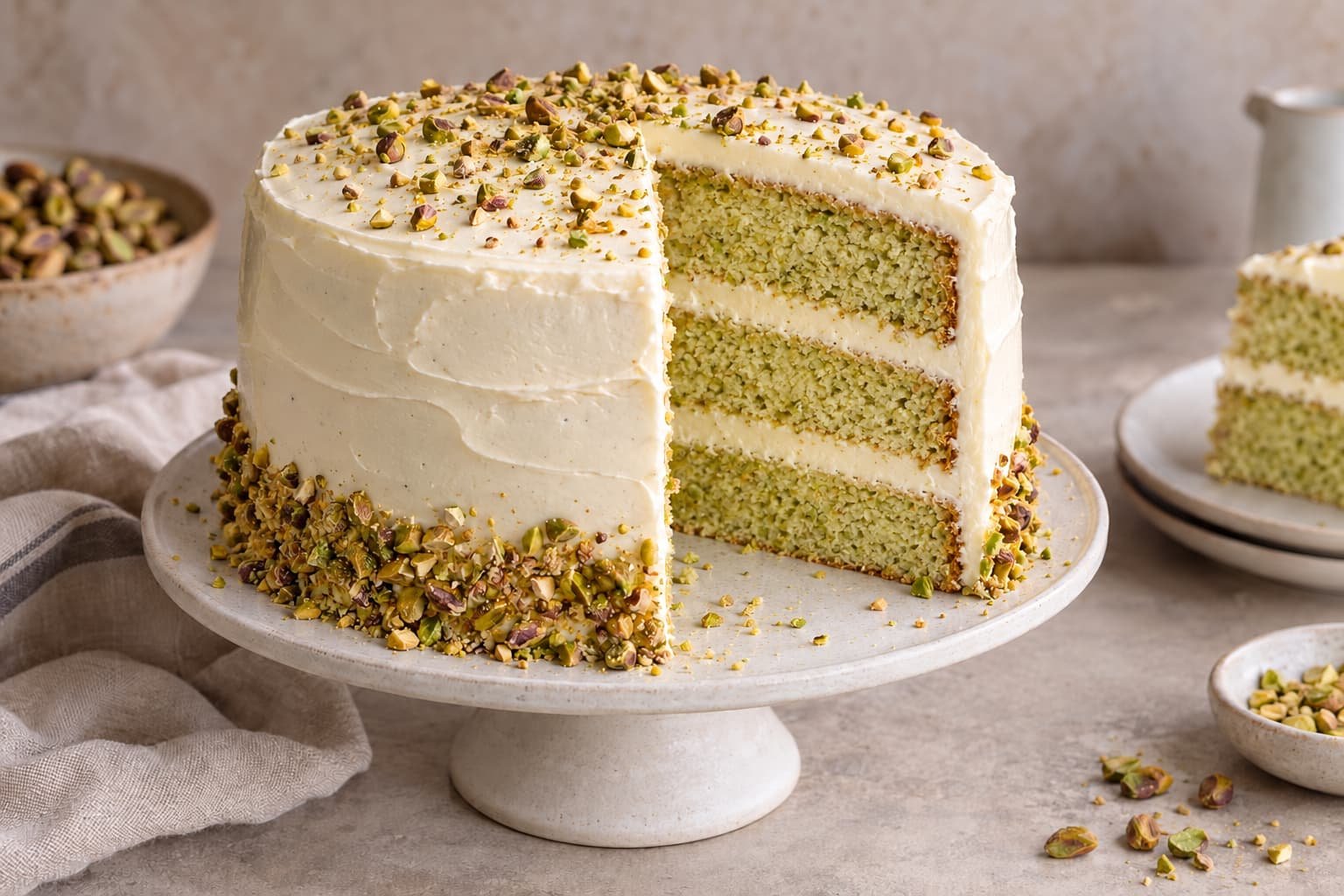
A fragrant pistachio crumb, lightly golden edges, and silky cream cheese frosting give this pistachio layer cake its balance of nutty richness and gentle tang. Finely ground pistachios run through all three layers, while a chopped pistachio finish adds enough crunch to keep each forkful interesting. The natural crumb is pale green with warm golden tones rather than an artificially bright color.
I grind the pistachios with a portion of the measured sugar so they stay loose instead of turning into nut butter. Butter supplies flavor, oil keeps the refrigerated cake supple, and cake flour limits gluten development for a tender slice. The batter is ready when the final flour streaks disappear and it falls from the spatula in a thick ribbon. Equal batter weights, level pans, and complete cooling are the keys to even layers that do not slide under the frosting.
Why This Pistachio Cake Recipe Frickin’ Works
- Finely grinding the pistachios with measured granulated sugar absorbs surface oils and produces an even nut texture without creating pistachio paste.
- Cake flour supplies enough structure for three stackable layers while its lower protein content keeps the crumb softer than all-purpose flour would.
- Butter contributes flavor and aeration, while neutral oil remains fluid when chilled and helps the finished cake retain a moist, tender mouthfeel.
- Sour cream adds fat, moisture, and acidity; the small amount of baking soda balances that acidity and supports an even rise alongside baking powder.
- Cool butter and cold block-style cream cheese make a stable frosting that holds between the layers without requiring excessive confectioners’ sugar.
Ingredient Notes for Pistachio Layer Cake with Soft, Tender Crumb
- Unsalted pistachios: Roasted, unsalted kernels provide concentrated flavor without introducing unpredictable salt. Grind only the portion used in the batter; the coarser garnish supplies a distinct crunchy finish.
- Cake flour: Its lower protein content reduces gluten formation and creates the soft crumb this layered cake needs. Fluff, spoon, and level if measuring by volume, although weighing gives more consistent layers.
- Unsalted butter and neutral oil: Butter traps air during creaming and contributes dairy flavor. Oil limits firmness after refrigeration. Use a neutral oil such as canola, sunflower, or grapeseed so the pistachio remains prominent.
- Granulated sugar: Sugar sweetens, tenderizes, and helps the butter hold air. A measured portion is processed with the nuts, so account for that amount rather than adding extra sugar.
- Sour cream and whole milk: Full-fat sour cream enriches the crumb, while milk loosens the batter and supplies water for starch hydration. Bring both to room temperature to protect the butter emulsion.
- Almond extract: A restrained amount strengthens the pistachio aroma without making the cake taste like marzipan. Measure carefully because almond extract can dominate delicate flavors.
- Block-style cream cheese: Use full-fat cream cheese sold in a firm block, not spreadable tub cream cheese. Keeping it cold limits softening, while cool room-temperature butter provides the frosting’s structure.
My Tips for the Best Results
- Use light-colored aluminum pans of the same brand and dimensions. Dark pans transfer heat more aggressively, which can set and brown the edges before the pistachio centers finish baking.
- Weigh the filled pans rather than judging batter depth by eye. Equal batter weights are the most reliable answer to how to keep pistachio layer cake layers even, especially when stacking three layers.
- Keep the butter cool enough to hold an indentation without looking glossy. Butter that is greasy or nearly melted cannot trap air efficiently, and the baked layers may turn dense or dip in the center.
- Scrape the mixer bowl thoroughly during creaming and after the eggs. A hidden layer of dense butter at the bottom creates oily pockets and uneven tunnels in the finished cake.
- Do not beat the frosting after it becomes smooth. Cream cheese releases moisture as it is worked, so extra mixing makes the frosting softer rather than fluffier. Chill it for 10 to 15 minutes if it becomes difficult to spread.
Ingredients for Pistachio Layer Cake
- 180 g roasted unsalted shelled pistachios (For the cake layers, about 1 1/2 cups)
- 330 g granulated sugar (Divide 50 g for grinding with the pistachios and 280 g for creaming)
- 300 g cake flour (About 2 1/2 cups, spooned and leveled if not weighed)
- 12 g baking powder (1 tablespoon)
- 2 g baking soda (1/2 teaspoon)
- 4 g fine sea salt (3/4 teaspoon)
- 170 g unsalted butter (3/4 cup, softened to cool room temperature)
- 60 g neutral oil (1/4 cup, such as canola, sunflower, or grapeseed oil)
- 4 large eggs (About 200 g without shells, at room temperature)
- 180 g full-fat sour cream (3/4 cup, at room temperature)
- 180 g whole milk (3/4 cup, at room temperature)
- 10 g pure vanilla extract (2 teaspoons)
- 2 g almond extract (1/2 teaspoon)
- 340 g unsalted butter (For the frosting, 1 1/2 cups, cool room temperature)
- 500 g confectioners’ sugar (For the frosting, about 4 cups, sifted if lumpy)
- 10 g pure vanilla extract (For the frosting, 2 teaspoons)
- 2 g fine sea salt (For the frosting, 1/4 teaspoon)
- 450 g full-fat block-style cream cheese (For the frosting, cold and cut into 8 pieces)
- 50 g roasted unsalted shelled pistachios (Coarsely chopped for the finish)
How to Make Pistachio Layer Cake
- STEP 1). Prepare the oven, pans, and pistachios Position a rack in the center of the oven and heat it to 350°F (177°C). Lightly grease three light-colored 8 by 2-inch round pans, line the bottoms with parchment, and grease the parchment. In a food processor, pulse the 180 g pistachios with 50 g of the measured granulated sugar for 20 to 30 seconds. Stop when the nuts resemble fine, sandy crumbs; prolonged processing will release oil and make a paste.
- STEP 2). Combine the dry and liquid mixtures Whisk the ground pistachio mixture, cake flour, baking powder, baking soda, and 4 g salt in a medium bowl until the green crumbs are evenly dispersed and no leavening clumps remain. In a separate bowl or large measuring jug, whisk the sour cream, milk, vanilla, and almond extract until smooth. Keeping the dry and liquid components separate makes it easier to add them gradually without overworking the cake flour later.
- STEP 3). Cream the butter, oil, and sugar Fit a stand mixer with the paddle attachment. Beat the 170 g softened butter and remaining 280 g granulated sugar on medium speed for 3 minutes, scraping the bowl and paddle halfway through. The mixture should look lighter, fluffy, and slightly increased in volume. Stream in the oil over 20 seconds, then beat for 30 seconds. The butter should remain emulsified rather than greasy; if it looks melted, pause and cool the bowl briefly.
- STEP 4). Add the eggs without breaking the emulsion With the mixer on medium-low speed, add the eggs one at a time, beating for about 20 seconds after each addition. Scrape the bowl down after the second and fourth eggs, reaching beneath the paddle where dense butter can collect. Increase to medium and beat for 30 seconds. The mixture should be smooth and thick, although a slightly curdled appearance is acceptable and will resolve when the flour is added. Avoid extended beating once the eggs are incorporated.
- STEP 5). Finish the pistachio batter Run the mixer on low and add one-third of the dry mixture, followed by half of the sour cream mixture. Repeat, then finish with the final third of the dry ingredients. Mix only until most flour disappears, about 15 seconds after each addition. Remove the bowl and fold with a flexible spatula, scraping the bottom and sides. Stop when no dry pockets remain and the batter falls in a thick ribbon; overmixing will toughen the layers.
- STEP 6). Divide and bake the layers evenly Divide the batter among the prepared pans, ideally weighing about 590 to 610 g into each pan, then smooth the surfaces with a small offset spatula. Bake all three pans on the center rack for 25 to 28 minutes, rotating their positions after 20 minutes if the oven browns unevenly. The cakes are done when the centers spring back lightly, the edges begin to pull from the pans, and a tester shows moist crumbs but no wet batter.
- STEP 7). Cool the cake layers completely Set the pans on wire racks for 15 minutes. Run a thin knife around each edge without cutting into the cake, invert the layers onto the racks, remove the parchment, and turn them right side up. Let them cool completely for about 90 minutes before leveling or frosting. Warm cake softens cream cheese frosting and encourages sliding. If the tops are domed, trim them level with a serrated knife only after the crumb feels cool and firm.
- STEP 8). Make the cream cheese frosting Using a clean mixer bowl and paddle, beat the 340 g cool room-temperature butter on medium speed for 2 minutes until smooth. Add the confectioners’ sugar in four portions on low speed, then beat on medium for 2 minutes. Mix in the vanilla and 2 g salt. Add the cold cream cheese one piece at a time on low, mixing only until each piece disappears. Stop as soon as the frosting is smooth, thick, and spreadable to avoid softening it.
- STEP 9). Fill, frost, chill, and slice the cake Place one cooled layer on a cake board or serving plate and spread about 220 g frosting evenly to the edge. Repeat with the second layer, then place the final layer cut side down. Apply a thin crumb coat and chill for 15 minutes. Cover the top and sides with the remaining frosting, press the chopped pistachios around the lower edge and sprinkle some over the top, then chill for 15 minutes. Slice with a warm, wiped-dry serrated knife for clean portions.
Storage and Freezing
- Storage: Cover the assembled cake and refrigerate it for up to 4 days. Keep cut surfaces covered with frosting or fitted with plastic wrap to reduce drying.
- Freezing: Wrap unfrosted, completely cooled layers individually in plastic wrap and foil, then freeze for up to 2 months. The fully assembled cake may be frozen uncovered until firm, wrapped securely, and stored for up to 1 month.
- Thawing: Thaw wrapped cake layers overnight in the refrigerator before unwrapping to prevent condensation from settling on the crumb.
- Thaw an assembled cake overnight in the refrigerator, then remove its wrapping while still cold.
- Serving: Let the refrigerated cake stand at room temperature for 30 to 45 minutes before slicing. The frosting will soften and the butter-rich crumb will regain its tender texture.
Frequently Asked Questions
What does pistachio layer cake taste like?
This cake has a buttery, gently roasted nut flavor supported by vanilla and a small amount of almond extract. The almond extract sharpens the pistachio aroma without replacing it, while tangy cream cheese frosting keeps the overall dessert from tasting flat or excessively sweet.
The crumb is soft and close rather than airy like chiffon. Finely ground nuts add richness and a slight natural texture, while the coarsely chopped pistachio garnish provides a contrasting crunch.
How do you keep pistachio layer cake layers even?
Weigh the empty mixing bowl before making the batter, subtract that weight once the batter is finished, and divide the result equally among three identical 8-inch pans. For this formula, each pan should hold approximately 590 to 610 g, with minor variation from bowl and spatula losses.
Spread the batter level before baking and place the pans on the same centered rack when possible. Completely cooled layers can be trimmed with a serrated knife if a small dome remains, but equal batter distribution prevents most assembly problems.
Why did my pistachio cake turn out dense or oily?
Overprocessing the pistachios can release their fat and create a heavy paste instead of dry crumbs. Pulse them with the measured sugar only until sandy. Butter that is too warm can also lose its ability to hold air, producing a greasy batter with less lift.
After the flour goes in, mix only until the last dry streaks disappear. Vigorous or extended mixing develops gluten, while inaccurate leavening or opening the oven before the structure sets can leave compressed, damp-looking areas.
What pistachio layer cake ingredient substitutions are appropriate?
Neutral oils can be exchanged by weight among canola, sunflower, and grapeseed oil because each contributes moisture without a strong competing flavor. Roasted unsalted pistachios are important to the intended flavor and salt balance, and full-fat block cream cheese is necessary for a frosting firm enough to stack.
Avoid replacing cake flour with nut flour or replacing sour cream with thin milk. Those changes alter protein, starch, fat, and water levels simultaneously, so the layers may not rise or hold together as written.
Can you make pistachio layer cake ahead?
The unfrosted layers can be prepared up to one day ahead. Once completely cool, wrap each layer tightly and keep it at cool room temperature, or refrigerate if the kitchen is warm. Chilled layers are especially convenient to level and stack because their crumb is firmer.
The cream cheese frosting can be refrigerated in an airtight container for up to 2 days. Let it stand briefly, then mix on low only until spreadable. The assembled cake can be refrigerated overnight and brought toward room temperature before serving.
Why is my cream cheese frosting too soft for stacking?
Spreadable tub cream cheese contains more water and is not suitable for this frosting. Use cold, full-fat block cream cheese and butter that is cool but pliable. Adding the cream cheese last limits mixing time and helps the butter and confectioners’ sugar maintain the frosting’s structure.
If the finished frosting slumps from the spatula, refrigerate it for 10 to 15 minutes and check again. Avoid adding extra liquid or whipping it aggressively, since both actions can make the texture looser.
More Ridiculously Delicious Cakes
- Vanilla Bean Layer Cake with Soft, Tender Layers
- Carrot Layer Cake with a Moist Crumb
- Strawberry Layer Cake with Soft Berry-Flavored Layers
- Lemon Layer Cake with Soft, Bright Citrus Layers
- Moist Chocolate Fudge Layer Cake with Silky Fudge Frosting
- Black Forest Layer Cake with Soft, Tender Crumb
Pistachio Layer Cake with Soft, Tender Crumb
Ingredients
Equipment
Method
- Position a rack in the center of the oven and heat it to 350°F (177°C). Lightly grease three light-colored 8 by 2-inch round pans, line the bottoms with parchment, and grease the parchment. In a food processor, pulse the 180 g pistachios with 50 g of the measured granulated sugar for 20 to 30 seconds. Stop when the nuts resemble fine, sandy crumbs; prolonged processing will release oil and make a paste.
- Whisk the ground pistachio mixture, cake flour, baking powder, baking soda, and 4 g salt in a medium bowl until the green crumbs are evenly dispersed and no leavening clumps remain. In a separate bowl or large measuring jug, whisk the sour cream, milk, vanilla, and almond extract until smooth. Keeping the dry and liquid components separate makes it easier to add them gradually without overworking the cake flour later.
- Fit a stand mixer with the paddle attachment. Beat the 170 g softened butter and remaining 280 g granulated sugar on medium speed for 3 minutes, scraping the bowl and paddle halfway through. The mixture should look lighter, fluffy, and slightly increased in volume. Stream in the oil over 20 seconds, then beat for 30 seconds. The butter should remain emulsified rather than greasy; if it looks melted, pause and cool the bowl briefly.
- With the mixer on medium-low speed, add the eggs one at a time, beating for about 20 seconds after each addition. Scrape the bowl down after the second and fourth eggs, reaching beneath the paddle where dense butter can collect. Increase to medium and beat for 30 seconds. The mixture should be smooth and thick, although a slightly curdled appearance is acceptable and will resolve when the flour is added. Avoid extended beating once the eggs are incorporated.
- Run the mixer on low and add one-third of the dry mixture, followed by half of the sour cream mixture. Repeat, then finish with the final third of the dry ingredients. Mix only until most flour disappears, about 15 seconds after each addition. Remove the bowl and fold with a flexible spatula, scraping the bottom and sides. Stop when no dry pockets remain and the batter falls in a thick ribbon; overmixing will toughen the layers.
- Divide the batter among the prepared pans, ideally weighing about 590 to 610 g into each pan, then smooth the surfaces with a small offset spatula. Bake all three pans on the center rack for 25 to 28 minutes, rotating their positions after 20 minutes if the oven browns unevenly. The cakes are done when the centers spring back lightly, the edges begin to pull from the pans, and a tester shows moist crumbs but no wet batter.
- Set the pans on wire racks for 15 minutes. Run a thin knife around each edge without cutting into the cake, invert the layers onto the racks, remove the parchment, and turn them right side up. Let them cool completely for about 90 minutes before leveling or frosting. Warm cake softens cream cheese frosting and encourages sliding. If the tops are domed, trim them level with a serrated knife only after the crumb feels cool and firm.
- Using a clean mixer bowl and paddle, beat the 340 g cool room-temperature butter on medium speed for 2 minutes until smooth. Add the confectioners’ sugar in four portions on low speed, then beat on medium for 2 minutes. Mix in the vanilla and 2 g salt. Add the cold cream cheese one piece at a time on low, mixing only until each piece disappears. Stop as soon as the frosting is smooth, thick, and spreadable to avoid softening it.
- Place one cooled layer on a cake board or serving plate and spread about 220 g frosting evenly to the edge. Repeat with the second layer, then place the final layer cut side down. Apply a thin crumb coat and chill for 15 minutes. Cover the top and sides with the remaining frosting, press the chopped pistachios around the lower edge and sprinkle some over the top, then chill for 15 minutes. Slice with a warm, wiped-dry serrated knife for clean portions.
Notes
- Use light-colored aluminum pans of the same brand and dimensions. Dark pans transfer heat more aggressively, which can set and brown the edges before the pistachio centers finish baking.
- Weigh the filled pans rather than judging batter depth by eye. Equal batter weights are the most reliable answer to how to keep pistachio layer cake layers even, especially when stacking three layers.
- Keep the butter cool enough to hold an indentation without looking glossy. Butter that is greasy or nearly melted cannot trap air efficiently, and the baked layers may turn dense or dip in the center.
- Scrape the mixer bowl thoroughly during creaming and after the eggs. A hidden layer of dense butter at the bottom creates oily pockets and uneven tunnels in the finished cake.
- Do not beat the frosting after it becomes smooth. Cream cheese releases moisture as it is worked, so extra mixing makes the frosting softer rather than fluffier. Chill it for 10 to 15 minutes if it becomes difficult to spread.