

Table of Contents
Fragrant lemon zest, a fine golden crumb, and silky citrus buttercream give this lemon layer cake its bright flavor without making it sharply sour. The two layers are tender but sturdy, so they hold their shape beneath the frosting and slice into clean, distinct portions. Butter supplies flavor, oil preserves softness, and fresh lemon juice keeps the finish lively rather than sugary and flat.
I rub the zest into the sugar before creaming because its coarse crystals help release the peel’s aromatic oils. From there, room-temperature ingredients, short alternating additions, and a low-speed finish protect the cake’s fine crumb. I divide the batter by weight, bake until the centers spring back without wet batter, and cool the layers completely before leveling or frosting. Warm cake and buttercream are an effing slippery combination.
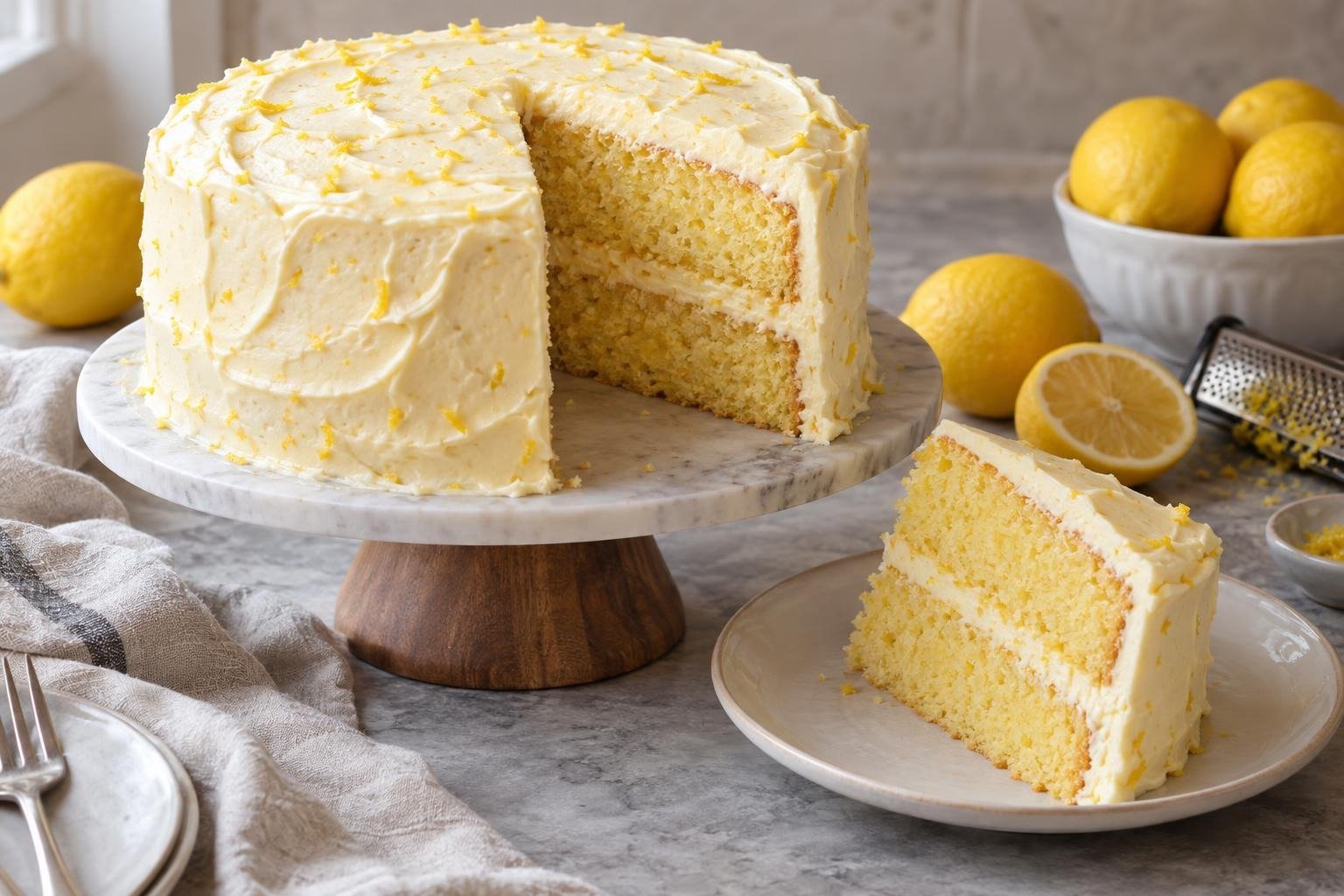
This Is Why You’ll Love this Lemon Cake
- Fresh lemon zest is rubbed directly into the granulated sugar, distributing its aromatic oils through the batter instead of leaving damp clumps of peel.
- Butter provides flavor and aeration, while a measured amount of neutral oil helps the refrigerated cake remain soft after assembly.
- Cake flour limits gluten development, and buttermilk contributes moisture, acidity, and enough milk protein to support a tender but sliceable crumb.
- Adding the flour mixture and lemon-buttermilk mixture in alternating stages keeps the batter emulsified and reduces the amount of mixing needed after the flour becomes wet.
- Weighing the batter between two matching 9-inch pans produces even layers that bake at a similar rate and require minimal trimming before assembly.
Ingredient Notes for Lemon Layer Cake with Soft, Bright Citrus Layers
- Cake flour: Its lower protein content produces a finer, softer crumb than standard all-purpose flour. For a formula-supported replacement, sift 315 grams all-purpose flour with 45 grams cornstarch twice before measuring the required 360 grams.
- Fresh lemons: Zest supplies most of the recognizable lemon aroma, while juice contributes acidity and a clean citrus finish. Grate only the yellow peel because the white pith tastes bitter, then juice the lemons after zesting.
- Unsalted butter: Butter carries the lemon oils and traps air during creaming. Bring it to about 65 to 68°F so it bends under light pressure but remains cool, matte, and structured rather than greasy.
- Neutral oil: A small amount of canola, sunflower, or grapeseed oil stays fluid when chilled, helping the finished cake remain soft without replacing the flavor and aeration supplied by butter.
- Granulated sugar: Sugar sweetens, retains moisture, and helps aerate the softened butter. Rubbing it with the zest before mixing releases citrus oils and distributes the zest evenly.
- Buttermilk: Full-fat cultured buttermilk adds moisture and mild acidity while supporting a close, tender crumb. Shake the container before measuring and bring it to room temperature so the batter stays emulsified.
- Eggs: Large room-temperature eggs provide structure, richness, and emulsifiers. Add them gradually so the butter mixture can absorb their water without separating.
- Confectioners’ sugar: Finely milled sugar thickens the buttercream and creates a smooth finish. Sift it if compacted or visibly lumpy, especially when using a piping bag or creating sharp edges.
- Heavy cream: Cream loosens the frosting while preserving its richness. Add it gradually because warmer buttercream generally needs less liquid than cool, stiff buttercream.
Expert Baking Tips
- Zest the lemons directly over the sugar so every drop of aromatic citrus oil lands in the mixing bowl. Stop grating as soon as the white pith becomes visible.
- Bring the eggs, buttermilk, butter, and lemon juice to room temperature before mixing. Ingredients at similar temperatures form a more stable emulsion and produce a finer crumb.
- Use a digital scale to divide the batter. Equal batter weights matter more than judging depth by eye, especially when the pans have sloped or rounded sides.
- Once the flour is wet, keep the mixer on low and stop promptly. Extended mixing develops gluten and knocks out the air created during creaming, which can make the layers tight or uneven.
- Chill only the crumb-coated cake, not uncovered cake layers. A short chill firms the buttercream and traps loose crumbs, while prolonged uncovered refrigeration dries the exposed crumb.
Ingredients for Lemon Layer Cake
- 360 g cake flour (Spoon and level if measuring by volume; approximately 3 cups)
- 12 g baking powder (Approximately 1 tablespoon)
- 2 g baking soda (Approximately 1/2 teaspoon)
- 5 g fine sea salt (Approximately 3/4 teaspoon)
- 300 g granulated sugar (Approximately 1 1/2 cups)
- 18 g finely grated lemon zest (About 3 tablespoons, from approximately 3 large lemons)
- 170 g unsalted butter (Softened to 65 to 68°F; approximately 3/4 cup)
- 60 ml neutral oil (Canola, sunflower, or grapeseed oil; 1/4 cup)
- 4 large eggs (At room temperature)
- 240 ml full-fat cultured buttermilk (At room temperature; 1 cup)
- 60 ml fresh lemon juice (Strained; 1/4 cup)
- 10 ml pure vanilla extract (2 teaspoons)
- 340 g unsalted butter (For the buttercream, softened to 65 to 68°F; approximately 1 1/2 cups)
- 600 g confectioners’ sugar (For the buttercream, sifted if lumpy; approximately 5 cups)
- 45 ml fresh lemon juice (For the buttercream, strained; 3 tablespoons)
- 6 g finely grated lemon zest (For the buttercream; about 1 tablespoon)
- 45 ml heavy cream (For the buttercream, at room temperature; 3 tablespoons)
- 5 ml pure vanilla extract (For the buttercream; 1 teaspoon)
- 1 g fine sea salt (For the buttercream; approximately 1/4 teaspoon)
How to Make Lemon Layer Cake
- STEP 1). Prepare the oven and cake pans Heat a conventional oven to 350°F with a rack in the center. Lightly grease two 9-inch by 2-inch round metal pans, line their bottoms with parchment, and grease the parchment. Dust the sides lightly with cake flour and tap out the excess. Matching light-colored metal pans conduct heat evenly; dark pans may brown the edges before the centers finish baking.
- STEP 2). Combine the dry and liquid mixtures Sift the cake flour, baking powder, baking soda, and 5 grams salt into a medium bowl, then whisk for 20 seconds to distribute the leaveners. In a separate bowl or measuring jug, whisk the room-temperature buttermilk, 60 milliliters lemon juice, and 10 milliliters vanilla until uniform. The mixture may look slightly thick or curdled from the acid, which is normal.
- STEP 3). Release the zest oils and cream the butter Place the granulated sugar and 18 grams lemon zest in the mixer bowl. Rub them together with your fingertips for about 1 minute, until the sugar feels damp and smells strongly citrusy. Add the softened cake butter and beat with the paddle on medium speed for 3 to 4 minutes, scraping halfway through, until pale, fluffy, and increased in volume. Beat in the oil for 30 seconds.
- STEP 4). Emulsify the eggs into the creamed base Crack the eggs into a small bowl. With the mixer running on medium-low speed, add them one at a time, beating for about 25 seconds after each addition and scraping the bowl after the second and fourth eggs. The mixture should look creamy and cohesive, not watery. If it begins to curdle, add 1 tablespoon of the measured flour mixture and continue mixing only until it smooths out.
- STEP 5). Finish the lemon cake batter Run the mixer on low and add one-third of the flour mixture, mixing until mostly incorporated. Add half the buttermilk mixture in a slow stream, followed by another third of the flour, the remaining liquid, and the remaining flour. Stop when only a few pale flour streaks remain. Remove the bowl and fold with a silicone spatula, scraping the bottom, until the batter is smooth and no dry pockets remain.
- STEP 6). Divide and bake the layers Weigh the finished batter and divide it equally between the prepared pans, usually about 760 grams per pan. Smooth the surfaces and tap each pan once on the counter to release large air pockets. Bake side by side for 27 to 33 minutes, rotating once after 22 minutes if the oven browns unevenly. The cakes are done when the centers spring back and a tester shows moist crumbs but no wet batter.
- STEP 7). Cool the cake layers completely Set the pans on wire racks for 15 minutes, until the cakes feel stable and the edges begin releasing. Run a thin knife around each edge, invert onto the racks, remove the parchment, and turn the layers right side up. Cool for at least 1 hour 45 minutes, until no warmth remains in the centers. Frosting warm cake melts the buttercream and can make the layers slide.
- STEP 8). Whip the lemon buttercream Beat the 340 grams softened butter with a clean paddle on medium speed for 3 minutes, until creamy and pale. Add the confectioners’ sugar in three additions on low speed, scraping after each. Add 45 milliliters lemon juice, 6 grams zest, vanilla, salt, and half the cream. Beat on medium for 2 minutes, adding the remaining cream gradually, until smooth, spreadable, and able to hold a soft peak.
- STEP 9). Level, fill, and frost the cake Trim any domed tops with a serrated knife only after the layers are completely cool. Place one layer cut side up on a plate and spread about 1 1/4 cups buttercream evenly across it, stopping just short of the edge. Add the second layer cut side down. Apply a thin crumb coat, chill for 30 minutes, then cover the top and sides with the remaining buttercream. Let the cake stand 20 minutes before slicing with a warm, dry knife.
Storage and Freezing
- Room temperature: Keep the assembled cake covered in a cake carrier for up to 1 day in a cool room, away from sunlight or heat.
- Refrigerator: Store covered for up to 5 days. Press parchment against exposed cut surfaces or store individual slices in airtight containers to limit drying.
- Freezer: Wrap completely cooled, unfrosted layers twice in plastic and freeze for up to 2 months. Frosted slices can be frozen until firm, then wrapped and stored airtight for up to 1 month.
- Thawing: Thaw wrapped cake layers overnight in the refrigerator, then bring them close to room temperature before unwrapping to prevent condensation on the crumb.
- Thaw frosted slices overnight in a covered container in the refrigerator.
- Serving: For the softest crumb and smoothest buttercream, let refrigerated cake stand at room temperature for 45 to 60 minutes before serving. Do not leave it in a warm room for more than 2 hours.
Frequently Asked Questions
How to keep lemon layer cake layers even?
Weigh the finished batter, subtract the bowl weight if necessary, and divide the batter equally between two matching 9-inch pans. Spread it to the edges in an even layer rather than leaving a mound in the center.
Bake both pans on the same center rack with space between them. If your oven has a strong hot spot, rotate the pans once near the end rather than repeatedly opening the door, which can interrupt the rise.
Why did my lemon cake turn out dense or gummy?
Dense layers usually point to butter that was too warm, an unstable egg emulsion, or excessive mixing after the flour was added. Properly creamed butter should look pale and aerated but remain cool enough to hold its shape.
A gummy line can also form when the cake is removed before the center sets. Look for a springy center and moist crumbs on the tester. Glossy batter or a wet streak means the cake needs more oven time.
What lemon layer cake ingredient substitutions work best?
Cake flour can be replaced with 315 grams all-purpose flour thoroughly combined with 45 grams cornstarch. Sift the mixture twice before using it so the starch is evenly dispersed and no compact pockets remain.
Keep the butter, neutral oil, eggs, buttermilk, and lemon juice as written. Each controls a different part of the cake’s aeration, moisture, fat balance, and acidity, so exchanging them can noticeably change the rise and crumb.
Can you make lemon layer cake ahead?
The cake layers can be baked up to 2 days before assembly. Once completely cool, wrap each layer tightly in plastic and refrigerate. Bring the wrapped layers out for about 20 minutes before leveling so they remain firm but are not refrigerator-hard.
The assembled cake can also be refrigerated overnight in a covered carrier. Let it stand at room temperature for 45 to 60 minutes before serving so the buttercream softens and the crumb regains its tender texture.
What makes this lemon layer cake taste strongly of lemon?
Most of the aroma comes from finely grated zest because the peel contains concentrated citrus oils. Rubbing that zest into granulated sugar releases and spreads the oils throughout the fat-rich batter, where their aroma is retained effectively.
Fresh juice adds acidity and a brighter finish, but adding excessive juice would thin the batter and frosting. This formula uses zest and measured juice in both components, creating clear lemon flavor without sacrificing structure.
More Ridiculously Delicious Cakes
- Moist Chocolate Fudge Layer Cake with Silky Fudge Frosting
- Vanilla Bean Layer Cake with Soft, Tender Layers
- Chocolate Sour Cream Bundt Cake with a Moist Crumb
- Cinnamon Streusel Coffee Cake with a Soft Sour Cream Crumb
- Apple Cinnamon Crunch Cake with a Soft, Moist Crumb
- Strawberry Layer Cake with Soft Berry-Flavored Layers
- Black Forest Layer Cake with Soft, Tender Crumb
- Raspberry Lemon Coffee Cake with Soft, Tender Crumb
Lemon Layer Cake with Soft, Bright Citrus Layers
Ingredients
Equipment
Method
- Heat a conventional oven to 350°F with a rack in the center. Lightly grease two 9-inch by 2-inch round metal pans, line their bottoms with parchment, and grease the parchment. Dust the sides lightly with cake flour and tap out the excess. Matching light-colored metal pans conduct heat evenly; dark pans may brown the edges before the centers finish baking.
- Sift the cake flour, baking powder, baking soda, and 5 grams salt into a medium bowl, then whisk for 20 seconds to distribute the leaveners. In a separate bowl or measuring jug, whisk the room-temperature buttermilk, 60 milliliters lemon juice, and 10 milliliters vanilla until uniform. The mixture may look slightly thick or curdled from the acid, which is normal.
- Place the granulated sugar and 18 grams lemon zest in the mixer bowl. Rub them together with your fingertips for about 1 minute, until the sugar feels damp and smells strongly citrusy. Add the softened cake butter and beat with the paddle on medium speed for 3 to 4 minutes, scraping halfway through, until pale, fluffy, and increased in volume. Beat in the oil for 30 seconds.
- Crack the eggs into a small bowl. With the mixer running on medium-low speed, add them one at a time, beating for about 25 seconds after each addition and scraping the bowl after the second and fourth eggs. The mixture should look creamy and cohesive, not watery. If it begins to curdle, add 1 tablespoon of the measured flour mixture and continue mixing only until it smooths out.
- Run the mixer on low and add one-third of the flour mixture, mixing until mostly incorporated. Add half the buttermilk mixture in a slow stream, followed by another third of the flour, the remaining liquid, and the remaining flour. Stop when only a few pale flour streaks remain. Remove the bowl and fold with a silicone spatula, scraping the bottom, until the batter is smooth and no dry pockets remain.
- Weigh the finished batter and divide it equally between the prepared pans, usually about 760 grams per pan. Smooth the surfaces and tap each pan once on the counter to release large air pockets. Bake side by side for 27 to 33 minutes, rotating once after 22 minutes if the oven browns unevenly. The cakes are done when the centers spring back and a tester shows moist crumbs but no wet batter.
- Set the pans on wire racks for 15 minutes, until the cakes feel stable and the edges begin releasing. Run a thin knife around each edge, invert onto the racks, remove the parchment, and turn the layers right side up. Cool for at least 1 hour 45 minutes, until no warmth remains in the centers. Frosting warm cake melts the buttercream and can make the layers slide.
- Beat the 340 grams softened butter with a clean paddle on medium speed for 3 minutes, until creamy and pale. Add the confectioners’ sugar in three additions on low speed, scraping after each. Add 45 milliliters lemon juice, 6 grams zest, vanilla, salt, and half the cream. Beat on medium for 2 minutes, adding the remaining cream gradually, until smooth, spreadable, and able to hold a soft peak.
- Trim any domed tops with a serrated knife only after the layers are completely cool. Place one layer cut side up on a plate and spread about 1 1/4 cups buttercream evenly across it, stopping just short of the edge. Add the second layer cut side down. Apply a thin crumb coat, chill for 30 minutes, then cover the top and sides with the remaining buttercream. Let the cake stand 20 minutes before slicing with a warm, dry knife.
Notes
- Zest the lemons directly over the sugar so every drop of aromatic citrus oil lands in the mixing bowl. Stop grating as soon as the white pith becomes visible.
- Bring the eggs, buttermilk, butter, and lemon juice to room temperature before mixing. Ingredients at similar temperatures form a more stable emulsion and produce a finer crumb.
- Use a digital scale to divide the batter. Equal batter weights matter more than judging depth by eye, especially when the pans have sloped or rounded sides.
- Once the flour is wet, keep the mixer on low and stop promptly. Extended mixing develops gluten and knocks out the air created during creaming, which can make the layers tight or uneven.
- Chill only the crumb-coated cake, not uncovered cake layers. A short chill firms the buttercream and traps loose crumbs, while prolonged uncovered refrigeration dries the exposed crumb.



