
Table of Contents
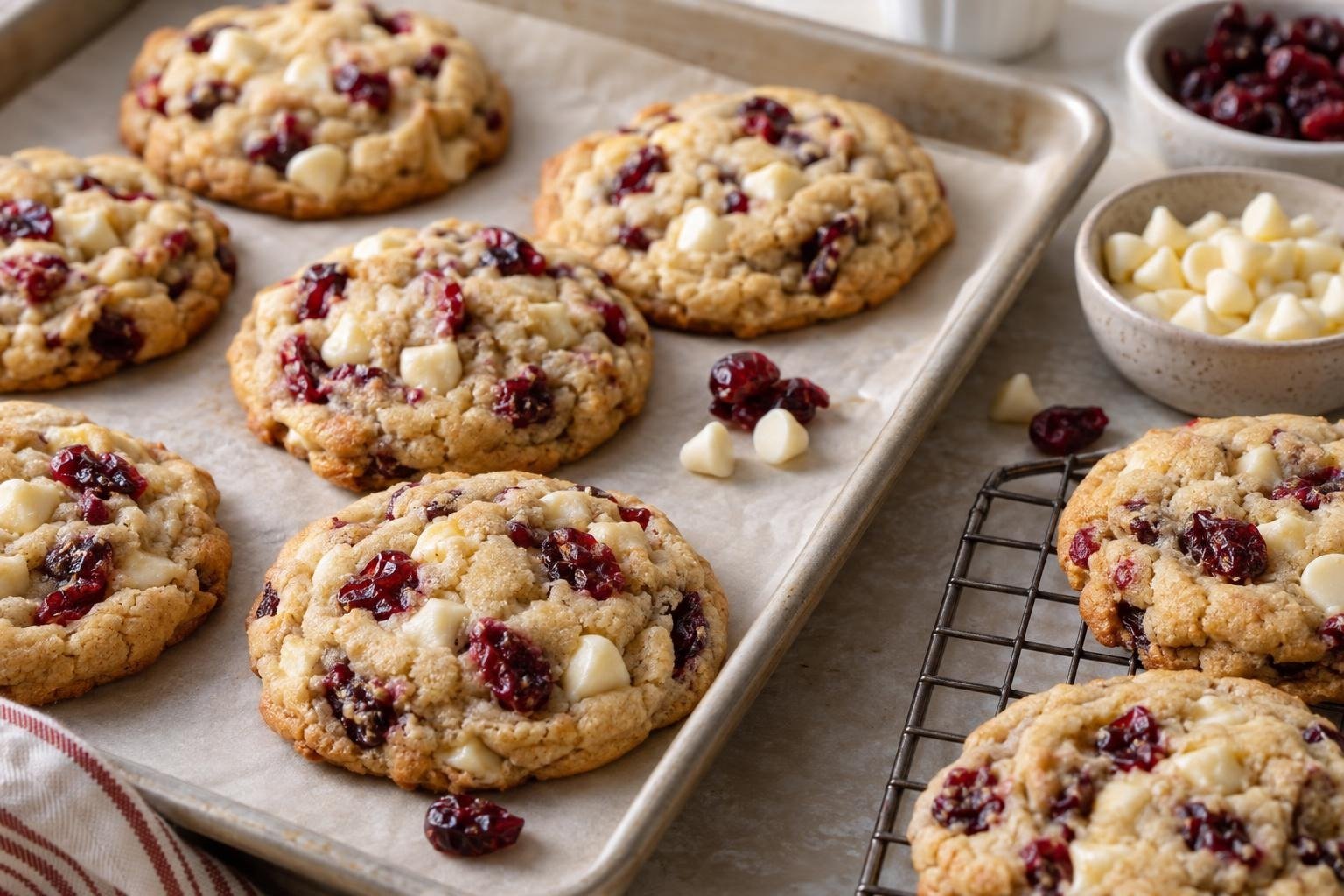
Buttery vanilla aroma, lightly golden edges, tart cranberry pockets, and creamy white chocolate run through every bite of these chewy cranberry white chocolate cookies. The centers stay thick and soft without being underbaked, while the edges provide just enough structure to keep the cookies from feeling cakey. Sweetened dried cranberries also cut through the richness, which matters when white chocolate is invited to the party.
I use softened butter for controlled creaming, plenty of brown sugar for moisture, an extra yolk for richness, and a small amount of cornstarch to limit toughness. The finished dough should be soft and scoopable but sturdy enough to hold a rounded mound. Chilling the measured portions gives the flour time to hydrate and firms the butter, while precise bake cues prevent both excessive spread and raw centers.
What Makes these Chocolate Cookies So Ridiculously Good
- Brown sugar supplies more moisture than granulated sugar, supporting a bendable, chewy center while still allowing the edges to brown.
- An extra egg yolk adds fat and emulsifiers without the additional water found in a whole egg, creating richness without making the dough loose.
- Cornstarch softens the flour’s protein structure, helping the cookies remain tender rather than turning bready or tough.
- Two hours of chilling firms the butter and hydrates the flour, so the 45-gram portions spread gradually instead of flowing into thin cookies.
- A brief rest on the hot baking sheet uses carryover heat to finish setting the centers safely without drying out the edges.
Ingredient Notes for Chewy Cranberry White Chocolate Cookies with Soft, Chewy Centers
- Unsalted butter: Bring the butter to a cool room temperature of about 18 to 20°C. It should accept a fingertip indentation but remain firm and slightly cool, not shiny, greasy, or partially melted.
- Brown and granulated sugars: Brown sugar holds moisture for chewiness, while granulated sugar promotes spread and crisp edge development. Light or dark brown sugar works, although dark brown sugar gives a deeper molasses flavor.
- Egg and egg yolk: The whole egg provides water and protein for structure. The additional yolk supplies fat and emulsifiers that enrich the dough and support a soft, cohesive center.
- All-purpose flour and cornstarch: Flour builds the cookie structure, while cornstarch reduces the overall protein concentration for a more tender bite. Weigh both ingredients and avoid packing them into measuring cups.
- Sweetened dried cranberries: Use pliable dried cranberries rather than fresh or frozen berries. Fresh fruit introduces too much water and would require a different flour and sugar balance.
- White chocolate: Chips hold distinct pockets, while a chopped white chocolate bar produces irregular creamy streaks. Use real white chocolate containing cocoa butter for the cleanest melt and flavor.
My Baking Tips
- Use a scale for the flour and each dough portion. Even 45-gram portions bake at the same rate, which prevents a tray containing both dry small cookies and underdone large ones.
- Check the butter before mixing. Properly softened butter bends under pressure while holding its shape; melted or greasy butter cannot trap air correctly and encourages excessive spread.
- Bake on completely cool sheets. Placing chilled dough on a warm pan melts the butter before the cookie structure begins to set, producing thinner and less even results.
- Remove the cookies according to surface cues rather than waiting for deeply browned centers. The centers should be soft but visibly set, with no glossy, fluid dough showing through cracks.
- Press a few visible cranberries or white chocolate pieces into the top of each portion before chilling if desired. Keep most mix-ins inside the dough so exposed white chocolate does not scorch against the pan.
Ingredients for Chewy Cranberry White Chocolate Cookies
- 170 g unsalted butter (Softened to 18 to 20°C, pliable but not greasy)
- 180 g packed light brown sugar (Dark brown sugar may be used for a stronger molasses flavor)
- 70 g granulated sugar
- 1 large egg (At room temperature)
- 1 large egg yolk (At room temperature)
- 2 tsp pure vanilla extract
- 260 g all-purpose flour (Weighed for accuracy)
- 10 g cornstarch (About 1 tablespoon plus 1 teaspoon)
- 3/4 tsp baking soda
- 1/2 tsp fine sea salt
- 140 g sweetened dried cranberries (Separated if clumped)
- 170 g white chocolate chips (Or finely chopped white chocolate containing cocoa butter)
How to Make Chewy Cranberry White Chocolate Cookies
- STEP 1). Prepare the pans and dry ingredients Line two or three light-colored rimmed baking sheets with parchment paper. In a medium bowl, whisk the all-purpose flour, cornstarch, baking soda, and fine sea salt for about 30 seconds, breaking up every visible lump. Thorough distribution is important because concentrated baking soda can leave bitter spots. Set the dry mixture aside, and separate any cranberries or white chocolate pieces that have clumped together.
- STEP 2). Cream the butter and sugars Place the softened butter, brown sugar, and granulated sugar in the bowl of a stand mixer fitted with the paddle attachment. Beat on medium speed for 2 to 3 minutes, stopping once to scrape the bowl and paddle. The mixture should look creamy, cohesive, and slightly lighter, but not extremely fluffy. Excessive aeration can make the cookies rise and collapse, while greasy butter indicates that it has become too warm.
- STEP 3). Emulsify the egg, yolk, and vanilla Add the room-temperature egg and egg yolk to the butter mixture, then mix on medium-low speed for about 30 seconds. Add the vanilla and continue mixing for 30 to 45 seconds, scraping the bowl as needed. Stop when the mixture is smooth, glossy, and evenly emulsified, with no slippery egg streaks around the bottom. If it looks slightly curdled, mix only until it becomes cohesive rather than adding extra flour.
- STEP 4). Finish the cookie dough Add the dry ingredients to the butter mixture and mix on low speed for 15 to 20 seconds, until most of the flour disappears but a few pale streaks remain. Add the dried cranberries and white chocolate, then fold with a flexible spatula until evenly distributed. The dough should be soft, thick, and slightly tacky, not wet or pourable. Stop as soon as the flour is incorporated to avoid developing a tough gluten network.
- STEP 5). Portion and chill the dough Divide the dough into 24 portions weighing about 45 grams each, roughly 3 level tablespoons. Roll each portion gently into a compact ball without compressing it hard, then arrange the balls on the prepared sheets or a parchment-lined tray. Cover tightly and refrigerate for at least 2 hours or up to 48 hours. Properly chilled dough will feel firm on the outside and retain its rounded shape when lifted.
- STEP 6). Bake until the centers are set Position a rack in the center of the oven and preheat to 350°F, or 177°C, for at least 20 minutes. Arrange eight chilled portions on one lined baking sheet, leaving about 3 inches between them. Bake one sheet at a time for 11 to 13 minutes, until the edges are light golden and set while the centers look puffed, matte around the perimeter, and soft but not wet or fluid. Repeat with the remaining dough on cool sheets.
- STEP 7). Cool through the carryover setting stage Set each hot baking sheet on a heat-safe surface and leave the cookies undisturbed for 10 minutes. Their centers will settle and finish setting through carryover heat, so moving them immediately can cause breakage. When the bottoms feel stable and the edges release cleanly, transfer the cookies with a thin spatula to a wire rack. Cool for at least 20 additional minutes before serving so the white chocolate firms and the crumb becomes chewy rather than fragile.
Storage and Freezing
- Storage: Keep completely cooled cookies in an airtight container at room temperature for up to 4 days. Place parchment between layers and add a small piece of sandwich bread to the container if the cookies begin losing moisture.
- Freezing baked cookies: Freeze cooled cookies in a rigid airtight container, with parchment between layers, for up to 2 months.
- Freezing cookie dough: Freeze the chilled 45-gram portions on a lined tray until firm, then transfer them to a labeled freezer bag for up to 2 months. Remove excess air to limit freezer burn.
- Thawing and baking: Bake frozen portions directly from the freezer at 350°F, or 177°C, adding about 1 to 2 minutes. Use the same golden-edge and set-center cues rather than relying only on time.
- Serving: Thaw baked cookies in their closed container at room temperature to prevent condensation from making the surfaces sticky. For softer white chocolate pockets, warm an individual cookie for 5 to 8 seconds in a microwave.
Frequently Asked Questions
Why did my cranberry white chocolate cookies spread too much?
Overly warm butter, insufficient chilling, undermeasured flour, or a hot baking sheet can cause excessive spreading. The mixed dough should be thick enough to hold a rounded scoop, and the chilled portions should feel firm before they enter the oven.
Confirm the oven has reached 350°F with an oven thermometer if possible. An oven running cool delays edge setting, giving the butter more time to melt and flow before the flour and egg proteins establish structure.
How do I know when chewy cranberry white chocolate cookies are fully baked?
Look for lightly golden, stable edges and a center that is puffed and mostly matte. The middle may appear soft, but it should not look glossy, fluid, or visibly raw beneath surface cracks.
Leave the cookies on the hot sheet for 10 minutes after baking. Carryover heat completes the center setting while preserving moisture, so baking until the entire top is brown will produce a drier, crisper cookie after cooling.
What keeps these cranberry cookies soft and chewy?
Brown sugar retains moisture, while the extra yolk adds fat and emulsifiers without introducing the water of another whole egg. Cornstarch limits toughness, and the two-hour chill allows the flour to hydrate before baking.
The final texture also depends on timing. Removing the cookies when the edges are set but the centers remain soft prevents moisture loss, while the sheet-pan rest gives the centers enough residual heat to become cohesive rather than raw.
Should dried cranberries be soaked before adding them to cookie dough?
Soaking is unnecessary for this formula because sweetened dried cranberries are already pliable and the dough’s moisture has been balanced around them. Drainage differences could introduce extra water, causing additional spread and damp pockets around the fruit.
If the cranberries are stuck together, separate them by hand before folding. Exceptionally hard or stale fruit will not soften reliably during the short bake, so use a fresh package with berries that bend rather than snap.
Can I freeze dough for chewy cranberry white chocolate cookies?
Portion and chill the dough first, then freeze the 45-gram balls in a single layer until firm. Transfer them to an airtight freezer bag, remove excess air, and store for up to 2 months.
Bake the portions directly from frozen at 350°F, adding approximately 1 to 2 minutes. The cookies are ready when their edges are light golden and their centers are puffed, soft, and set rather than wet-looking.
More Ridiculously Delicious Cookies
- Small Batch Chocolate Chip Cookies with Chewy Centers and Crisp Edges
- Fudgy Chocolate Crinkle Cookies with Crackled Sugar Tops
- Chewy Coconut Cookies with Soft, Chewy Centers
- Bakery-Style Oatmeal Raisin Cookies with Chewy Centers
- Soft and Chewy Peanut Butter Cookies with Crisp Edges
- Bakery-Style Soft Sugar Cookies with Soft, Chewy Centers
Chewy Cranberry White Chocolate Cookies with Soft, Chewy Centers
Ingredients
Equipment
Method
- Line two or three light-colored rimmed baking sheets with parchment paper. In a medium bowl, whisk the all-purpose flour, cornstarch, baking soda, and fine sea salt for about 30 seconds, breaking up every visible lump. Thorough distribution is important because concentrated baking soda can leave bitter spots. Set the dry mixture aside, and separate any cranberries or white chocolate pieces that have clumped together.
- Place the softened butter, brown sugar, and granulated sugar in the bowl of a stand mixer fitted with the paddle attachment. Beat on medium speed for 2 to 3 minutes, stopping once to scrape the bowl and paddle. The mixture should look creamy, cohesive, and slightly lighter, but not extremely fluffy. Excessive aeration can make the cookies rise and collapse, while greasy butter indicates that it has become too warm.
- Add the room-temperature egg and egg yolk to the butter mixture, then mix on medium-low speed for about 30 seconds. Add the vanilla and continue mixing for 30 to 45 seconds, scraping the bowl as needed. Stop when the mixture is smooth, glossy, and evenly emulsified, with no slippery egg streaks around the bottom. If it looks slightly curdled, mix only until it becomes cohesive rather than adding extra flour.
- Add the dry ingredients to the butter mixture and mix on low speed for 15 to 20 seconds, until most of the flour disappears but a few pale streaks remain. Add the dried cranberries and white chocolate, then fold with a flexible spatula until evenly distributed. The dough should be soft, thick, and slightly tacky, not wet or pourable. Stop as soon as the flour is incorporated to avoid developing a tough gluten network.
- Divide the dough into 24 portions weighing about 45 grams each, roughly 3 level tablespoons. Roll each portion gently into a compact ball without compressing it hard, then arrange the balls on the prepared sheets or a parchment-lined tray. Cover tightly and refrigerate for at least 2 hours or up to 48 hours. Properly chilled dough will feel firm on the outside and retain its rounded shape when lifted.
- Position a rack in the center of the oven and preheat to 350°F, or 177°C, for at least 20 minutes. Arrange eight chilled portions on one lined baking sheet, leaving about 3 inches between them. Bake one sheet at a time for 11 to 13 minutes, until the edges are light golden and set while the centers look puffed, matte around the perimeter, and soft but not wet or fluid. Repeat with the remaining dough on cool sheets.
- Set each hot baking sheet on a heat-safe surface and leave the cookies undisturbed for 10 minutes. Their centers will settle and finish setting through carryover heat, so moving them immediately can cause breakage. When the bottoms feel stable and the edges release cleanly, transfer the cookies with a thin spatula to a wire rack. Cool for at least 20 additional minutes before serving so the white chocolate firms and the crumb becomes chewy rather than fragile.
Notes
- Use a scale for the flour and each dough portion. Even 45-gram portions bake at the same rate, which prevents a tray containing both dry small cookies and underdone large ones.
- Check the butter before mixing. Properly softened butter bends under pressure while holding its shape; melted or greasy butter cannot trap air correctly and encourages excessive spread.
- Bake on completely cool sheets. Placing chilled dough on a warm pan melts the butter before the cookie structure begins to set, producing thinner and less even results.
- Remove the cookies according to surface cues rather than waiting for deeply browned centers. The centers should be soft but visibly set, with no glossy, fluid dough showing through cracks.
- Press a few visible cranberries or white chocolate pieces into the top of each portion before chilling if desired. Keep most mix-ins inside the dough so exposed white chocolate does not scorch against the pan.