

Table of Contents
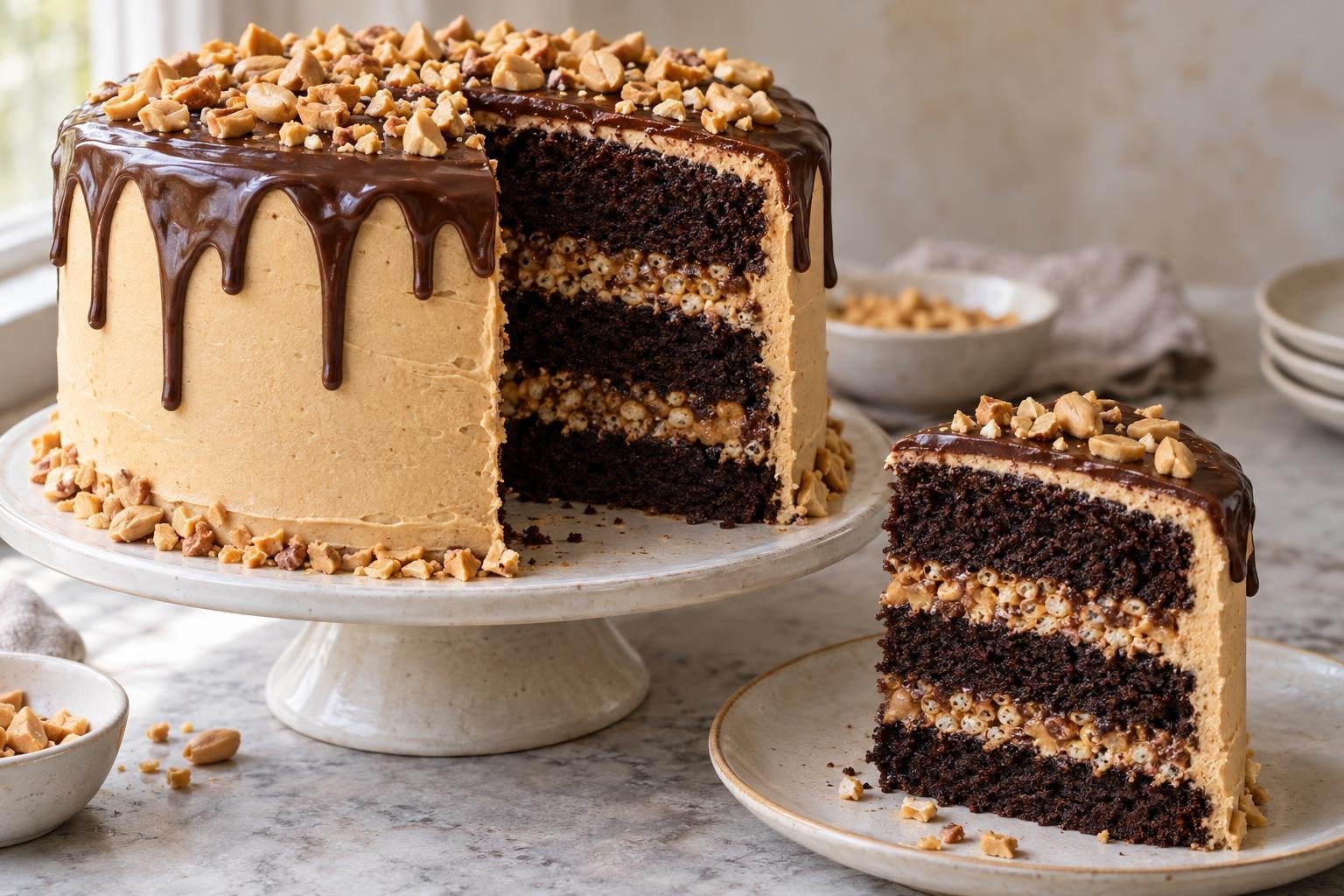
I have a weakness for cakes that refuse to choose just one texture, and this chocolate peanut butter crunch cake recipe delivers the whole delicious argument. The dark cocoa layers are soft and deeply chocolatey, while thin chocolate peanut butter cereal discs add a crisp, slightly salty snap between them. I use hot coffee to deepen the cocoa without making the cake taste like coffee, then balance that intensity with a creamy peanut butter frosting that stays sturdy enough for stacking. A glossy ganache drip and roasted peanuts finish the cake without burying its best feature: that surprise crunch inside every slice. It is playful, polished, and exactly the sort of cake I want when a plain chocolate layer cake feels a little too well behaved.
What Makes this Chocolate Cake So Ridiculously Good
- Coffee wakes up the cocoa: Hot coffee hydrates the cocoa particles and intensifies their roasted flavor, giving the cake a deeper chocolate character without leaving an obvious coffee taste.
- Oil protects the crumb: Neutral oil remains fluid after refrigeration, so these chocolate layers stay soft even after the assembled cake has been chilled to stabilize the frosting.
- Crunch gets a protective coating: Chocolate and peanut butter surround the crisp rice cereal, limiting direct contact with the moist cake and helping the filling retain its distinctive snap.
- Conventional peanut butter behaves beautifully: Its emulsified consistency produces smooth frosting and cohesive crunch layers without the oil separation that can make natural peanut butter unpredictable.
- Thin discs keep slices civilized: Forming the crunch slightly smaller than the cake prevents hard edges from poking through the frosting while giving every serving a crisp center.
Ingredient Notes for Chocolate Peanut Butter Crunch Cake
- Dutch-process cocoa: Its mellow acidity and dark roasted flavor suit the baking powder and baking soda combination in this formula. Sift it with the flour because cocoa readily forms dry pockets.
- Hot brewed coffee: Coffee blooms the cocoa and supplies much of the batter’s liquid. Use it hot but not vigorously boiling, and add it gradually to prevent splashing.
- Buttermilk: Its acidity supports the baking soda and contributes dairy proteins that encourage browning. Bring it to room temperature so the batter emulsifies evenly.
- Neutral oil: Canola, sunflower, or grapeseed oil keeps the refrigerated layers tender without adding a competing flavor. Measure it by weight for consistent moisture.
- Creamy peanut butter: Use a smooth, conventional emulsified peanut butter in both the crunch and frosting. Stirred natural peanut butter can separate and make either component greasy or unstable.
- Crisp rice cereal: Fresh, dry cereal creates the cake’s contrasting texture. Fold it into the chocolate mixture gently and keep it away from steam or water.
- Milk chocolate: Its dairy sweetness softens the roasted peanut flavor and creates crunch discs that remain easier to cut than discs made entirely with dark chocolate.
- Heavy cream: Cream loosens the peanut butter frosting and forms the ganache. Add it cautiously to the frosting because a small quantity changes the consistency quickly.
- Roasted salted peanuts: These reinforce the peanut flavor and provide a savory finish. Chop them into small pieces so they adhere to the ganache and do not interfere with slicing.
A Few Golden Rules for Chocolate Peanut Butter Crunch Cake Recipe
- Weigh the batter: Dividing approximately 465 g into each pan produces similarly thick layers that bake at the same rate and create a level finished stack.
- Respect the cooling stage: Even faint residual warmth can melt the peanut butter frosting, so touch the center and underside of every layer before beginning assembly.
- Keep every crunch tool dry: A wet bowl or spatula can cause melted chocolate to seize, leaving the cereal difficult to coat and spread evenly.
- Correct soft frosting gradually: If the frosting slumps, refrigerate the bowl for 10 minutes and remix briefly instead of adding extra confectioners’ sugar, which can make it overly sweet.
- Slice with confident pressure: Warm and dry the knife between cuts, then press cleanly through the crunch rather than sawing aggressively and dragging crumbs through the frosting.
My Best Tips for Stacking and Decorating a Chocolate Peanut Butter Crunch Cake
A crunchy layer cake needs a little more structural thought than a soft filling does. I focus on level cake layers, controlled frosting consistency, and thin crunch discs so the finished cake slices neatly instead of staging a delicious collapse.
- Keep the crunch away from the perimeter: A narrow frosting border cushions each disc and seals the cereal filling inside, producing smoother sides and a more stable stack.
- Match frosting to the job: Keep the filling slightly firm for support, then soften the remaining frosting with a small amount of cream only if the exterior needs easier spreading.
- Check the stack from two directions: Look across the cake at eye level, rotate the turntable, and correct leaning layers before applying the final coat.
- Control the drip before committing: Test one spoonful of ganache on the chilled cake; it should move slowly and stop before reaching the cake board.
- Warm the knife, not the cake: A hot, thoroughly dried blade passes through chilled ganache and crunch more cleanly without softening the entire slice.
The goal is not architectural perfection. A straight, chilled stack and a decisive slicing motion will give you clean layers with plenty of personality.
Ingredients for Chocolate Peanut Butter Crunch Cake
- 15 g unsalted butter (Softened, for greasing the cake pans)
- 250 g all-purpose flour (About 2 cups, spooned and leveled)
- 75 g Dutch-process cocoa powder (About 3/4 cup, sifted if lumpy)
- 350 g granulated sugar (About 1 3/4 cups)
- 8 g baking soda (2 teaspoons)
- 4 g baking powder (1 teaspoon)
- 5 g fine sea salt (1 teaspoon)
- 100 g large eggs (2 large eggs, at room temperature)
- 240 g buttermilk (1 cup, at room temperature)
- 120 g neutral oil (About 1/2 cup)
- 10 g pure vanilla extract (2 teaspoons)
- 240 g hot brewed coffee (1 cup, approximately 180 to 190°F)
- 140 g milk chocolate (Finely chopped, for the crunch layers)
- 120 g creamy conventional peanut butter (About 1/2 cup, for the crunch layers)
- 75 g crisp rice cereal (About 3 cups, fresh and dry)
- 1 g fine sea salt (For the crunch layers)
- 454 g unsalted butter (2 cups, softened to 65 to 68°F)
- 450 g creamy conventional peanut butter (About 1 3/4 cups, at room temperature)
- 500 g confectioners’ sugar (About 4 cups, sifted)
- 90 g heavy cream (6 tablespoons, at room temperature)
- 10 g pure vanilla extract (2 teaspoons)
- 3 g fine sea salt (1/2 teaspoon)
- 150 g semisweet chocolate (Finely chopped, for the ganache)
- 120 g heavy cream (1/2 cup, for the ganache)
- 70 g roasted salted peanuts (About 1/2 cup, coarsely chopped)
How to Make Chocolate Peanut Butter Crunch Cake
- STEP 1). Prepare the oven and cake pans Position a rack in the center of the oven and preheat to 350°F. Grease three 8-inch round cake pans with the 15 g softened butter, line the bottoms with parchment circles, and lightly grease the parchment. Set the pans on a digital scale nearby so the batter can be divided accurately. Properly prepared pans protect the tender chocolate layers from tearing when they are turned out.
- STEP 2). Combine the dry ingredients Place the all-purpose flour, Dutch-process cocoa, granulated sugar, baking soda, baking powder, and salt in a large mixing bowl. Pass any visibly lumpy cocoa through a fine-mesh sieve, then whisk everything for about 45 seconds. Scrape around the bottom and sides of the bowl as you whisk. The mixture should look uniformly cocoa-colored, with no pale flour streaks or compact lumps of leavening.
- STEP 3). Mix and finish the chocolate batter In a medium bowl, whisk the eggs, buttermilk, oil, and vanilla until smooth and fully emulsified. Pour the wet mixture into the dry ingredients and whisk from the center outward just until no dry flour remains. Slowly stream in the hot coffee while whisking gently. The finished batter will be thin, glossy, and fluid rather than fluffy. Scrape the bowl with a flexible spatula, checking the bottom for dense cocoa or flour pockets.
- STEP 4). Divide and bake the cake layers Divide the batter equally among the three prepared pans, approximately 465 g per pan, and tap each pan gently on the counter to release large air bubbles. Bake for 25 to 30 minutes, rotating the pans front to back after 20 minutes if the oven heats unevenly. The layers are done when their centers spring back lightly and a skewer emerges with a few moist crumbs but no wet batter.
- STEP 5). Cool and release the cakes Set the pans on wire racks and cool the layers in their pans for 15 minutes. Run a thin knife around each edge, invert the cakes onto the racks, remove the parchment, and turn them upright. Let them cool completely for about 75 minutes. Do not stack, trim, or frost warm cake because trapped heat will soften the buttercream and make the delicate layers more likely to split.
- STEP 6). Form the peanut butter crunch discs Trace two 7-inch circles on parchment and turn the sheets ink-side down on flat trays. Melt the milk chocolate in a dry microwave-safe bowl using 20-second intervals, stirring between each, until smooth. Stir in the 120 g peanut butter and 1 g salt, then fold in the cereal without crushing it. Divide between the circles, press into thin even discs, and refrigerate for 25 to 30 minutes until firm but still cuttable.
- STEP 7). Whip the peanut butter frosting Beat the 454 g softened butter in a stand mixer fitted with the paddle attachment on medium speed for 2 minutes, until creamy and free of firm lumps. Add the 450 g peanut butter and beat for 1 minute. Mix in the sifted confectioners’ sugar on low in three additions, alternating with the 90 g cream. Add vanilla and salt, then beat on medium-low for 2 minutes until smooth, spreadable, and able to hold a soft peak.
- STEP 8). Prepare and cool the ganache Place the finely chopped semisweet chocolate in a heatproof bowl. Heat the 120 g heavy cream in a small saucepan until steaming with bubbles appearing around the edge, then pour it over the chocolate. Leave undisturbed for 2 minutes and stir from the center outward until glossy. Cool for 15 to 25 minutes, stirring occasionally, until the ganache flows slowly from a spoon rather than running like warm cream.
- STEP 9). Fill and stack the cake Level any pronounced domes with a serrated knife. Place one cake layer on an 8-inch cake board and spread about 180 g frosting over it, leaving the center level. Pipe or spread a slightly raised frosting border around the edge, set one crunch disc inside, and cover it with about 80 g more frosting. Repeat with the second cake and crunch disc, then add the final layer upside down. Check the stack at eye level and refrigerate for 20 minutes.
- STEP 10). Coat, decorate, chill, and serve Apply a thin crumb coat with an offset spatula, chill for 20 minutes, then cover the top and sides with the remaining frosting and smooth with an icing scraper. Chill for another 20 minutes. Test one ganache drip on the back, then spoon ganache around the rim and spread the remainder over the top. Add the chopped peanuts while the ganache is tacky. Chill for 60 minutes, then temper at room temperature for 25 minutes before slicing with a hot, dry knife.
Storage and Freezing
- Storage: Keep the assembled cake covered in the refrigerator for up to 4 days. A cake carrier protects the frosting and prevents it from absorbing refrigerator odors.
- Freezing: Freeze individual slices uncovered until firm, then wrap each slice in plastic wrap and place in an airtight container for up to 1 month. The cereal will gradually lose some crispness after freezing.
- Thawing: Thaw wrapped slices overnight in the refrigerator. Remove the wrapping after thawing so condensation forms on the wrapper rather than the frosting.
- Serving: Let refrigerated cake stand at room temperature for 20 to 30 minutes before serving. This softens the buttercream while keeping the crunch layers firm enough for clean slices.
Frequently Asked Questions
What gives chocolate peanut butter crunch cake its crunchy texture?
The crunch comes from crisp rice cereal coated with melted milk chocolate and conventional peanut butter. The coating binds the cereal into thin discs while helping shield it from moisture in the cake and frosting.
Fresh cereal matters because stale cereal cannot regain its snap. Keep the discs chilled until assembly and surround them with frosting so their edges do not break through the finished cake.
Why did my peanut butter crunch layer become too hard to slice?
An overly thick disc or excessive chilling can make the chocolate coating feel harder than intended. Spread each portion into a thin 7-inch circle and avoid compressing the cereal into a dense slab.
Let the finished cake temper at room temperature for about 25 minutes before cutting. A hot, thoroughly dried knife and firm downward pressure will pass through the crunch more cleanly than a sawing motion.
Can I make this chocolate peanut butter crunch cake ahead?
The cake layers can be baked one day ahead, cooled completely, wrapped tightly, and kept at room temperature. The frosting can also be prepared a day ahead and refrigerated in an airtight container.
Bring the frosting back to cool room temperature and mix briefly before using it. For the strongest crunch, prepare the cereal discs and assemble the cake no more than one day before serving.
How do I stop the cake layers from sliding during assembly?
Sliding usually means the frosting is too warm, the cake layers are not level, or the crunch discs are sitting on an overly thick cushion of filling. The buttercream should hold a soft peak without looking greasy.
Build the cake on a flat board, keep each frosting layer even, and chill the stack before crumb coating. If it begins leaning, refrigerate it immediately and realign the layers once the frosting has firmed.
Does the coffee make this chocolate cake taste like coffee?
The brewed coffee primarily strengthens the cocoa’s roasted character rather than creating a distinct coffee flavor. Chocolate, peanut butter, and ganache remain the dominant flavors in the finished cake.
Use freshly brewed plain coffee without flavored syrups or dairy. Add it hot so it hydrates the cocoa effectively, but stream it into the batter slowly to keep the thin mixture controlled and evenly blended.
More Ridiculously Delicious Cakes
- Bakery-Style Peanut Butter Cup Birthday Cake
- Chocolate Sour Cream Bundt Cake with a Moist Crumb
- Chocolate Swiss Roll Cake with a Light Cocoa Sponge
- Triple Chocolate Mousse Layer Cake Recipe
- Bakery-Style Vintage Chocolate Lambeth Cake
Chocolate Peanut Butter Crunch Cake Recipe
Ingredients
Equipment
Method
- Position a rack in the center of the oven and preheat to 350°F. Grease three 8-inch round cake pans with the 15 g softened butter, line the bottoms with parchment circles, and lightly grease the parchment. Set the pans on a digital scale nearby so the batter can be divided accurately. Properly prepared pans protect the tender chocolate layers from tearing when they are turned out.
- Place the all-purpose flour, Dutch-process cocoa, granulated sugar, baking soda, baking powder, and salt in a large mixing bowl. Pass any visibly lumpy cocoa through a fine-mesh sieve, then whisk everything for about 45 seconds. Scrape around the bottom and sides of the bowl as you whisk. The mixture should look uniformly cocoa-colored, with no pale flour streaks or compact lumps of leavening.
- In a medium bowl, whisk the eggs, buttermilk, oil, and vanilla until smooth and fully emulsified. Pour the wet mixture into the dry ingredients and whisk from the center outward just until no dry flour remains. Slowly stream in the hot coffee while whisking gently. The finished batter will be thin, glossy, and fluid rather than fluffy. Scrape the bowl with a flexible spatula, checking the bottom for dense cocoa or flour pockets.
- Divide the batter equally among the three prepared pans, approximately 465 g per pan, and tap each pan gently on the counter to release large air bubbles. Bake for 25 to 30 minutes, rotating the pans front to back after 20 minutes if the oven heats unevenly. The layers are done when their centers spring back lightly and a skewer emerges with a few moist crumbs but no wet batter.
- Set the pans on wire racks and cool the layers in their pans for 15 minutes. Run a thin knife around each edge, invert the cakes onto the racks, remove the parchment, and turn them upright. Let them cool completely for about 75 minutes. Do not stack, trim, or frost warm cake because trapped heat will soften the buttercream and make the delicate layers more likely to split.
- Trace two 7-inch circles on parchment and turn the sheets ink-side down on flat trays. Melt the milk chocolate in a dry microwave-safe bowl using 20-second intervals, stirring between each, until smooth. Stir in the 120 g peanut butter and 1 g salt, then fold in the cereal without crushing it. Divide between the circles, press into thin even discs, and refrigerate for 25 to 30 minutes until firm but still cuttable.
- Beat the 454 g softened butter in a stand mixer fitted with the paddle attachment on medium speed for 2 minutes, until creamy and free of firm lumps. Add the 450 g peanut butter and beat for 1 minute. Mix in the sifted confectioners’ sugar on low in three additions, alternating with the 90 g cream. Add vanilla and salt, then beat on medium-low for 2 minutes until smooth, spreadable, and able to hold a soft peak.
- Place the finely chopped semisweet chocolate in a heatproof bowl. Heat the 120 g heavy cream in a small saucepan until steaming with bubbles appearing around the edge, then pour it over the chocolate. Leave undisturbed for 2 minutes and stir from the center outward until glossy. Cool for 15 to 25 minutes, stirring occasionally, until the ganache flows slowly from a spoon rather than running like warm cream.
- Level any pronounced domes with a serrated knife. Place one cake layer on an 8-inch cake board and spread about 180 g frosting over it, leaving the center level. Pipe or spread a slightly raised frosting border around the edge, set one crunch disc inside, and cover it with about 80 g more frosting. Repeat with the second cake and crunch disc, then add the final layer upside down. Check the stack at eye level and refrigerate for 20 minutes.
- Apply a thin crumb coat with an offset spatula, chill for 20 minutes, then cover the top and sides with the remaining frosting and smooth with an icing scraper. Chill for another 20 minutes. Test one ganache drip on the back, then spoon ganache around the rim and spread the remainder over the top. Add the chopped peanuts while the ganache is tacky. Chill for 60 minutes, then temper at room temperature for 25 minutes before slicing with a hot, dry knife.
Notes
- Weigh the batter: Dividing approximately 465 g into each pan produces similarly thick layers that bake at the same rate and create a level finished stack.
- Respect the cooling stage: Even faint residual warmth can melt the peanut butter frosting, so touch the center and underside of every layer before beginning assembly.
- Keep every crunch tool dry: A wet bowl or spatula can cause melted chocolate to seize, leaving the cereal difficult to coat and spread evenly.
- Correct soft frosting gradually: If the frosting slumps, refrigerate the bowl for 10 minutes and remix briefly instead of adding extra confectioners’ sugar, which can make it overly sweet.
- Slice with confident pressure: Warm and dry the knife between cuts, then press cleanly through the crunch rather than sawing aggressively and dragging crumbs through the frosting.



