

Table of Contents
Some days, one kind of chocolate simply isn’t going to cut it, and that’s when I bring out this triple chocolate mousse layer cake recipe! Between the tender dark chocolate cake layers are two creamy fillings, one made with milk chocolate and the other with white chocolate, all finished with a rich dark chocolate ganache. I especially enjoy how each chocolate brings something different to the cake, from the deep cocoa flavor to the sweeter, silky mousse. The trickiest part is getting those mousse layers to set without losing their light, airy texture. I use a little gelatin for stability and fold in softly whipped cream to keep them creamy rather than stiff. It’s certainly not a cake I’d throw together in a hurry, but cutting into those beautifully defined layers makes the extra effort worth it. And honestly, three kinds of chocolate are a pretty convincing reason to celebrate!
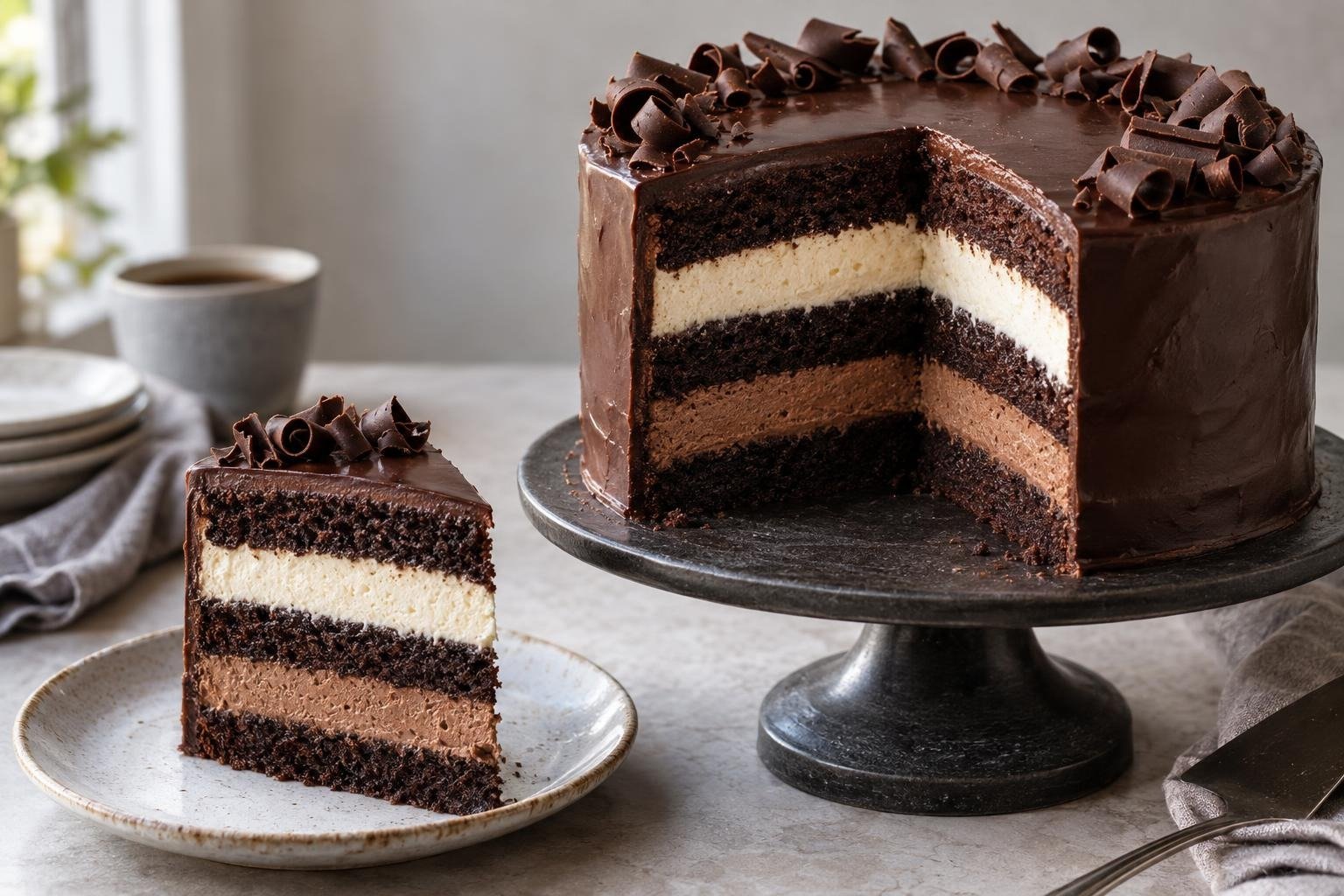
Why This Chocolate Mousse Cake Frickin’ Works
- Three chocolates, each with its own personality: Dark cocoa cake brings that deep, intense chocolate flavor, milk chocolate adds a softer, creamier middle, and white chocolate gives the cake a sweet, delicate contrast. I like keeping the mousses separate because each layer brings something different to the finished slice.
- Chocolate cake that stays tender after chilling: Mousse cakes spend plenty of time in the refrigerator, so I use neutral oil in the chocolate batter instead of relying on butter. The oil helps keep the crumb soft even when it’s cold, making it a much better match for those creamy mousse layers.
- A little gelatin keeps everything standing tall: Nobody wants their carefully stacked mousse layers sliding across the cake stand! I use a measured amount of gelatin in each filling to help it set firmly enough for slicing while keeping that soft, creamy texture. The important part is dissolving it properly and letting the chocolate mixture cool before folding in the cream.
- Hot coffee brings out the chocolate: Adding hot coffee to the batter helps develop the cocoa’s deeper flavors without making the cake taste like coffee. Dutch-process cocoa gives the layers their rich color and mellow chocolate flavor, creating a delicious contrast with the sweeter fillings.
- Ganache makes the perfect finishing touch: A smooth dark chocolate ganache coats the outside of the cake, bringing another layer of chocolate flavor without adding excessive sweetness. I let it cool until spreadable before frosting, so it covers the chilled cake without disturbing the mousse layers underneath.
Ingredient Notes for Triple Chocolate Mousse Layer Cake
- Dutch-process cocoa powder: Its mellow acidity, dark color, and strong cocoa flavor suit the baking soda and baking powder combination used in these cake layers.
- Cake flour: Its lower protein content limits gluten development, producing layers tender enough to complement mousse while retaining sufficient strength for stacking.
- Buttermilk: The acidity supports leavening and contributes moisture, while its milk proteins help the cake crumb set without becoming tough.
- Neutral oil: Use a flavorless liquid oil such as canola or sunflower oil. It keeps the cake supple after refrigeration, unlike fats that harden when cold.
- Milk chocolate: Choose real chocolate containing cocoa butter rather than confectionery coating. Its cocoa butter helps the mousse set smoothly alongside the gelatin.
- White chocolate: Select a bar or couverture with cocoa butter listed among the ingredients. Chips formulated to resist melting can produce a thick or grainy mousse base.
- Heavy cream: Cream containing 35 to 36 percent milk fat whips reliably. Keep the portions intended for whipping thoroughly chilled until needed.
- Dark chocolate: A chocolate containing 60 to 65 percent cacao gives the ganache enough firmness and bitterness to balance the sweeter mousse layers.
A Few Good Things to Know
- Weigh the divided batter: Equal quantities in all three pans produce level layers that stack neatly and finish baking at approximately the same time.
- Watch the chocolate base carefully: If either mousse base cools until thick or lumpy, warm it briefly over barely simmering water before folding in the cream.
- Stop whipping at soft peaks: Overwhipped cream is difficult to fold evenly and can leave the mousse grainy, dense, or streaked with small clumps of fat.
- Keep the cake ring snug: A visible gap between the cake and collar allows mousse to flow underneath, creating uneven bands and a less stable stack.
- Temper the serving temperature: Let refrigerated slices stand for 15 to 20 minutes before eating so the ganache softens and the chocolate flavors become more expressive.
My Best Tips for Stacking and Decorating a Triple Chocolate Mousse Layer Cake
Mousse cakes reward a little patience and orderly assembly. I focus on temperature, straight sides, and gentle handling so the finished layers stay distinct when the knife goes through.
- Build inside a collar: An acetate-lined cake ring keeps fluid mousse contained and gives the finished cake smooth, vertical sides without requiring excessive trimming or frosting.
- Center every cake layer: Align the edges before chilling because a displaced middle layer becomes difficult to correct once the mousse has set around it.
- Respect the temperature window: Fold whipped cream into a chocolate base that feels cool but remains fluid. A hot base deflates the cream, while a cold one forms chocolate flecks.
- Keep the top crumb-free: Place the final cake layer cut-side down so its flat pan-baked surface creates a level foundation for the dark ganache coating.
- Warm the slicing knife: Heat and thoroughly dry a long knife before each cut, then wipe it clean so the milk and white mousse bands remain sharply defined.
The refrigerator does most of the structural work here, so let each layer set fully and the decorating becomes far less dramatic than the cake looks.
Ingredients for Triple Chocolate Mousse Layer Cake
- 300 g cake flour (For the chocolate cake layers; spooned and leveled if measured by volume)
- 75 g Dutch-process cocoa powder (For the chocolate cake layers; sifted)
- 360 g granulated sugar (For the chocolate cake layers)
- 8 g baking powder (For the chocolate cake layers)
- 6 g baking soda (For the chocolate cake layers)
- 5 g fine sea salt (For the chocolate cake layers)
- 150 g large eggs (For the chocolate cake layers; about 3 eggs without shells, at room temperature)
- 300 g buttermilk (For the chocolate cake layers; at room temperature)
- 150 g neutral oil (For the chocolate cake layers; canola or sunflower oil)
- 10 g pure vanilla extract (For the chocolate cake layers)
- 240 ml hot brewed coffee (For the chocolate cake layers; freshly brewed and steaming)
- 4 g powdered unflavored gelatin (For the milk chocolate mousse)
- 20 g cold water (For blooming the milk chocolate mousse gelatin)
- 255 g milk chocolate (For the milk chocolate mousse; finely chopped)
- 180 g heavy cream (For heating in the milk chocolate mousse)
- 300 g heavy cream (For whipping into the milk chocolate mousse; thoroughly chilled)
- 4 g powdered unflavored gelatin (For the white chocolate mousse)
- 20 g cold water (For blooming the white chocolate mousse gelatin)
- 255 g white chocolate (For the white chocolate mousse; finely chopped)
- 120 g heavy cream (For heating in the white chocolate mousse)
- 300 g heavy cream (For whipping into the white chocolate mousse; thoroughly chilled)
- 350 g dark chocolate (For the ganache; 60 to 65 percent cacao, finely chopped)
- 350 g heavy cream (For the ganache)
- 25 g unsalted butter (For the ganache; softened and cut into small pieces)
- 40 g dark chocolate (For decorating; shaved into curls with a vegetable peeler)
How to Make Triple Chocolate Mousse Layer Cake
- STEP 1). Prepare the oven and cake pans Position racks in the upper and lower thirds of the oven and preheat to 350°F (177°C). Lightly grease three 8-inch round cake pans, line the bottoms with parchment, and grease the parchment. Dust the sides lightly with cocoa powder and tap out the excess. Set two pans on one rack and the third on the other, leaving space for heat circulation; their positions will be rotated during baking.
- STEP 2). Combine the dry cake ingredients Place a fine-mesh sieve over a large mixing bowl and sift together the 300 g cake flour and 75 g Dutch-process cocoa. Add the 360 g sugar, 8 g baking powder, 6 g baking soda, and 5 g salt. Whisk for about 30 seconds, reaching around the bottom and sides, until the cocoa is evenly dispersed and no pale streaks or compacted lumps remain.
- STEP 3). Mix the chocolate cake batter In a medium bowl, whisk the eggs, buttermilk, oil, and vanilla until smooth and fully emulsified. Pour this mixture into the dry ingredients and whisk from the center outward just until no dry flour remains. Gradually add the hot coffee while whisking gently. The finished batter will be fluid, glossy, and free of cocoa pockets. Divide it evenly among the prepared pans, approximately 530 g per pan.
- STEP 4). Bake the cake layers Bake for 28 to 34 minutes, rotating the pans between racks and turning them front to back after 20 minutes. The layers are done when their centers spring back under a light touch, the edges begin to pull slightly from the pans, and a wooden pick returns with moist crumbs but no wet batter. Cool in the pans on racks for 15 minutes before carefully turning out and removing the parchment.
- STEP 5). Cool and level the cakes Turn the layers upright on wire racks and cool completely for about 75 minutes. Once cool, use a long serrated knife to remove only pronounced domes, keeping each layer as even and thick as possible. Place one layer on a cake board. Fit an 8-inch cake ring around it and line the ring with a 4-inch-high acetate collar, making sure the collar sits flush against the board without gaps.
- STEP 6). Prepare the milk chocolate mousse Sprinkle 4 g gelatin over 20 g cold water in a small bowl and let it bloom for 5 minutes. Heat 180 g cream in a saucepan until steaming, about 160°F to 170°F (71°C to 77°C), then remove from the heat and dissolve the gelatin in it. Pour over the milk chocolate, rest for 2 minutes, and stir smooth. Cool to 90°F to 95°F (32°C to 35°C). Whip 300 g cold cream to soft peaks, then fold it into the chocolate in three additions.
- STEP 7). Add the milk chocolate layer Immediately scrape the milk chocolate mousse over the cake inside the acetate collar. Spread it into an even layer with a small offset spatula, working it firmly against the collar to prevent air gaps. Center the second cake layer over the mousse and press very gently until level without squeezing mousse up the sides. Cover the ring loosely and refrigerate for 45 minutes, until the mousse feels set enough to support light fingertip pressure.
- STEP 8). Make the white mousse and complete the stack Bloom the remaining 4 g gelatin in 20 g cold water for 5 minutes. Heat 120 g cream until steaming, dissolve in the gelatin, and pour it over the white chocolate. Rest for 2 minutes, stir until smooth, and cool to 88°F to 92°F (31°C to 33°C). Whip the remaining 300 g cold cream to soft peaks and fold it in gradually. Spread the mousse over the second cake, add the final cake cut-side down, cover, and refrigerate for at least 4 hours.
- STEP 9). Prepare and apply the dark chocolate ganache Place the 350 g chopped dark chocolate in a heatproof bowl. Heat the 350 g cream just until small bubbles appear at the edge, pour it over the chocolate, and let it stand for 3 minutes. Stir slowly from the center until glossy, then blend in the softened butter. Cool for 20 to 30 minutes, stirring occasionally, until spreadable. Remove the ring and acetate, then coat the chilled cake with a thin crumb coat followed by the remaining ganache.
- STEP 10). Decorate, chill, and slice Smooth the ganache with an offset spatula, keeping the top level and the sides straight, then scatter the 40 g dark chocolate curls around the top edge. Refrigerate the finished cake for 30 minutes so the coating firms without becoming excessively hard. For clean portions, warm a long sharp knife under hot water, dry it thoroughly, and cut downward through the cake. Wipe, rewarm, and dry the knife before every slice.
Storage and Freezing
- Storage: Keep the assembled cake covered in a cake carrier or loosely wrapped after the ganache has set.
- Refrigerate for up to 4 days because both fillings contain whipped cream.
- Freezing: Freeze the fully chilled, undecorated cake for up to 1 month. Wrap the cake, still on its board, in two layers of plastic wrap followed by foil.
- Thawing: Unwrap the frozen cake and thaw it overnight in the refrigerator before coating with freshly prepared ganache. Keeping it chilled during thawing reduces condensation on the mousse.
- Serving: Remove the cake or individual slices from the refrigerator 15 to 20 minutes before serving. Do not leave the mousse cake at room temperature for more than 2 hours.
Frequently Asked Questions
What keeps the chocolate mousse layers from collapsing?
Gelatin reinforces the cocoa butter and whipped cream structure in both mousses, while the cake ring prevents the fillings from spreading before they set. The measured amount creates support without making the mousse rubbery.
The chocolate base must also be cool before the whipped cream is folded in. If it is hot, the cream loses its trapped air; if it is too cold, the chocolate starts setting before the mousse is evenly mixed.
How far ahead should a triple chocolate mousse layer cake be made?
Plan to assemble the cake at least 5 hours before decorating so the first mousse can set and the completed stack receives a full 4-hour chill. Overnight refrigeration is also practical and gives the layers ample time to stabilize.
Apply the ganache the day of serving or up to one day ahead. Keep the finished cake covered in the refrigerator, then let it stand briefly at room temperature before slicing for a creamier texture.
Why did my chocolate mousse turn grainy?
Graininess commonly appears when the chocolate mixture is too cold during folding, causing cocoa butter to set in tiny fragments. Overwhipped cream can also form fatty clumps that remain visible in the finished mousse.
Keep the chocolate base within the temperature range given in the method and whip the cream only to soft peaks. Fold with a flexible spatula using broad strokes, stopping as soon as the color looks uniform.
Can I assemble this mousse cake without an acetate collar?
A parchment collar can contain the mousse in a pinch, but it wrinkles more readily and will not produce the same polished sides. The collar still needs firm support from an 8-inch cake ring or springform pan ring.
Avoid stacking the unset mousse freehand because it is too fluid to hold a straight edge. If using parchment, cut a tall, smooth strip and overlap its ends slightly so mousse cannot escape through the seam.
When is the cake ready to remove from the ring?
The completed stack needs at least 4 hours in the refrigerator. The top cake should feel firmly anchored, and the mousse visible through the acetate should look matte and hold its shape when the ring is lifted.
If the sides bulge or the top shifts, return the cake to the refrigerator before removing the collar. Peel acetate away slowly rather than pulling it outward, which can tear the mousse surface.
More Ridiculously Delicious Cakes
- Bakery-Style Chocolate Malt Birthday Cake
- Two-Tier Chocolate Vanilla Celebration Cake
- Bakery-Style Chocolate Hazelnut Birthday Cake
- Chocolate Fudge Birthday Cake With Whipped Ganache
- Chocolate Snack Cake for an Everyday Pan Cake
Triple Chocolate Mousse Layer Cake Recipe
Ingredients
Equipment
Method
- Position racks in the upper and lower thirds of the oven and preheat to 350°F (177°C). Lightly grease three 8-inch round cake pans, line the bottoms with parchment, and grease the parchment. Dust the sides lightly with cocoa powder and tap out the excess. Set two pans on one rack and the third on the other, leaving space for heat circulation; their positions will be rotated during baking.
- Place a fine-mesh sieve over a large mixing bowl and sift together the 300 g cake flour and 75 g Dutch-process cocoa. Add the 360 g sugar, 8 g baking powder, 6 g baking soda, and 5 g salt. Whisk for about 30 seconds, reaching around the bottom and sides, until the cocoa is evenly dispersed and no pale streaks or compacted lumps remain.
- In a medium bowl, whisk the eggs, buttermilk, oil, and vanilla until smooth and fully emulsified. Pour this mixture into the dry ingredients and whisk from the center outward just until no dry flour remains. Gradually add the hot coffee while whisking gently. The finished batter will be fluid, glossy, and free of cocoa pockets. Divide it evenly among the prepared pans, approximately 530 g per pan.
- Bake for 28 to 34 minutes, rotating the pans between racks and turning them front to back after 20 minutes. The layers are done when their centers spring back under a light touch, the edges begin to pull slightly from the pans, and a wooden pick returns with moist crumbs but no wet batter. Cool in the pans on racks for 15 minutes before carefully turning out and removing the parchment.
- Turn the layers upright on wire racks and cool completely for about 75 minutes. Once cool, use a long serrated knife to remove only pronounced domes, keeping each layer as even and thick as possible. Place one layer on a cake board. Fit an 8-inch cake ring around it and line the ring with a 4-inch-high acetate collar, making sure the collar sits flush against the board without gaps.
- Sprinkle 4 g gelatin over 20 g cold water in a small bowl and let it bloom for 5 minutes. Heat 180 g cream in a saucepan until steaming, about 160°F to 170°F (71°C to 77°C), then remove from the heat and dissolve the gelatin in it. Pour over the milk chocolate, rest for 2 minutes, and stir smooth. Cool to 90°F to 95°F (32°C to 35°C). Whip 300 g cold cream to soft peaks, then fold it into the chocolate in three additions.
- Immediately scrape the milk chocolate mousse over the cake inside the acetate collar. Spread it into an even layer with a small offset spatula, working it firmly against the collar to prevent air gaps. Center the second cake layer over the mousse and press very gently until level without squeezing mousse up the sides. Cover the ring loosely and refrigerate for 45 minutes, until the mousse feels set enough to support light fingertip pressure.
- Bloom the remaining 4 g gelatin in 20 g cold water for 5 minutes. Heat 120 g cream until steaming, dissolve in the gelatin, and pour it over the white chocolate. Rest for 2 minutes, stir until smooth, and cool to 88°F to 92°F (31°C to 33°C). Whip the remaining 300 g cold cream to soft peaks and fold it in gradually. Spread the mousse over the second cake, add the final cake cut-side down, cover, and refrigerate for at least 4 hours.
- Place the 350 g chopped dark chocolate in a heatproof bowl. Heat the 350 g cream just until small bubbles appear at the edge, pour it over the chocolate, and let it stand for 3 minutes. Stir slowly from the center until glossy, then blend in the softened butter. Cool for 20 to 30 minutes, stirring occasionally, until spreadable. Remove the ring and acetate, then coat the chilled cake with a thin crumb coat followed by the remaining ganache.
- Smooth the ganache with an offset spatula, keeping the top level and the sides straight, then scatter the 40 g dark chocolate curls around the top edge. Refrigerate the finished cake for 30 minutes so the coating firms without becoming excessively hard. For clean portions, warm a long sharp knife under hot water, dry it thoroughly, and cut downward through the cake. Wipe, rewarm, and dry the knife before every slice.
Notes
- Weigh the divided batter: Equal quantities in all three pans produce level layers that stack neatly and finish baking at approximately the same time.
- Watch the chocolate base carefully: If either mousse base cools until thick or lumpy, warm it briefly over barely simmering water before folding in the cream.
- Stop whipping at soft peaks: Overwhipped cream is difficult to fold evenly and can leave the mousse grainy, dense, or streaked with small clumps of fat.
- Keep the cake ring snug: A visible gap between the cake and collar allows mousse to flow underneath, creating uneven bands and a less stable stack.
- Temper the serving temperature: Let refrigerated slices stand for 15 to 20 minutes before eating so the ganache softens and the chocolate flavors become more expressive.



