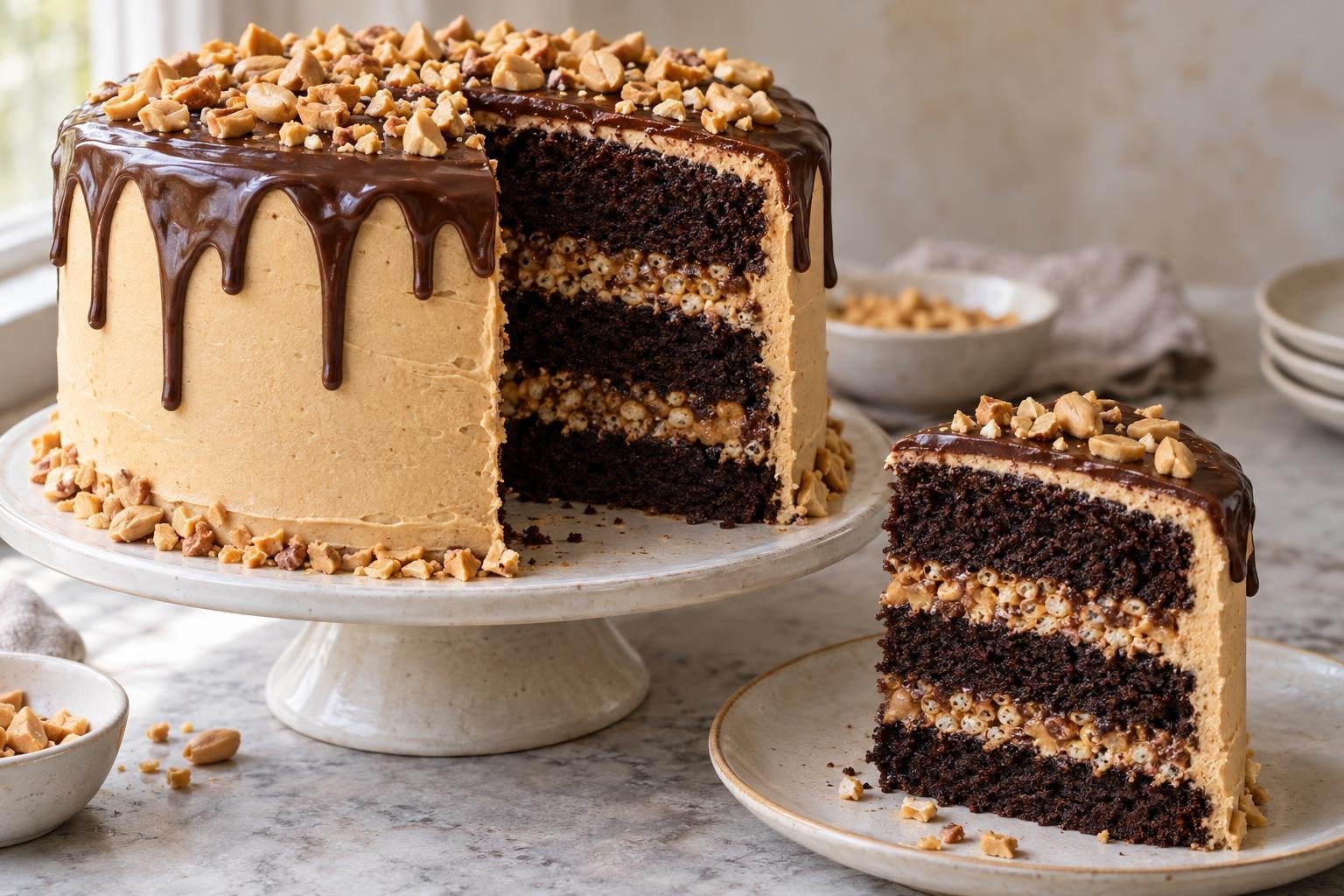
Position a rack in the center of the oven and preheat to 350°F. Grease three 8-inch round cake pans with the 15 g softened butter, line the bottoms with parchment circles, and lightly grease the parchment. Set the pans on a digital scale nearby so the batter can be divided accurately. Properly prepared pans protect the tender chocolate layers from tearing when they are turned out.
Place the all-purpose flour, Dutch-process cocoa, granulated sugar, baking soda, baking powder, and salt in a large mixing bowl. Pass any visibly lumpy cocoa through a fine-mesh sieve, then whisk everything for about 45 seconds. Scrape around the bottom and sides of the bowl as you whisk. The mixture should look uniformly cocoa-colored, with no pale flour streaks or compact lumps of leavening.
In a medium bowl, whisk the eggs, buttermilk, oil, and vanilla until smooth and fully emulsified. Pour the wet mixture into the dry ingredients and whisk from the center outward just until no dry flour remains. Slowly stream in the hot coffee while whisking gently. The finished batter will be thin, glossy, and fluid rather than fluffy. Scrape the bowl with a flexible spatula, checking the bottom for dense cocoa or flour pockets.
Divide the batter equally among the three prepared pans, approximately 465 g per pan, and tap each pan gently on the counter to release large air bubbles. Bake for 25 to 30 minutes, rotating the pans front to back after 20 minutes if the oven heats unevenly. The layers are done when their centers spring back lightly and a skewer emerges with a few moist crumbs but no wet batter.
Set the pans on wire racks and cool the layers in their pans for 15 minutes. Run a thin knife around each edge, invert the cakes onto the racks, remove the parchment, and turn them upright. Let them cool completely for about 75 minutes. Do not stack, trim, or frost warm cake because trapped heat will soften the buttercream and make the delicate layers more likely to split.
Trace two 7-inch circles on parchment and turn the sheets ink-side down on flat trays. Melt the milk chocolate in a dry microwave-safe bowl using 20-second intervals, stirring between each, until smooth. Stir in the 120 g peanut butter and 1 g salt, then fold in the cereal without crushing it. Divide between the circles, press into thin even discs, and refrigerate for 25 to 30 minutes until firm but still cuttable.
Beat the 454 g softened butter in a stand mixer fitted with the paddle attachment on medium speed for 2 minutes, until creamy and free of firm lumps. Add the 450 g peanut butter and beat for 1 minute. Mix in the sifted confectioners’ sugar on low in three additions, alternating with the 90 g cream. Add vanilla and salt, then beat on medium-low for 2 minutes until smooth, spreadable, and able to hold a soft peak.
Place the finely chopped semisweet chocolate in a heatproof bowl. Heat the 120 g heavy cream in a small saucepan until steaming with bubbles appearing around the edge, then pour it over the chocolate. Leave undisturbed for 2 minutes and stir from the center outward until glossy. Cool for 15 to 25 minutes, stirring occasionally, until the ganache flows slowly from a spoon rather than running like warm cream.
Level any pronounced domes with a serrated knife. Place one cake layer on an 8-inch cake board and spread about 180 g frosting over it, leaving the center level. Pipe or spread a slightly raised frosting border around the edge, set one crunch disc inside, and cover it with about 80 g more frosting. Repeat with the second cake and crunch disc, then add the final layer upside down. Check the stack at eye level and refrigerate for 20 minutes.
Apply a thin crumb coat with an offset spatula, chill for 20 minutes, then cover the top and sides with the remaining frosting and smooth with an icing scraper. Chill for another 20 minutes. Test one ganache drip on the back, then spoon ganache around the rim and spread the remainder over the top. Add the chopped peanuts while the ganache is tacky. Chill for 60 minutes, then temper at room temperature for 25 minutes before slicing with a hot, dry knife.