
Table of Contents
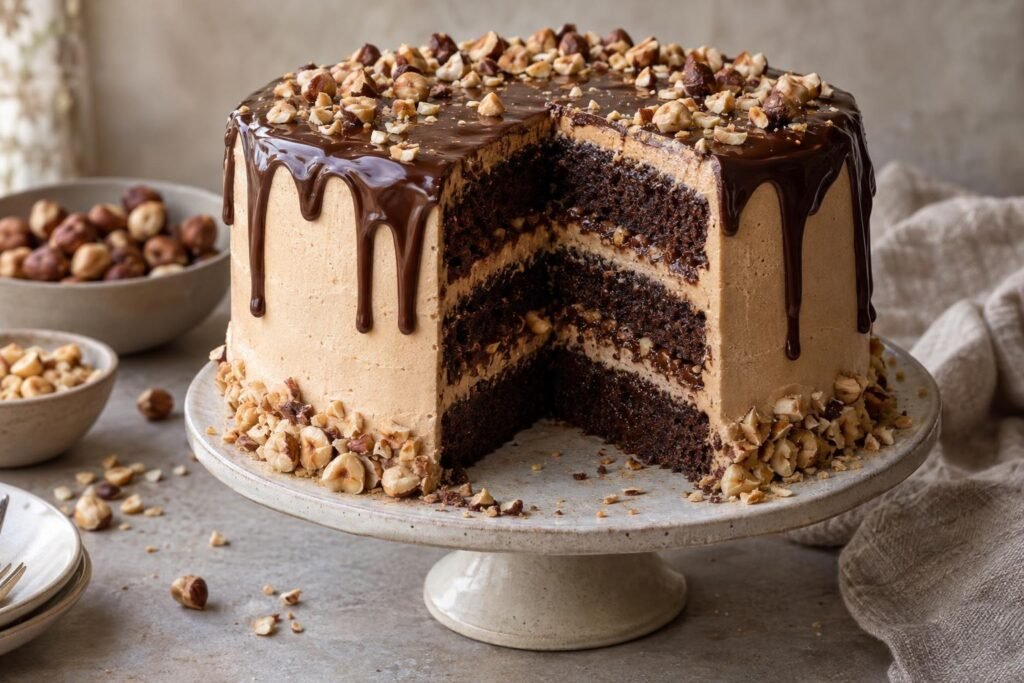
I love the moment when the kitchen fills with the warm aroma of toasted hazelnuts and rich chocolate, signaling something truly special is baking. This chocolate hazelnut praline cake recipe captures that magic by layering tender cocoa sponge with a buttery praline-studded buttercream and a silky ganache center. The subtle hint of coffee deepens the chocolate flavor without stealing the show, while chopped toasted hazelnuts add a satisfying crunch and aroma that make every slice feel like a celebration. Baking this cake feels like wrapping yourself in comfort and elegance all at once, perfect for sharing with loved ones or savoring on a cozy afternoon.

Why You’ll Love this Chocolate Cake
- Coffee deepens chocolate flavor: Hot brewed coffee unlocks the cocoa powder’s roasted complexity, amplifying richness without lending any overt coffee taste, creating a deeply satisfying chocolate base.
- Neutral oil ensures softness: Using canola or grapeseed oil keeps the cake layers tender and moist, maintaining a supple crumb that stays delightful even under chilled buttercream and ganache.
- Fresh hazelnut praline adds authenticity: Toasted hazelnuts caramelized into a glossy paste bring genuine nutty and buttery notes, infusing both buttercream and ganache with natural praline flavor instead of artificial extracts.
- Ganache creates a luscious filling: Combining dark chocolate, cream, and praline paste yields a smooth, stable center that slices cleanly while melting luxuriously on the palate.
- Swiss meringue buttercream balances sweetness: Whipping egg whites with sugar and folding in butterlightens the frosting’s texture, allowing the nuanced caramelized hazelnut flavors to shine without being overwhelmed by sugar.
Ingredient Notes for Chocolate Hazelnut Praline Cake
- Dutch-process cocoa powder: Its mellow acidity and dark color suit the baking soda and baking powder combination in this formula. Sift it with the flour because compact cocoa lumps resist dissolving.
- Hot coffee: Coffee hydrates and blooms the cocoa, making the chocolate taste fuller. Use freshly brewed coffee that is hot but no longer bubbling, since boiling liquid can begin setting the eggs.
- Buttermilk: Its water hydrates the flour while its acidity and milk proteins support tenderness, browning, and balanced leavening. Shake the container before weighing it.
- Neutral oil: Canola, grapeseed, or another mild liquid oil keeps the crumb flexible after refrigeration. Strongly flavored oils would compete with the hazelnut praline.
- Hazelnuts: Toasting drives off moisture and develops roasted flavor before caramel is added. Removing most loose skins prevents the praline from becoming unnecessarily bitter.
- Dark chocolate: Chocolate between 60 and 70 percent cocoa gives the ganache enough structure and bitterness to balance the caramelized praline and sweet cake.
- Egg whites: Cleanly separated whites are essential for a stable Swiss meringue. Even a small amount of yolk fat can delay or prevent proper whipping.
- Unsalted butter: For smooth buttercream, the butter should be pliable but cool, around 18 to 20°C. Greasy or partially melted butter will produce a loose finish.
Golden Rules for The Best Chocolate Hazelnut Praline Cake
- Weigh the batter for level layers: Dividing approximately 520 grams into each pan produces a balanced stack and helps all three cakes finish baking at nearly the same time.
- Let the praline processor do its job: The mixture passes through sandy and clumpy stages before becoming fluid, so scrape the bowl and continue rather than adding oil.
- Read your buttercream’s temperature: Soupy buttercream needs brief chilling, while curdled-looking buttercream is usually too cold and benefits from gently warming the bowl before rewhipping.
- Keep ganache inside the boundary: Leave a narrow gap between the filling and buttercream dam so the upper layer does not force ganache through the sides.
- Use a hot, clean knife: Warm the blade under hot water, dry it thoroughly, and wipe it between cuts to reveal distinct cake, ganache, and buttercream layers.
My Best Tips for Stacking and Decorating a Chocolate Hazelnut Praline Cake
A tall layer cake rewards a little patience. I focus on temperature, even filling, and clean edges so the finished cake feels stable rather than like an engineering emergency covered in buttercream.
- Match the layers before stacking: Arrange the cooled cakes from flattest to most domed, placing the sturdiest layer on the bottom and trimming only pronounced crowns.
- Build a proper buttercream dam: Pipe a continuous ring around each layer before adding ganache, with no gaps where the softer filling could escape under pressure.
- Check the cake from eye level: Rotate the turntable and look across the top after adding each layer; correcting a tilt early is easier than hiding it later.
- Chill the crumb coat until firm: The buttercream should feel dry and solid when lightly touched, which prevents crumbs and filling from dragging through the final coat.
- Control the ganache drip temperature: Use ganache that flows slowly from a spoon and test one drip on the back before committing to the visible side.
Straight sides are lovely, but stability and a clean slice matter more. Keep the cake cool, work deliberately, and let the toasted hazelnuts provide the effortless sparkle.
Ingredients for Chocolate Hazelnut Praline Cake
- 285 g all-purpose flour (spooned and leveled if measuring by volume)
- 75 g Dutch-process cocoa powder (sifted)
- 350 g granulated sugar (for the chocolate cake layers)
- 10 g baking soda (2 teaspoons)
- 4 g baking powder (1 teaspoon)
- 5 g fine sea salt (1 teaspoon, for the cake layers)
- 150 g large eggs (3 large eggs, at room temperature)
- 270 g buttermilk (at room temperature)
- 180 g neutral oil (such as canola or grapeseed oil)
- 10 g pure vanilla extract (2 teaspoons, for the cake layers)
- 240 g hot brewed coffee (hot but not boiling)
- 250 g raw hazelnuts (divided between praline and decoration)
- 130 g granulated sugar (for the hazelnut praline)
- 35 g water (for the caramel)
- 2 g fine sea salt (divided between the praline and ganache)
- 200 g dark chocolate (60 to 70 percent cocoa, finely chopped)
- 160 g heavy cream (for the praline ganache)
- 180 g egg whites (about 6 large whites)
- 300 g granulated sugar (for the Swiss meringue buttercream)
- 450 g unsalted butter (cubed and pliable but cool, about 18 to 20°C)
- 5 g pure vanilla extract (1 teaspoon, for the buttercream)
- 2 g fine sea salt (for the buttercream)
How to Make Chocolate Hazelnut Praline Cake
- STEP 1). Prepare the pans and toast the hazelnuts Position a rack in the center of the oven and preheat it to 175°C. Grease three 8-inch round cake pans, line the bottoms with parchment, and lightly grease the parchment. Spread the hazelnuts on a rimmed baking sheet and toast for 9 to 12 minutes, shaking once, until fragrant and golden beneath their skins. Wrap them in a clean towel for 5 minutes, rub away the loose skins, then reserve 70 grams for decorating and keep 180 grams for the praline.
- STEP 2). Make the hazelnut praline paste Line the baking sheet with parchment. Combine 130 grams sugar and 35 grams water in a clean heavy-bottomed saucepan, stirring only before it boils. Cook over medium heat without further stirring until the syrup turns a deep amber, about 6 to 9 minutes. Immediately pour it over the 180 grams toasted hazelnuts and cool until hard, about 25 minutes. Break into pieces and process with 1 gram salt for 8 to 12 minutes, scraping frequently, until fluid, glossy, and warm. Weigh 240 grams for buttercream and 80 grams for ganache.
- STEP 3). Combine the cake’s dry ingredients Keep the oven at 175°C. Place the flour, cocoa powder, 350 grams sugar, baking soda, baking powder, and 5 grams salt in a large mixing bowl. Whisk thoroughly for at least 30 seconds, reaching into the bottom and sides so the leaveners are evenly distributed. Break up any remaining cocoa or sugar pockets with the whisk. Uniform dry mixing matters in this thin batter because an isolated clump of baking soda can leave a bitter spot or create uneven rising.
- STEP 4). Mix the chocolate cake batter In a second bowl, whisk the eggs, buttermilk, oil, and 10 grams vanilla until smooth and fully emulsified. Pour the wet mixture into the dry ingredients and whisk gently from the center outward until no dry flour remains, about 45 seconds. Slowly add the hot coffee while whisking on low speed or by hand. The batter will be thin and glossy; stop once its color is even and scrape the bowl with a flexible spatula. Extended mixing at this stage can make the crumb unnecessarily springy.
- STEP 5). Divide and bake the cake layers Divide the batter evenly among the prepared pans, approximately 520 grams per pan, and tap each pan once on the counter to release large air pockets. Bake all three on the center rack for 28 to 34 minutes, rotating their positions after 22 minutes only if the oven browns unevenly. The cakes are done when their centers spring back lightly, a tester shows moist crumbs without liquid batter, and the edges just begin pulling from the pans. Avoid baking until the tester is completely dry.
- STEP 6). Cool and release the layers Set the pans on wire racks and cool the cakes in them for 15 minutes. Run a thin offset spatula around each edge without cutting into the crumb, invert onto the racks, and remove the parchment. Turn the layers upright and cool completely for 60 to 90 minutes before trimming or stacking. Warm layers soften buttercream and trap steam, so check the center and underside rather than judging only by the cool outer edge. Once cool, trim prominent domes with a serrated knife if necessary.
- STEP 7). Prepare the praline chocolate ganache Place the chopped dark chocolate in a heatproof bowl. Heat the cream in a small saucepan over medium heat until steaming and bubbling only around the edge, then pour it over the chocolate. Leave undisturbed for 2 minutes before stirring from the center outward until glossy. Mix in 80 grams praline paste and the remaining 1 gram salt. Reserve about 100 grams for the drip, then let both portions stand until thick and spreadable, stirring occasionally. Refrigerate briefly if the ganache remains runny after 30 minutes.
- STEP 8). Whip the praline Swiss meringue buttercream Combine the egg whites and 300 grams sugar in the clean mixer bowl over barely simmering water, keeping the bowl above the water. Whisk constantly until the sugar dissolves and the mixture reaches 71°C. Transfer to the mixer and whip on high until a stiff, glossy meringue forms and the bowl feels neutral, about 8 to 12 minutes. Switch to the paddle and add butter gradually on medium speed. Beat until smooth, then mix in 240 grams praline paste, vanilla, and 2 grams salt. Continue slowly for 2 minutes to remove large air pockets.
- STEP 9). Fill, stack, and crumb coat the cake Secure one cake layer to an 8-inch board with a dab of buttercream. Spread about 100 grams buttercream over it, then pipe a raised buttercream dam around the edge. Add half the filling portion of ganache inside the dam and level it without pressing outward. Repeat with the second layer, then place the final layer cut side down. Check that the stack is level, apply a thin buttercream crumb coat over the top and sides, and refrigerate for 30 minutes until the coating feels firm and no longer tacky.
- STEP 10). Finish the buttercream and ganache decoration Apply the remaining buttercream to the chilled cake with an offset spatula, then smooth the sides with a bench scraper while rotating the turntable. Chill for 20 minutes. Gently warm the reserved ganache over barely warm water until it falls slowly from a spoon; it should not feel hot. Test one drip on the back of the cake, then pipe or spoon drips around the edge and spread a thin layer over the top. Roughly chop the reserved 70 grams hazelnuts, press some around the base, and scatter the rest on top.
Storage and Freezing
- Refrigeration: Store the assembled cake in a covered cake carrier in the refrigerator for up to 4 days. Keep cut surfaces covered with parchment or plastic wrap to limit drying.
- Freezing: Freeze unfrosted cake layers, individually wrapped in plastic and foil, for up to 2 months. The completed cake may be frozen in a rigid airtight container for up to 1 month, although the decorative ganache may lose some shine.
- Thawing: Thaw wrapped cake layers overnight in the refrigerator before unwrapping.
- Thaw the completed cake overnight in its container in the refrigerator to reduce surface condensation.
- Serving: For softer buttercream and fuller chocolate flavor, let refrigerated slices stand at room temperature for 30 to 45 minutes. Do not leave the cake at room temperature longer than 2 hours.
Frequently Asked Questions
Why did my chocolate cake layers sink in the middle?
Sunken centers usually indicate underbaking, inaccurate leavener measurement, or an oven door opened before the structure had set. The center should spring back and a tester should carry moist crumbs, not glossy batter.
Weigh the batter evenly, verify the oven temperature, and avoid vigorous mixing after adding flour. Excess aeration can make the layers rise dramatically before their crumb is strong enough to remain elevated.
How do I fix Swiss meringue buttercream that looks curdled or soupy?
Curdled buttercream is generally too cold. Warm the outside of the mixer bowl briefly over steaming water or with a warm towel, then beat with the paddle until the emulsion becomes smooth.
Soupy buttercream is too warm. Refrigerate the bowl for 10 to 15 minutes, then beat again. Add no extra butter until temperature correction has had time to work.
What texture should homemade hazelnut praline paste have?
Finished praline should be glossy, fluid, and similar to loose nut butter while warm. It first becomes crumbs, then a thick clump, before the hazelnuts release enough oil to form a paste.
A gritty result usually needs more processing. Stop periodically to scrape the bowl and prevent overheating, but avoid adding liquid because water can seize caramel and shorten the filling’s stability.
Does the coffee make chocolate hazelnut praline cake taste like coffee?
The brewed coffee primarily deepens the cocoa’s roasted flavor, while dark chocolate and hazelnut praline remain dominant. Its bitterness also helps balance the sugar in the cake and frosting.
Use regular or decaffeinated coffee with a medium or dark roast. Very strongly flavored coffee may become noticeable, so avoid flavored brews containing vanilla, spices, or sweeteners.
Can I make this chocolate hazelnut praline cake ahead of time?
The cake layers and praline can be prepared two days before assembly. Wrap cooled layers tightly and refrigerate them, then keep the praline paste in an airtight container at cool room temperature.
The buttercream and ganache may be made one day ahead and refrigerated. Bring both back to workable temperature, rewhip the buttercream, and stir the ganache gently before filling and decorating.
More Ridiculously Delicious Cakes
- Chocolate Streusel Coffee Cake with Soft, Tender Crumb
- Chocolate Sour Cream Bundt Cake with a Moist Crumb
- Chocolate Fudge Birthday Cake With Whipped Ganache
- Rich Chocolate Orange Truffle Cake Recipe with Silky Ganache
- Chocolate Snack Cake for an Everyday Pan Cake
Chocolate Hazelnut Praline Cake Recipe
Ingredients
Equipment
Method
- Position a rack in the center of the oven and preheat it to 175°C. Grease three 8-inch round cake pans, line the bottoms with parchment, and lightly grease the parchment. Spread the hazelnuts on a rimmed baking sheet and toast for 9 to 12 minutes, shaking once, until fragrant and golden beneath their skins. Wrap them in a clean towel for 5 minutes, rub away the loose skins, then reserve 70 grams for decorating and keep 180 grams for the praline.
- Line the baking sheet with parchment. Combine 130 grams sugar and 35 grams water in a clean heavy-bottomed saucepan, stirring only before it boils. Cook over medium heat without further stirring until the syrup turns a deep amber, about 6 to 9 minutes. Immediately pour it over the 180 grams toasted hazelnuts and cool until hard, about 25 minutes. Break into pieces and process with 1 gram salt for 8 to 12 minutes, scraping frequently, until fluid, glossy, and warm. Weigh 240 grams for buttercream and 80 grams for ganache.
- Keep the oven at 175°C. Place the flour, cocoa powder, 350 grams sugar, baking soda, baking powder, and 5 grams salt in a large mixing bowl. Whisk thoroughly for at least 30 seconds, reaching into the bottom and sides so the leaveners are evenly distributed. Break up any remaining cocoa or sugar pockets with the whisk. Uniform dry mixing matters in this thin batter because an isolated clump of baking soda can leave a bitter spot or create uneven rising.
- In a second bowl, whisk the eggs, buttermilk, oil, and 10 grams vanilla until smooth and fully emulsified. Pour the wet mixture into the dry ingredients and whisk gently from the center outward until no dry flour remains, about 45 seconds. Slowly add the hot coffee while whisking on low speed or by hand. The batter will be thin and glossy; stop once its color is even and scrape the bowl with a flexible spatula. Extended mixing at this stage can make the crumb unnecessarily springy.
- Divide the batter evenly among the prepared pans, approximately 520 grams per pan, and tap each pan once on the counter to release large air pockets. Bake all three on the center rack for 28 to 34 minutes, rotating their positions after 22 minutes only if the oven browns unevenly. The cakes are done when their centers spring back lightly, a tester shows moist crumbs without liquid batter, and the edges just begin pulling from the pans. Avoid baking until the tester is completely dry.
- Set the pans on wire racks and cool the cakes in them for 15 minutes. Run a thin offset spatula around each edge without cutting into the crumb, invert onto the racks, and remove the parchment. Turn the layers upright and cool completely for 60 to 90 minutes before trimming or stacking. Warm layers soften buttercream and trap steam, so check the center and underside rather than judging only by the cool outer edge. Once cool, trim prominent domes with a serrated knife if necessary.
- Place the chopped dark chocolate in a heatproof bowl. Heat the cream in a small saucepan over medium heat until steaming and bubbling only around the edge, then pour it over the chocolate. Leave undisturbed for 2 minutes before stirring from the center outward until glossy. Mix in 80 grams praline paste and the remaining 1 gram salt. Reserve about 100 grams for the drip, then let both portions stand until thick and spreadable, stirring occasionally. Refrigerate briefly if the ganache remains runny after 30 minutes.
- Combine the egg whites and 300 grams sugar in the clean mixer bowl over barely simmering water, keeping the bowl above the water. Whisk constantly until the sugar dissolves and the mixture reaches 71°C. Transfer to the mixer and whip on high until a stiff, glossy meringue forms and the bowl feels neutral, about 8 to 12 minutes. Switch to the paddle and add butter gradually on medium speed. Beat until smooth, then mix in 240 grams praline paste, vanilla, and 2 grams salt. Continue slowly for 2 minutes to remove large air pockets.
- Secure one cake layer to an 8-inch board with a dab of buttercream. Spread about 100 grams buttercream over it, then pipe a raised buttercream dam around the edge. Add half the filling portion of ganache inside the dam and level it without pressing outward. Repeat with the second layer, then place the final layer cut side down. Check that the stack is level, apply a thin buttercream crumb coat over the top and sides, and refrigerate for 30 minutes until the coating feels firm and no longer tacky.
- Apply the remaining buttercream to the chilled cake with an offset spatula, then smooth the sides with a bench scraper while rotating the turntable. Chill for 20 minutes. Gently warm the reserved ganache over barely warm water until it falls slowly from a spoon; it should not feel hot. Test one drip on the back of the cake, then pipe or spoon drips around the edge and spread a thin layer over the top. Roughly chop the reserved 70 grams hazelnuts, press some around the base, and scatter the rest on top.
Notes
- Weigh the batter for level layers: Dividing approximately 520 grams into each pan produces a balanced stack and helps all three cakes finish baking at nearly the same time.
- Let the praline processor do its job: The mixture passes through sandy and clumpy stages before becoming fluid, so scrape the bowl and continue rather than adding oil.
- Read your buttercream’s temperature: Soupy buttercream needs brief chilling, while curdled-looking buttercream is usually too cold and benefits from gently warming the bowl before rewhipping.
- Keep ganache inside the boundary: Leave a narrow gap between the filling and buttercream dam so the upper layer does not force ganache through the sides.
- Use a hot, clean knife: Warm the blade under hot water, dry it thoroughly, and wipe it between cuts to reveal distinct cake, ganache, and buttercream layers.



