Table of Contents
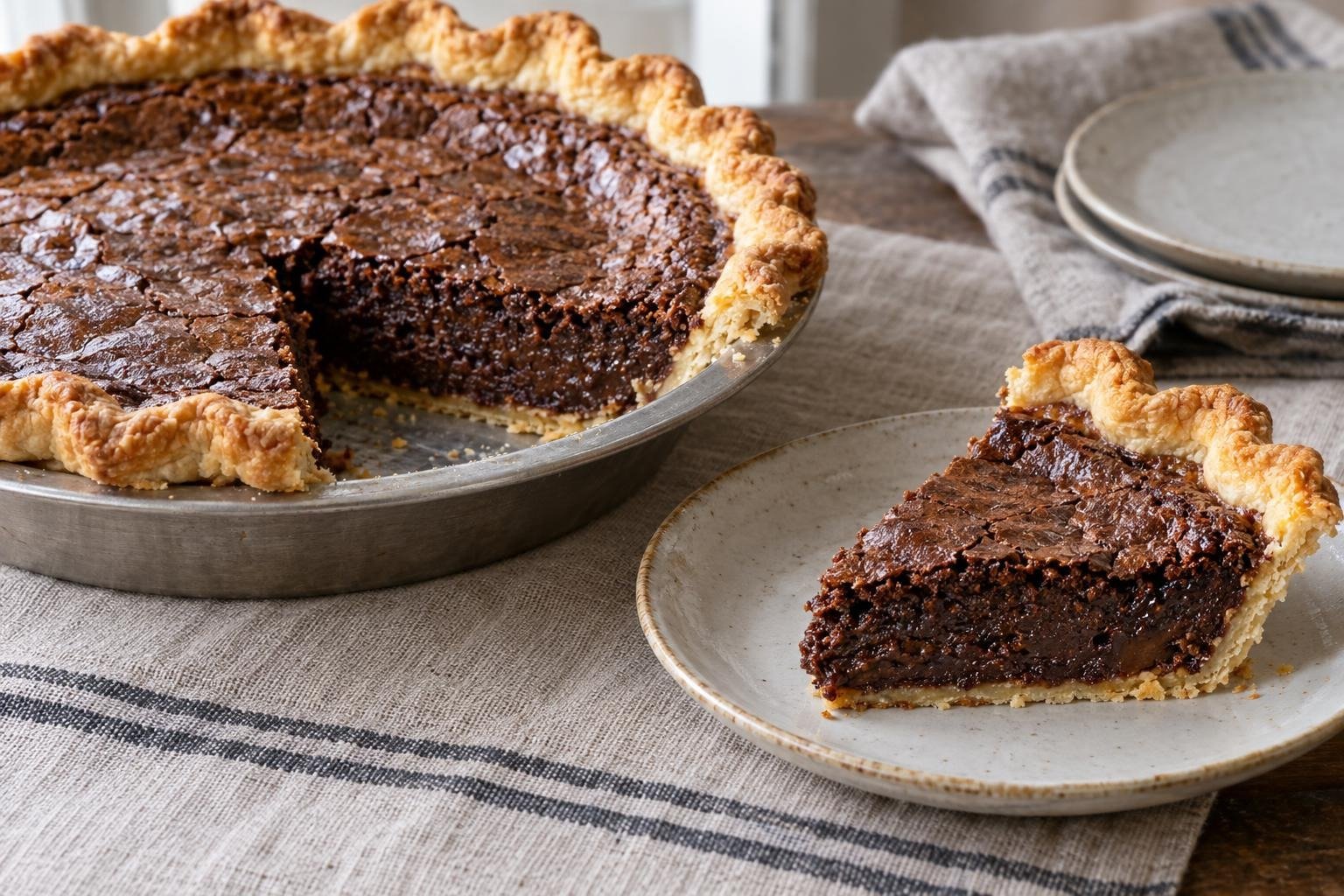
A delicate crackled top gives way to a dark, fudgy center, while the golden butter crust stays crisp beneath the rich cocoa filling. This chocolate chess pie balances deep chocolate flavor with the characteristic sweetness and softly chewy structure of a traditional chess pie, creating clean slices that remain creamy rather than runny.
I fully blind-bake the pastry before adding the filling because a wet cocoa custard does an excellent job of finding every underbaked patch in a crust. For the filling, I whisk only until smooth rather than aerated, then bake until the edges are puffed and the center wobbles as one cohesive section. The pie finishes setting as it cools, so patience is doing real structural work here.
Why You’ll Love this Chocolate Pie
- A fully blind-baked pastry shell develops its structure before the liquid filling is added, which helps prevent a pale, soggy bottom.
- Cold butter remains in distinct pieces throughout the dough, producing steam in the oven and creating a tender, flaky crust.
- Natural cocoa powder disperses into melted butter first, reducing dry cocoa pockets and giving the filling an even chocolate flavor.
- Eggs provide the primary custard structure, while small amounts of flour and cornmeal absorb moisture and reinforce sliceability without making the filling cakey.
- Cooling the baked pie for at least four hours allows the egg proteins, starches, melted butter, and dissolved sugar to settle into a cohesive filling.
Ingredient Notes for Chocolate Chess Pie with a Tender Pastry Crust
- All-purpose flour: Flour gives the pastry enough protein to hold its shape and provides supplemental starch in the filling. Measure by weight when possible, and avoid packing it into the cup.
- Unsalted butter: Very cold butter creates flaky pastry, while melted butter carries cocoa evenly through the filling. Using unsalted butter lets me control the seasoning in both components.
- Natural cocoa powder: Natural unsweetened cocoa supplies concentrated chocolate flavor without adding more fat or sugar. Sift it if it is visibly lumpy because dry cocoa pockets are difficult to remove once the eggs are incorporated.
- Granulated sugar: Sugar provides the characteristic sweetness, glossy surface, and dense texture associated with chess pie. Whisk it thoroughly into the warm cocoa mixture, but do not attempt to dissolve every crystal.
- Eggs: Whole eggs set the filling as their proteins coagulate in the oven. Room-temperature eggs blend into the butter mixture more readily and reduce the risk of greasy separation.
- Evaporated milk: Its concentrated milk solids add body and a mild cooked-dairy flavor without introducing as much water as regular milk. This recipe uses unsweetened evaporated milk, not sweetened condensed milk.
- Fine yellow cornmeal: Cornmeal is a traditional chess pie thickener that absorbs moisture and contributes a subtle, pleasantly substantial finish. Fine cornmeal hydrates more evenly than coarse cornmeal in this smooth filling.
My Baking Tips
- Use a metal pie plate rather than a deep ceramic dish. Metal transfers heat quickly to the pastry bottom, and this filling is sized for a standard 9-inch plate.
- Fill the parchment all the way to the crust edge with pie weights. Sparse weights allow the sides to slump before the butter melts and the pastry structure sets.
- Keep the blind-baked shell on its baking sheet when adding the filling. This supports the hot pastry, catches drips, and makes transferring the fluid-filled pie safer.
- Whisk the eggs gently rather than beating the filling until foamy. Excess air can produce a thick, fragile top and an unevenly puffed custard.
- Judge doneness by movement, not surface cracks alone. The center must wobble as one section; loose ripples indicate that the custard needs additional baking time.
Ingredients for Chocolate Chess Pie
- 1 1/3 (160 g) cups all-purpose flour (For the pastry, plus a small amount for rolling)
- 1 teaspoon granulated sugar (For the pastry)
- 1/2 teaspoon fine salt (For the pastry)
- 1/2 (113 g) cup unsalted butter (Very cold and cut into 1/2-inch cubes)
- 4 (60 ml) tablespoons ice water (Add gradually; the dough may not require the final tablespoon)
- 6 (85 g) tablespoons unsalted butter (Melted and cooled until warm, not hot)
- 1/3 (30 g) cup natural unsweetened cocoa powder (Sifted if lumpy)
- 1 1/4 (250 g) cups granulated sugar (For the filling)
- 1 (8 g) tablespoon all-purpose flour (For the filling)
- 1 (9 g) tablespoon fine yellow cornmeal (Not coarse or self-rising cornmeal mix)
- 1/4 teaspoon fine salt (For the filling)
- 3 large eggs (At room temperature)
- 1/2 (120 ml) cup evaporated milk (Unsweetened and at room temperature)
- 2 teaspoons pure vanilla extract (Stir into the filling last)
How to Make Chocolate Chess Pie
- STEP 1). Make and chill the pastry dough Whisk the 160 g flour, 1 teaspoon sugar, and 1/2 teaspoon salt in a large bowl. Add the cold cubed butter and flatten it into irregular flakes with your fingertips or a pastry blender, stopping when the largest pieces are about the size of almonds. Drizzle in 3 tablespoons ice water and toss with a fork. Add the remaining water only if dry flour remains. Press the shaggy dough into a disk, wrap it, and refrigerate for 45 minutes.
- STEP 2). Roll and fit the crust Lightly flour the counter and roll the chilled dough into a 12-inch circle about 1/8 inch thick, rotating it frequently to prevent sticking. Transfer it to a 9-inch metal pie plate without stretching the dough, then ease it firmly into the bottom and corners. Trim the overhang to 1 inch, fold it under, and crimp the edge. Prick the bottom several times with a fork, then refrigerate the shaped shell for 15 minutes while the oven heats to 400°F.
- STEP 3). Fully blind-bake the pastry shell Set the chilled shell on a rimmed baking sheet. Line it with crumpled parchment, fill it completely with pie weights, and bake on the lower-middle oven rack at 400°F for 18 minutes. Lift out the parchment and weights carefully, then bake for 7 to 10 minutes more. The bottom should look dry and lightly golden, not pale or translucent. Cool the shell on its baking sheet for 10 minutes, reduce the oven to 350°F, and keep the rack in place.
- STEP 4). Mix the chocolate chess filling Whisk the warm melted butter and sifted cocoa in a medium bowl until glossy and free of dry pockets. In a large bowl, whisk the 250 g sugar, 8 g flour, cornmeal, and 1/4 teaspoon salt until evenly distributed. Add the cocoa-butter mixture and whisk to a thick paste. Incorporate the eggs one at a time without whipping in excess air, then whisk in the evaporated milk and vanilla. Stop when the filling is fluid, dark, and completely uniform.
- STEP 5). Fill and bake the pie Pour the filling into the warm blind-baked crust and use a spatula to scrape the bowl thoroughly. Bake the pie on its rimmed baking sheet at 350°F for 35 to 42 minutes, shielding the crust edge with foil if it darkens too quickly. The outer 2 inches should be puffed and set, while the center should wobble together like soft gelatin rather than ripple like liquid. An instant-read thermometer inserted near the center should register approximately 175°F to 180°F.
- STEP 6). Cool until fully set Transfer the pie plate to a wire rack and leave the pie undisturbed at room temperature for at least 4 hours. The puffed filling will settle slightly, and its thin crackled surface may develop small fissures as it cools. This is characteristic of chess pie, not a defect. Do not refrigerate the pie while it is still hot because trapped condensation can dampen the crust. The center should feel set and the pie plate should be completely cool before slicing.
- STEP 7). Slice and serve cleanly For neat portions, wipe a thin, sharp knife between cuts and slice the fully cooled pie into 10 wedges. Serve at room temperature for the creamiest texture, or chill the pie for 30 minutes first if especially sharp edges are wanted. Avoid adding warm toppings, which can soften the crackled surface and pastry crust.
Storage and Freezing
- Storage: Cover the completely cooled pie and refrigerate it for up to 4 days. Keep it in the pie plate so the filling remains supported.
- Freezing: Freeze the cooled pie whole or in individual wedges for up to 1 month. Wrap it securely in plastic wrap, then place it in an airtight container to limit freezer odors and crust damage.
- Thawing: Unwrap the frozen pie and thaw it overnight in the refrigerator. Removing the wrapping prevents condensation from collecting against the surface.
- Serving: Let refrigerated slices stand at room temperature for 20 to 30 minutes for a softer, creamier filling. Do not leave the pie at room temperature for longer than 2 hours after its initial cooling period.
Frequently Asked Questions
Why does chocolate chess pie sometimes have a soggy bottom?
A soggy bottom usually results from adding the liquid filling to a pale, partially baked shell. The weighted crust needs an additional uncovered bake until its base looks dry and lightly golden.
A metal pie plate and lower-middle oven rack also improve heat transfer beneath the pastry. Keep the shell on a preheated baking path without placing it over an insulating silicone mat.
How do I know when chocolate chess pie is finished baking?
The perimeter should appear puffed and stable, while the center moves as one soft, cohesive section when the baking sheet is nudged. Liquid-looking ripples mean the eggs and starches have not set sufficiently.
Small surface cracks are normal but are not a reliable endpoint by themselves. If using an instant-read thermometer, aim for approximately 175°F to 180°F near the center without touching the bottom crust.
What makes a chess pie filling set properly?
Whole eggs form the main custard network as they heat, while flour and fine cornmeal absorb free moisture and reinforce the filling. The measured balance matters because too much thickener would turn the center cakey or gritty.
The filling continues firming as melted butter cools and the hydrated starches settle. Cutting it hot interrupts that process, leaving a soft center even when the pie was baked correctly.
Should chocolate chess pie be refrigerated before slicing?
Room-temperature cooling for at least four hours is the essential first step. This gives the filling time to finish setting while allowing steam to escape, which protects the crust from condensation.
Refrigeration is optional for the first serving, although 30 minutes of chilling can make exceptionally sharp slices. Once served, cover and refrigerate the remaining egg-based pie within two hours.
Can I use sweetened condensed milk instead of evaporated milk?
Sweetened condensed milk is not suitable as a direct replacement because it contributes a large amount of sugar and far less free water. That change would alter the sweetness, viscosity, baking time, and final custard structure.
Use unsweetened evaporated milk for the intended balance. Check the can carefully because the two products are commonly sold beside each other but perform very differently in a chocolate chess pie recipe.
More Ridiculously Delicious Pies & Tarts
- Chocolate Hazelnut Cream Pie with Golden Pastry
- Raspberry Chocolate Tart with Silky Ganache
- Lemon Chess Pie with Golden Pastry
- Salted Caramel Apple Pie with Golden Pastry
- Pear Cranberry Pie with a Buttery Crust
Chocolate Chess Pie with a Tender Pastry Crust
Ingredients
Equipment
Method
- Whisk the 160 g flour, 1 teaspoon sugar, and 1/2 teaspoon salt in a large bowl. Add the cold cubed butter and flatten it into irregular flakes with your fingertips or a pastry blender, stopping when the largest pieces are about the size of almonds. Drizzle in 3 tablespoons ice water and toss with a fork. Add the remaining water only if dry flour remains. Press the shaggy dough into a disk, wrap it, and refrigerate for 45 minutes.
- Lightly flour the counter and roll the chilled dough into a 12-inch circle about 1/8 inch thick, rotating it frequently to prevent sticking. Transfer it to a 9-inch metal pie plate without stretching the dough, then ease it firmly into the bottom and corners. Trim the overhang to 1 inch, fold it under, and crimp the edge. Prick the bottom several times with a fork, then refrigerate the shaped shell for 15 minutes while the oven heats to 400°F.
- Set the chilled shell on a rimmed baking sheet. Line it with crumpled parchment, fill it completely with pie weights, and bake on the lower-middle oven rack at 400°F for 18 minutes. Lift out the parchment and weights carefully, then bake for 7 to 10 minutes more. The bottom should look dry and lightly golden, not pale or translucent. Cool the shell on its baking sheet for 10 minutes, reduce the oven to 350°F, and keep the rack in place.
- Whisk the warm melted butter and sifted cocoa in a medium bowl until glossy and free of dry pockets. In a large bowl, whisk the 250 g sugar, 8 g flour, cornmeal, and 1/4 teaspoon salt until evenly distributed. Add the cocoa-butter mixture and whisk to a thick paste. Incorporate the eggs one at a time without whipping in excess air, then whisk in the evaporated milk and vanilla. Stop when the filling is fluid, dark, and completely uniform.
- Pour the filling into the warm blind-baked crust and use a spatula to scrape the bowl thoroughly. Bake the pie on its rimmed baking sheet at 350°F for 35 to 42 minutes, shielding the crust edge with foil if it darkens too quickly. The outer 2 inches should be puffed and set, while the center should wobble together like soft gelatin rather than ripple like liquid. An instant-read thermometer inserted near the center should register approximately 175°F to 180°F.
- Transfer the pie plate to a wire rack and leave the pie undisturbed at room temperature for at least 4 hours. The puffed filling will settle slightly, and its thin crackled surface may develop small fissures as it cools. This is characteristic of chess pie, not a defect. Do not refrigerate the pie while it is still hot because trapped condensation can dampen the crust. The center should feel set and the pie plate should be completely cool before slicing.
- For neat portions, wipe a thin, sharp knife between cuts and slice the fully cooled pie into 10 wedges. Serve at room temperature for the creamiest texture, or chill the pie for 30 minutes first if especially sharp edges are wanted. Avoid adding warm toppings, which can soften the crackled surface and pastry crust.
Notes
- Use a metal pie plate rather than a deep ceramic dish. Metal transfers heat quickly to the pastry bottom, and this filling is sized for a standard 9-inch plate.
- Fill the parchment all the way to the crust edge with pie weights. Sparse weights allow the sides to slump before the butter melts and the pastry structure sets.
- Keep the blind-baked shell on its baking sheet when adding the filling. This supports the hot pastry, catches drips, and makes transferring the fluid-filled pie safer.
- Whisk the eggs gently rather than beating the filling until foamy. Excess air can produce a thick, fragile top and an unevenly puffed custard.
- Judge doneness by movement, not surface cracks alone. The center must wobble as one section; loose ripples indicate that the custard needs additional baking time.