Table of Contents
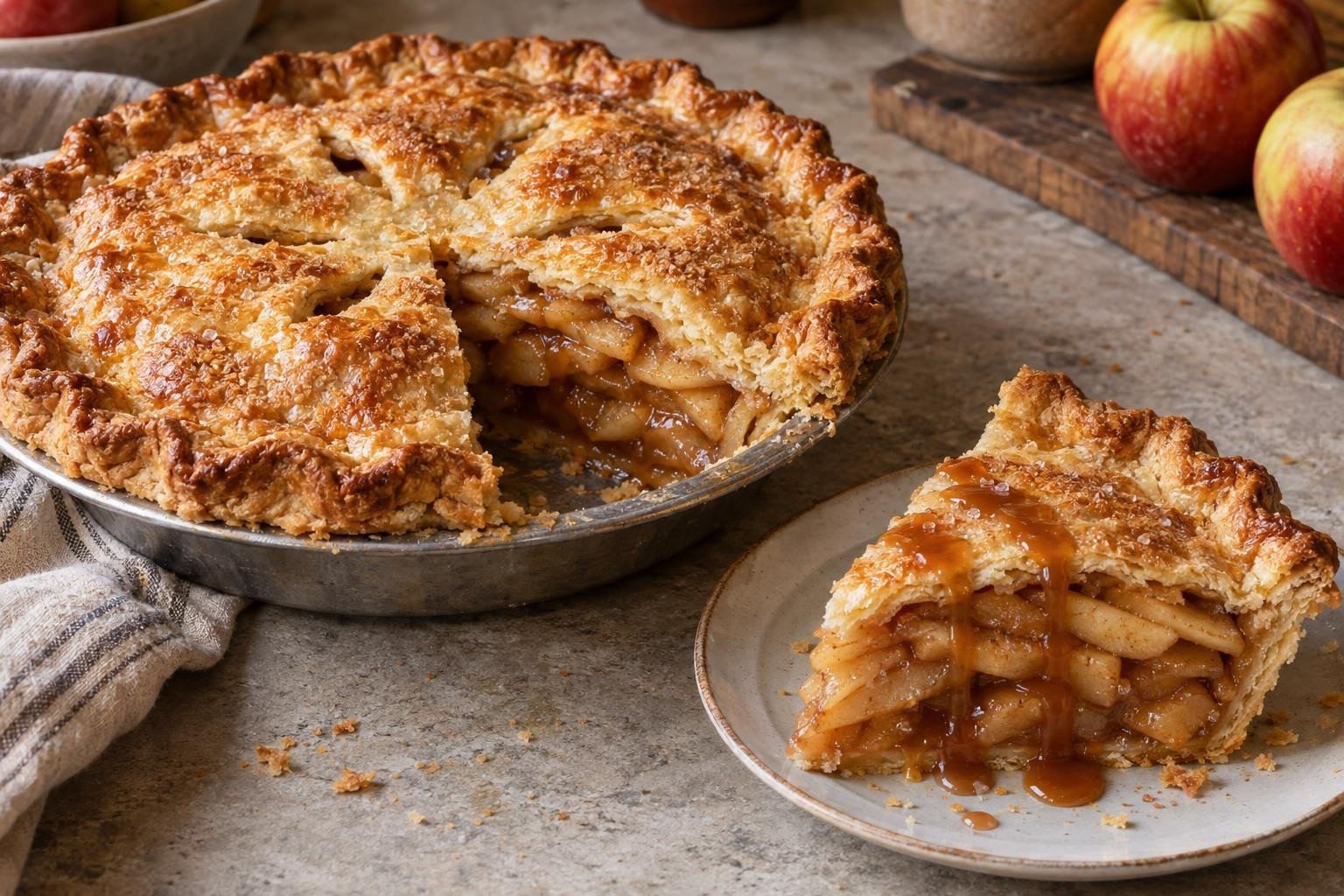
Deep-golden pastry shatters around tender cinnamon apples, while buttery caramel adds a toasted-sugar finish and a distinct pop of salt. This salted caramel apple pie balances tart and sweet apples so the filling tastes layered rather than sugary, and the thickened juices stay around the fruit instead of flooding the plate. A final caramel drizzle adds gloss and a pleasantly sticky contrast to the crisp crust.
I cook the apple filling before it enters the pastry, which lets me remove excess moisture, activate the cornstarch, and judge the fruit by sight and touch. The slices should bend without collapsing, and their juices should look glossy rather than watery. A hot metal baking sheet gives the bottom crust an immediate burst of heat, while a full four-hour cooling period allows the caramel and starch network to set before slicing.
This Is Why You’ll Love this Apple Pie
- Precooking the apples releases their excess juice before the pie is assembled, reducing the risk of a watery center and the large air gap that raw apples can create beneath the top crust.
- Cornstarch thickens the apple juices as they simmer, so the filling is already glossy and cohesive before it reaches the oven instead of relying entirely on residual baking heat.
- The wet caramel method dissolves the sugar evenly, while warmed cream limits abrupt temperature changes when it is added to the hot syrup.
- A preheated metal baking sheet transfers strong heat directly to the pie pan, helping the all-butter bottom crust brown before the fruit filling can soften it.
- Cooling the baked pie for at least four hours gives the starch, caramel, and concentrated apple pectin time to form a filling that holds defined slices.
Ingredient Notes for Salted Caramel Apple Pie with Golden Pastry
- All-purpose flour: Its moderate protein content gives the pastry enough structure to support the heavy apple filling without making the crust tough. Weigh it when possible and avoid packing it into measuring cups.
- Unsalted butter: Cold butter creates flaky pastry layers as its water turns to steam. Keep the crust butter refrigerated until mixing; the butter used for caramel can be cool because it is whisked into hot syrup.
- Ice water: Cold water hydrates the flour without prematurely melting the butter. Add only enough to make the dough hold together when squeezed, since excess water encourages gluten development and shrinkage.
- Granulated sugar: This forms the caramel base. A small amount of water allows the sugar to dissolve and cook evenly, but stirring after boiling begins can encourage crystallization.
- Heavy cream: Cream softens the cooked sugar into a pourable caramel and contributes dairy fat for a smooth mouthfeel. Warm it before adding it because cold cream can make the caramel seize aggressively.
- Firm baking apples: A roughly equal mixture of tart Granny Smith and sweeter Honeycrisp apples provides acidity, aroma, and slices that retain their shape. Other firm tart and sweet baking apples can be combined, but soft or mealy varieties may collapse.
- Cornstarch: This thickener captures the apple juice during precooking and baking. Cook until the liquid bubbles and turns translucent, since an opaque, chalky sauce indicates that the starch has not fully gelatinized.
- Fine sea salt: Salt in the pastry seasons the flour and butter, while salt in the caramel tempers sweetness and sharpens its toasted flavor. Fine crystals disperse more consistently than coarse salt in both components.
- Egg wash and turbinado sugar: Egg promotes deep, even browning on the top crust, and coarse sugar adds a crisp finish. Keep the wash on the exposed pastry rather than letting it pool around the pan rim.
My Tips for the Best Results
- Keep both pastry disks cold but pliable. If the dough cracks immediately when rolled, let it stand for 5 minutes; if the butter begins to look shiny or soft, refrigerate it before continuing.
- Slice the apples to an even 1/4-inch thickness so they soften at a similar rate. Very thin pieces turn into applesauce, while thick wedges can remain crunchy after the crust is fully browned.
- Watch the caramel rather than relying only on a timer. Remove it when it reaches a deep amber shade and smells toasted; a very dark brown syrup can become bitter before the cream is added.
- Cool the precooked filling in a wide, shallow layer. Putting hot apples into the pastry melts the butter, weakens the layers, and increases the chance of a greasy or soggy bottom.
- Bake until filling actively bubbles through more than one vent. A browned crust alone does not confirm that the thickener at the center has reached the heat needed to set properly.
Ingredients for Salted Caramel Apple Pie
- 2 1/2 (315 g) cups all-purpose flour (spooned and leveled if measured by volume)
- 1 tablespoon granulated sugar (for the pastry)
- 1 teaspoon fine sea salt (for the pastry)
- 1 (226 g) cup unsalted butter (cold and cut into 1/2-inch cubes)
- 1/2 (120 ml) cup ice water (use only as much as needed)
- 1 (200 g) cup granulated sugar (for the salted caramel)
- 1/4 (60 ml) cup water (for dissolving the caramel sugar)
- 1/2 (120 ml) cup heavy cream (warmed until steaming but not boiling)
- 3 (42 g) tablespoons unsalted butter (cut into pieces)
- 3/4 teaspoon fine sea salt (for the caramel)
- 1 teaspoon pure vanilla extract (stirred into the finished caramel)
- 3 (1.36 kg) pounds peeled and cored baking apples (about half Granny Smith and half Honeycrisp, sliced 1/4 inch thick)
- 1/2 (100 g) cup packed light brown sugar (for the apple filling)
- 1/4 (32 g) cup cornstarch (for thickening the apple juices)
- 1 1/2 teaspoons ground cinnamon (for the apple filling)
- 1/4 teaspoon ground nutmeg (freshly grated if available)
- 1/4 teaspoon fine sea salt (for the apple filling)
- 1 tablespoon fresh lemon juice (adds acidity and limits browning)
- 1 large egg (beaten with the water for egg wash)
- 1 tablespoon water (for the egg wash)
- 1 tablespoon turbinado sugar (for the top crust)
How to Make Salted Caramel Apple Pie
- STEP 1). Make and chill the all-butter pastry Whisk the flour, sugar, and salt in a large bowl. Add the cold butter and cut it in with a pastry blender until most pieces resemble peas, with a few flat almond-sized pieces remaining. Drizzle in three-quarters of the ice water while tossing with a fork, then add the remainder only until the dough holds when squeezed. Divide into two disks, making one slightly larger for the base. Wrap and refrigerate for at least 2 hours.
- STEP 2). Roll and line the pie pan On a lightly floured surface, roll the larger dough disk into a 13-inch circle about 1/8 inch thick, rotating it frequently to prevent sticking. Transfer it to a 9-inch metal pie pan without stretching, then press it gently into the corners and leave a 1-inch overhang. Roll the second disk into a 12-inch circle, place it on a parchment-lined baking sheet, and refrigerate both crusts while preparing the caramel and filling.
- STEP 3). Cook the salted caramel Combine the granulated sugar and water in a medium heavy-bottomed saucepan. Cook over medium heat, without stirring after it begins to boil, until the syrup turns a deep amber color, about 8 to 12 minutes. Remove the pan from the heat and gradually whisk in the warm cream, protecting your hands from the vigorous steam. Whisk in the butter, salt, and vanilla until smooth. Measure 3/4 cup for the filling and reserve the remaining caramel for serving.
- STEP 4). Precook and cool the apple filling Combine the sliced apples, brown sugar, cornstarch, cinnamon, nutmeg, salt, and lemon juice in a large Dutch oven. Cook over medium heat for 10 to 14 minutes, folding frequently with a silicone spatula so the slices heat evenly without breaking. Stop when the apples bend slightly, the released liquid bubbles, and the sauce looks thick and translucent. Remove from the heat, fold in 3/4 cup caramel, spread the filling on a rimmed sheet, and cool for 25 minutes.
- STEP 5). Fill, seal, and chill the pie Spoon the cooled apple filling into the lined pie pan, arranging the slices compactly and mounding them slightly in the center. Lay the second pastry round over the fruit, trim both layers to a 1-inch overhang, and fold the edges underneath. Crimp firmly, then cut five vents in the top. Beat the egg with one tablespoon water, brush a thin layer over the pastry, and sprinkle with turbinado sugar. Refrigerate the assembled pie for 20 minutes.
- STEP 6). Bake until deeply golden and bubbling While the assembled pie chills, position a rack in the lower third of the oven, place a rimmed metal baking sheet on it, and heat the oven to 425°F for at least 20 minutes. Set the pie on the hot sheet and bake for 20 minutes. Reduce the temperature to 375°F and continue baking for 45 to 55 minutes, shielding the edge if it darkens too quickly. The crust should be deep golden and thick filling should bubble through the vents.
- STEP 7). Cool completely and finish with caramel Transfer the pie pan to a wire rack and cool for at least 4 hours before cutting. This rest is part of the setting process, not decorative patience, because slicing while warm releases the thickened juices. If the reserved caramel has become firm, warm it gently in short intervals until pourable but not hot. Cut the cooled pie with a sharp knife, wipe the blade between servings, and drizzle each slice with a portion of the reserved caramel.
Storage and Freezing
- Storage: Once completely cool, cover the pie and refrigerate it for up to 4 days. Keep the reserved caramel in a separate airtight container in the refrigerator.
- Freezing: Wrap individual cooled slices tightly and freeze in an airtight container for up to 2 months.
- Freezing the slices separately prevents repeated thawing of the whole pie.
- Thawing: Thaw wrapped slices overnight in the refrigerator, then uncover them so condensation does not soften the crust.
- Serving: Let refrigerated pie stand at room temperature for 20 to 30 minutes, or warm individual slices in a 300°F oven for 10 to 12 minutes. Warm the caramel separately until pourable. Do not leave the pie at room temperature for more than 2 hours.
Frequently Asked Questions
What are the best apples for salted caramel apple pie?
A combination of tart Granny Smith and sweeter Honeycrisp apples gives this pie balanced flavor and a filling with visible slices. Both varieties remain reasonably firm during precooking and baking, instead of dissolving into a uniform purée.
Other firm baking apples may be combined using the same prepared weight. Avoid relying entirely on soft, mealy apples because they release moisture quickly and lose their structure before the pastry is fully baked.
How do you avoid a soggy bottom in salted caramel apple pie?
Precook the apples until their juice has thickened, cool the filling before assembly, and bake the pie in a metal pan on a preheated metal sheet. These steps limit free moisture and transfer strong heat to the bottom pastry early in the bake.
Do not remove the pie when the top merely looks brown. The bottom needs the full baking time, and the filling should bubble through the vents before the pie leaves the oven.
Why is my salted caramel apple pie filling runny?
Runny filling usually comes from undercooked starch, overly juicy apples, inaccurate thickener measurement, or slicing while the pie is still warm. During precooking, the sauce should visibly bubble and change from cloudy to glossy and translucent.
After baking, leave the pie untouched for at least four hours. The filling may look fluid through the vents while hot, but it thickens substantially as the caramel, starch, and concentrated apple juices cool.
How long should salted caramel apple pie cool before slicing?
Four full hours on a wire rack gives this deep apple filling enough time to reach room temperature and set into defined portions. The pan may feel cool around the rim before the dense center has finished releasing heat.
For especially tidy slices, refrigerate the cooled pie briefly and use a sharp knife. Warm individual portions afterward if you prefer a softer filling, rather than cutting the entire pie while hot.
Can I make salted caramel apple pie ahead of time?
The completed pie can be baked one day before serving, cooled fully, covered, and refrigerated. Store the extra caramel separately so it does not soak into the top crust, then warm the sauce gently before drizzling.
The pastry dough can also be prepared and refrigerated for up to two days. Let the disks soften only until rollable, keeping the butter cold enough that distinct pieces remain visible in the dough.
More Ridiculously Delicious Pies & Tarts
- Classic Apple Crumble Pie with a Buttery, Crisp Topping
- Classic Pecan Pie with Gooey Brown Sugar Filling
- Sour Cherry Pie with Lattice Crust and Juicy Filling
- Blackberry Pie with a Juicy Berry Filling
- Blueberry Lattice Pie with a Juicy, Sliceable Filling
- Coconut Cream Pie with Golden Pastry
- Salted Caramel Cream Pie with Golden Pastry
- Buttermilk Pie with Golden Pastry
Salted Caramel Apple Pie with Golden Pastry
Ingredients
Equipment
Method
- Whisk the flour, sugar, and salt in a large bowl. Add the cold butter and cut it in with a pastry blender until most pieces resemble peas, with a few flat almond-sized pieces remaining. Drizzle in three-quarters of the ice water while tossing with a fork, then add the remainder only until the dough holds when squeezed. Divide into two disks, making one slightly larger for the base. Wrap and refrigerate for at least 2 hours.
- On a lightly floured surface, roll the larger dough disk into a 13-inch circle about 1/8 inch thick, rotating it frequently to prevent sticking. Transfer it to a 9-inch metal pie pan without stretching, then press it gently into the corners and leave a 1-inch overhang. Roll the second disk into a 12-inch circle, place it on a parchment-lined baking sheet, and refrigerate both crusts while preparing the caramel and filling.
- Combine the granulated sugar and water in a medium heavy-bottomed saucepan. Cook over medium heat, without stirring after it begins to boil, until the syrup turns a deep amber color, about 8 to 12 minutes. Remove the pan from the heat and gradually whisk in the warm cream, protecting your hands from the vigorous steam. Whisk in the butter, salt, and vanilla until smooth. Measure 3/4 cup for the filling and reserve the remaining caramel for serving.
- Combine the sliced apples, brown sugar, cornstarch, cinnamon, nutmeg, salt, and lemon juice in a large Dutch oven. Cook over medium heat for 10 to 14 minutes, folding frequently with a silicone spatula so the slices heat evenly without breaking. Stop when the apples bend slightly, the released liquid bubbles, and the sauce looks thick and translucent. Remove from the heat, fold in 3/4 cup caramel, spread the filling on a rimmed sheet, and cool for 25 minutes.
- Spoon the cooled apple filling into the lined pie pan, arranging the slices compactly and mounding them slightly in the center. Lay the second pastry round over the fruit, trim both layers to a 1-inch overhang, and fold the edges underneath. Crimp firmly, then cut five vents in the top. Beat the egg with one tablespoon water, brush a thin layer over the pastry, and sprinkle with turbinado sugar. Refrigerate the assembled pie for 20 minutes.
- While the assembled pie chills, position a rack in the lower third of the oven, place a rimmed metal baking sheet on it, and heat the oven to 425°F for at least 20 minutes. Set the pie on the hot sheet and bake for 20 minutes. Reduce the temperature to 375°F and continue baking for 45 to 55 minutes, shielding the edge if it darkens too quickly. The crust should be deep golden and thick filling should bubble through the vents.
- Transfer the pie pan to a wire rack and cool for at least 4 hours before cutting. This rest is part of the setting process, not decorative patience, because slicing while warm releases the thickened juices. If the reserved caramel has become firm, warm it gently in short intervals until pourable but not hot. Cut the cooled pie with a sharp knife, wipe the blade between servings, and drizzle each slice with a portion of the reserved caramel.
Notes
- Keep both pastry disks cold but pliable. If the dough cracks immediately when rolled, let it stand for 5 minutes; if the butter begins to look shiny or soft, refrigerate it before continuing.
- Slice the apples to an even 1/4-inch thickness so they soften at a similar rate. Very thin pieces turn into applesauce, while thick wedges can remain crunchy after the crust is fully browned.
- Watch the caramel rather than relying only on a timer. Remove it when it reaches a deep amber shade and smells toasted; a very dark brown syrup can become bitter before the cream is added.
- Cool the precooked filling in a wide, shallow layer. Putting hot apples into the pastry melts the butter, weakens the layers, and increases the chance of a greasy or soggy bottom.
- Bake until filling actively bubbles through more than one vent. A browned crust alone does not confirm that the thickener at the center has reached the heat needed to set properly.