Table of Contents
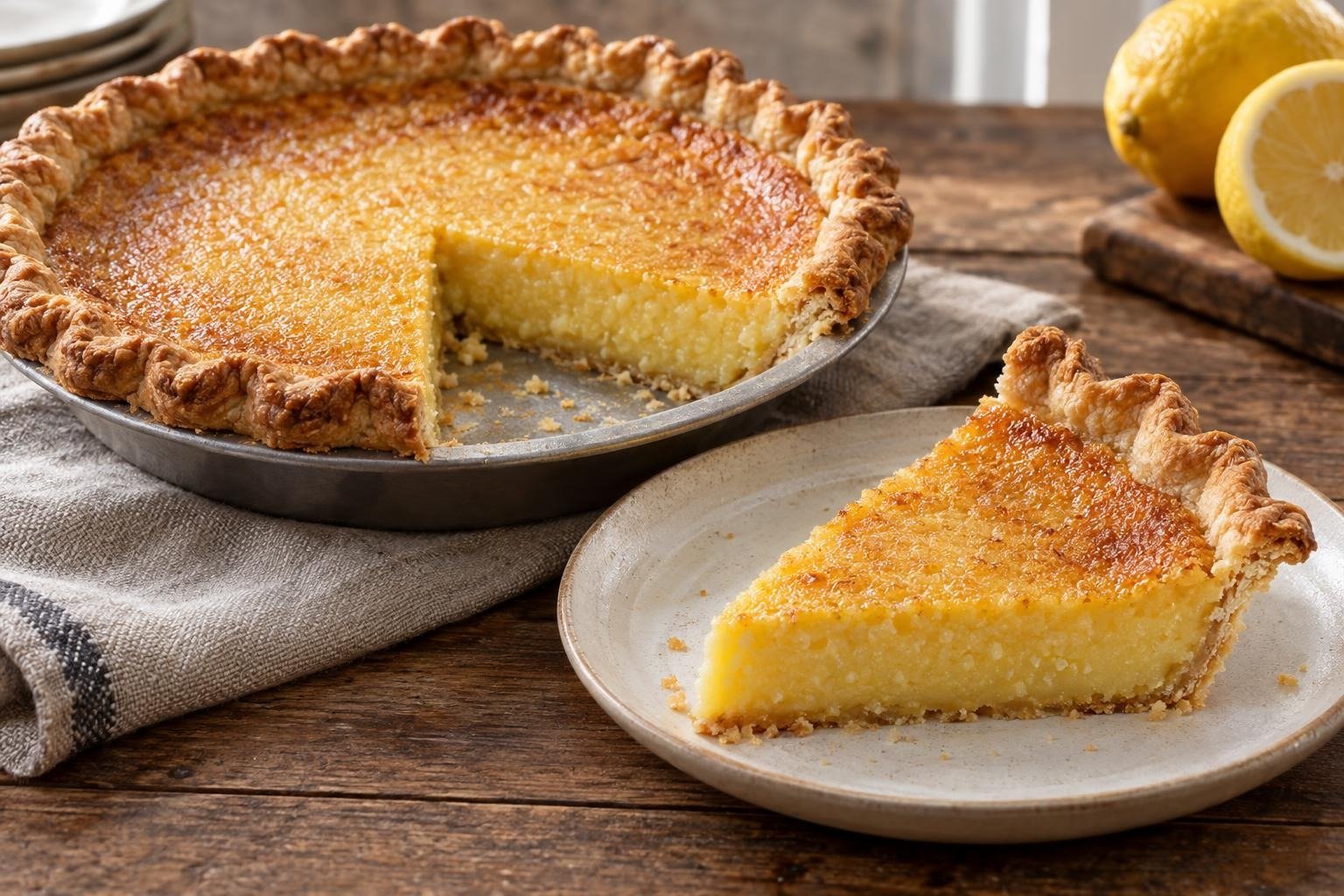
A golden, flaky pastry shell surrounds a bright lemon filling with a lightly burnished top, creamy center, and subtle cornmeal texture. This lemon chess pie balances plenty of fresh citrus with the rich sweetness expected from the Southern classic, while a fully blind-baked crust keeps every slice sturdy rather than damp underneath.
I use a metal pie plate, a preheated baking sheet, and two-stage blind baking to drive moisture out of the pastry before the filling goes in. The filling needs gentle whisking rather than aggressive aeration, and I pull the pie when the edges are set but the center still moves as one soft unit. That controlled wobble disappears as the egg proteins finish setting during cooling, giving the pie defined slices without a rubbery or curdled center.
What Makes this Lemon Pie Deliciously Ridiculous
- Fully blind baking the pastry before adding the liquid filling creates a crisp barrier and helps prevent a soggy bottom in lemon chess pie.
- Fresh lemon zest carries aromatic citrus oils, while measured lemon juice supplies acidity and a clean, tart finish without making the custard excessively loose.
- Fine cornmeal absorbs moisture, contributes the characteristic chess pie texture, and helps form the lightly burnished surface.
- Cultured buttermilk adds acidity and milk solids, moderating the sweetness while supporting a creamy, cohesive filling.
- Baking at 325°F after the initial high-temperature crust bake sets the egg-rich filling gradually, reducing curdling, deep cracks, and overbrowned edges.
Ingredient Notes for Lemon Chess Pie with Golden Pastry
- All-purpose flour: Its moderate protein level gives the pastry enough structure to hold the custard without making it tough. Weigh it and avoid packing flour into a measuring cup.
- Unsalted butter: Cold butter creates distinct pastry layers, while melted butter enriches the filling. Keeping these portions separate and at their specified temperatures is essential.
- Ice water and vinegar: Cold water hydrates the dough without melting its butter. Vinegar limits gluten development and makes the chilled pastry easier to roll without contributing a noticeable acidic flavor.
- Granulated sugar: Sugar sweetens the pie, helps produce its glossy golden surface, and raises the temperature at which the eggs set. Reducing it substantially would change both texture and doneness timing.
- Fresh lemons: Zest the lemons before juicing them, removing only the yellow outer layer. Bottled juice lacks the fresh aromatic oils that make the filling taste distinctly lemony.
- Large eggs: Eggs provide the filling's primary structure. Bring them to room temperature so the melted butter blends in smoothly rather than forming firm droplets.
- Cultured buttermilk: Full-fat buttermilk supplies body, dairy richness, and acidity. Regular milk is not a direct replacement because it changes both the flavor and the filling's solids-to-liquid balance.
- Fine yellow cornmeal: Fine cornmeal thickens the filling without an aggressively gritty texture. Coarse or stone-ground cornmeal will remain more noticeable in the finished pie.
- Vanilla extract: A small amount rounds out the butter and lemon without turning the filling into a vanilla custard. Use pure extract for the cleanest flavor.
A Few Baking Tips
- Keep the shaped shell cold until the moment it enters the oven. Firm butter melts more slowly, helping the pastry hold its crimp and produce flaky layers instead of greasy patches.
- Fill the parchment-lined shell all the way to the rim with weights. Partial weighting supports the base but allows the sides to slump before the pastry structure becomes firm.
- Use a metal pie plate rather than a thick ceramic dish when crisp bottom pastry is the priority. Metal transfers heat to the base more quickly during blind baking.
- Whisk the filling only until blended. A cap of trapped bubbles can bake into a foamy or uneven surface, while gentle mixing produces a denser, creamier chess pie texture.
- Judge doneness by movement rather than surface color alone. A fluid wave means the center needs more time, but a small cohesive wobble will set as the pie cools.
Ingredients for Lemon Chess Pie
- 150 g all-purpose flour (For the pastry, about 1 1/4 cups, spooned and leveled)
- 8 g granulated sugar (For the pastry, about 2 teaspoons)
- 3 g fine sea salt (Divided between the pastry and filling)
- 113 g unsalted butter (For the pastry, cold and cut into 1/2-inch cubes)
- 50 g ice water (About 3 tablespoons plus 1 teaspoon)
- 5 g apple cider vinegar (About 1 teaspoon)
- 300 g granulated sugar (For the filling, about 1 1/2 cups)
- 18 g fine yellow cornmeal (About 2 tablespoons)
- 10 g all-purpose flour (About 1 tablespoon plus 1 teaspoon)
- 4 large eggs (About 200 g without shells, at room temperature)
- 85 g unsalted butter (Melted and cooled until just warm, about 6 tablespoons)
- 120 g full-fat cultured buttermilk (About 1/2 cup, at room temperature)
- 60 g fresh lemon juice (About 1/4 cup, strained)
- 10 g finely grated lemon zest (About 2 packed tablespoons, from 2 to 3 lemons)
- 5 g pure vanilla extract (About 1 teaspoon)
How to Make Lemon Chess Pie
- STEP 1). Mix and chill the pastry dough Whisk the 150 g flour, 8 g sugar, and 2 g of the salt in a medium bowl. Toss in the cold cubed butter, then flatten each piece between your fingertips until most pieces are roughly pea-sized with a few larger flakes. Stir the vinegar into the ice water and drizzle it over the flour mixture. Fold with a flexible spatula until the dough forms moist clumps with no loose, powdery flour. Press into a disk, wrap tightly, and refrigerate for 60 minutes.
- STEP 2). Roll, shape, and firm the pie shell Roll the chilled dough between two sheets of parchment into a 12-inch circle about 1/8 inch thick, rotating the packet to keep the shape even. Peel off the top paper, invert the dough into an ungreased 9-inch metal pie plate, and remove the remaining paper. Ease the dough into the corners without stretching it. Trim the overhang to 1 inch, fold it underneath, and crimp the rim. Refrigerate the shaped shell for 30 minutes while heating the oven to 400°F with a rimmed baking sheet inside.
- STEP 3). Blind bake the pastry until golden Line the cold shell with crumpled parchment, pressing it against the sides, and fill completely with pie weights. Set the plate on the hot baking sheet and bake on the lower-middle rack for 17 minutes, until the rim looks dry and pale gold. Carefully lift out the parchment and weights. Return the uncovered shell to the baking sheet for 7 to 9 minutes, until the base is matte and lightly golden with no raw-looking patches. Do not dock the crust, since the liquid filling could seep through.
- STEP 4). Mix the lemon chess filling without aerating it Reduce the oven to 325°F. Rub the lemon zest into the 300 g sugar in a large bowl until the sugar feels damp and smells strongly citrusy. Whisk in the cornmeal, 10 g flour, and remaining 1 g salt. Add the room-temperature eggs one at a time, whisking gently until uniform but not foamy. Slowly whisk in the melted, just-warm butter, followed by the buttermilk, lemon juice, and vanilla. Scrape the bowl and stir until the filling is smooth, with no streaks of egg or butter.
- STEP 5). Fill and gently bake the pie Place the blind-baked shell, still in its pie plate, on the rimmed baking sheet. Pour in the filling and pass the last portion through a fine strainer if you notice any firm egg strands. Bake at 325°F for 45 to 55 minutes. The outer 2 inches should be set and slightly puffed, while the center should wobble as one cohesive area rather than ripple like liquid. An instant-read thermometer inserted near the center should register approximately 175 to 180°F. Shield the crust rim with foil if it darkens too quickly.
- STEP 6). Cool, chill, and slice cleanly Transfer the pie plate to a wire rack and cool at room temperature for 2 hours, away from drafts that could encourage surface cracks. The filling will settle slightly and continue firming as residual heat dissipates. Once the plate is no longer warm, loosely cover the pie and refrigerate it for at least 2 additional hours before slicing. For clean portions, dip a thin-bladed knife in hot water, wipe it dry, and cut through the custard and crust in one firm motion, cleaning the blade between slices.
Storage and Freezing
- Refrigeration: Cover the completely cooled lemon chess pie and refrigerate for up to 4 days. Keep it in the pie plate or transfer individual slices to an airtight container.
- Freezing: Freeze fully chilled slices on a parchment-lined tray until firm, then wrap each slice tightly and place it in a freezer-safe container for up to 1 month.
- Thawing: Unwrap frozen slices and thaw them overnight in the refrigerator to prevent condensation from collecting against the pastry.
- Serving: Serve chilled for the firmest slices, or let portions stand at room temperature for 15 to 20 minutes for a softer, creamier texture. Do not leave the egg-based pie at room temperature for more than 2 hours.
Frequently Asked Questions
Why did my lemon chess pie turn out runny?
A runny center usually means the pie was removed while the filling still moved in loose waves, or it was sliced before cooling completely. The center should wobble as one cohesive section when the pie leaves the oven.
Give the pie the full two-hour room-temperature cooling period followed by at least two hours in the refrigerator. If the center remains fluid after chilling, additional cooling will not correct an underbaked egg custard.
How do you avoid a soggy bottom in lemon chess pie?
Fully blind bake the shell until its base looks dry, matte, and lightly golden before adding the filling. Pie weights must support both the bottom and sides during the first stage, followed by several uncovered minutes in the oven.
A metal pie plate placed on a preheated baking sheet improves heat transfer beneath the crust. Avoid docking the pastry because holes can allow the thin filling to seep into or beneath it.
What causes cracks on top of a chess pie?
Deep cracks usually point to excessive heat or overbaking. As the eggs overcoagulate, the filling puffs dramatically and then contracts while cooling, leaving splits across the surface.
Bake at 325°F and remove the pie while the center retains a controlled wobble. Cooling on a rack away from cold drafts also limits abrupt temperature changes. Fine shallow lines are cosmetic and do not mean the filling is unsafe or dry throughout.
Can I replace the buttermilk in this lemon chess pie recipe?
Cultured buttermilk is integral to this formula because it contributes acidity, dairy solids, and enough body to balance the lemon juice. Regular milk is thinner and less acidic, so a direct replacement can alter the set and make the filling taste flatter.
For the intended texture, use full-fat cultured buttermilk and bring it to room temperature before mixing. Shake the container first so its thicker milk solids are evenly distributed.
How long should lemon chess pie cool before slicing?
Allow 2 hours on a wire rack so carryover heat can finish setting the center and moisture can escape from the pastry. Refrigerate the no-longer-warm pie for at least another 2 hours before cutting.
Four hours of total cooling produces defined slices and prevents the warm filling from flowing away from the crust. A hot, dry knife wiped between cuts gives the neatest portions once the custard is thoroughly chilled.
More Ridiculously Delicious Pies & Tarts
- Blueberry Lattice Pie with a Juicy, Sliceable Filling
- Classic Pecan Pie with Gooey Brown Sugar Filling
- Banana Cream Pie with Golden Pastry
- Pistachio Cream Pie with Golden Pastry
- Strawberry Rhubarb Pie with a Sweet-Tart Filling
Lemon Chess Pie with Golden Pastry
Ingredients
Equipment
Method
- Whisk the 150 g flour, 8 g sugar, and 2 g of the salt in a medium bowl. Toss in the cold cubed butter, then flatten each piece between your fingertips until most pieces are roughly pea-sized with a few larger flakes. Stir the vinegar into the ice water and drizzle it over the flour mixture. Fold with a flexible spatula until the dough forms moist clumps with no loose, powdery flour. Press into a disk, wrap tightly, and refrigerate for 60 minutes.
- Roll the chilled dough between two sheets of parchment into a 12-inch circle about 1/8 inch thick, rotating the packet to keep the shape even. Peel off the top paper, invert the dough into an ungreased 9-inch metal pie plate, and remove the remaining paper. Ease the dough into the corners without stretching it. Trim the overhang to 1 inch, fold it underneath, and crimp the rim. Refrigerate the shaped shell for 30 minutes while heating the oven to 400°F with a rimmed baking sheet inside.
- Line the cold shell with crumpled parchment, pressing it against the sides, and fill completely with pie weights. Set the plate on the hot baking sheet and bake on the lower-middle rack for 17 minutes, until the rim looks dry and pale gold. Carefully lift out the parchment and weights. Return the uncovered shell to the baking sheet for 7 to 9 minutes, until the base is matte and lightly golden with no raw-looking patches. Do not dock the crust, since the liquid filling could seep through.
- Reduce the oven to 325°F. Rub the lemon zest into the 300 g sugar in a large bowl until the sugar feels damp and smells strongly citrusy. Whisk in the cornmeal, 10 g flour, and remaining 1 g salt. Add the room-temperature eggs one at a time, whisking gently until uniform but not foamy. Slowly whisk in the melted, just-warm butter, followed by the buttermilk, lemon juice, and vanilla. Scrape the bowl and stir until the filling is smooth, with no streaks of egg or butter.
- Place the blind-baked shell, still in its pie plate, on the rimmed baking sheet. Pour in the filling and pass the last portion through a fine strainer if you notice any firm egg strands. Bake at 325°F for 45 to 55 minutes. The outer 2 inches should be set and slightly puffed, while the center should wobble as one cohesive area rather than ripple like liquid. An instant-read thermometer inserted near the center should register approximately 175 to 180°F. Shield the crust rim with foil if it darkens too quickly.
- Transfer the pie plate to a wire rack and cool at room temperature for 2 hours, away from drafts that could encourage surface cracks. The filling will settle slightly and continue firming as residual heat dissipates. Once the plate is no longer warm, loosely cover the pie and refrigerate it for at least 2 additional hours before slicing. For clean portions, dip a thin-bladed knife in hot water, wipe it dry, and cut through the custard and crust in one firm motion, cleaning the blade between slices.
Notes
- Keep the shaped shell cold until the moment it enters the oven. Firm butter melts more slowly, helping the pastry hold its crimp and produce flaky layers instead of greasy patches.
- Fill the parchment-lined shell all the way to the rim with weights. Partial weighting supports the base but allows the sides to slump before the pastry structure becomes firm.
- Use a metal pie plate rather than a thick ceramic dish when crisp bottom pastry is the priority. Metal transfers heat to the base more quickly during blind baking.
- Whisk the filling only until blended. A cap of trapped bubbles can bake into a foamy or uneven surface, while gentle mixing produces a denser, creamier chess pie texture.
- Judge doneness by movement rather than surface color alone. A fluid wave means the center needs more time, but a small cohesive wobble will set as the pie cools.