
Table of Contents
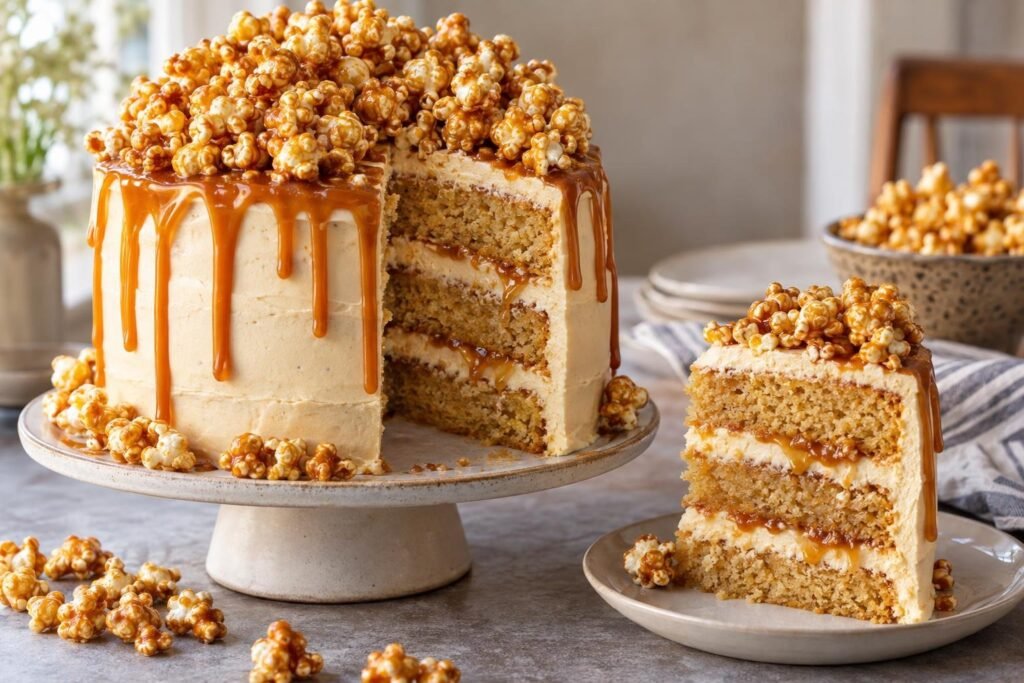
Buttery caramel, toasted brown sugar, and crisp popcorn give this caramel popcorn birthday cake recipe its full bakery-window drama. Beneath the glossy drip and crunchy crown are three tender brown sugar cake layers with a fine, moist crumb, plus salted caramel buttercream that balances the sweetness instead of piling on more sugar for the sake of spectacle.
I build the flavor in stages: brown sugar and buttermilk keep the cake moist, properly cooked caramel contributes bittersweet depth, and the popcorn is coated and baked until dry rather than left sticky. I cool every component before assembly, apply the caramel in thin layers, and add the popcorn close to serving so the cake slices neatly while the topping keeps its essential crunch.

What Makes this Cake So Ridiculously Good
- Brown sugar, butter, and neutral oil create a cake that has caramel-like flavor from the start, with butter for richness and oil for a softer refrigerated crumb.
- Buttermilk supplies acidity and moisture, while four eggs provide enough protein to support three layers, caramel filling, and a substantial popcorn crown.
- Cooking the salted caramel to a deep amber develops complexity that keeps the buttercream from tasting one-dimensionally sweet.
- Baking the coated popcorn at low heat removes excess moisture and sets a crisp caramel shell that is more suitable for decorating than sticky stovetop popcorn.
- Chilling after the crumb coat stabilizes the layers, while adding the popcorn near serving limits moisture migration from the frosting into the crunchy topping.
Ingredient Notes for Bakery-Style Caramel Popcorn Birthday Cake
- All-purpose flour: Its moderate protein level gives the layers enough structure for stacking without the firm chew of bread flour. Weigh it rather than packing it into a cup, which can produce dry, heavy cake.
- Light brown sugar: Molasses adds moisture, color, and a warm caramel note to the cake. Break up firm lumps before creaming so they do not remain as dark, gummy spots in the crumb.
- Butter and neutral oil: Butter contributes flavor and helps aerate the batter, while oil stays fluid when chilled. That combination keeps this decorated layer cake pleasantly tender after refrigeration.
- Buttermilk: Its water hydrates the flour, and its acidity supports a tender crumb. Use room-temperature buttermilk so the butter mixture remains emulsified instead of turning curdled and greasy.
- Heavy cream: Cream loosens the caramel and supplies enough fat to produce a smooth sauce. Warm it before adding it to the hot sugar because cold cream causes more violent bubbling and can make the caramel seize.
- Popcorn kernels: Fresh kernels pop more fully and leave fewer hard pieces. Sort through the popcorn after popping and remove every unpopped kernel before coating or decorating the cake.
- Light corn syrup: In the popcorn coating, glucose interferes with sucrose crystallization, helping the caramel bake into a smooth, crisp shell rather than a sandy coating.
- Confectioners’ sugar: Finely milled sugar thickens and stabilizes the buttercream. Sifting is important here because small lumps become especially visible in a smooth caramel finish.
A Few Good Things to Know
- Weigh the batter into the pans. Even layers bake at the same rate and make the tall finished cake much easier to stack without leaning.
- Let the caramel color beyond pale gold, but remove it before it smells scorched. A deep amber caramel contributes the slight bitterness needed to balance the sweet frosting and popcorn.
- Never add warm caramel to buttercream. If the caramel is above cool room temperature, it can melt the butter and leave the frosting loose, glossy, and difficult to recover.
- Use only a thin caramel layer inside each buttercream dam. Excess sauce acts as a lubricant between the cakes and can cause the layers to slide under the weight of the decoration.
- Decorate with popcorn shortly before presentation. Refrigerated frosting and humid air soften caramel corn, so keep it airtight at room temperature until the cake is ready to serve.
Ingredients for Caramel Popcorn Birthday Cake
- 360 g all-purpose flour (For the cake; spooned and leveled if measuring 3 cups by volume.)
- 12 g baking powder (For the cake; about 1 tablespoon.)
- 4 g fine sea salt (For the cake; about 3/4 teaspoon.)
- 170 g unsalted butter (For the cake; softened to 18 to 21°C, about 3/4 cup.)
- 60 g neutral vegetable oil (For the cake; about 1/4 cup.)
- 300 g light brown sugar (For the cake; packed and free of hard lumps, about 1 1/2 cups.)
- 200 g large eggs (For the cake; 4 large eggs without shells, at room temperature.)
- 240 g buttermilk (For the cake; 1 cup, at room temperature.)
- 10 g pure vanilla extract (For the cake; 2 teaspoons.)
- 200 g granulated sugar (For the salted caramel sauce; 1 cup.)
- 60 g water (For the salted caramel sauce; 1/4 cup.)
- 170 g heavy cream (For the salted caramel sauce; about 3/4 cup, warmed until steaming.)
- 56 g unsalted butter (For the salted caramel sauce; 1/4 cup, cubed and at room temperature.)
- 4 g fine sea salt (For the salted caramel sauce; about 3/4 teaspoon.)
- 5 g pure vanilla extract (For the salted caramel sauce; 1 teaspoon.)
- 25 g popcorn kernels (For the caramel popcorn; approximately 3 tablespoons.)
- 15 g neutral vegetable oil (For popping the corn; 1 tablespoon.)
- 75 g light brown sugar (For coating the popcorn; packed, about 6 tablespoons.)
- 43 g unsalted butter (For coating the popcorn; 3 tablespoons.)
- 25 g light corn syrup (For coating the popcorn; about 1 tablespoon plus 1 teaspoon.)
- 1 g fine sea salt (For coating the popcorn; about 1/4 teaspoon.)
- 1 g baking soda (For coating the popcorn; about 1/4 teaspoon.)
- 340 g unsalted butter (For the buttercream; 1 1/2 cups, softened to 18 to 21°C.)
- 480 g confectioners’ sugar (For the buttercream; about 4 cups, sifted.)
- 30 g heavy cream (For the buttercream; 2 tablespoons, at room temperature.)
- 3 g pure vanilla extract (For the buttercream; about 1/2 teaspoon.)
- 2 g fine sea salt (For the buttercream; about 1/3 teaspoon.)
How to Make Caramel Popcorn Birthday Cake
- STEP 1). Prepare the pans and dry ingredients Position a rack in the center of the oven and heat it to 175°C or 350°F. Grease three 8-inch by 2-inch round aluminum pans, line the bottoms with parchment, and lightly grease the paper. In a medium bowl, whisk the flour, baking powder, and cake salt for 30 seconds. Distributing the leavener now prevents irregular tunnels and isolated salty spots in the finished layers.
- STEP 2). Mix the brown sugar cake batter Using a stand mixer with the paddle, beat the 170 g softened butter, 60 g oil, and 300 g brown sugar on medium speed for 3 minutes, scraping twice, until lighter and creamy. Add the eggs one at a time, mixing until each disappears, then add the cake vanilla. On low speed, alternate the dry mixture in three additions with the buttermilk in two, stopping when only a few flour streaks remain. Fold by hand until smooth.
- STEP 3). Bake and cool the cake layers Divide the batter evenly among the prepared pans, approximately 455 g per pan, and smooth the surfaces with an offset spatula. Bake for 23 to 28 minutes, rotating the pans once if the oven heats unevenly. The cakes are done when the centers spring back, the edges begin pulling from the pans, and a tester shows moist crumbs but no wet batter. Cool in the pans for 15 minutes, then turn onto racks and cool completely.
- STEP 4). Cook and cool the salted caramel sauce Combine the granulated sugar and water in a clean, heavy-bottomed saucepan. Cook over medium heat without stirring, swirling only as needed, until the syrup reaches a deep amber color, about 8 to 12 minutes. Remove it from the heat and slowly whisk in the warm cream, protecting your hands from the vigorous steam. Whisk in the 56 g butter, caramel salt, and caramel vanilla. Transfer to a heatproof bowl and cool until thickened but pourable, about 21°C or 70°F.
- STEP 5). Pop and sort the popcorn Reduce the oven to 135°C or 275°F and line a large rimmed baking sheet with parchment. Heat the 15 g oil with three popcorn kernels in a large covered pot over medium heat. When those kernels pop, add the remaining kernels, cover, and shake periodically until popping slows to one pop every 2 to 3 seconds. Transfer the popcorn to a large heatproof bowl, carefully discarding every unpopped kernel before adding caramel.
- STEP 6). Coat and bake the caramel popcorn In a small saucepan, combine the 75 g brown sugar, 43 g butter, corn syrup, and popcorn salt. Bring to a steady boil over medium heat and cook for 2 minutes while stirring. Remove from the heat and stir in the baking soda; the mixture will foam. Immediately pour it over the popcorn and fold with a heatproof spatula. Spread on the prepared sheet and bake for 35 to 40 minutes, stirring every 10 minutes, then cool completely until crisp.
- STEP 7). Whip the salted caramel buttercream Beat the 340 g softened butter with the clean paddle attachment on medium speed for 3 minutes, until pale and creamy. Mix in the sifted confectioners’ sugar in four additions on low speed. Add 130 g of the cooled salted caramel sauce, the 30 g cream, buttercream vanilla, and buttercream salt. Beat on medium-low for 2 minutes, then mix by hand to remove large air pockets. The frosting should hold a soft peak without looking greasy or runny.
- STEP 8). Level, fill, and stack the cake Use a serrated knife to trim domed tops only if necessary. Set one layer on a cake board and spread about 180 g buttercream evenly over it. Pipe a raised buttercream ring around the edge, then spread 40 g cooled caramel inside the ring. Repeat with the second layer, keeping the caramel away from the exposed edge. Add the final layer upside down for a flat top, checking from several angles that the stack remains centered and vertical.
- STEP 9). Crumb coat and chill the cake Spread a thin coat of buttercream over the top and sides with an offset spatula, trapping loose crumbs rather than chasing a perfect finish. Fill obvious gaps between the layers, then smooth with a bench scraper while rotating the turntable. Refrigerate the cake uncovered for 30 minutes, until the coating feels firm and no longer transfers to a fingertip. Keep the remaining buttercream at cool room temperature and stir it smooth before the final coat.
- STEP 10). Finish, decorate, and serve Apply the remaining buttercream in an even final coat and smooth the top and sides. Chill for 20 minutes. Warm the remaining caramel gently until it flows from a spoon but is not hot, then test one drip on the back of the cold cake before finishing the edge and top. Arrange the cooled caramel popcorn in a generous crown immediately before serving. Use a warm, dry knife for clean slices, wiping the blade between cuts and checking that no hard kernels remain.
Storage and Freezing
- Storage: Refrigerate the assembled cake without its popcorn crown in a covered cake carrier for up to 4 days. Let slices stand at room temperature for 25 to 35 minutes before serving so the buttercream and crumb can soften.
- Caramel popcorn: Store completely cooled popcorn in an airtight container at room temperature for up to 3 days. Keep it separate from the cake until shortly before serving.
- Freezing: Wrap unfrosted cake layers individually in plastic wrap and foil, then freeze for up to 2 months. The finished cake can be frozen without caramel popcorn for up to 1 month in an airtight container.
- Thawing: Thaw wrapped cake layers overnight in the refrigerator, then bring them close to room temperature before unwrapping.
- Thaw a finished cake overnight in the refrigerator and add fresh, crisp popcorn after thawing.
- Serving: Remove only the number of slices needed and return the rest to the refrigerator within 2 hours. Add extra caramel popcorn to individual slices rather than storing popcorn against the moist frosting.
Frequently Asked Questions
How do you keep caramel popcorn crisp on a birthday cake?
Moisture is the enemy of caramel popcorn. Bake the coated popcorn until the shell feels dry and crisp, cool it completely, and keep it in an airtight container at room temperature. Even slightly warm popcorn releases steam inside a container and becomes tacky.
Add the popcorn crown shortly before presenting or slicing the cake. Buttercream, caramel sauce, and refrigerator humidity gradually soften the coating, so storing the fully decorated cake overnight will sacrifice the crunch.
Why did the cake layers slide after filling?
Sliding usually means the caramel was warm, the sauce layer was too thick, or the buttercream dam was too soft. The caramel should be cool and thick enough to fall from a spoon in a ribbon rather than run like syrup.
Use only 40 g caramel inside each firm buttercream ring, keep it away from the edge, and chill the crumb-coated cake before applying the final frosting. A centered stack also distributes the weight more evenly.
What makes this caramel popcorn cake bakery-style?
Three evenly scaled cake layers, a stable buttercream dam, a chilled crumb coat, and a controlled caramel drip create the height and clean finish associated with bakery layer cakes. The brown sugar cake also carries caramel flavor throughout instead of relying only on decoration.
The popcorn is treated as a separate textural component. Baking its coating until dry gives the crown a crisp finish, while adding it near serving preserves the contrast between tender cake, creamy frosting, fluid caramel, and crunchy popcorn.
Can I prepare the caramel popcorn birthday cake in advance?
Most components are well suited to advance preparation. Bake and wrap the cooled cake layers up to 2 days ahead, make the caramel up to 1 week ahead, and prepare the caramel popcorn up to 3 days ahead. Store each component as directed and keep the popcorn separate.
Assemble and frost the cake 1 day before serving, but leave off the drip if the sauce seems warm or thin. Add the crisp popcorn crown shortly before presentation for the best texture.
How do I know when the salted caramel is dark enough?
Look for a uniform deep amber shade similar to copper or strong tea, with a toasted aroma that is noticeable but not smoky. Pale caramel tastes mainly sweet, while black flecks, visible smoke, or a sharply burnt smell indicate that the sugar has gone too far.
Take the pan from the heat as soon as the target color appears because residual heat continues cooking the sugar. Add the warm cream slowly and from a safe distance, since the mixture will release forceful steam.
What is the best way to cut a cake topped with caramel popcorn?
Remove popcorn pieces directly along the planned cut so the knife does not crush them into the frosting. Dip a long serrated or chef’s knife in hot water, dry it completely, and cut downward with gentle sawing pressure rather than forcing the blade through all three layers.
Wipe and warm the knife between portions for cleaner buttercream edges. Before serving each slice, check once more for unpopped kernels, which are hard enough to create an unpleasant biting hazard.
More Ridiculously Delicious Desserts to Try
- Brown Butter Plum Upside-Down Cake with Caramelized Plums
- Salted Caramel Filling for Layer Cakes
- Pineapple Upside-Down Cake with Golden Caramelized Pineapple
- Chocolate Fudge Birthday Cake With Whipped Ganache Recipe
- Bakery-Style Strawberry Milkshake Birthday Cake Recipe
Bakery-Style Caramel Popcorn Birthday Cake
Ingredients
Equipment
Method
- Position a rack in the center of the oven and heat it to 175°C or 350°F. Grease three 8-inch by 2-inch round aluminum pans, line the bottoms with parchment, and lightly grease the paper. In a medium bowl, whisk the flour, baking powder, and cake salt for 30 seconds. Distributing the leavener now prevents irregular tunnels and isolated salty spots in the finished layers.
- Using a stand mixer with the paddle, beat the 170 g softened butter, 60 g oil, and 300 g brown sugar on medium speed for 3 minutes, scraping twice, until lighter and creamy. Add the eggs one at a time, mixing until each disappears, then add the cake vanilla. On low speed, alternate the dry mixture in three additions with the buttermilk in two, stopping when only a few flour streaks remain. Fold by hand until smooth.
- Divide the batter evenly among the prepared pans, approximately 455 g per pan, and smooth the surfaces with an offset spatula. Bake for 23 to 28 minutes, rotating the pans once if the oven heats unevenly. The cakes are done when the centers spring back, the edges begin pulling from the pans, and a tester shows moist crumbs but no wet batter. Cool in the pans for 15 minutes, then turn onto racks and cool completely.
- Combine the granulated sugar and water in a clean, heavy-bottomed saucepan. Cook over medium heat without stirring, swirling only as needed, until the syrup reaches a deep amber color, about 8 to 12 minutes. Remove it from the heat and slowly whisk in the warm cream, protecting your hands from the vigorous steam. Whisk in the 56 g butter, caramel salt, and caramel vanilla. Transfer to a heatproof bowl and cool until thickened but pourable, about 21°C or 70°F.
- Reduce the oven to 135°C or 275°F and line a large rimmed baking sheet with parchment. Heat the 15 g oil with three popcorn kernels in a large covered pot over medium heat. When those kernels pop, add the remaining kernels, cover, and shake periodically until popping slows to one pop every 2 to 3 seconds. Transfer the popcorn to a large heatproof bowl, carefully discarding every unpopped kernel before adding caramel.
- In a small saucepan, combine the 75 g brown sugar, 43 g butter, corn syrup, and popcorn salt. Bring to a steady boil over medium heat and cook for 2 minutes while stirring. Remove from the heat and stir in the baking soda; the mixture will foam. Immediately pour it over the popcorn and fold with a heatproof spatula. Spread on the prepared sheet and bake for 35 to 40 minutes, stirring every 10 minutes, then cool completely until crisp.
- Beat the 340 g softened butter with the clean paddle attachment on medium speed for 3 minutes, until pale and creamy. Mix in the sifted confectioners’ sugar in four additions on low speed. Add 130 g of the cooled salted caramel sauce, the 30 g cream, buttercream vanilla, and buttercream salt. Beat on medium-low for 2 minutes, then mix by hand to remove large air pockets. The frosting should hold a soft peak without looking greasy or runny.
- Use a serrated knife to trim domed tops only if necessary. Set one layer on a cake board and spread about 180 g buttercream evenly over it. Pipe a raised buttercream ring around the edge, then spread 40 g cooled caramel inside the ring. Repeat with the second layer, keeping the caramel away from the exposed edge. Add the final layer upside down for a flat top, checking from several angles that the stack remains centered and vertical.
- Spread a thin coat of buttercream over the top and sides with an offset spatula, trapping loose crumbs rather than chasing a perfect finish. Fill obvious gaps between the layers, then smooth with a bench scraper while rotating the turntable. Refrigerate the cake uncovered for 30 minutes, until the coating feels firm and no longer transfers to a fingertip. Keep the remaining buttercream at cool room temperature and stir it smooth before the final coat.
- Apply the remaining buttercream in an even final coat and smooth the top and sides. Chill for 20 minutes. Warm the remaining caramel gently until it flows from a spoon but is not hot, then test one drip on the back of the cold cake before finishing the edge and top. Arrange the cooled caramel popcorn in a generous crown immediately before serving. Use a warm, dry knife for clean slices, wiping the blade between cuts and checking that no hard kernels remain.
Notes
- Weigh the batter into the pans. Even layers bake at the same rate and make the tall finished cake much easier to stack without leaning.
- Let the caramel color beyond pale gold, but remove it before it smells scorched. A deep amber caramel contributes the slight bitterness needed to balance the sweet frosting and popcorn.
- Never add warm caramel to buttercream. If the caramel is above cool room temperature, it can melt the butter and leave the frosting loose, glossy, and difficult to recover.
- Use only a thin caramel layer inside each buttercream dam. Excess sauce acts as a lubricant between the cakes and can cause the layers to slide under the weight of the decoration.
- Decorate with popcorn shortly before presentation. Refrigerated frosting and humid air soften caramel corn, so keep it airtight at room temperature until the cake is ready to serve.



