
Table of Contents
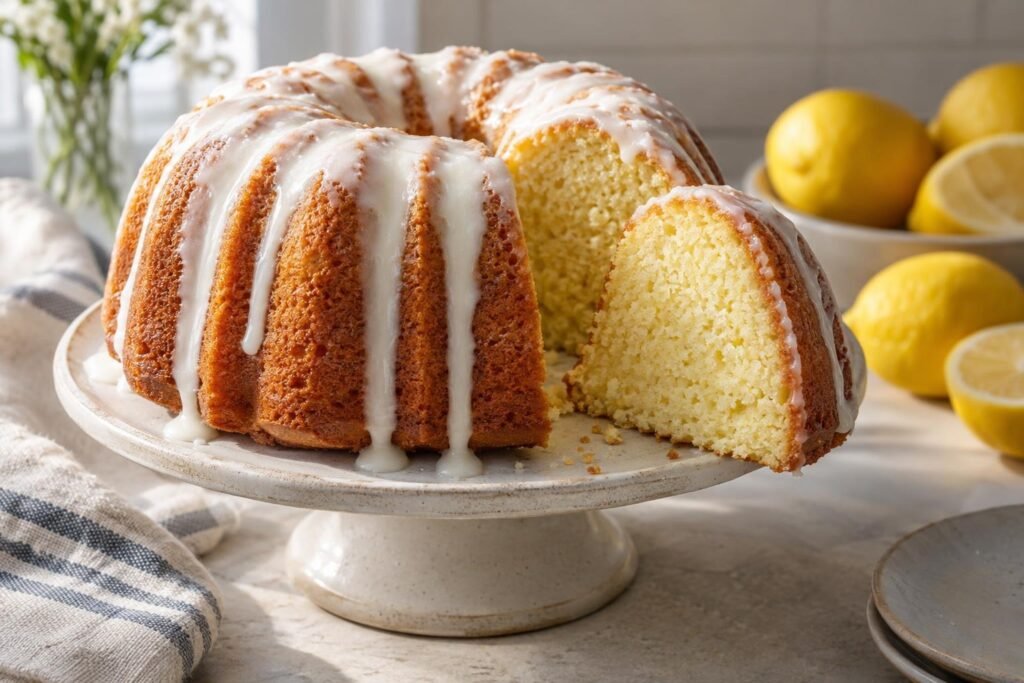
Fresh lemon perfume rises from the golden ridges of this lemon olive oil Bundt cake, while a thin citrus glaze settles into every curve. The crumb is tender and moist without feeling oily, and the olive oil gives the cake a subtle fruitiness that keeps the lemon from tasting one-dimensional. It slices neatly once fully cooled, making it practical for a dinner dessert, afternoon coffee, or a make-ahead celebration cake.
I build the batter by aerating room-temperature eggs with lemon-infused sugar, then streaming in the olive oil slowly enough to create a stable emulsion. Alternating the dry ingredients with the yogurt mixture limits gluten development and preserves that soft crumb. For a clean release, I coat every detail of a 10-cup Bundt pan with softened butter and flour, cool the baked cake for exactly 15 minutes in the pan, and look for edges that have begun to pull away before inverting.

Why This Lemon Cake Is Ridiculously Delicious
- Rubbing fresh lemon zest into granulated sugar releases aromatic citrus oils and distributes them throughout the batter instead of leaving damp clumps of zest.
- Whipping the eggs and lemon sugar before adding the oil incorporates fine air bubbles, giving the relatively rich batter enough lift to produce a tender, defined Bundt shape.
- Slowly streaming olive oil into the aerated egg mixture creates an emulsion, so the fat remains evenly dispersed rather than producing a greasy or compact crumb.
- Whole-milk yogurt supplies moisture, acidity, and milk proteins; the acidity supports the baking soda while the proteins help the cake set cleanly for slicing.
- A measured 15-minute pan cooling period allows the crumb to firm without letting condensation and caramelized sugar glue the cake to the Bundt pan.
Ingredient Notes for Lemon Olive Oil Bundt Cake with a Tender Crumb
- Extra-virgin olive oil: Choose a fruity, mild or medium-intensity oil that tastes pleasant on its own. An aggressively bitter or peppery oil can dominate the lemon. Room-temperature oil emulsifies more readily with the eggs.
- Fresh lemons: Finely grate only the yellow outer zest because the white pith is bitter. Zest the lemons before juicing, and strain the juice to remove seeds and excess pulp.
- Granulated sugar: Sugar sweetens the cake, tenderizes the crumb, and helps the eggs hold incorporated air. Rubbing it with the zest extracts and disperses the lemon’s aromatic oils.
- Eggs: Room-temperature eggs whip to a more stable, voluminous foam and accept the olive oil more readily. Weigh the eggs without shells when consistent batter structure matters.
- Whole-milk plain yogurt: Yogurt contributes moisture, acidity, and body. Use smooth, unflavored yogurt rather than strained Greek yogurt, which would make this formula’s batter substantially thicker.
- All-purpose flour: The moderate protein level provides enough structure for unmolding while remaining tender. Weigh it and avoid compacting flour into a measuring cup.
- Baking powder and baking soda: The combination supplies balanced lift in this acidic batter. Baking soda also encourages browning, but excess would leave an alkaline flavor and weaken the crumb.
- Butter and flour for the pan: Softened butter adheres to Bundt details more reliably than melted butter. A light flour coating reveals missed areas and creates a dry barrier that helps the baked cake release.
- Confectioners’ sugar: Finely milled sugar dissolves quickly in lemon juice for an opaque glaze. Sifting prevents stubborn white lumps without requiring additional liquid.
My Tips for the Best Results
- Measure the Bundt pan’s capacity with water if its size is uncertain. A true 10-cup pan holds about 2.4 liters when filled to the rim, although cake batter should never reach that level.
- Inspect the buttered pan under bright light before adding flour. Shiny metal around the center tube or in a deep groove indicates an uncoated area that could tear during unmolding.
- Keep the eggs, yogurt, lemon juice, and olive oil near room temperature. Cold yogurt or juice can tighten the oil emulsion, reducing aeration and producing an uneven crumb.
- Begin checking at 48 minutes rather than relying only on color. Olive oil and sugar promote browning, so a golden exterior may appear before the deepest section has finished setting.
- Do not glaze a warm cake. Residual heat melts the confectioners’ sugar glaze, causing it to soak into the crust instead of forming distinct white ribbons over the Bundt ridges.
Ingredients for Lemon Olive Oil Bundt Cake
- 14 g unsalted butter (Very soft but not melted, for coating the pan)
- 12 g all-purpose flour (For dusting the prepared pan)
- 330 g all-purpose flour (For the cake batter)
- 10 g baking powder (Approximately 2 1/2 teaspoons)
- 2 g baking soda (Approximately 1/2 teaspoon)
- 5 g fine sea salt (For the cake batter)
- 350 g granulated sugar
- 14 g finely grated lemon zest (From about 3 medium lemons, yellow zest only)
- 200 g large eggs (About 4 large eggs without shells, at room temperature)
- 200 g extra-virgin olive oil (Mild or medium-fruity, at room temperature)
- 180 g whole-milk plain yogurt (Smooth, unstrained, at room temperature)
- 75 g fresh lemon juice (Strained, at room temperature)
- 8 g vanilla extract (Approximately 2 teaspoons)
- 175 g confectioners’ sugar (Sifted)
- 36 g fresh lemon juice (Strained, for the glaze)
- 1 g fine sea salt (For the glaze)
How to Make Lemon Olive Oil Bundt Cake
- STEP 1). Prepare the oven and Bundt pan Position a rack in the lower-middle of the oven and preheat to 350°F (175°C). Brush the inside of a 10-cup Bundt pan with the very soft butter, working methodically into the center tube, sharp corners, and decorative grooves. Add the 12 g flour, rotate and tap the pan until every buttered surface has a thin coating, then knock out all loose flour. This dry, continuous coating is essential because exposed patches are where the cake is most likely to stick.
- STEP 2). Combine the dry ingredients and make lemon sugar Sift the 330 g flour, baking powder, baking soda, and 5 g salt into a medium bowl, then whisk for 20 seconds to distribute the leaveners evenly. In a large mixing bowl, combine the granulated sugar and lemon zest. Rub them together firmly with clean fingertips for about 1 minute, until the sugar feels slightly damp, turns pale yellow, and smells strongly of lemon. This releases the zest’s aromatic oils before the liquid ingredients dilute them.
- STEP 3). Aerate the eggs with the lemon sugar Add the room-temperature eggs to the lemon sugar. Using a stand mixer with the whisk attachment or a hand mixer, beat on medium-high speed for 4 to 5 minutes. Stop once the mixture is pale, thickened, and approximately doubled in volume; batter falling from the whisk should leave a ribbon on the surface for 2 to 3 seconds. Scrape the bowl halfway through so no dense sugar remains at the bottom. This aeration provides fine, even lift rather than large tunnels.
- STEP 4). Emulsify the olive oil and combine the acidic liquids Reduce the mixer to medium-low speed. Pour the olive oil into the egg foam in a thin, steady stream over 90 seconds, aiming near the side of the bowl rather than directly onto the whisk. Continue mixing for 30 seconds, until glossy, uniform, and slightly thickened with no oily layer. In a separate bowl, whisk the yogurt, 75 g lemon juice, and vanilla until smooth. Both mixtures should be at room temperature to reduce curdling and preserve the emulsion.
- STEP 5). Alternate the dry and yogurt mixtures Switch to a flexible spatula. Fold one-third of the flour mixture into the olive oil mixture using broad strokes around the bowl and through the center. Fold in half of the yogurt mixture, then repeat with another third of the flour and the remaining yogurt. Finish with the final flour addition. Stop as soon as no dry pockets remain; the batter should be thick, glossy, and pourable. Scrape the bottom carefully because hidden flour there can create dense streaks in the finished crumb.
- STEP 6). Fill the pan and bake until evenly set Transfer the batter to the prepared Bundt pan, distributing it evenly around the center tube. The 10-cup pan should be comfortably below two-thirds full. Smooth the surface and tap the pan twice on a folded kitchen towel to release large trapped bubbles without collapsing the fine aeration. Bake for 48 to 55 minutes, rotating once after 35 minutes. The cake is done when deeply golden, springy at the thickest section, and a skewer emerges with moist crumbs but no wet batter.
- STEP 7). Cool briefly and unmold the cake Set the pan on a wire rack and leave the cake undisturbed for 15 minutes. During this interval, the structure firms while the edges begin to contract from the metal. Gently press any edge that still touches the pan and loosen only the top rim with a thin flexible spatula, without digging into the decorative sides. Place the rack over the pan, invert both together, and lift the pan straight up. Cool the unmolded cake completely for at least 1 hour 45 minutes before glazing.
- STEP 8). Glaze and allow the finish to set Place the completely cool cake and rack over a rimmed sheet pan. Whisk the sifted confectioners’ sugar, 36 g lemon juice, and 1 g salt until smooth and opaque. The glaze should fall from the whisk in a thick ribbon and slowly merge back into the bowl; if it seems stiff, keep whisking before changing its consistency. Spoon it over the crown so it drips naturally down the ridges. Let the glaze set for 30 minutes before transferring and slicing with a serrated knife.
Storage and Freezing
- Room temperature: Store the glazed cake in an airtight cake carrier or tightly covered container for up to 3 days. Keep it in a cool room away from direct sunlight.
- Refrigeration: Refrigerate for up to 5 days if the room is warm. Cover cut surfaces tightly to prevent the crumb from drying and allow slices to stand at room temperature for 20 to 30 minutes before serving.
- Freezing: Freeze the completely cooled, unglazed cake or individual slices for up to 2 months. Wrap tightly in plastic wrap, add a layer of foil, and place in a freezer-safe container.
- Thawing: Thaw wrapped cake at room temperature so condensation forms on the wrapping rather than the crust. Glaze the whole cake only after it is fully thawed and no longer cold.
- Serving: For clean slices, let the glaze set fully and use a serrated knife with a gentle sawing motion. Wipe the blade between cuts when presentation matters.
Frequently Asked Questions
What pan size is best for lemon olive oil Bundt cake?
A 10-cup Bundt pan, approximately 2.4 liters when filled to the rim, suits this quantity of batter and produces well-defined ridges without crowding the oven rise. The unbaked batter should sit comfortably below two-thirds of the pan’s height.
Measure an unmarked pan by filling it with water one cup at a time. A substantially smaller pan could overflow, while a larger pan will produce a lower cake that may finish baking sooner.
How do you keep lemon olive oil Bundt cake from sticking?
Coat every interior surface with very soft butter, including the center tube and deepest decorative grooves, then apply a thin layer of flour. Bare, shiny patches are vulnerable because the sugary crust can bond directly to the metal.
After baking, cool the cake in its pan for 15 minutes before inverting. Unmolding immediately can tear the soft crumb, but leaving it much longer allows condensation and cooling sugar to increase adhesion.
Why did my olive oil Bundt cake turn out dense or oily?
A dense or oily crumb commonly points to weak egg aeration, olive oil added too quickly, or excessive mixing after the flour went in. The egg mixture should become pale and ribbon-like before the oil is streamed in gradually to form a glossy emulsion.
Room-temperature ingredients also matter. Cold yogurt or lemon juice can tighten or destabilize the emulsion, while vigorous mixing after flour addition develops gluten and knocks out the fine air bubbles needed for lift.
When is lemon Bundt cake fully baked?
The cake should be deeply golden, spring back when lightly pressed at its thickest point, and begin pulling slightly from the outer edge of the pan. A thin skewer inserted between the center tube and outer wall should emerge with a few moist crumbs but no shiny batter.
Check several inches away from the center tube, where the batter is deepest. Testing only next to hot metal can give a misleading result because that area sets sooner than the middle of the cake.
Which olive oil works best in a lemon olive oil Bundt cake recipe?
A mild or medium-fruity extra-virgin olive oil complements fresh lemon without creating an aggressively bitter or peppery finish. Taste the oil before baking because its flavor remains noticeable in a cake where it supplies all the batter’s liquid fat.
Avoid an oil that smells stale, waxy, or rancid. Store olive oil tightly capped away from heat and light, and bring it to room temperature before mixing so it emulsifies smoothly with the aerated eggs.
More Ridiculously Delicious Cakes
- Raspberry Lemon Coffee Cake with Soft, Tender Crumb
- Lemon Layer Cake with Soft, Bright Citrus Layers
- Chocolate Sour Cream Bundt Cake with a Moist Crumb
- Mocha Bundt Cake with Soft, Tender Crumb
- Vanilla Bean Layer Cake with Soft, Tender Layers
Lemon Olive Oil Bundt Cake with a Tender Crumb
Ingredients
Equipment
Method
- Position a rack in the lower-middle of the oven and preheat to 350°F (175°C). Brush the inside of a 10-cup Bundt pan with the very soft butter, working methodically into the center tube, sharp corners, and decorative grooves. Add the 12 g flour, rotate and tap the pan until every buttered surface has a thin coating, then knock out all loose flour. This dry, continuous coating is essential because exposed patches are where the cake is most likely to stick.
- Sift the 330 g flour, baking powder, baking soda, and 5 g salt into a medium bowl, then whisk for 20 seconds to distribute the leaveners evenly. In a large mixing bowl, combine the granulated sugar and lemon zest. Rub them together firmly with clean fingertips for about 1 minute, until the sugar feels slightly damp, turns pale yellow, and smells strongly of lemon. This releases the zest’s aromatic oils before the liquid ingredients dilute them.
- Add the room-temperature eggs to the lemon sugar. Using a stand mixer with the whisk attachment or a hand mixer, beat on medium-high speed for 4 to 5 minutes. Stop once the mixture is pale, thickened, and approximately doubled in volume; batter falling from the whisk should leave a ribbon on the surface for 2 to 3 seconds. Scrape the bowl halfway through so no dense sugar remains at the bottom. This aeration provides fine, even lift rather than large tunnels.
- Reduce the mixer to medium-low speed. Pour the olive oil into the egg foam in a thin, steady stream over 90 seconds, aiming near the side of the bowl rather than directly onto the whisk. Continue mixing for 30 seconds, until glossy, uniform, and slightly thickened with no oily layer. In a separate bowl, whisk the yogurt, 75 g lemon juice, and vanilla until smooth. Both mixtures should be at room temperature to reduce curdling and preserve the emulsion.
- Switch to a flexible spatula. Fold one-third of the flour mixture into the olive oil mixture using broad strokes around the bowl and through the center. Fold in half of the yogurt mixture, then repeat with another third of the flour and the remaining yogurt. Finish with the final flour addition. Stop as soon as no dry pockets remain; the batter should be thick, glossy, and pourable. Scrape the bottom carefully because hidden flour there can create dense streaks in the finished crumb.
- Transfer the batter to the prepared Bundt pan, distributing it evenly around the center tube. The 10-cup pan should be comfortably below two-thirds full. Smooth the surface and tap the pan twice on a folded kitchen towel to release large trapped bubbles without collapsing the fine aeration. Bake for 48 to 55 minutes, rotating once after 35 minutes. The cake is done when deeply golden, springy at the thickest section, and a skewer emerges with moist crumbs but no wet batter.
- Set the pan on a wire rack and leave the cake undisturbed for 15 minutes. During this interval, the structure firms while the edges begin to contract from the metal. Gently press any edge that still touches the pan and loosen only the top rim with a thin flexible spatula, without digging into the decorative sides. Place the rack over the pan, invert both together, and lift the pan straight up. Cool the unmolded cake completely for at least 1 hour 45 minutes before glazing.
- Place the completely cool cake and rack over a rimmed sheet pan. Whisk the sifted confectioners’ sugar, 36 g lemon juice, and 1 g salt until smooth and opaque. The glaze should fall from the whisk in a thick ribbon and slowly merge back into the bowl; if it seems stiff, keep whisking before changing its consistency. Spoon it over the crown so it drips naturally down the ridges. Let the glaze set for 30 minutes before transferring and slicing with a serrated knife.
Notes
- Measure the Bundt pan’s capacity with water if its size is uncertain. A true 10-cup pan holds about 2.4 liters when filled to the rim, although cake batter should never reach that level.
- Inspect the buttered pan under bright light before adding flour. Shiny metal around the center tube or in a deep groove indicates an uncoated area that could tear during unmolding.
- Keep the eggs, yogurt, lemon juice, and olive oil near room temperature. Cold yogurt or juice can tighten the oil emulsion, reducing aeration and producing an uneven crumb.
- Begin checking at 48 minutes rather than relying only on color. Olive oil and sugar promote browning, so a golden exterior may appear before the deepest section has finished setting.
- Do not glaze a warm cake. Residual heat melts the confectioners’ sugar glaze, causing it to soak into the crust instead of forming distinct white ribbons over the Bundt ridges.



