
Table of Contents
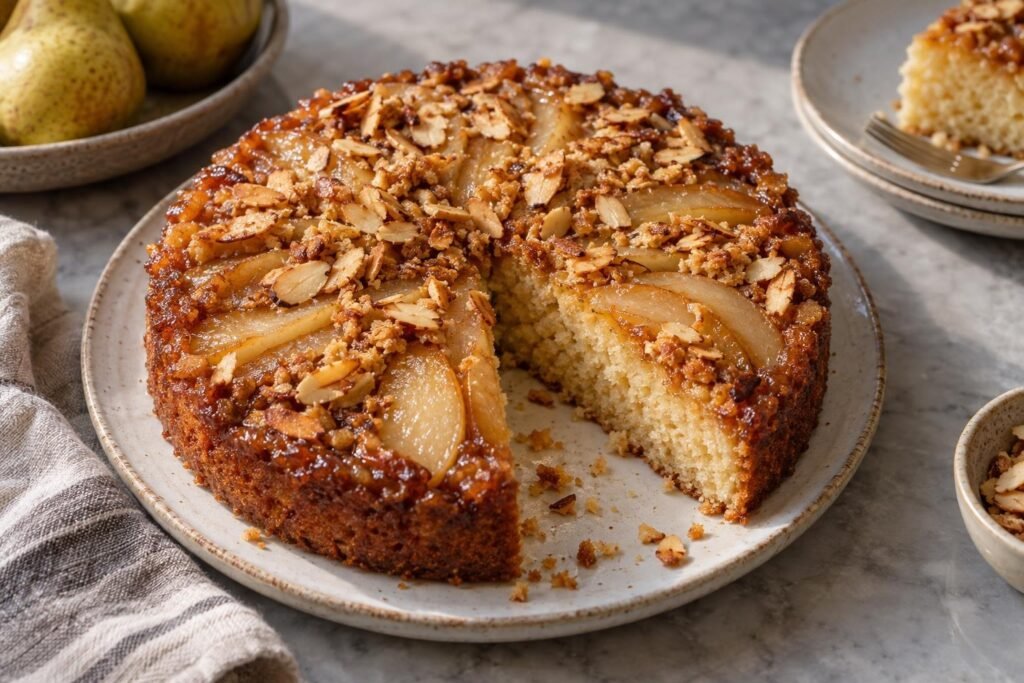
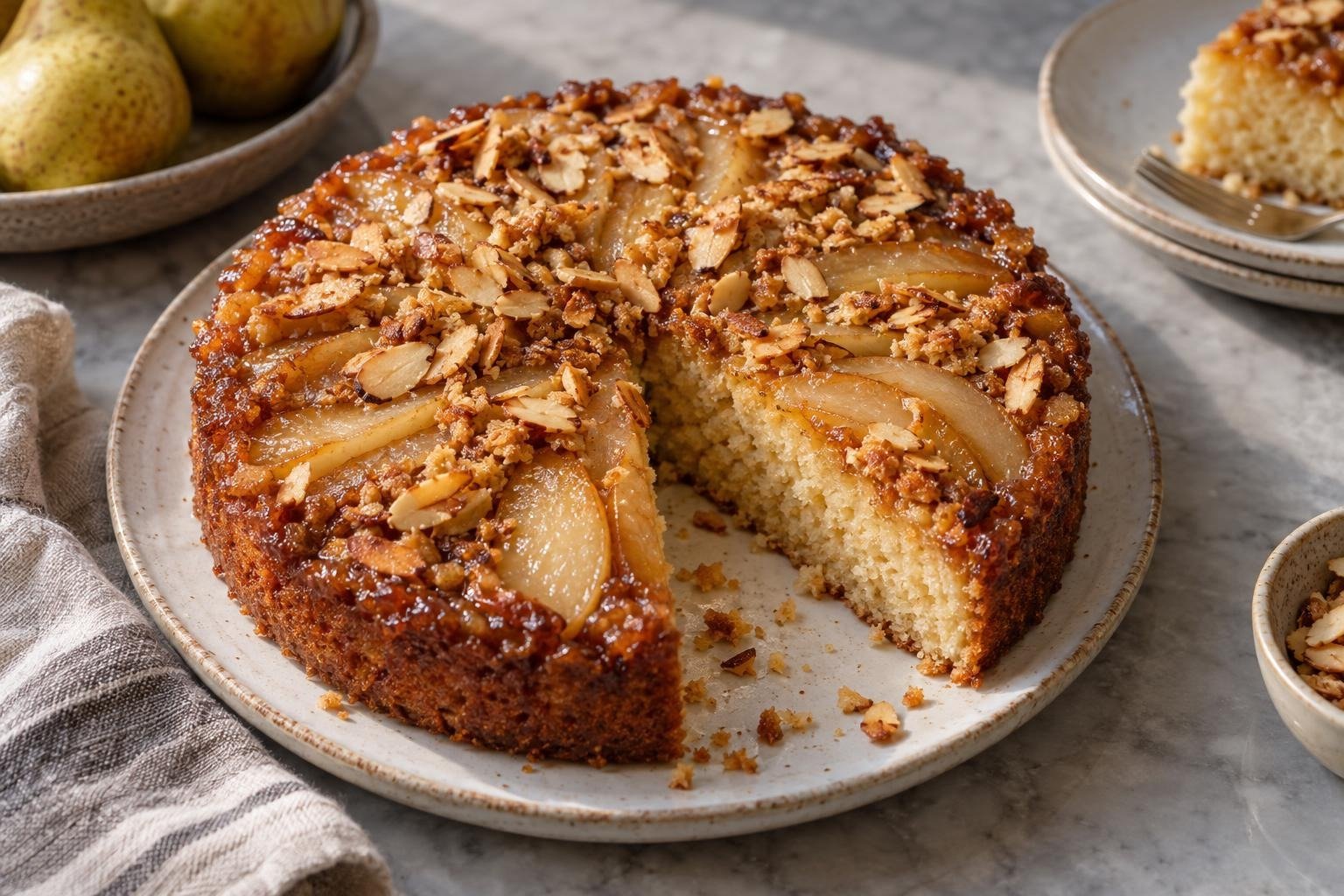
Glossy caramelized pears, a tender almond-rich crumb, and crisp toasted streusel give this pear almond upside-down cake three distinct textures in every slice. The fruit softens without collapsing, while brown sugar and butter form a glossy caramel that settles into the top of the cake after inversion. A little lemon keeps the pears bright against the warm vanilla and almond flavors.
I use ripe but firm pears, slice them evenly, and blot away surface moisture before arranging them in the pan. That moisture control helps the caramel cling instead of turning watery. The cake batter should be thick enough to cover the fruit without disturbing it, and the finished cake needs a short 12-minute rest before turning out. That timing lets the crumb stabilize while the caramel remains warm enough to release cleanly.
Why This Cake Recipe Frickin’ Works
- Blotting the sliced pears removes excess surface juice, helping the butter and brown sugar form a concentrated caramel rather than a thin syrup.
- Almond flour contributes fat and tenderness, while all-purpose flour supplies enough structure to support the pear layer during inversion.
- Sour cream adds controlled moisture and acidity, producing a soft crumb without making the batter loose enough to displace the arranged fruit.
- Creaming softened butter and sugar builds fine air cells, giving the relatively rich almond batter an even, resilient rise.
- The almond streusel is baked separately and added after inversion, so it stays crisp instead of absorbing pear juice beneath the cake.
Ingredient Notes for Pear Almond Upside-Down Cake with Toasted Almond Crumb
- Pears: Choose pears that yield only slightly near the stem. Very soft fruit releases too much liquid and can lose its shape. Slice the peeled, cored pears 6 mm thick and blot them thoroughly before arranging.
- Almond flour: Finely ground blanched almond flour supplies fat, moisture retention, and almond flavor. Do not use coarse almond meal, which produces a heavier crumb and a visibly speckled texture.
- All-purpose flour: Wheat flour provides the gluten structure needed to hold the fruit layer after inversion. Measure by weight and mix only until the final dry streaks disappear.
- Unsalted butter: Softened butter forms both the caramel base and aerated cake batter. Melted butter will not trap air properly in the batter, so bring it to a cool, pliable consistency before creaming.
- Brown sugar: Light brown sugar melts into a buttery caramel beneath the pears and helps the streusel form crisp clusters. Pack it only when using volume measurements.
- Sour cream: Full-fat sour cream adds moisture and acidity while keeping the batter thick. Stir it smooth before measuring so it incorporates without leaving dense pockets.
- Sliced almonds: Sliced almonds give the finishing crumb a light, crisp texture. Keep the pieces visible rather than grinding them, and cool the baked crumb completely before scattering it over the cake.
Expert Baking Tips
- Use a light-colored metal pan rather than glass or dark nonstick metal. It conducts heat predictably and reduces the risk of scorching the brown sugar before the center finishes baking.
- Arrange the pear slices closely but avoid building multiple thick layers. Uneven fruit depth traps excess liquid and can create gummy patches where the batter meets the caramel.
- Keep the butter, eggs, and sour cream near room temperature. Ingredients at similar temperatures emulsify more smoothly, helping prevent a dense or greasy cake crumb.
- Do not wait until the cake is completely cool to invert it. At 12 minutes, the crumb has begun to set but the caramel is still fluid enough to release the pears.
- Add the toasted almond crumb shortly before serving. Leaving it on the moist caramel surface for several hours softens the clusters and reduces their contrast with the tender cake.
Ingredients for Pear Almond Upside-Down Cake
- 42 g unsalted butter (For the pear layer, softened, plus additional butter for greasing the pan)
- 100 g light brown sugar (For the pear layer, packed if measured by volume)
- 15 g fresh lemon juice (For coating the pears)
- 450 g ripe but firm pears (Prepared weight after peeling and coring, sliced 6 mm thick and blotted dry)
- 45 g sliced almonds (For the toasted almond crumb)
- 30 g all-purpose flour (For the toasted almond crumb)
- 30 g light brown sugar (For the toasted almond crumb)
- 0.5 g fine sea salt (For the toasted almond crumb)
- 28 g unsalted butter (For the toasted almond crumb, melted and cooled slightly)
- 150 g all-purpose flour (For the cake batter)
- 75 g finely ground blanched almond flour (For the cake batter, loosened before weighing)
- 6 g baking powder (About 1 1/2 teaspoons)
- 3 g fine sea salt (About 1/2 teaspoon)
- 113 g unsalted butter (For the cake batter, softened to about 68°F)
- 150 g granulated sugar (For the cake batter)
- 100 g large eggs (About 2 large eggs without shells, at room temperature)
- 5 g pure vanilla extract (About 1 teaspoon)
- 1 g pure almond extract (About 1/4 teaspoon; measure carefully because the flavor is concentrated)
- 120 g full-fat sour cream (At room temperature and stirred smooth)
How to Make Pear Almond Upside-Down Cake
- STEP 1). Prepare the pan and arrange the pears Heat the oven to 350°F with a rack in the center. Butter a 9-inch round metal cake pan, line the bottom with parchment, and lightly butter the parchment. Spread 42 g softened butter evenly across the base, then sprinkle with 100 g brown sugar. Toss the sliced pears with lemon juice, blot them again, and arrange them in a tight overlapping spiral. Keep the fruit in one even layer so the cake bakes level and releases without loose slices.
- STEP 2). Bake the toasted almond crumb Line a rimmed baking sheet with parchment. Combine the sliced almonds, 30 g flour, 30 g brown sugar, and 0.5 g salt in a medium bowl. Pour in 28 g melted butter and stir until the flour is moistened and small clusters form. Spread the mixture in a loose layer and bake at 350°F for 12 to 15 minutes, stirring once, until golden and fragrant. Cool completely on the baking sheet; it will become crisper as the butter firms.
- STEP 3). Combine the cake’s dry ingredients Whisk 150 g all-purpose flour, the almond flour, baking powder, and 3 g salt in a medium bowl for about 30 seconds. Break up any compacted almond flour with your fingertips or the whisk. The mixture should look uniform, with no visible pockets of leavening. Thorough distribution matters because almond flour contains no gluten and the wheat flour must carry the cake’s structure evenly around the moist pear layer.
- STEP 4). Cream the butter and sugar Place 113 g softened butter and the granulated sugar in the bowl of a stand mixer fitted with the paddle. Beat on medium speed for 3 to 4 minutes, stopping once to scrape the bowl and paddle. The mixture should become pale, fluffy, and slightly increased in volume rather than greasy. Add the eggs one at a time on medium-low speed, mixing until each disappears, then blend in the vanilla and almond extracts.
- STEP 5). Finish and spread the batter Mix the sour cream into the butter mixture on low speed until mostly smooth. Add the dry ingredients in two additions, folding the final addition by hand with a silicone spatula. Stop when no dry flour remains; the batter should be thick, soft, and spoonable. Dollop it gently over the pears rather than pouring it into one spot. Use a small offset spatula to spread the batter to the edges without shifting the fruit, then smooth the top level.
- STEP 6). Bake until the center is set Set the pan on a rimmed baking sheet to catch any caramel drips. Bake at 350°F for 43 to 48 minutes, rotating the pan after 30 minutes, until the cake is deeply golden, springs back when lightly pressed near the center, and begins pulling slightly from the sides. A skewer inserted into the cake portion should show moist crumbs but no wet batter. If the top browns early, cover it loosely with foil without sealing the pan.
- STEP 7). Rest, invert, and finish the cake Transfer the pan to a wire rack and cool for exactly 12 minutes. Run a thin offset spatula around the edge without cutting toward the pears. Place a large flat serving plate over the pan, protect your hands with dry oven mitts, and invert both pieces in one confident motion. Leave the pan in place for 30 seconds, then lift it straight up. Replace any attached pear slices while warm, cool for at least 30 minutes, and scatter the toasted almond crumb over the pears just before slicing.
Storage and Freezing
- Room temperature: Cover the completely cooled cake and store it for up to 1 day in a cool room. Keep the almond crumb in a separate airtight container and add it when serving.
- Refrigeration: Refrigerate the covered cake for up to 4 days because of the moist fruit topping. Bring individual slices to room temperature for 20 to 30 minutes before serving.
- Freezing: Freeze uncrumbed slices in an airtight container with parchment between layers for up to 2 months.
- Freeze the toasted almond crumb separately.
- Thawing: Thaw wrapped slices overnight in the refrigerator, then uncover and bring them to room temperature. Add fresh crisp almond crumb after thawing.
- Serving: For cleaner portions, cut with a thin sharp knife and wipe the blade between slices. The cake is flavorful at room temperature or gently warmed.
Frequently Asked Questions
When should you turn out pear almond upside-down cake?
Turn out this cake after it has rested in the pan for 12 minutes. The crumb is still warm, but it has gained enough structure to hold the pear layer during inversion.
Waiting much longer allows the butter and brown sugar caramel to thicken against the pan. Invert firmly onto a flat plate, pause for 30 seconds, and lift the pan straight upward rather than twisting it.
Why does pear almond upside-down cake stick to the pan?
Sticking usually comes from excess pear moisture, unlined metal, or caramel that has cooled too long. Blot the sliced fruit, butter the pan and parchment, and keep the pears in a single even layer.
If a slice remains attached, lift it carefully with a small offset spatula and place it back onto the warm cake. The soft caramel will help it settle neatly into position.
How ripe should pears be for an upside-down cake?
Pears should smell fragrant and yield only slightly when pressed near the stem. The flesh must remain firm enough to peel, core, and slice cleanly without becoming slippery or translucent.
Very hard pears may stay chalky after baking, while soft pears can collapse and release excessive juice. Even 6 mm slices provide enough thickness to remain visible after caramelization without creating a heavy fruit layer.
What pear almond upside-down cake ingredient substitutions are appropriate?
Coarse almond meal should not replace the finely ground blanched almond flour because it changes both the crumb and moisture distribution. All-purpose flour also cannot replace the almond flour gram for gram without altering the cake’s fat and liquid balance.
The almond extract may be omitted if needed, although the cake will have a milder almond aroma. Keep the sliced almonds and almond flour unchanged so the named flavor and contrasting crumb remain intact.
How do you know when pear almond upside-down cake is fully baked?
The exposed cake surface should be deeply golden, gently spring back at the center, and pull slightly from the pan’s edge. A skewer inserted through the cake portion should emerge with moist crumbs rather than glossy batter.
Avoid testing directly through a pear because caramel and fruit juice can resemble underbaked batter. If the surface colors before the center sets, cover it loosely with foil and continue baking in short intervals.
More Ridiculously Delicious Cakes
- Carrot Layer Cake with a Moist Crumb
- Lemon Layer Cake with Soft, Bright Citrus Layers
- Strawberry Rhubarb Coffee Cake with Soft, Tender Crumb
- Chocolate Peanut Butter Sheet Cake with Soft, Tender Crumb
- Coconut Layer Cake with Soft, Tender Crumb
Pear Almond Upside-Down Cake with Toasted Almond Crumb
Ingredients
Equipment
Method
- Heat the oven to 350°F with a rack in the center. Butter a 9-inch round metal cake pan, line the bottom with parchment, and lightly butter the parchment. Spread 42 g softened butter evenly across the base, then sprinkle with 100 g brown sugar. Toss the sliced pears with lemon juice, blot them again, and arrange them in a tight overlapping spiral. Keep the fruit in one even layer so the cake bakes level and releases without loose slices.
- Line a rimmed baking sheet with parchment. Combine the sliced almonds, 30 g flour, 30 g brown sugar, and 0.5 g salt in a medium bowl. Pour in 28 g melted butter and stir until the flour is moistened and small clusters form. Spread the mixture in a loose layer and bake at 350°F for 12 to 15 minutes, stirring once, until golden and fragrant. Cool completely on the baking sheet; it will become crisper as the butter firms.
- Whisk 150 g all-purpose flour, the almond flour, baking powder, and 3 g salt in a medium bowl for about 30 seconds. Break up any compacted almond flour with your fingertips or the whisk. The mixture should look uniform, with no visible pockets of leavening. Thorough distribution matters because almond flour contains no gluten and the wheat flour must carry the cake’s structure evenly around the moist pear layer.
- Place 113 g softened butter and the granulated sugar in the bowl of a stand mixer fitted with the paddle. Beat on medium speed for 3 to 4 minutes, stopping once to scrape the bowl and paddle. The mixture should become pale, fluffy, and slightly increased in volume rather than greasy. Add the eggs one at a time on medium-low speed, mixing until each disappears, then blend in the vanilla and almond extracts.
- Mix the sour cream into the butter mixture on low speed until mostly smooth. Add the dry ingredients in two additions, folding the final addition by hand with a silicone spatula. Stop when no dry flour remains; the batter should be thick, soft, and spoonable. Dollop it gently over the pears rather than pouring it into one spot. Use a small offset spatula to spread the batter to the edges without shifting the fruit, then smooth the top level.
- Set the pan on a rimmed baking sheet to catch any caramel drips. Bake at 350°F for 43 to 48 minutes, rotating the pan after 30 minutes, until the cake is deeply golden, springs back when lightly pressed near the center, and begins pulling slightly from the sides. A skewer inserted into the cake portion should show moist crumbs but no wet batter. If the top browns early, cover it loosely with foil without sealing the pan.
- Transfer the pan to a wire rack and cool for exactly 12 minutes. Run a thin offset spatula around the edge without cutting toward the pears. Place a large flat serving plate over the pan, protect your hands with dry oven mitts, and invert both pieces in one confident motion. Leave the pan in place for 30 seconds, then lift it straight up. Replace any attached pear slices while warm, cool for at least 30 minutes, and scatter the toasted almond crumb over the pears just before slicing.
Notes
- Use a light-colored metal pan rather than glass or dark nonstick metal. It conducts heat predictably and reduces the risk of scorching the brown sugar before the center finishes baking.
- Arrange the pear slices closely but avoid building multiple thick layers. Uneven fruit depth traps excess liquid and can create gummy patches where the batter meets the caramel.
- Keep the butter, eggs, and sour cream near room temperature. Ingredients at similar temperatures emulsify more smoothly, helping prevent a dense or greasy cake crumb.
- Do not wait until the cake is completely cool to invert it. At 12 minutes, the crumb has begun to set but the caramel is still fluid enough to release the pears.
- Add the toasted almond crumb shortly before serving. Leaving it on the moist caramel surface for several hours softens the clusters and reduces their contrast with the tender cake.



