Go Back
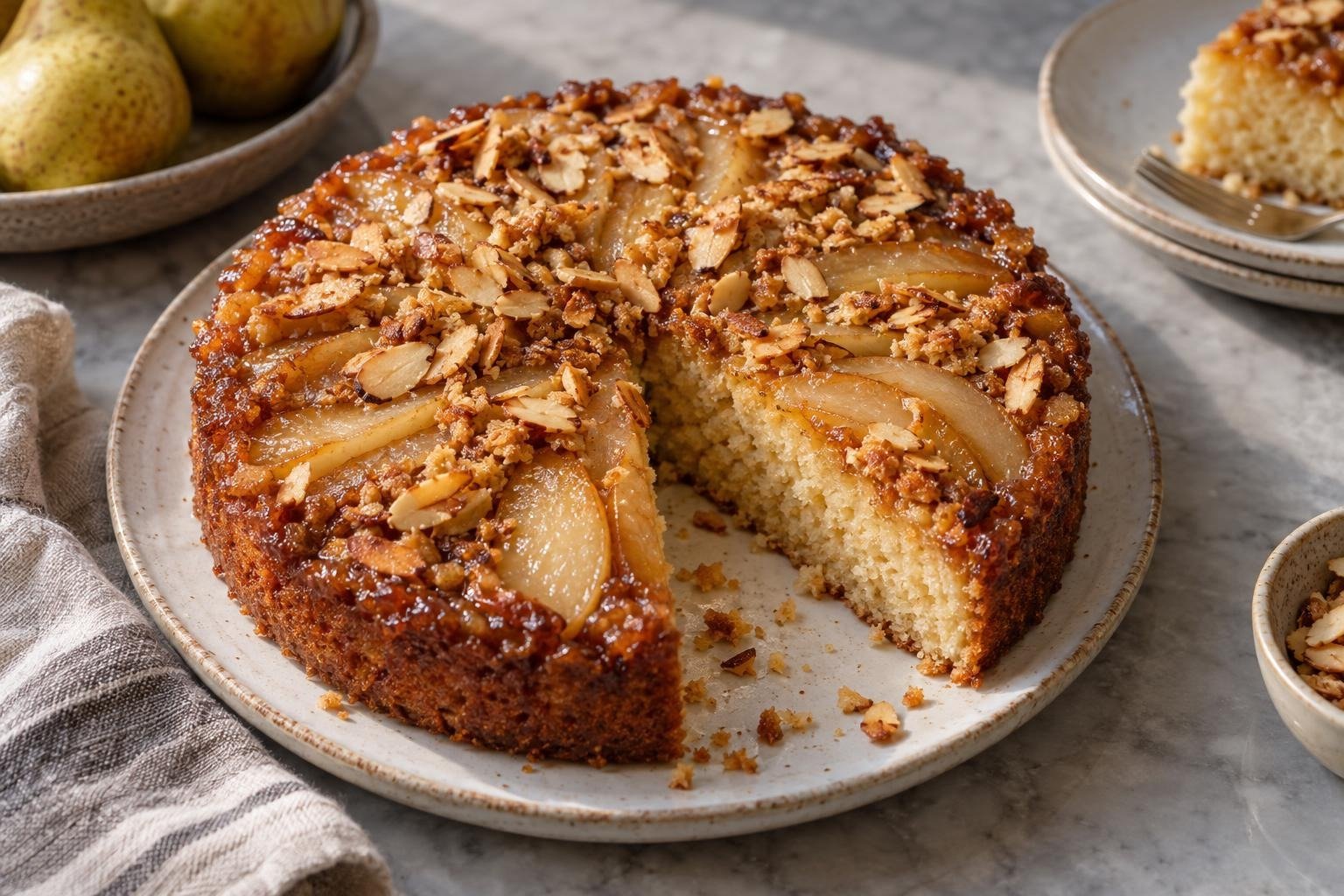
Pear almond upside-down cake with caramelized pear slices and toasted almond crumb on a ceramic plate

Pear Almond Upside-Down Cake with Toasted Almond Crumb

A tender almond and sour cream cake baked over neatly layered pears in buttery brown sugar caramel, then inverted warm and finished with crisp toasted almond crumb.
Prep Time 30 minutes
Cook Time 1 hour
Cooling 45 minutes
Total Time 2 hours 15 minutes
Servings: 10 slices
Course: Dessert
Cuisine: American
Calories: 442

Ingredients
  

  • 42 g unsalted butter For the pear layer, softened, plus additional butter for greasing the pan
  • 100 g light brown sugar For the pear layer, packed if measured by volume
  • 15 g fresh lemon juice For coating the pears
  • 450 g ripe but firm pears Prepared weight after peeling and coring, sliced 6 mm thick and blotted dry
  • 45 g sliced almonds For the toasted almond crumb
  • 30 g all-purpose flour For the toasted almond crumb
  • 30 g light brown sugar For the toasted almond crumb
  • 0.5 g fine sea salt For the toasted almond crumb
  • 28 g unsalted butter For the toasted almond crumb, melted and cooled slightly
  • 150 g all-purpose flour For the cake batter
  • 75 g finely ground blanched almond flour For the cake batter, loosened before weighing
  • 6 g baking powder About 1 1/2 teaspoons
  • 3 g fine sea salt About 1/2 teaspoon
  • 113 g unsalted butter For the cake batter, softened to about 68°F
  • 150 g granulated sugar For the cake batter
  • 100 g large eggs About 2 large eggs without shells, at room temperature
  • 5 g pure vanilla extract About 1 teaspoon
  • 1 g pure almond extract About 1/4 teaspoon; measure carefully because the flavor is concentrated
  • 120 g full-fat sour cream At room temperature and stirred smooth

Equipment

  • 9-inch round light-colored metal cake pan with 2-inch sides
  • Parchment paper
  • Rimmed baking sheet
  • Digital kitchen scale
  • Stand mixer with paddle attachment or electric hand mixer
  • Medium and large mixing bowls
  • Silicone spatula
  • Small offset spatula
  • Wire cooling rack
  • Large flat serving plate

Method
 

  1. Heat the oven to 350°F with a rack in the center. Butter a 9-inch round metal cake pan, line the bottom with parchment, and lightly butter the parchment. Spread 42 g softened butter evenly across the base, then sprinkle with 100 g brown sugar. Toss the sliced pears with lemon juice, blot them again, and arrange them in a tight overlapping spiral. Keep the fruit in one even layer so the cake bakes level and releases without loose slices.
  2. Line a rimmed baking sheet with parchment. Combine the sliced almonds, 30 g flour, 30 g brown sugar, and 0.5 g salt in a medium bowl. Pour in 28 g melted butter and stir until the flour is moistened and small clusters form. Spread the mixture in a loose layer and bake at 350°F for 12 to 15 minutes, stirring once, until golden and fragrant. Cool completely on the baking sheet; it will become crisper as the butter firms.
  3. Whisk 150 g all-purpose flour, the almond flour, baking powder, and 3 g salt in a medium bowl for about 30 seconds. Break up any compacted almond flour with your fingertips or the whisk. The mixture should look uniform, with no visible pockets of leavening. Thorough distribution matters because almond flour contains no gluten and the wheat flour must carry the cake’s structure evenly around the moist pear layer.
  4. Place 113 g softened butter and the granulated sugar in the bowl of a stand mixer fitted with the paddle. Beat on medium speed for 3 to 4 minutes, stopping once to scrape the bowl and paddle. The mixture should become pale, fluffy, and slightly increased in volume rather than greasy. Add the eggs one at a time on medium-low speed, mixing until each disappears, then blend in the vanilla and almond extracts.
  5. Mix the sour cream into the butter mixture on low speed until mostly smooth. Add the dry ingredients in two additions, folding the final addition by hand with a silicone spatula. Stop when no dry flour remains; the batter should be thick, soft, and spoonable. Dollop it gently over the pears rather than pouring it into one spot. Use a small offset spatula to spread the batter to the edges without shifting the fruit, then smooth the top level.
  6. Set the pan on a rimmed baking sheet to catch any caramel drips. Bake at 350°F for 43 to 48 minutes, rotating the pan after 30 minutes, until the cake is deeply golden, springs back when lightly pressed near the center, and begins pulling slightly from the sides. A skewer inserted into the cake portion should show moist crumbs but no wet batter. If the top browns early, cover it loosely with foil without sealing the pan.
  7. Transfer the pan to a wire rack and cool for exactly 12 minutes. Run a thin offset spatula around the edge without cutting toward the pears. Place a large flat serving plate over the pan, protect your hands with dry oven mitts, and invert both pieces in one confident motion. Leave the pan in place for 30 seconds, then lift it straight up. Replace any attached pear slices while warm, cool for at least 30 minutes, and scatter the toasted almond crumb over the pears just before slicing.
Notes

  • Use a light-colored metal pan rather than glass or dark nonstick metal. It conducts heat predictably and reduces the risk of scorching the brown sugar before the center finishes baking.
  • Arrange the pear slices closely but avoid building multiple thick layers. Uneven fruit depth traps excess liquid and can create gummy patches where the batter meets the caramel.
  • Keep the butter, eggs, and sour cream near room temperature. Ingredients at similar temperatures emulsify more smoothly, helping prevent a dense or greasy cake crumb.
  • Do not wait until the cake is completely cool to invert it. At 12 minutes, the crumb has begun to set but the caramel is still fluid enough to release the pears.
  • Add the toasted almond crumb shortly before serving. Leaving it on the moist caramel surface for several hours softens the clusters and reduces their contrast with the tender cake.