
Table of Contents
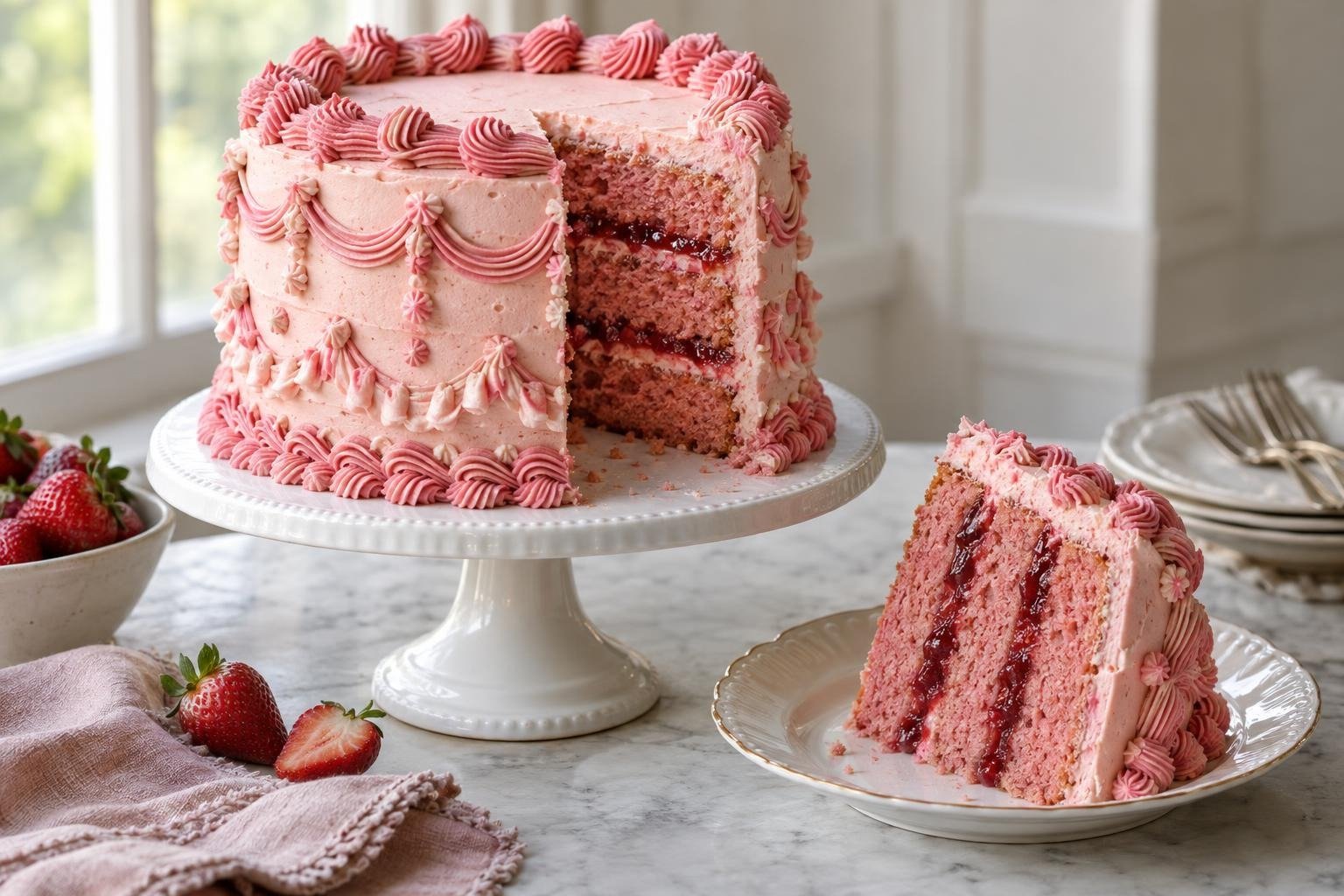
Soft pink layers, concentrated strawberry aroma, a bright ribbon of preserves, and rows of extravagant buttercream piping give this vintage strawberry Lambeth cake recipe its unmistakable charm. The crumb is tender but sturdy enough to stack, while the tangy berry filling keeps all that vanilla buttercream from becoming one sweet note. When sliced, the pale strawberry cake and vivid jam create a dramatic interior worthy of the frilly exterior.
I reduce the strawberry puree before it enters the batter, which concentrates flavor without flooding the cake with excess water. Freeze-dried strawberry powder adds another layer of berry flavor while behaving more like a dry ingredient, so the crumb remains stable. For the decoration, I keep the buttercream slightly firmer than ordinary cake frosting and chill the coated cake before piping. That gives the shells, swags, and ruffles crisp definition instead of droopy little buttercream curtains.
What Makes this Strawberry Cake So Frickin’ Good
- Reducing the strawberry puree removes excess water while concentrating the fruit’s flavor, color, and natural acidity.
- Freeze-dried strawberry powder strengthens the berry flavor without adding moisture that could make the layers heavy or gummy.
- Butter, oil, and sour cream perform different jobs: butter contributes flavor, oil keeps the refrigerated crumb tender, and sour cream supports moisture and structure.
- A buttercream dam contains the strawberry preserves, preventing the filling from squeezing into the outer frosting when the layers are stacked.
- The firm American-style buttercream crusts lightly when chilled, helping intricate Lambeth shells, swags, ropes, and ruffles hold their shape.
Ingredient Notes for Vintage Strawberry Lambeth Cake
- Strawberries: Fresh or frozen berries work because they are cooked into a reduction. Frozen fruit can go directly into the saucepan, but it may need a few additional minutes for the excess water to evaporate.
- Freeze-dried strawberries: Grind the berries into a fine powder and remove any hard pieces before measuring. The powder delivers concentrated flavor and also absorbs a small amount of liquid in the batter.
- All-purpose flour: Its moderate protein content gives the layers enough strength for stacking without producing the chewy crumb associated with higher-protein bread flour.
- Unsalted butter and oil: Softened butter traps air during creaming and contributes flavor. Neutral oil remains fluid when chilled, helping the decorated cake retain a tender mouthfeel.
- Sour cream: Full-fat sour cream supplies moisture, fat, and acidity. Bring it to room temperature so it blends smoothly rather than chilling and tightening the creamed butter.
- Strawberry preserves: Choose a thick preserve rather than a loose sauce. Stirring in lemon juice sharpens the fruit flavor, while straining large pieces makes the cake easier to fill and slice.
- Confectioners’ sugar: The sugar and its small amount of starch provide the structure required for Lambeth piping. Sifting removes lumps that could block fine star and petal tips.
- Gel food coloring: Concentrated gel colors the buttercream without introducing enough liquid to soften the piping consistency. Use a small measured amount, then deepen individual portions as needed.
Expert Baking Tips
- Weigh the cooked strawberry reduction rather than judging it only by volume. Too much puree introduces enough water to weaken the crumb, while an over-reduced paste will be difficult to distribute evenly.
- Keep the cake ingredients near room temperature. If the eggs or dairy are cold, the butter mixture can curdle; pause and warm the outside of the bowl briefly with a warm towel before continuing.
- Do not overmix after adding the flour. Finish the final streaks with a flexible spatula, scraping through the bottom of the bowl where pockets of dry flour and dense butter often hide.
- Practice each Lambeth border on parchment before piping the cake. Scrape the practice buttercream back into its bag as long as it remains cool, smooth, and free from crumbs.
- If the piped shells look ragged, the buttercream may be too cold. Knead the piping bag gently with warm hands. If the swags slump, refrigerate the bag for 5 to 10 minutes before continuing.
Ingredients for Vintage Strawberry Lambeth Cake
- 250 g fresh or frozen strawberries (Hulled if fresh; for the strawberry reduction)
- 25 g freeze-dried strawberries (Ground into a fine powder)
- 320 g all-purpose flour (Spooned and leveled if not weighed)
- 10 g baking powder (Approximately 2 1/2 teaspoons)
- 4 g fine sea salt (For the cake batter)
- 170 g unsalted butter (Softened to 20 to 22°C for the cake)
- 300 g granulated sugar (For the cake batter)
- 45 g neutral vegetable oil (Such as canola or grapeseed oil)
- 150 g large eggs (About 3 large eggs without shells, at room temperature)
- 10 g pure vanilla extract (For the cake batter)
- 80 g whole milk (At room temperature)
- 100 g full-fat sour cream (At room temperature)
- 10 g unsalted butter (Softened, for greasing the pans)
- 240 g thick strawberry preserves (Strained if the fruit pieces are large)
- 10 g fresh lemon juice (For the strawberry filling)
- 570 g unsalted butter (Softened to 20 to 22°C for the buttercream)
- 950 g confectioners’ sugar (Sifted)
- 75 g heavy cream (At room temperature)
- 15 g pure vanilla extract (For the buttercream)
- 3 g fine sea salt (For the buttercream)
- 2 g pink gel food coloring (Divide between pale and deeper pink buttercream)
How to Make Vintage Strawberry Lambeth Cake
- STEP 1). Reduce and cool the strawberries Place the strawberries in a small heavy-bottomed saucepan and cook over medium heat, stirring and crushing the fruit frequently, until the mixture is thick, glossy, and reduced to 100 g, about 10 to 14 minutes. A spatula drawn across the pan should leave a trail that remains visible for several seconds. Transfer the reduction to a shallow bowl and cool completely to room temperature. Warm puree can melt the creamed butter and reduce the batter’s aeration.
- STEP 2). Prepare the pans and dry ingredients Heat the oven to 175°C or 350°F with a rack in the center. Grease three 6-inch round cake pans with the 10 g softened butter, line the bottoms with parchment, and lightly grease the parchment. Grind the freeze-dried strawberries in a food processor or spice grinder, then sift them into a medium bowl with the flour, baking powder, and salt. Whisk for 30 seconds so the leavening and berry powder are evenly dispersed.
- STEP 3). Cream the butter, sugar, and oil Fit a stand mixer with the paddle attachment. Beat the 170 g softened butter and granulated sugar on medium speed for 3 minutes, stopping once to scrape the bowl and paddle. The mixture should look noticeably lighter and slightly fluffy, not greasy. Add the oil gradually and beat for another minute until emulsified. Proper aeration creates a fine crumb, but excessively warm butter will look shiny and will not hold the tiny air pockets needed for lift.
- STEP 4). Finish and divide the strawberry batter Add the eggs to the creamed mixture one at a time on medium-low speed, mixing until each disappears before adding the next, then blend in the vanilla. Whisk the cooled strawberry reduction, milk, and sour cream together. On low speed, add the dry ingredients in three additions, alternating with the strawberry mixture in two additions. Stop when only a few flour streaks remain, then fold by hand until smooth. Divide about 440 g of batter into each prepared pan and level the tops.
- STEP 5). Bake and cool the cake layers Bake all three pans on the center rack for 25 to 30 minutes, rotating their positions after 20 minutes only if the oven browns unevenly. The cakes are done when the centers spring back under a light touch, the edges begin to pull from the pans, and a skewer returns with a few moist crumbs but no wet batter. Cool in the pans for 15 minutes, turn onto wire racks, remove the parchment, and cool completely before wrapping or assembling.
- STEP 6). Prepare the firm vanilla buttercream Clean the mixer bowl and beat the 570 g softened butter with the paddle on medium speed for 3 minutes until smooth and slightly pale. Add the sifted confectioners’ sugar in four additions on low speed, alternating with 60 g of the cream. Add the vanilla and salt, then beat on medium-low for 2 minutes. Mix in the remaining 15 g cream. The buttercream should form a firm peak with a softly curved tip; beat in the pink gel coloring until evenly tinted.
- STEP 7). Fill, stack, and crumb-coat the cake Level domed cake tops with a serrated knife if necessary. Stir the strawberry preserves with the lemon juice. Secure one layer to a cake board with buttercream, pipe a thick buttercream dam around its edge, and spread 120 g filling inside without crossing the dam. Repeat with the second layer, then place the final layer upside down for a flat top. Apply a thin crumb coat over the cake with an offset spatula and chill uncovered for 30 minutes until firm.
- STEP 8). Apply the smooth buttercream finish Reserve approximately 700 g buttercream for piping and use the remainder to cover the chilled cake. Spread a generous coat over the top and sides, then refine it with a bench scraper held vertically against the turning cake. Fill gaps and scrape again until the surface is smooth and about 6 mm thick. Chill for 20 minutes. Divide the reserved buttercream between piping bags fitted with open-star, petal, and round tips, deepening part of it with additional coloring already measured into the formula.
- STEP 9). Pipe the Lambeth decoration and serve Use a toothpick or decorating scribe to mark evenly spaced points around the chilled cake. Pipe overlapping shells along the top and bottom borders, then connect the side marks with two layers of swags. Add petal-tip ruffles, star-tip flourishes, and small round-tip dots where the swags meet, keeping steady pressure and releasing before lifting each tip. Chill the finished cake for 20 minutes to set the design, then stand it at room temperature for 30 to 45 minutes before slicing with a warm, dry knife.
Storage and Freezing
- Storage: Keep the decorated cake covered in the refrigerator for up to 4 days. A tall cake container protects the piped borders from damage and prevents the buttercream from absorbing refrigerator odors.
- Freezing: Freeze unfrosted, completely cooled layers wrapped twice in plastic and once in foil for up to 2 months. The assembled cake may be frozen for up to 1 month, but delicate piping can be damaged by wrapping and condensation.
- Thawing: Thaw wrapped cake layers overnight in the refrigerator before unwrapping.
- Thaw an assembled cake uncovered in its container in the refrigerator, then bring it gradually to room temperature to limit condensation.
- Serving: Let the refrigerated cake stand at room temperature for 30 to 45 minutes before cutting. The buttercream should feel cool but yielding, and the cake crumb should no longer feel firm from the refrigerator.
Frequently Asked Questions
What makes a strawberry cake a Lambeth cake?
A Lambeth cake is defined primarily by its layered overpiping rather than by a particular cake flavor. Repeated shells, swags, ruffles, ropes, and dots create the ornate vintage appearance associated with this decorating style.
This version pairs that decoration with strawberry cake layers and preserves. The buttercream is intentionally firm because softer whipped frosting would not maintain the sharply defined borders or suspended swags.
Why does the strawberry puree need to be reduced?
Fresh strawberries contain substantial water, and adding them directly can dilute the batter and weaken its structure. Cooking the fruit down concentrates its sugars, acids, pigments, and aromatic compounds while removing excess moisture.
Stop when the puree weighs 100 g and a spatula leaves a temporary trail across the saucepan. A loose, watery puree can produce a dense or gummy band near the bottom of each layer.
How do I keep the strawberry filling from leaking out?
Use thick preserves and pipe an unbroken buttercream dam around the edge of each cake layer. Keep the filling below the top of that dam and leave a small space before the cake’s outer edge.
Chilling the crumb-coated cake also stabilizes the stack before the final frosting is applied. If the layers slide while stacking, the filling is too loose, too warm, or spread too thickly.
Which piping tips create the vintage Lambeth design?
Small and medium open-star tips produce shells, stars, and textured ropes, while a petal tip creates ruffles. A small round tip adds dots, strings, and fine connecting details. Exact tip numbers vary by manufacturer, so the opening shape matters more than the printed number.
Build the decoration from larger borders to smaller accents. That sequence establishes the structure first and lets the final dots cover joins or small gaps.
Can I decorate the cake in advance?
The finished cake can be decorated one to two days before serving and stored covered in the refrigerator. Firm American-style buttercream protects the cake and holds the piped details well when kept cool.
Bring the cake out 30 to 45 minutes before serving so the butter and crumb can soften. Avoid leaving it in direct sunlight or a warm room, where suspended swags and tall borders may lose definition.
More Ridiculously Delicious Cakes
- Strawberry Layer Cake with Soft Berry-Flavored Layers
- Bakery-Style Strawberry Shortcake Layer Cake with Stabilized Cream
- Strawberry Rhubarb Coffee Cake with Soft, Tender Crumb
- Bakery-Style Strawberry Milkshake Birthday Cake
- Bakery-Style Vintage Blue Buttercream Birthday Cake
Vintage Strawberry Lambeth Cake
Ingredients
Equipment
Method
- Place the strawberries in a small heavy-bottomed saucepan and cook over medium heat, stirring and crushing the fruit frequently, until the mixture is thick, glossy, and reduced to 100 g, about 10 to 14 minutes. A spatula drawn across the pan should leave a trail that remains visible for several seconds. Transfer the reduction to a shallow bowl and cool completely to room temperature. Warm puree can melt the creamed butter and reduce the batter’s aeration.
- Heat the oven to 175°C or 350°F with a rack in the center. Grease three 6-inch round cake pans with the 10 g softened butter, line the bottoms with parchment, and lightly grease the parchment. Grind the freeze-dried strawberries in a food processor or spice grinder, then sift them into a medium bowl with the flour, baking powder, and salt. Whisk for 30 seconds so the leavening and berry powder are evenly dispersed.
- Fit a stand mixer with the paddle attachment. Beat the 170 g softened butter and granulated sugar on medium speed for 3 minutes, stopping once to scrape the bowl and paddle. The mixture should look noticeably lighter and slightly fluffy, not greasy. Add the oil gradually and beat for another minute until emulsified. Proper aeration creates a fine crumb, but excessively warm butter will look shiny and will not hold the tiny air pockets needed for lift.
- Add the eggs to the creamed mixture one at a time on medium-low speed, mixing until each disappears before adding the next, then blend in the vanilla. Whisk the cooled strawberry reduction, milk, and sour cream together. On low speed, add the dry ingredients in three additions, alternating with the strawberry mixture in two additions. Stop when only a few flour streaks remain, then fold by hand until smooth. Divide about 440 g of batter into each prepared pan and level the tops.
- Bake all three pans on the center rack for 25 to 30 minutes, rotating their positions after 20 minutes only if the oven browns unevenly. The cakes are done when the centers spring back under a light touch, the edges begin to pull from the pans, and a skewer returns with a few moist crumbs but no wet batter. Cool in the pans for 15 minutes, turn onto wire racks, remove the parchment, and cool completely before wrapping or assembling.
- Clean the mixer bowl and beat the 570 g softened butter with the paddle on medium speed for 3 minutes until smooth and slightly pale. Add the sifted confectioners’ sugar in four additions on low speed, alternating with 60 g of the cream. Add the vanilla and salt, then beat on medium-low for 2 minutes. Mix in the remaining 15 g cream. The buttercream should form a firm peak with a softly curved tip; beat in the pink gel coloring until evenly tinted.
- Level domed cake tops with a serrated knife if necessary. Stir the strawberry preserves with the lemon juice. Secure one layer to a cake board with buttercream, pipe a thick buttercream dam around its edge, and spread 120 g filling inside without crossing the dam. Repeat with the second layer, then place the final layer upside down for a flat top. Apply a thin crumb coat over the cake with an offset spatula and chill uncovered for 30 minutes until firm.
- Reserve approximately 700 g buttercream for piping and use the remainder to cover the chilled cake. Spread a generous coat over the top and sides, then refine it with a bench scraper held vertically against the turning cake. Fill gaps and scrape again until the surface is smooth and about 6 mm thick. Chill for 20 minutes. Divide the reserved buttercream between piping bags fitted with open-star, petal, and round tips, deepening part of it with additional coloring already measured into the formula.
- Use a toothpick or decorating scribe to mark evenly spaced points around the chilled cake. Pipe overlapping shells along the top and bottom borders, then connect the side marks with two layers of swags. Add petal-tip ruffles, star-tip flourishes, and small round-tip dots where the swags meet, keeping steady pressure and releasing before lifting each tip. Chill the finished cake for 20 minutes to set the design, then stand it at room temperature for 30 to 45 minutes before slicing with a warm, dry knife.
Notes
- Weigh the cooked strawberry reduction rather than judging it only by volume. Too much puree introduces enough water to weaken the crumb, while an over-reduced paste will be difficult to distribute evenly.
- Keep the cake ingredients near room temperature. If the eggs or dairy are cold, the butter mixture can curdle; pause and warm the outside of the bowl briefly with a warm towel before continuing.
- Do not overmix after adding the flour. Finish the final streaks with a flexible spatula, scraping through the bottom of the bowl where pockets of dry flour and dense butter often hide.
- Practice each Lambeth border on parchment before piping the cake. Scrape the practice buttercream back into its bag as long as it remains cool, smooth, and free from crumbs.
- If the piped shells look ragged, the buttercream may be too cold. Knead the piping bag gently with warm hands. If the swags slump, refrigerate the bag for 5 to 10 minutes before continuing.