Place the strawberries in a small heavy-bottomed saucepan and cook over medium heat, stirring and crushing the fruit frequently, until the mixture is thick, glossy, and reduced to 100 g, about 10 to 14 minutes. A spatula drawn across the pan should leave a trail that remains visible for several seconds. Transfer the reduction to a shallow bowl and cool completely to room temperature. Warm puree can melt the creamed butter and reduce the batter’s aeration.
Heat the oven to 175°C or 350°F with a rack in the center. Grease three 6-inch round cake pans with the 10 g softened butter, line the bottoms with parchment, and lightly grease the parchment. Grind the freeze-dried strawberries in a food processor or spice grinder, then sift them into a medium bowl with the flour, baking powder, and salt. Whisk for 30 seconds so the leavening and berry powder are evenly dispersed.
Fit a stand mixer with the paddle attachment. Beat the 170 g softened butter and granulated sugar on medium speed for 3 minutes, stopping once to scrape the bowl and paddle. The mixture should look noticeably lighter and slightly fluffy, not greasy. Add the oil gradually and beat for another minute until emulsified. Proper aeration creates a fine crumb, but excessively warm butter will look shiny and will not hold the tiny air pockets needed for lift.
Add the eggs to the creamed mixture one at a time on medium-low speed, mixing until each disappears before adding the next, then blend in the vanilla. Whisk the cooled strawberry reduction, milk, and sour cream together. On low speed, add the dry ingredients in three additions, alternating with the strawberry mixture in two additions. Stop when only a few flour streaks remain, then fold by hand until smooth. Divide about 440 g of batter into each prepared pan and level the tops.
Bake all three pans on the center rack for 25 to 30 minutes, rotating their positions after 20 minutes only if the oven browns unevenly. The cakes are done when the centers spring back under a light touch, the edges begin to pull from the pans, and a skewer returns with a few moist crumbs but no wet batter. Cool in the pans for 15 minutes, turn onto wire racks, remove the parchment, and cool completely before wrapping or assembling.
Clean the mixer bowl and beat the 570 g softened butter with the paddle on medium speed for 3 minutes until smooth and slightly pale. Add the sifted confectioners’ sugar in four additions on low speed, alternating with 60 g of the cream. Add the vanilla and salt, then beat on medium-low for 2 minutes. Mix in the remaining 15 g cream. The buttercream should form a firm peak with a softly curved tip; beat in the pink gel coloring until evenly tinted.
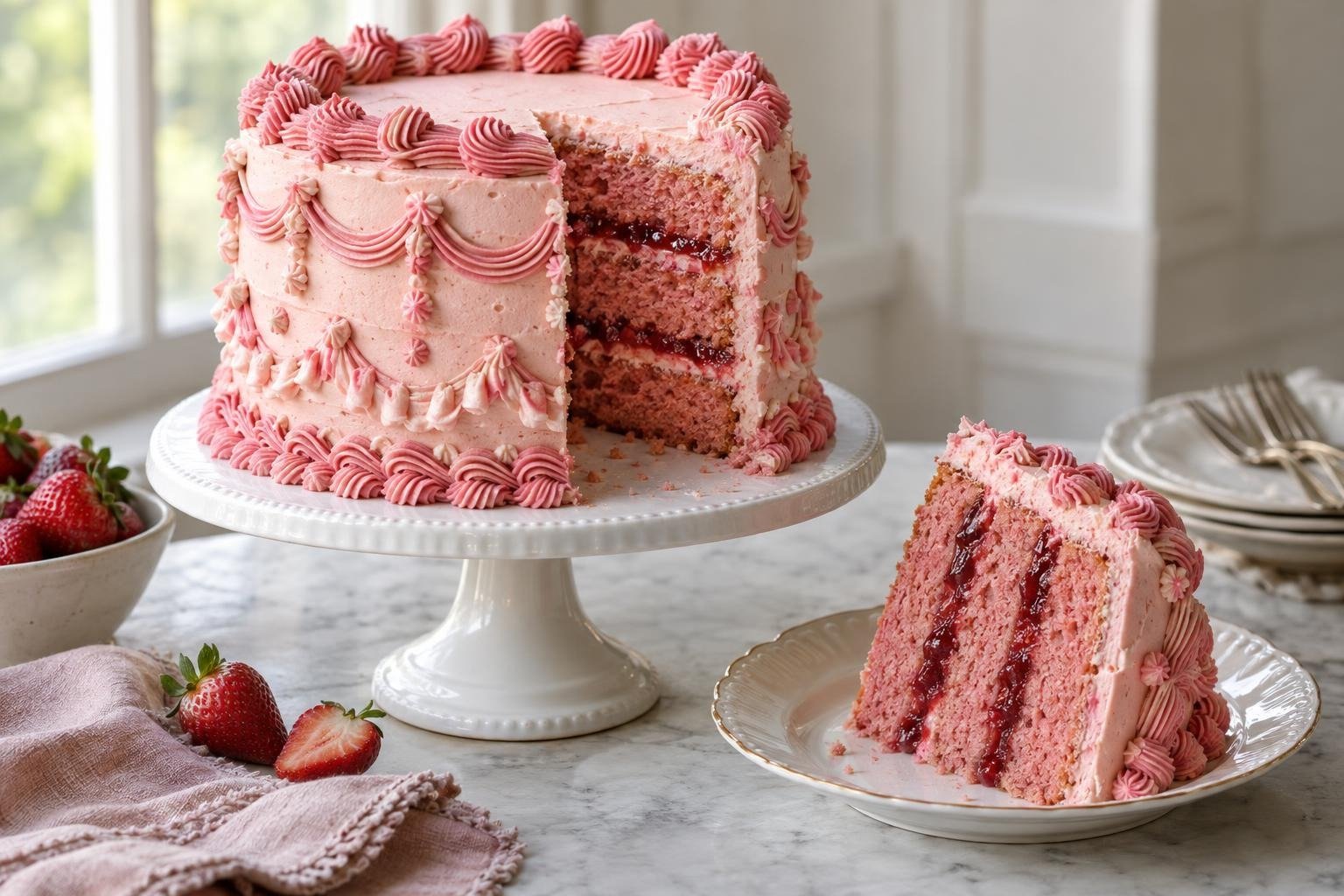
Level domed cake tops with a serrated knife if necessary. Stir the strawberry preserves with the lemon juice. Secure one layer to a cake board with buttercream, pipe a thick buttercream dam around its edge, and spread 120 g filling inside without crossing the dam. Repeat with the second layer, then place the final layer upside down for a flat top. Apply a thin crumb coat over the cake with an offset spatula and chill uncovered for 30 minutes until firm.
Reserve approximately 700 g buttercream for piping and use the remainder to cover the chilled cake. Spread a generous coat over the top and sides, then refine it with a bench scraper held vertically against the turning cake. Fill gaps and scrape again until the surface is smooth and about 6 mm thick. Chill for 20 minutes. Divide the reserved buttercream between piping bags fitted with open-star, petal, and round tips, deepening part of it with additional coloring already measured into the formula.
Use a toothpick or decorating scribe to mark evenly spaced points around the chilled cake. Pipe overlapping shells along the top and bottom borders, then connect the side marks with two layers of swags. Add petal-tip ruffles, star-tip flourishes, and small round-tip dots where the swags meet, keeping steady pressure and releasing before lifting each tip. Chill the finished cake for 20 minutes to set the design, then stand it at room temperature for 30 to 45 minutes before slicing with a warm, dry knife.