
Table of Contents
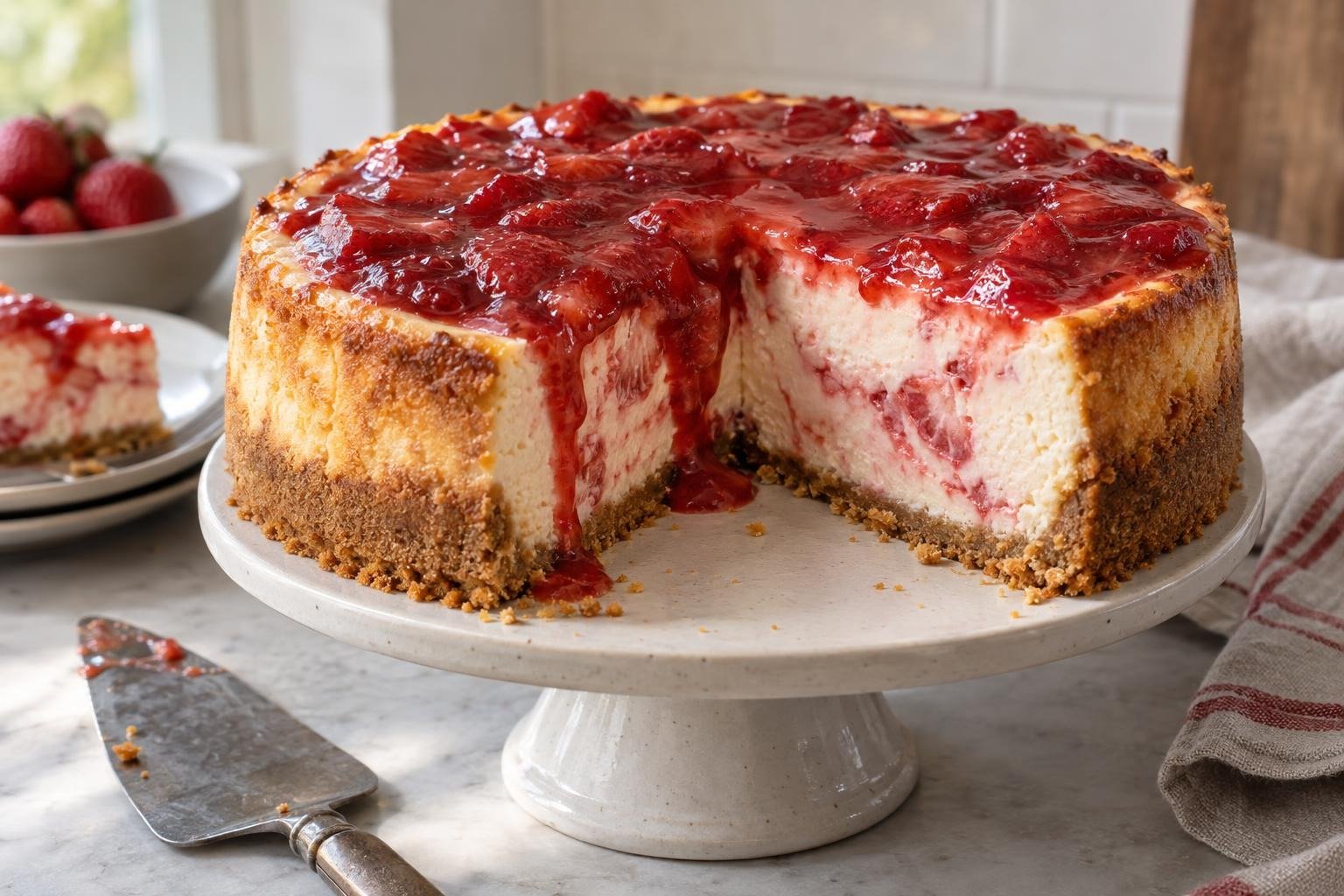
A buttery, lightly salty graham crust supports a cool pink filling with concentrated berry flavor, creamy texture, and ribbons of glossy strawberry sauce. This strawberry cheesecake is baked rather than set with gelatin, so each slice has the rich structure of classic cheesecake while fresh strawberries keep the flavor bright instead of candy-sweet.
I cook the strawberries before they touch the filling because reducing their water intensifies the flavor and protects the cheesecake from becoming loose. The cream cheese stays near 70°F, the mixer remains on low speed, and the cake comes out when the perimeter is set but the center still wobbles as one piece. A slow oven cool followed by a full eight-hour refrigerator chill finishes the set without turning the filling dry or dense.
What Makes this Strawberry Cheesecake So Ridiculously Good
- Cooking the strawberries removes excess water and concentrates their flavor before they are mixed into the fat-rich cream cheese filling.
- Four blocks of cream cheese provide enough fat and milk protein for a rich, sliceable 9-inch cheesecake without relying on gelatin.
- Cornstarch binds some of the moisture from the sour cream and strawberry reduction, helping the filling remain creamy while holding clean edges.
- Low-speed mixing limits incorporated air, which reduces dramatic rising, sinking, and cracking during baking and cooling.
- A water bath, gradual oven cooling, and an eight-hour chill control how gently the eggs set and give the cheesecake its smooth final texture.
Ingredient Notes for Strawberry Cheesecake with a Creamy Filling
- Brick cream cheese: Full-fat block-style cream cheese supplies the fat, protein, and structure for the filling. Bring it to about 70°F so it blends smoothly without prolonged mixing; whipped or tub-style cream cheese contains too much air or moisture for this formula.
- Fresh strawberries: Ripe berries provide the strongest color and aroma. Cooking them into a measured reduction concentrates their flavor and prevents raw fruit juice from thinning the cheesecake batter.
- Granulated sugar: Sugar sweetens the crust, sauce, and filling while also slowing egg-protein coagulation. This contributes to a softer, creamier set than an aggressively baked, low-sugar custard would have.
- Cornstarch: A small amount thickens the strawberry sauce, while the portion in the filling manages moisture from the fruit and sour cream. Whisk it thoroughly with the sugar to prevent dry starch pockets.
- Sour cream: Full-fat sour cream adds acidity and moisture, balancing the richness of the cream cheese. Bring it to room temperature so the batter stays fluid and combines without extra beating.
- Large eggs: Eggs set the cheesecake during baking. Room-temperature eggs incorporate quickly at low speed, helping avoid the foam and excess expansion that can lead to cracks.
Baking Tips Worth Knowing
- Use cream cheese that bends easily under light finger pressure but does not look greasy or partially melted. Cold lumps require excessive mixing, while overheated cream cheese can weaken the filling.
- Scrape the mixer bowl down to the base after the cream cheese, after the sugar, and before adding the eggs. Dense cream cheese often hides beneath the paddle and creates pale lumps in the finished slices.
- Keep the mixer on low once the eggs enter. Air bubbles expand in the oven, making the cheesecake rise dramatically before collapsing or cracking as it cools.
- Judge doneness by the movement of the center rather than waiting for the entire surface to become firm. A completely rigid center in the oven usually means the residual heat will take the filling past its creamiest stage.
- Plan to bake the cheesecake the day before serving. Eight hours of refrigeration lets the fat firm, the egg-thickened filling settle, and the strawberry flavor become more cohesive.
Ingredients for Strawberry Cheesecake
- 500 g fresh strawberries (Hulled and quartered)
- 100 g granulated sugar (For the strawberry sauce)
- 15 g fresh lemon juice (Brightens the cooked berry flavor)
- 8 g cornstarch (For thickening the strawberry sauce)
- 20 g cool water (For the cornstarch slurry)
- 200 g graham cracker crumbs (Finely ground)
- 30 g granulated sugar (For the crust)
- 1 g fine sea salt (For the crust)
- 85 g unsalted butter (Melted and cooled slightly)
- 900 g full-fat brick cream cheese (Softened to about 70°F)
- 200 g granulated sugar (For the cheesecake filling)
- 18 g cornstarch (For the cheesecake filling)
- 2 g fine sea salt (For the cheesecake filling)
- 180 g full-fat sour cream (At room temperature)
- 10 g pure vanilla extract (For aroma and flavor)
- 4 large eggs (About 200 g without shells, at room temperature)
How to Make Strawberry Cheesecake
- STEP 1). Prepare the oven, pan, and water bath Position a rack in the lower-middle of the oven and heat it to 325°F. Lightly grease a 9-inch springform pan, line the base with parchment, and wrap the outside in two wide layers of heavy-duty foil, keeping every seam above the rim. Set the wrapped pan inside a large roasting pan. Heat a kettle of water for the bath, but do not pour it into the roasting pan yet.
- STEP 2). Cook and cool the strawberry sauce Combine the strawberries, 100 g sugar, and lemon juice in a medium saucepan. Cook over medium heat for 12 to 16 minutes, stirring and crushing the fruit, until bubbling and noticeably reduced. Blend until smooth. Stir together 8 g cornstarch and 20 g cool water, whisk the slurry into the sauce, and boil for 1 minute. Transfer to a wide bowl and cool until no longer warm, stirring occasionally so steam can escape.
- STEP 3). Mix and prebake the graham crust Combine the graham crumbs, 30 g sugar, and 1 g salt in a mixing bowl. Stir in the melted butter until every crumb looks evenly moistened and the mixture holds when squeezed. Press it firmly across the base and about 1 inch up the sides of the prepared pan, using a flat-bottomed cup to compact it. Bake on a rimmed sheet for 10 minutes, then cool while preparing the filling.
- STEP 4). Mix the filling slowly until smooth Place the softened cream cheese in the mixer bowl and beat with the paddle on low speed for 2 minutes, stopping twice to scrape the bowl and paddle. Whisk 200 g sugar, 18 g cornstarch, and 2 g salt together, then add gradually and mix only until smooth. Blend in the sour cream, vanilla, and 150 g cooled strawberry sauce. Add the eggs one at a time on low, mixing about 20 seconds after each, just until no yellow streaks remain.
- STEP 5). Fill, swirl, and set up the water bath Pour the filling over the cooled crust and smooth the surface with an offset spatula. Spoon 90 g strawberry sauce in small dots over the batter, then drag a thin knife through the dots with only a few shallow passes to create a defined swirl without muddying the filling. Tap the pan gently twice to release large bubbles. Place the roasting pan in the oven and carefully add hot water until it reaches halfway up the springform pan.
- STEP 6). Bake until the center wobbles as one piece Bake at 325°F for 70 to 85 minutes without opening the door during the first hour. The outer 2 inches should look set and slightly puffed, while a 3-inch area in the center should wobble together when the pan is nudged; it must not ripple like liquid batter. An instant-read thermometer inserted near the center should register about 150 to 155°F. Remove the cheesecake from the oven only after these cues align.
- STEP 7). Cool gradually before refrigerating Turn off the oven, prop the door open about 2 inches, and leave the cheesecake in its water bath for 1 hour. Transfer the springform pan to a cooling rack, remove the foil, and run a thin knife around the upper edge to release any spots clinging to the pan. Cool at room temperature for 1 hour, until the pan no longer feels warm, then cover without touching the surface and refrigerate for at least 8 hours.
- STEP 8). Unmold, finish, and slice cleanly Set the chilled pan on a stable surface, release the springform ring, and transfer the cheesecake to a serving plate with a wide spatula. Stir the remaining strawberry sauce until spreadable, then spoon it over the top, leaving a narrow pink border visible. Let the cheesecake stand for 15 minutes before slicing. Dip a long thin knife in hot water, wipe it dry, and repeat between every cut to produce 12 clean slices.
Storage and Freezing
- Refrigerate: Cover the cheesecake without pressing wrap against the strawberry topping and refrigerate for up to 4 days.
- Freeze: Freeze untopped individual slices until firm, wrap each slice tightly, and place them in an airtight container for up to 1 month.
- Freeze the remaining strawberry sauce separately.
- Thaw: Unwrap frozen slices and thaw them covered in the refrigerator overnight. Add thawed sauce after the filling is fully defrosted.
- Serve: Let refrigerated slices stand at room temperature for 15 to 20 minutes for a creamier texture. Do not leave the cheesecake unrefrigerated for more than 2 hours.
Frequently Asked Questions
How do you tell when strawberry cheesecake is done?
The outer 2 inches should appear set and slightly puffed, while the center should wobble as one cohesive area when the pan is nudged. A wet ripple or sloshing movement means the egg-thickened filling needs more time.
For an additional check, the center should register about 150 to 155°F on an instant-read thermometer. Remove the cheesecake before the center becomes completely rigid because residual heat continues setting it during the gradual cool.
Why did my strawberry cheesecake crack after baking?
Cracks commonly result from excess air, overbaking, abrupt cooling, or filling that sticks to the pan while contracting. Keep the mixer on low, especially after adding the eggs, and stop baking while the center still has a controlled wobble.
The water bath softens the oven heat, while the one-hour rest in the turned-off oven slows contraction. Running a thin knife around the upper edge after baking also prevents the cake from pulling against the pan as it cools.
What makes this baked strawberry cheesecake filling creamy instead of dense?
Room-temperature cream cheese combines smoothly without prolonged beating, and sour cream adds moisture and acidity. Sugar delays egg-protein setting, while cornstarch manages moisture from the sour cream and cooked strawberries without turning the filling rubbery.
Gentle baking matters just as much as the ingredient ratio. The filling should finish setting through residual heat and refrigeration, not by remaining in the oven until the center looks hard.
Can I make strawberry cheesecake ahead of serving?
A baked strawberry cheesecake is particularly well suited to advance preparation because it requires at least eight hours of chilling. Bake and cool it the day before serving, then refrigerate it in the springform pan so the sides remain protected.
Unmold and add the reserved strawberry sauce several hours before serving or shortly before slicing. The finished cheesecake keeps well for up to four refrigerated days, although the crust gradually softens as it absorbs moisture.
Does a water bath prevent every cheesecake crack?
A water bath reduces the risk by surrounding the pan with gentle, humid heat, but it cannot compensate for whipped-in air or severe overbaking. Proper foil wrapping also matters because water leaking into the springform pan can make the crust soggy.
Combine the bath with low-speed mixing, a visibly wobbling center, and gradual cooling. Small surface lines are cosmetic and can be covered with strawberry sauce, but deep cracks usually indicate excessive expansion or a filling baked beyond its ideal set.
More Ridiculously Delicious Cheesecakes
- Blueberry Cheesecake with a Creamy Filling
- White Chocolate Raspberry Cheesecake with Creamy Filling
- Raspberry Cheesecake with a Creamy Berry Filling
- Chocolate No-Bake Cheesecake Bars with a Creamy Filling
- Cherry Cheesecake with a Creamy Filling
Strawberry Cheesecake with a Creamy Filling
Ingredients
Equipment
Method
- Position a rack in the lower-middle of the oven and heat it to 325°F. Lightly grease a 9-inch springform pan, line the base with parchment, and wrap the outside in two wide layers of heavy-duty foil, keeping every seam above the rim. Set the wrapped pan inside a large roasting pan. Heat a kettle of water for the bath, but do not pour it into the roasting pan yet.
- Combine the strawberries, 100 g sugar, and lemon juice in a medium saucepan. Cook over medium heat for 12 to 16 minutes, stirring and crushing the fruit, until bubbling and noticeably reduced. Blend until smooth. Stir together 8 g cornstarch and 20 g cool water, whisk the slurry into the sauce, and boil for 1 minute. Transfer to a wide bowl and cool until no longer warm, stirring occasionally so steam can escape.
- Combine the graham crumbs, 30 g sugar, and 1 g salt in a mixing bowl. Stir in the melted butter until every crumb looks evenly moistened and the mixture holds when squeezed. Press it firmly across the base and about 1 inch up the sides of the prepared pan, using a flat-bottomed cup to compact it. Bake on a rimmed sheet for 10 minutes, then cool while preparing the filling.
- Place the softened cream cheese in the mixer bowl and beat with the paddle on low speed for 2 minutes, stopping twice to scrape the bowl and paddle. Whisk 200 g sugar, 18 g cornstarch, and 2 g salt together, then add gradually and mix only until smooth. Blend in the sour cream, vanilla, and 150 g cooled strawberry sauce. Add the eggs one at a time on low, mixing about 20 seconds after each, just until no yellow streaks remain.
- Pour the filling over the cooled crust and smooth the surface with an offset spatula. Spoon 90 g strawberry sauce in small dots over the batter, then drag a thin knife through the dots with only a few shallow passes to create a defined swirl without muddying the filling. Tap the pan gently twice to release large bubbles. Place the roasting pan in the oven and carefully add hot water until it reaches halfway up the springform pan.
- Bake at 325°F for 70 to 85 minutes without opening the door during the first hour. The outer 2 inches should look set and slightly puffed, while a 3-inch area in the center should wobble together when the pan is nudged; it must not ripple like liquid batter. An instant-read thermometer inserted near the center should register about 150 to 155°F. Remove the cheesecake from the oven only after these cues align.
- Turn off the oven, prop the door open about 2 inches, and leave the cheesecake in its water bath for 1 hour. Transfer the springform pan to a cooling rack, remove the foil, and run a thin knife around the upper edge to release any spots clinging to the pan. Cool at room temperature for 1 hour, until the pan no longer feels warm, then cover without touching the surface and refrigerate for at least 8 hours.
- Set the chilled pan on a stable surface, release the springform ring, and transfer the cheesecake to a serving plate with a wide spatula. Stir the remaining strawberry sauce until spreadable, then spoon it over the top, leaving a narrow pink border visible. Let the cheesecake stand for 15 minutes before slicing. Dip a long thin knife in hot water, wipe it dry, and repeat between every cut to produce 12 clean slices.
Notes
- Use cream cheese that bends easily under light finger pressure but does not look greasy or partially melted. Cold lumps require excessive mixing, while overheated cream cheese can weaken the filling.
- Scrape the mixer bowl down to the base after the cream cheese, after the sugar, and before adding the eggs. Dense cream cheese often hides beneath the paddle and creates pale lumps in the finished slices.
- Keep the mixer on low once the eggs enter. Air bubbles expand in the oven, making the cheesecake rise dramatically before collapsing or cracking as it cools.
- Judge doneness by the movement of the center rather than waiting for the entire surface to become firm. A completely rigid center in the oven usually means the residual heat will take the filling past its creamiest stage.
- Plan to bake the cheesecake the day before serving. Eight hours of refrigeration lets the fat firm, the egg-thickened filling settle, and the strawberry flavor become more cohesive.