Table of Contents
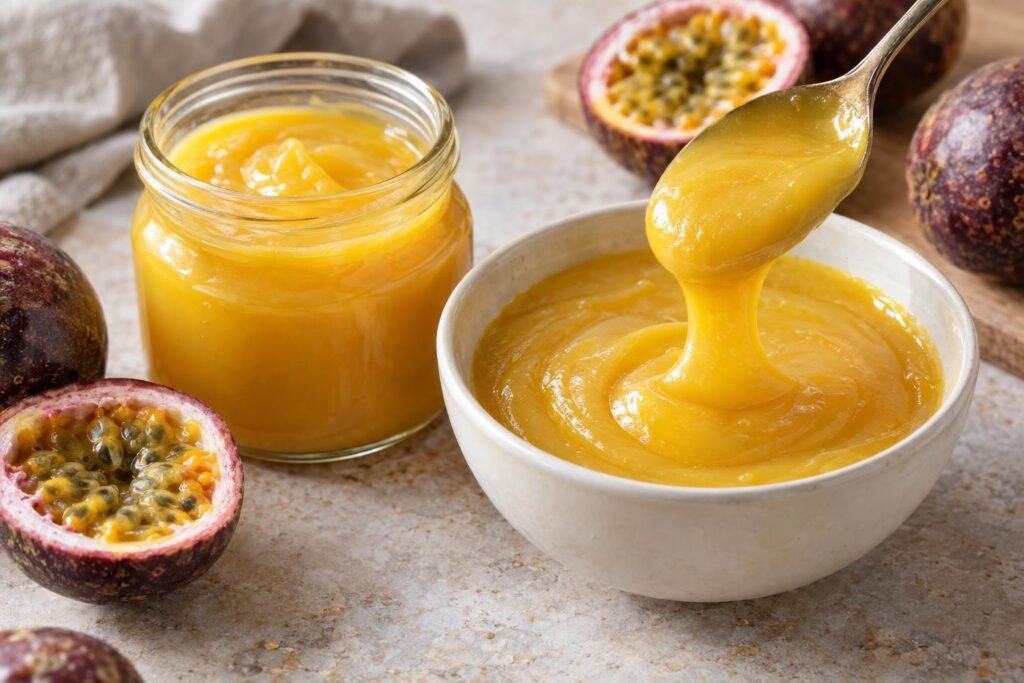
Bright tropical fragrance, sharp citrus-like acidity, and a buttery finish give this passion fruit curd its unmistakable personality. It cooks into a glossy golden sauce that becomes thick and spoonable after chilling, without turning stiff or gummy. The sugar softens the fruit’s tart edge rather than covering it, while whole eggs and extra yolks provide enough structure for cake layers, cupcakes, tart shells, or a very respectable swipe across a warm scone.
I combine the sugar and cornstarch before adding the eggs so the starch disperses without lumps, then cook the curd slowly in a nonreactive saucepan. Temperature and texture matter more than the clock: the finished mixture should reach 82 to 84°C, coat a spatula, and leave a clean trail when stirred. Straining removes any cooked egg particles, while blending in softened butter below 65°C creates the smooth emulsion and rich finish that make fruit curd so effing satisfying.

Why This Recipe Turns Out So Good
- A nearly equal balance of strained passion fruit puree and sugar preserves the fruit’s assertive acidity while keeping the finished curd pleasantly tangy rather than aggressively sour.
- Whole eggs provide water and protein for structure, while two additional yolks contribute fat, emulsifiers, color, and a rounder custard texture.
- A small amount of cornstarch reinforces the egg network, helping the chilled curd remain thick enough for cupcakes without giving it a starchy or pudding-like finish.
- Cooking to 82 to 84°C properly thickens the eggs and starch while providing a clear, repeatable doneness cue that is more reliable than cooking time alone.
- Adding softened butter after the cooked base cools slightly preserves a brighter fruit flavor and forms a stable, glossy emulsion instead of leaving melted fat on the surface.
Ingredient Notes for Passion Fruit Curd with a Smooth Tangy Finish
- Passion fruit puree: Use unsweetened, single-strength passion fruit puree or strained fresh pulp. Weigh it after removing the seeds. Sweetened puree changes the sugar balance, and undiluted concentrate can make the curd excessively acidic.
- Granulated sugar: Sugar balances the fruit’s acidity, delays egg coagulation, and helps the curd remain smooth. Reducing it substantially can produce a sharper flavor and a less predictable cooked texture.
- Whole eggs: Whole eggs supply the proteins that set the curd. Bring them close to room temperature so they combine readily with the sugar and heat more evenly.
- Egg yolks: Additional yolks deepen the color and provide lecithin, a natural emulsifier that helps the passion fruit base and butter stay smoothly combined.
- Cornstarch: This modest quantity supports a thick, spoonable chilled consistency suitable for cupcakes and layer cakes. Mix it thoroughly with the sugar before any liquid is added to prevent lumps.
- Unsalted butter: Butter softens the fruit’s tartness and gives the curd a silky finish. Cut it into small cubes and soften it to about 18 to 21°C so it emulsifies without leaving greasy streaks.
- Fine sea salt: A small amount sharpens the tropical flavor and keeps the sweetness from tasting flat. Fine salt dissolves more evenly than coarse crystals.
Good to Know
- Judge doneness with both temperature and texture. A thermometer confirms adequate cooking, while the spatula trail shows that enough water has evaporated and the thickening system has developed.
- Keep the heat moderate and stir continuously once the mixture begins to warm. High heat can coagulate egg against the saucepan before the center reaches the correct temperature.
- Measure 150 g of puree after straining. Including seeds or using an estimated volume of seedy pulp changes the usable fruit quantity and can leave the finished curd thinner than intended.
- Do not evaluate the final thickness while the curd is hot. Egg proteins, starch, and butter all continue to firm as the curd cools, so allow the full four-hour chill before troubleshooting.
- For passion fruit curd for cupcakes, chill it completely and pipe it into a shallow cavity surrounded by a buttercream dam. Overfilling can make the cake split or push curd through the frosting.
Ingredients for Passion Fruit Curd
- 150 g unsweetened passion fruit puree (about 2/3 cup, single-strength and strained before weighing)
- 150 g granulated sugar (3/4 cup)
- 8 g cornstarch (1 tablespoon)
- 1 g fine sea salt (1/4 teaspoon)
- 3 large eggs (about 150 g without shells, brought close to room temperature)
- 2 large egg yolks (about 36 g, brought close to room temperature)
- 113 g unsalted butter (1/2 cup, cut into small cubes and softened to 18 to 21°C)
How to Make Passion Fruit Curd
- STEP 1). Prepare the puree, butter, and equipment Set a fine-mesh sieve over a medium heatproof bowl and place a tall blending jug nearby. If using fresh passion fruit pulp, press it through the sieve, then weigh exactly 150 g of the strained puree. Cut the butter into small cubes and let it soften to 18 to 21°C. Use a nonreactive stainless steel saucepan because prolonged contact between acidic fruit and reactive metals can create a metallic flavor and dull the curd’s golden color.
- STEP 2). Whisk the curd base until completely uniform Combine the sugar, cornstarch, and salt in the saucepan, whisking thoroughly to break up every visible starch lump. Add the whole eggs and yolks, then whisk until the mixture is smooth and slightly lighter, about 45 seconds. Gradually pour in the passion fruit puree while whisking continuously. Scrape around the base and corners with a silicone spatula; the uncooked mixture should look fluid and homogeneous, without dry sugar, streaks of egg white, or pockets of cornstarch.
- STEP 3). Cook gently to the correct temperature Place the saucepan over medium-low heat and cook for 8 to 12 minutes, stirring constantly with the spatula and sweeping the bottom, corners, and sides. As the eggs and starch thicken, the mixture will change from foamy and fluid to glossy and custard-like. Reduce the heat if steam becomes vigorous or you see bubbling around the edge. Remove the pan when the curd reaches 82 to 84°C, coats the spatula, and holds a clean trail for one second when stirred.
- STEP 4). Strain and emulsify with the softened butter Immediately pour the hot curd through the clean fine-mesh sieve into the blending jug, pressing gently with the spatula but not forcing cooked particles through. Stir for 3 to 5 minutes, until the temperature drops to 60 to 65°C. Add the softened butter in three additions, blending after each addition with the immersion blender head held below the surface. Continue just until glossy and completely smooth, avoiding excess air that would make the finished curd appear foamy.
- STEP 5). Cover, chill, and assess the final consistency Transfer the finished curd to a shallow airtight container and press plastic wrap or a reusable food-safe cover directly against the surface to prevent a skin. Let it cool at room temperature for no longer than 30 minutes, then refrigerate for at least 4 hours. Once fully chilled, stir gently with a spatula. It should hold soft ridges and cling to a spoon while remaining supple enough to spread or pipe into a cupcake without tearing the crumb.
Storage and Freezing
- Refrigeration: Keep the curd in a clean airtight container with a cover pressed against the surface.
- Refrigerate at 4°C or colder for up to 5 days.
- Freezing: Freeze the chilled curd in a freezer-safe container, leaving about 1 cm of headspace, for up to 2 months.
- Thawing: Thaw overnight in the refrigerator. Stir slowly with a spatula to restore an even, glossy consistency; vigorous whisking can incorporate unwanted bubbles.
- Serving: Keep the curd refrigerated until needed. Do not leave it at room temperature for more than 2 hours, and use a clean spoon whenever removing a portion.
Frequently Asked Questions
Why is my passion fruit curd runny after cooking?
Warm curd is naturally much looser than chilled curd, so refrigerate it for the full four hours before judging the consistency. Properly cooked curd should reach 82 to 84°C and coat a spatula before it leaves the saucepan.
If it remains pourable when cold, it may have been undercooked, measured with too much puree, or made with a diluted fruit product. Reheating finished curd can split the butter emulsion, so prevention is more reliable than recooking.
How do you tell when passion fruit curd is done?
The most reliable cue is a temperature of 82 to 84°C measured in the center of the mixture without touching the saucepan. The curd should look glossy, coat the back of a spatula, and briefly expose the pan when the spatula is drawn across the bottom.
Large bubbles or scrambled particles indicate excessive heat rather than proper doneness. Remove the saucepan promptly at the target temperature and strain the curd before incorporating the butter.
What kind of passion fruit puree should I use for curd?
Unsweetened, single-strength passion fruit puree gives the most predictable acidity and sugar balance. Frozen puree may be thawed in the refrigerator, while fresh pulp should be pressed through a fine-mesh sieve and weighed after the seeds are removed.
Passion fruit concentrate varies considerably in strength. Dilute it according to the manufacturer’s directions to make single-strength puree before weighing 150 g. Avoid sweetened nectars because their added sugar and water can alter both flavor and thickness.
Can I use this passion fruit curd for cupcakes and layer cakes?
Fully chilled curd is thick enough for cupcake centers and enclosed cake fillings. Core each cupcake without cutting through the base, then add only enough curd to fill the cavity. For layer cakes, pipe a firm buttercream dam around the perimeter before spreading the curd inside it.
Keep the filled dessert refrigerated, particularly if it will not be served promptly. The curd remains spoonable rather than sliceably firm, so an unsupported or excessively thick layer can slide under the cake’s weight.
When should passion fruit curd be made before serving?
Prepare the curd at least four hours before assembly so the butter, eggs, and starch can reach their final chilled structure. Making it one day ahead is especially practical because the curd will be uniformly cold and easier to portion without dripping.
The flavor remains bright for up to five days under refrigeration. Stir it gently before using, but avoid vigorous whisking because incorporated air can reduce the glossy appearance and create bubbles in piped fillings.
More Ridiculously Delicious Desserts to Try
- Lemon Curd with Whole Eggs with Smooth, Spreadable Texture
- Raspberry Cake Filling with a Thick, Spreadable Texture
Passion Fruit Curd with a Smooth Tangy Finish
Ingredients
Equipment
Method
- Set a fine-mesh sieve over a medium heatproof bowl and place a tall blending jug nearby. If using fresh passion fruit pulp, press it through the sieve, then weigh exactly 150 g of the strained puree. Cut the butter into small cubes and let it soften to 18 to 21°C. Use a nonreactive stainless steel saucepan because prolonged contact between acidic fruit and reactive metals can create a metallic flavor and dull the curd’s golden color.
- Combine the sugar, cornstarch, and salt in the saucepan, whisking thoroughly to break up every visible starch lump. Add the whole eggs and yolks, then whisk until the mixture is smooth and slightly lighter, about 45 seconds. Gradually pour in the passion fruit puree while whisking continuously. Scrape around the base and corners with a silicone spatula; the uncooked mixture should look fluid and homogeneous, without dry sugar, streaks of egg white, or pockets of cornstarch.
- Place the saucepan over medium-low heat and cook for 8 to 12 minutes, stirring constantly with the spatula and sweeping the bottom, corners, and sides. As the eggs and starch thicken, the mixture will change from foamy and fluid to glossy and custard-like. Reduce the heat if steam becomes vigorous or you see bubbling around the edge. Remove the pan when the curd reaches 82 to 84°C, coats the spatula, and holds a clean trail for one second when stirred.
- Immediately pour the hot curd through the clean fine-mesh sieve into the blending jug, pressing gently with the spatula but not forcing cooked particles through. Stir for 3 to 5 minutes, until the temperature drops to 60 to 65°C. Add the softened butter in three additions, blending after each addition with the immersion blender head held below the surface. Continue just until glossy and completely smooth, avoiding excess air that would make the finished curd appear foamy.
- Transfer the finished curd to a shallow airtight container and press plastic wrap or a reusable food-safe cover directly against the surface to prevent a skin. Let it cool at room temperature for no longer than 30 minutes, then refrigerate for at least 4 hours. Once fully chilled, stir gently with a spatula. It should hold soft ridges and cling to a spoon while remaining supple enough to spread or pipe into a cupcake without tearing the crumb.
Notes
- Judge doneness with both temperature and texture. A thermometer confirms adequate cooking, while the spatula trail shows that enough water has evaporated and the thickening system has developed.
- Keep the heat moderate and stir continuously once the mixture begins to warm. High heat can coagulate egg against the saucepan before the center reaches the correct temperature.
- Measure 150 g of puree after straining. Including seeds or using an estimated volume of seedy pulp changes the usable fruit quantity and can leave the finished curd thinner than intended.
- Do not evaluate the final thickness while the curd is hot. Egg proteins, starch, and butter all continue to firm as the curd cools, so allow the full four-hour chill before troubleshooting.
- For passion fruit curd for cupcakes, chill it completely and pipe it into a shallow cavity surrounded by a buttercream dam. Overfilling can make the cake split or push curd through the frosting.