Table of Contents
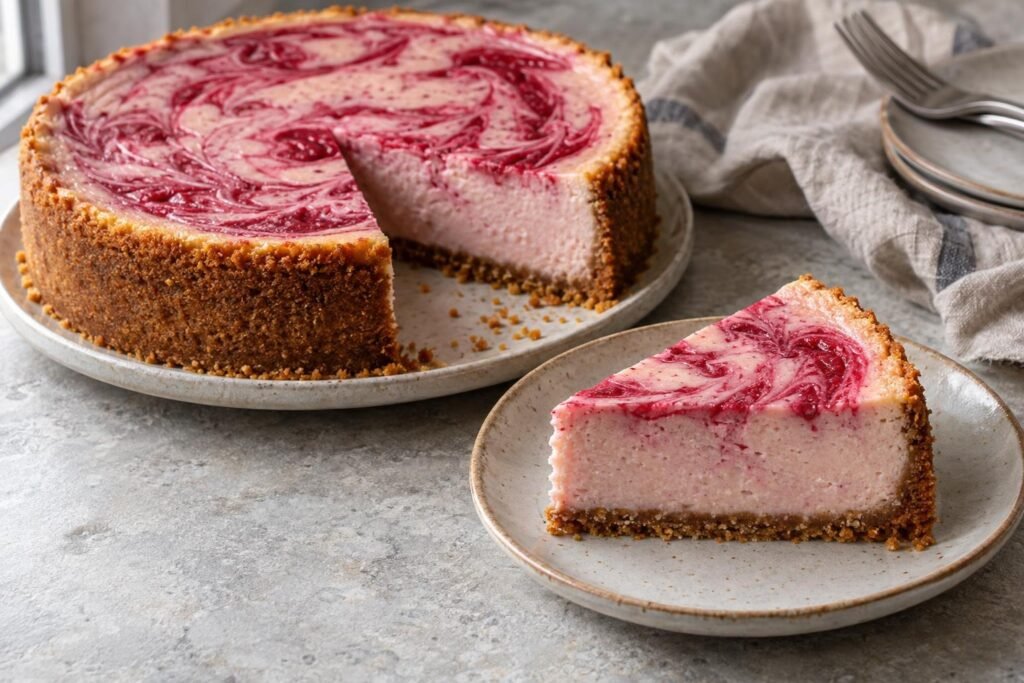
A buttery, lightly salted graham crust gives way to cool, creamy pink filling with concentrated berry flavor in every forkful. This raspberry cheesecake balances tangy cream cheese and sour cream with a seedless raspberry reduction, so the fruit tastes vivid without making the filling watery or icy.
I cook and weigh the raspberry reduction before mixing the filling because controlling that moisture is what keeps the cheesecake rich rather than loose. Low-speed mixing limits excess air, while a water bath moderates the heat around the 9-inch springform pan. Watch for a softly wobbling center rather than waiting for the entire cake to become firm, then cool it gradually and chill it for at least six hours before slicing.

Why You’ll Love this Raspberry Cheesecake
- Reducing the strained raspberry puree to a measured weight concentrates its flavor while removing excess water that could soften the cheesecake filling.
- Room-temperature cream cheese, sour cream, and eggs combine smoothly with less mixing, helping prevent lumps without whipping excessive air into the batter.
- Cornstarch supports the filling and thickens the raspberry reduction, giving chilled slices clean edges while preserving a creamy mouthfeel.
- A hot water bath buffers the oven heat around the springform pan, allowing the edges and center to set more evenly.
- Gradual oven cooling followed by a full six-hour refrigerator chill lets the egg and dairy structure stabilize before the cheesecake is released and cut.
Ingredient Notes for Raspberry Cheesecake with a Creamy Berry Filling
- Raspberries: Fresh or frozen raspberries both work because the fruit is cooked, strained, and reduced. Frozen berries can go into the saucepan without thawing. Straining removes the seeds, while reduction controls moisture and intensifies the berry flavor.
- Full-fat brick cream cheese: Use firm cream cheese sold in blocks rather than whipped or tub-style spread. Its fat and protein provide the dense, creamy structure this baked raspberry cheesecake needs. Bring it fully to room temperature so it blends without stubborn lumps.
- Granulated sugar: Sugar sweetens both the fruit and filling, but it also helps keep the cream cheese mixture supple. Scrape the bowl carefully after combining it with the cream cheese because dry pockets can remain near the bottom.
- Sour cream: Full-fat sour cream adds acidity, moisture, and a softer finish. Let it lose its refrigerator chill before mixing so the batter stays smooth and cohesive.
- Eggs: Large room-temperature eggs bind the filling as their proteins set in the oven. Add them individually on low speed and stop as soon as each disappears to avoid incorporating unnecessary air.
- Cornstarch: A small amount thickens the raspberry reduction and reinforces the filling. Whisk it thoroughly into the sugar for the filling so it disperses evenly instead of forming small white clumps.
- Graham cracker crust: Fine, evenly crushed crumbs pack more securely than coarse pieces. Melted butter binds the crumbs, while a little sugar encourages a crisp, cohesive base during the brief pre-bake.
Expert Baking Tips
- Weigh the strained raspberry puree after reducing it. Using more than 220 g introduces extra water, while reducing it too far can create a sticky, jam-like ribbon that does not blend smoothly into the filling.
- Room-temperature dairy should feel cool but pliable, not warm or oily. Cold cream cheese forms lumps, and prolonged mixing to remove those lumps can beat too much air into the batter.
- Keep the mixer on low once the sugar is added. Air bubbles expand in the oven and then contract during cooling, which can encourage an uneven surface or a sunken center.
- Add the water bath after placing the roasting pan on the oven rack. Carrying a pan full of hot water and cheesecake across the kitchen is awkward and increases the chance of water splashing into the batter.
- Judge doneness by the coordinated wobble in the center, not by browning. A liquid-looking ripple needs more time, but a completely rigid center is likely overbaked and may feel dry after chilling.
Ingredients for Raspberry Cheesecake
- 200 g graham cracker crumbs (finely ground, about 2 cups)
- 85 g unsalted butter (melted and cooled slightly, 6 tablespoons)
- 25 g granulated sugar (for the crust, 2 tablespoons)
- 1 pinch fine salt (for the crust)
- 340 g raspberries (fresh or frozen, about 3 cups)
- 70 g granulated sugar (for the raspberry reduction, about 1/3 cup)
- 15 g fresh lemon juice (1 tablespoon)
- 8 g cornstarch (for the raspberry reduction, 1 tablespoon)
- 15 g cool water (1 tablespoon, for the cornstarch slurry)
- 900 g full-fat brick cream cheese (four 8-ounce packages, softened to room temperature)
- 200 g granulated sugar (for the filling, 1 cup)
- 12 g cornstarch (for the filling, 1 1/2 tablespoons)
- 2 g fine salt (1/4 teaspoon)
- 120 g full-fat sour cream (1/2 cup, at room temperature)
- 10 ml pure vanilla extract (2 teaspoons)
- 4 large eggs (about 200 g without shells, at room temperature)
How to Make Raspberry Cheesecake
- STEP 1). Prepare the pan and heat the oven Position a rack in the lower-middle of the oven and preheat to 325°F. Lightly grease the inside of a 9-inch springform pan and line the base with a parchment round. Wrap the outside in two overlapping sheets of wide heavy-duty foil, bringing them above the seam without tearing them. Set the wrapped pan inside a large roasting pan. Heat a kettle of water for the bath, but do not pour it into the roasting pan yet.
- STEP 2). Cook and measure the raspberry reduction Combine the raspberries and 70 g sugar in a medium saucepan. Cook over medium heat for 6 to 8 minutes, stirring and crushing the berries until juicy and collapsed. Press the mixture through a fine-mesh sieve into the cleaned saucepan and discard the seeds. Simmer the puree until it weighs 220 g. Whisk the lemon juice, 8 g cornstarch, and cool water until smooth; whisk this slurry into the puree and boil gently for 1 minute. Cool completely.
- STEP 3). Mix and pre-bake the graham crust Combine the fine graham crumbs, melted butter, 25 g sugar, and salt in a bowl until every crumb looks evenly moistened. Tip the mixture into the prepared springform pan and press it firmly across the base with a flat-bottomed measuring cup, keeping the thickness level at the edges. Bake for 10 minutes, until fragrant and slightly darker. Place the pan on a rack for 15 minutes while preparing the filling, leaving the oven set to 325°F.
- STEP 4). Blend the cream cheese base on low speed Place the room-temperature cream cheese in the bowl of a stand mixer fitted with the paddle. Beat on low speed for about 1 minute, stopping twice to scrape the bowl and paddle, until smooth but not fluffy. Whisk the 200 g sugar, 12 g cornstarch, and salt together, then add them gradually. Mix on low for 1 to 2 minutes, scraping thoroughly, until the mixture is satiny and no dry sugar or visible cream cheese lumps remain.
- STEP 5). Finish the creamy raspberry filling Mix the sour cream and vanilla into the cream cheese base on low speed just until uniform. Add the eggs one at a time, mixing only until each yolk disappears and scraping the bowl after the second and fourth eggs. Reserve 40 g of the cooled raspberry reduction for swirling. Fold the remaining 180 g into the filling with a spatula until the color is even. The finished batter should be smooth, pourable, and minimally aerated, with no streaks at the bowl's bottom.
- STEP 6). Assemble the cheesecake and bake in a water bath Pour the raspberry filling over the cooled crust and smooth the surface. Dot the reserved reduction over the batter and draw a thin skewer through it a few times for a restrained swirl, without scraping the crust. Set the roasting pan in the oven, then carefully add enough hot water to reach halfway up the springform pan. Bake for 70 to 85 minutes. The edges should be set and slightly puffed, while the center 3 inches wobble together gently and register about 150°F to 155°F.
- STEP 7). Cool the cheesecake gradually Turn off the oven, prop the door open about 2 inches with a wooden spoon, and leave the cheesecake in the water bath for 1 hour. Remove the roasting pan carefully, lift out the springform pan, and discard the foil. Run a thin knife around the upper edge only if the cheesecake is gripping the pan. Cool uncovered on a rack for another 1 hour, until the pan is no longer warm. The center should look settled rather than fluid or raw.
- STEP 8). Chill, release, and cut clean slices Cover the cooled pan without touching the surface and refrigerate for at least 6 hours, preferably overnight. Set the chilled pan on a flat surface, release the springform ring, and transfer the cheesecake to a serving plate using a wide spatula if desired. For clean slices, dip a thin sharp knife in hot water, wipe it dry, and cut straight down. Clean and rewarm the blade between portions. The filling should hold a neat edge while remaining creamy.
Storage and Freezing
- Refrigeration: Keep the cheesecake covered in the refrigerator for up to 5 days. Store it in the springform base or in a rigid container so the crust and surface are protected.
- Freezing: Freeze the fully chilled cheesecake whole or in individual slices for up to 2 months. Place uncovered portions in the freezer until firm, then wrap them tightly and place them in an airtight container.
- Thawing: Unwrap frozen cheesecake and thaw it in a covered container in the refrigerator overnight. Refrigerated thawing protects the creamy texture and limits condensation on the surface.
- Serving: For the cleanest cuts, slice the cheesecake while cold. Let individual portions stand at room temperature for 15 to 20 minutes if you prefer a softer, creamier mouthfeel.
Frequently Asked Questions
How do you tell when raspberry cheesecake is done?
The outer 2 to 3 inches should look set and slightly puffed, while the center 3 inches move as one soft wobble when the pan is nudged. A fast, liquid ripple indicates that the center needs more time.
An instant-read thermometer inserted near the center should register about 150°F to 155°F. The cheesecake continues setting through gradual cooling and refrigeration, so waiting for a completely rigid center can produce a dry or grainy texture.
How long should raspberry cheesecake chill before slicing?
Allow at least 6 hours of refrigerator time after the cheesecake has completed its two-hour gradual cooling period. Overnight chilling is particularly convenient because the filling has ample time to become firm and evenly cold.
Cutting too early can make the center slump or cling heavily to the knife. A properly chilled slice should stand upright with a defined edge while still looking creamy rather than rubbery.
Why did my baked raspberry cheesecake crack?
Cracks commonly follow excess mixing, rapid temperature changes, or baking until the center is completely firm. Air incorporated into the batter expands and contracts, while overbaked egg proteins tighten enough to pull the surface apart.
Mix on low speed, use the water bath, and stop baking when the center still has a gentle coordinated wobble. Gradual cooling in the turned-off oven reduces sudden contraction, although small cracks can still occur without affecting flavor or texture.
Can I use frozen raspberries in this cheesecake?
Frozen raspberries are suitable because the fruit is cooked, strained, and reduced before it enters the filling. Add them to the saucepan directly from the freezer and expect the initial cooking stage to take a few minutes longer as they release their juice.
The important measurement is the finished 220 g reduction, not the volume of liquid released at the start. Cool it completely before mixing so it does not soften the cream cheese or warm the eggs.
Why is my raspberry cheesecake filling lumpy?
Lumps usually form when firm, cold cream cheese cannot blend evenly with sugar and other ingredients. Cold sour cream or eggs can also tighten the cream cheese mixture before it becomes smooth.
Bring the dairy and eggs to room temperature, smooth the cream cheese first, and scrape the bowl and paddle repeatedly. Once the eggs are added, avoid aggressive mixing to chase tiny lumps because that introduces air and can compromise the baked texture.
More Ridiculously Delicious Cheesecakes
- Creamy Vanilla Cheesecake with a Buttery Cookie Crust
- No-Bake Oreo Cheesecake with a Creamy Filling and Cookie Crust
- Classic New York Cheesecake with a Dense, Creamy Filling
- Japanese Cotton Cheesecake with a Light, Airy Texture
- Blueberry Cheesecake with a Creamy Filling
- Mango Cheesecake with a Smooth, Creamy Filling
- White Chocolate Raspberry Cheesecake with Creamy Filling
- Espresso Cheesecake with Creamy Filling
Raspberry Cheesecake with a Creamy Berry Filling
Ingredients
Equipment
Method
- Position a rack in the lower-middle of the oven and preheat to 325°F. Lightly grease the inside of a 9-inch springform pan and line the base with a parchment round. Wrap the outside in two overlapping sheets of wide heavy-duty foil, bringing them above the seam without tearing them. Set the wrapped pan inside a large roasting pan. Heat a kettle of water for the bath, but do not pour it into the roasting pan yet.
- Combine the raspberries and 70 g sugar in a medium saucepan. Cook over medium heat for 6 to 8 minutes, stirring and crushing the berries until juicy and collapsed. Press the mixture through a fine-mesh sieve into the cleaned saucepan and discard the seeds. Simmer the puree until it weighs 220 g. Whisk the lemon juice, 8 g cornstarch, and cool water until smooth; whisk this slurry into the puree and boil gently for 1 minute. Cool completely.
- Combine the fine graham crumbs, melted butter, 25 g sugar, and salt in a bowl until every crumb looks evenly moistened. Tip the mixture into the prepared springform pan and press it firmly across the base with a flat-bottomed measuring cup, keeping the thickness level at the edges. Bake for 10 minutes, until fragrant and slightly darker. Place the pan on a rack for 15 minutes while preparing the filling, leaving the oven set to 325°F.
- Place the room-temperature cream cheese in the bowl of a stand mixer fitted with the paddle. Beat on low speed for about 1 minute, stopping twice to scrape the bowl and paddle, until smooth but not fluffy. Whisk the 200 g sugar, 12 g cornstarch, and salt together, then add them gradually. Mix on low for 1 to 2 minutes, scraping thoroughly, until the mixture is satiny and no dry sugar or visible cream cheese lumps remain.
- Mix the sour cream and vanilla into the cream cheese base on low speed just until uniform. Add the eggs one at a time, mixing only until each yolk disappears and scraping the bowl after the second and fourth eggs. Reserve 40 g of the cooled raspberry reduction for swirling. Fold the remaining 180 g into the filling with a spatula until the color is even. The finished batter should be smooth, pourable, and minimally aerated, with no streaks at the bowl's bottom.
- Pour the raspberry filling over the cooled crust and smooth the surface. Dot the reserved reduction over the batter and draw a thin skewer through it a few times for a restrained swirl, without scraping the crust. Set the roasting pan in the oven, then carefully add enough hot water to reach halfway up the springform pan. Bake for 70 to 85 minutes. The edges should be set and slightly puffed, while the center 3 inches wobble together gently and register about 150°F to 155°F.
- Turn off the oven, prop the door open about 2 inches with a wooden spoon, and leave the cheesecake in the water bath for 1 hour. Remove the roasting pan carefully, lift out the springform pan, and discard the foil. Run a thin knife around the upper edge only if the cheesecake is gripping the pan. Cool uncovered on a rack for another 1 hour, until the pan is no longer warm. The center should look settled rather than fluid or raw.
- Cover the cooled pan without touching the surface and refrigerate for at least 6 hours, preferably overnight. Set the chilled pan on a flat surface, release the springform ring, and transfer the cheesecake to a serving plate using a wide spatula if desired. For clean slices, dip a thin sharp knife in hot water, wipe it dry, and cut straight down. Clean and rewarm the blade between portions. The filling should hold a neat edge while remaining creamy.
Notes
- Weigh the strained raspberry puree after reducing it. Using more than 220 g introduces extra water, while reducing it too far can create a sticky, jam-like ribbon that does not blend smoothly into the filling.
- Room-temperature dairy should feel cool but pliable, not warm or oily. Cold cream cheese forms lumps, and prolonged mixing to remove those lumps can beat too much air into the batter.
- Keep the mixer on low once the sugar is added. Air bubbles expand in the oven and then contract during cooling, which can encourage an uneven surface or a sunken center.
- Add the water bath after placing the roasting pan on the oven rack. Carrying a pan full of hot water and cheesecake across the kitchen is awkward and increases the chance of water splashing into the batter.
- Judge doneness by the coordinated wobble in the center, not by browning. A liquid-looking ripple needs more time, but a completely rigid center is likely overbaked and may feel dry after chilling.