Table of Contents
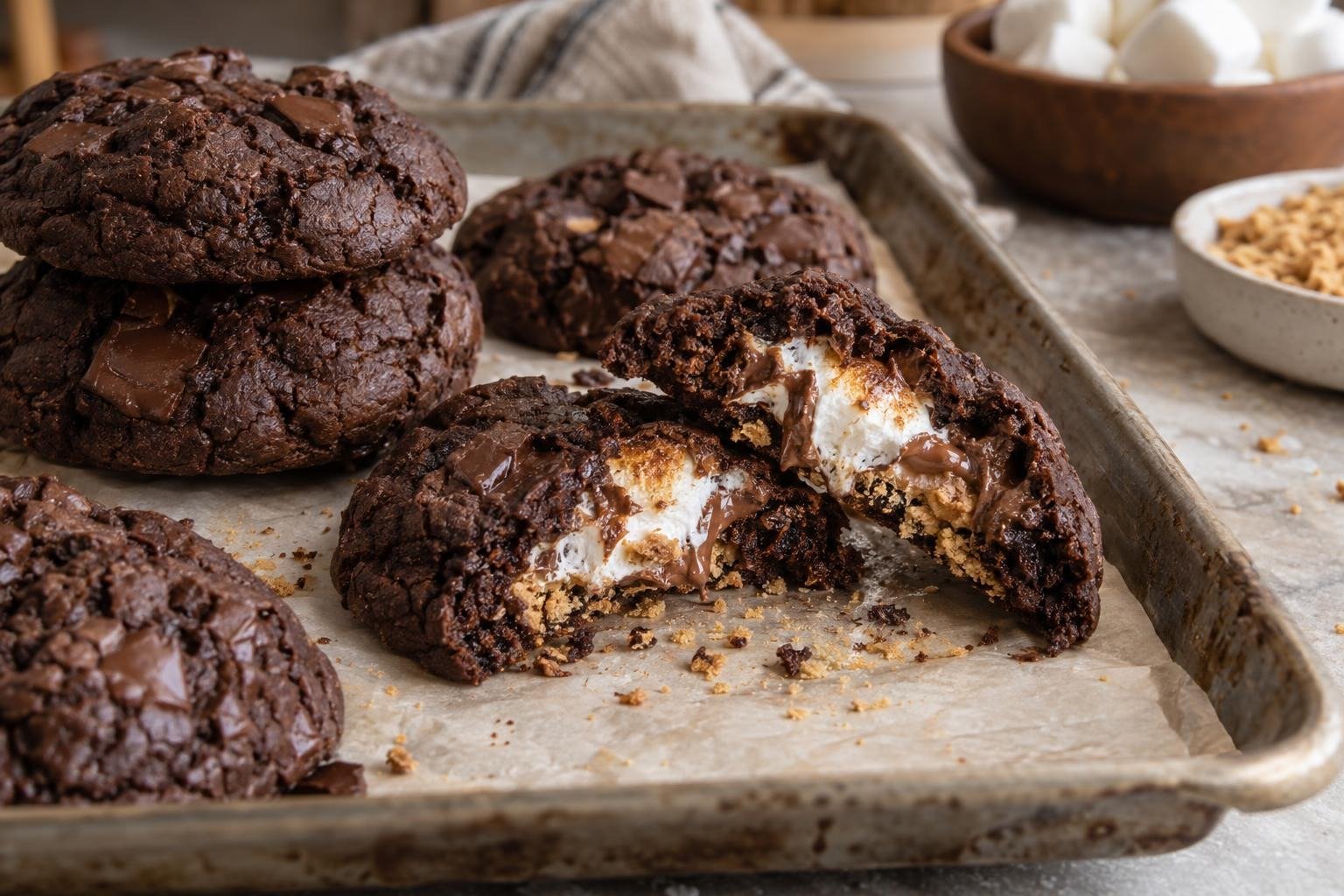
Dark cocoa edges, pools of semisweet chocolate, and a warm center of toasted marshmallow, melting milk chocolate, and crisp graham crumbs give these smores-stuffed cookies their full campfire character. The cookies stay thick and chewy rather than cakey, while the concealed filling softens into a gooey center without taking over the whole baking sheet.
I keep the filling compact, freeze it before assembly, and use 76 grams of dough around each portion. The dough should feel cool and pliable when sealed, not soft or greasy. During baking, I look for matte tops, set edges, and puffed centers because dark cocoa hides traditional browning cues. A short pan cooling period then lets the chocolate dough set before the cookies are moved.
Why You’ll Love these Ridiculously Delicious Cookies
- Freezing the toasted marshmallow and chocolate packets makes them firm enough to enclose without smearing filling across the dough seam.
- A measured 76-gram dough portion provides enough chocolate dough to maintain an even barrier around each expanding marshmallow center.
- Dutch-process cocoa contributes deep chocolate flavor and absorbs moisture, while brown sugar keeps the baked centers pleasantly chewy.
- Brief creaming limits excess air incorporation, helping the cookies remain dense enough to support the filling instead of puffing and collapsing.
- Chilling both the mixed dough and assembled cookies controls butter temperature, reduces spread, and gives pinched seams time to firm before baking.
Ingredient Notes for Smores-Stuffed Cookies with Toasted Marshmallow Centers
- Marshmallows: Standard-size marshmallows provide a controlled amount of filling. Cutting them crosswise creates a flat surface that browns evenly and makes each packet easier to seal.
- Milk chocolate: Milk chocolate melts readily and supplies the familiar creamy sweetness of a s'more. Chop it into compact 5-gram pieces so sharp corners do not pierce the dough.
- Graham cracker crumbs: Finely crushed crumbs adhere to the tacky toasted marshmallow and provide graham flavor without the rigid edges of a large cracker square.
- Unsalted butter: Butter at 18 to 20°C should indent under gentle pressure while remaining cool and opaque. Melted or greasy butter encourages spreading before the dough structure sets.
- Brown and granulated sugars: Brown sugar supplies moisture and chew, while granulated sugar promotes spread and lightly crisp edges. Keep the packed brown sugar free of hard lumps.
- Dutch-process cocoa: Sift any compacted cocoa before measuring. Its dark color makes visual doneness less obvious, so rely on the matte surface and set edge cues in the method.
- Egg and egg yolk: The whole egg binds the dough, while the additional yolk adds fat and emulsifiers for a richer, more flexible texture that seals without cracking.
- Semisweet chocolate chunks: Chunks create distinct melted pockets without making the dough excessively sweet. Bittersweet chocolate may be used gram for gram for a less sweet result.
My Best Baking Tips
- Weigh both the dough and filling components. Oversized marshmallow portions expand aggressively, while undersized dough portions create thin spots that are more likely to split.
- Keep the chocolate pieces compact and trim sharp corners. Long shards can puncture the dough from inside as the cookie spreads.
- If a sealed cookie shows a dark filling smear or visible marshmallow, patch that area with a small piece of dough before chilling it.
- Bake on cool, light-colored metal sheets. A warm pan starts melting the butter prematurely, while a dark pan can overcook the bottoms before the centers set.
- Serve the cookies warm rather than piping hot. A 20 to 30 minute cooling period thickens the molten filling and produces a gooey center that stays inside the cookie when broken.
Ingredients for Smores-Stuffed Cookies
- 6 standard-size marshmallows (cut crosswise into 12 halves)
- 60 g milk chocolate (chopped into 12 compact pieces)
- 45 g graham cracker crumbs (finely crushed)
- 170 g unsalted butter (softened to 18 to 20°C)
- 170 g light brown sugar (packed and free of hard lumps)
- 75 g granulated sugar
- 1 large egg (at room temperature)
- 1 large egg yolk (at room temperature)
- 2 tsp pure vanilla extract
- 250 g all-purpose flour
- 35 g Dutch-process cocoa powder (sift if lumpy)
- 8 g cornstarch
- 3 g baking soda (about 1/2 teaspoon)
- 4 g fine sea salt (about 3/4 teaspoon)
- 120 g semisweet chocolate chunks
How to Make Smores-Stuffed Cookies
- STEP 1). Toast and freeze the filling packets Line a rimmed metal baking sheet with foil and arrange the marshmallow halves cut-side up. Brown each cut surface with a kitchen torch held several inches away, moving constantly until golden with a few darker spots but not burned. Let them stand for 2 minutes, then press each toasted side into 3.75 grams of graham crumbs and top with one 5-gram milk chocolate piece. Freeze the 12 compact packets for at least 20 minutes while preparing the dough.
- STEP 2). Combine the dry ingredients Place a fine-mesh sieve over a medium bowl and sift together the all-purpose flour, Dutch-process cocoa, cornstarch, baking soda, and fine sea salt. Whisk for about 30 seconds, reaching around the sides and bottom so the cocoa and leavener are evenly dispersed. Breaking up cocoa pockets now prevents bitter streaks later and allows the dough to be mixed briefly after the flour is added, which helps preserve a tender, chewy texture.
- STEP 3). Cream the butter and sugars Fit a stand mixer with the paddle attachment. Beat the 18 to 20°C butter, brown sugar, and granulated sugar on medium speed for 2 minutes, stopping once to scrape the bowl and paddle. The mixture should look creamy and slightly lighter but should not become extremely fluffy. Add the whole egg, egg yolk, and vanilla, then mix on medium-low for 45 to 60 seconds until smooth, cohesive, and no slippery egg streaks remain.
- STEP 4). Finish and chill the chocolate dough Add the dry mixture to the butter mixture and mix on low speed for 20 to 30 seconds, just until only a few flour streaks remain. Fold in the semisweet chocolate chunks with a flexible spatula, scraping through the bottom until the dough is uniformly dark and no dry pockets remain. Cover the bowl and refrigerate for 45 minutes. Properly chilled dough should feel firm but pliable and should not leave a greasy coating on your fingers.
- STEP 5). Portion and seal the stuffed cookies Line two large light-colored baking sheets with parchment. Divide the dough into 12 portions of 76 grams each, then split every portion into two roughly equal pieces. Flatten both pieces into 8 to 9 cm discs. Place one frozen filling packet in the center of a disc, cover with the second, and firmly pinch the edges together. Roll gently to smooth the seam without crushing the filling, place seam-side down, and chill the assembled cookies for 10 minutes.
- STEP 6). Bake until the edges are set Heat the oven to 175°C and position a rack in the center. Arrange 6 chilled cookies on one prepared sheet with at least 7 cm between them, keeping the second sheet refrigerated. Bake one sheet at a time for 12 to 14 minutes. The cookies are done when their edges feel set, the tops appear matte rather than wet, and the centers remain puffed and soft. Dark dough will not show reliable browning, so do not wait for firm centers.
- STEP 7). Cool before transferring and serving Set the hot baking sheet on a heatproof surface and leave the cookies undisturbed for 15 minutes. Their centers are fragile immediately after baking, and this rest allows the dough structure and melted chocolate to set without losing chewiness. Use a wide spatula to transfer the cookies to a wire rack, then cool for another 20 minutes before serving. Repeat with the refrigerated sheet, allowing a hot pan to cool before reusing it if necessary.
Storage and Freezing
- Room temperature: Store completely cooled cookies in an airtight container for up to 3 days. Separate layers with parchment and keep the container away from heat, which can make the marshmallow filling sticky.
- Freezing baked cookies: Wrap cookies individually and freeze in an airtight container for up to 1 month.
- Freezing unbaked cookies: Freeze the fully assembled and sealed dough portions on a lined sheet until firm, then transfer them to a freezer-safe container for up to 1 month.
- Thawing and baking: Bake frozen dough portions directly at 175°C, adding 2 to 3 minutes and using matte tops and set edges as the doneness cues.
- Serving: Rewarm a baked cookie in a 150°C oven for 5 to 7 minutes, then rest it for 5 minutes so the filling is soft but not dangerously hot.
Frequently Asked Questions
How do you keep smores-stuffed cookies from leaking?
Containment depends on a frozen, compact filling and a continuous layer of cool dough. Weigh 76 grams of dough per cookie, center the filling, pinch the seam firmly, and patch any thin or discolored areas before baking.
Chilling the assembled cookies for 10 minutes keeps the butter firm while the outer structure begins setting. Avoid overfilling or using sharp chocolate shards, since both can rupture the dough as the marshmallow expands.
How can you tell when smores-stuffed cookies are done?
Look for set edges, matte tops, and centers that remain visibly puffed and soft. The dark cocoa dough will not develop an obvious golden color, so browning is not a dependable cue for this recipe.
A wet, glossy surface indicates the dough needs more time, while flat, firm centers suggest overbaking. Leave the cookies on the baking sheet for 15 minutes because the residual heat finishes setting the soft center safely.
Why did the marshmallow disappear inside my stuffed cookies?
Marshmallow melts and releases air as it heats, so some reduction in volume is normal. It appears to disappear when the filling is too small, the cookie is overbaked, or a weak seam allows melted marshmallow to escape onto the pan.
Use one standard marshmallow half per cookie and freeze the assembled filling packets. Remove the cookies when the tops turn matte and the centers remain puffy, then let them set on the pan without pressing them flat.
What ingredient substitutions work in smores-stuffed cookies?
Bittersweet chocolate can replace the semisweet chunks gram for gram, and dark chocolate can replace the milk chocolate centers if a less sweet filling is preferred. Keep the replacement pieces compact so they remain easy to enclose.
Avoid changing the flour, cocoa, butter, marshmallow, or sugar quantities. Those ingredients determine dough strength, moisture, spread, and filling expansion, so casual substitutions can produce dry dough, excess spreading, or broken seams.
Should stuffed cookie dough be frozen before baking?
A short refrigerator chill is sufficient when the cookies will be baked the same day. The mixed dough needs 45 minutes, and the sealed portions need another 10 minutes so the butter is cool and the filling remains firm.
Freezing is useful for advance preparation. Freeze sealed portions until solid, store them airtight for up to 1 month, and bake directly from frozen with 2 to 3 additional minutes rather than thawing them into soft, spread-prone dough.
More Ridiculously Delicious Cookies
- Thick Brown Butter Chocolate Chunk Cookies with Chewy Centers
- Chocolate Hazelnut Sandwich Cookies with Rich Nutty Filling
- Small-Batch Double Chocolate Cookies with Soft, Chewy Centers
- Fudgy Chocolate Crinkle Cookies with Crackled Sugar Tops
- Small Batch Chocolate Chip Cookies with Chewy Centers and Crisp Edges
Smores-Stuffed Cookies with Toasted Marshmallow Centers
Ingredients
Equipment
Method
- Line a rimmed metal baking sheet with foil and arrange the marshmallow halves cut-side up. Brown each cut surface with a kitchen torch held several inches away, moving constantly until golden with a few darker spots but not burned. Let them stand for 2 minutes, then press each toasted side into 3.75 grams of graham crumbs and top with one 5-gram milk chocolate piece. Freeze the 12 compact packets for at least 20 minutes while preparing the dough.
- Place a fine-mesh sieve over a medium bowl and sift together the all-purpose flour, Dutch-process cocoa, cornstarch, baking soda, and fine sea salt. Whisk for about 30 seconds, reaching around the sides and bottom so the cocoa and leavener are evenly dispersed. Breaking up cocoa pockets now prevents bitter streaks later and allows the dough to be mixed briefly after the flour is added, which helps preserve a tender, chewy texture.
- Fit a stand mixer with the paddle attachment. Beat the 18 to 20°C butter, brown sugar, and granulated sugar on medium speed for 2 minutes, stopping once to scrape the bowl and paddle. The mixture should look creamy and slightly lighter but should not become extremely fluffy. Add the whole egg, egg yolk, and vanilla, then mix on medium-low for 45 to 60 seconds until smooth, cohesive, and no slippery egg streaks remain.
- Add the dry mixture to the butter mixture and mix on low speed for 20 to 30 seconds, just until only a few flour streaks remain. Fold in the semisweet chocolate chunks with a flexible spatula, scraping through the bottom until the dough is uniformly dark and no dry pockets remain. Cover the bowl and refrigerate for 45 minutes. Properly chilled dough should feel firm but pliable and should not leave a greasy coating on your fingers.
- Line two large light-colored baking sheets with parchment. Divide the dough into 12 portions of 76 grams each, then split every portion into two roughly equal pieces. Flatten both pieces into 8 to 9 cm discs. Place one frozen filling packet in the center of a disc, cover with the second, and firmly pinch the edges together. Roll gently to smooth the seam without crushing the filling, place seam-side down, and chill the assembled cookies for 10 minutes.
- Heat the oven to 175°C and position a rack in the center. Arrange 6 chilled cookies on one prepared sheet with at least 7 cm between them, keeping the second sheet refrigerated. Bake one sheet at a time for 12 to 14 minutes. The cookies are done when their edges feel set, the tops appear matte rather than wet, and the centers remain puffed and soft. Dark dough will not show reliable browning, so do not wait for firm centers.
- Set the hot baking sheet on a heatproof surface and leave the cookies undisturbed for 15 minutes. Their centers are fragile immediately after baking, and this rest allows the dough structure and melted chocolate to set without losing chewiness. Use a wide spatula to transfer the cookies to a wire rack, then cool for another 20 minutes before serving. Repeat with the refrigerated sheet, allowing a hot pan to cool before reusing it if necessary.
Notes
- Weigh both the dough and filling components. Oversized marshmallow portions expand aggressively, while undersized dough portions create thin spots that are more likely to split.
- Keep the chocolate pieces compact and trim sharp corners. Long shards can puncture the dough from inside as the cookie spreads.
- If a sealed cookie shows a dark filling smear or visible marshmallow, patch that area with a small piece of dough before chilling it.
- Bake on cool, light-colored metal sheets. A warm pan starts melting the butter prematurely, while a dark pan can overcook the bottoms before the centers set.
- Serve the cookies warm rather than piping hot. A 20 to 30 minute cooling period thickens the molten filling and produces a gooey center that stays inside the cookie when broken.