Table of Contents
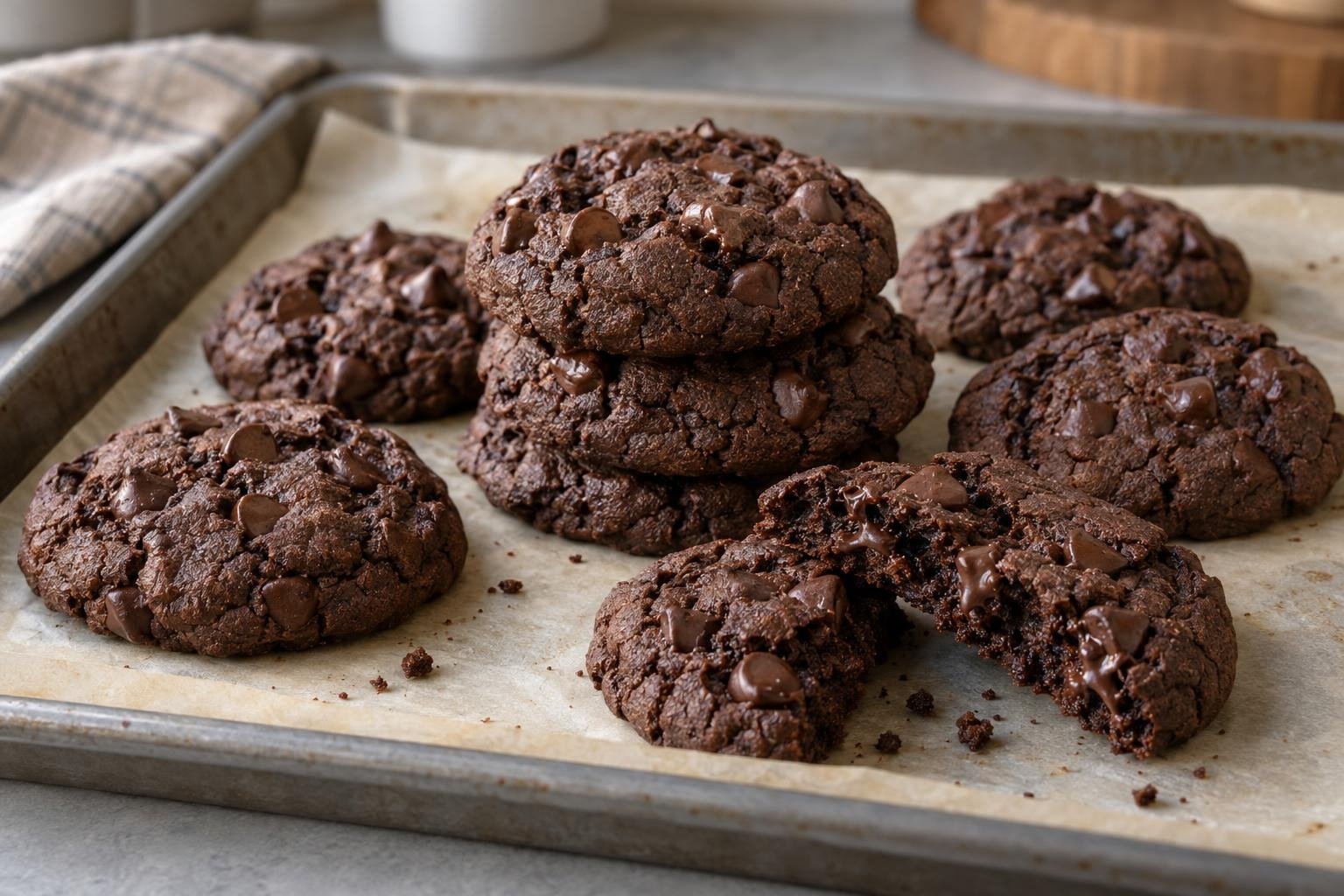
Deep cocoa aroma, pools of semisweet chocolate, lightly crisp edges, and soft, chewy centers give these small-batch double chocolate cookies plenty of contrast. The eight-cookie yield satisfies a chocolate-cookie craving without leaving an ambitious tower of leftovers, while Dutch-process cocoa creates a dark color and rounded chocolate flavor.
I use melted butter for efficient mixing, brown sugar for moisture retention, and just one egg yolk so the dough stays rich without becoming cakey. The important cues are practical: cool the butter before mixing, chill the portioned dough until firm around the edges, and remove the cookies when the edges are set but the centers still look slightly soft rather than wet.
Why You’ll Frickin’ Love This Recipe
- Melted butter coats the flour efficiently and limits excess aeration, producing a compact, chewy cookie rather than a cakey one.
- Light brown sugar contributes moisture and molasses flavor, while a smaller amount of granulated sugar helps the edges spread and become lightly crisp.
- One egg yolk supplies fat, emulsifiers, and enough binding power for a small batch without adding the extra water found in a whole egg.
- Dutch-process cocoa gives the dough a deep color and smooth chocolate flavor while contributing starch that absorbs moisture and thickens the dough.
- Chilling the portioned dough solidifies the butter and hydrates the flour and cocoa, helping eight evenly weighed cookies spread at a controlled rate.
Ingredient Notes for Small-Batch Double Chocolate Cookies with Soft, Chewy Centers
- Unsalted butter: Melted butter makes this small quantity simple to mix by hand. Cool it until barely warm before adding the sugars so the yolk does not overheat and the dough does not become excessively loose.
- Light brown and granulated sugars: Brown sugar holds moisture for a soft, chewy center, while granulated sugar encourages spreading and crisper edges. Break up firm brown sugar before weighing so it disperses evenly.
- Egg yolk: One large yolk provides richness, emulsification, and structure without the additional water of an egg white. Weigh it after separating for the most consistent small-batch result.
- Dutch-process cocoa: This alkalized cocoa provides dark color and mellow chocolate flavor. Spoon it into the scale bowl without packing, then whisk thoroughly with the flour to eliminate dry pockets.
- Semisweet chocolate: Chips hold distinct pockets throughout the cookies. Chopped semisweet chocolate may be used at the same weight for irregular melted pieces, but keep the cocoa percentage in a moderate semisweet range to balance the dough.
Expert Baking Tips
- Weigh the flour and cocoa whenever possible. Even one or two extra spoonfuls represent a large percentage of this small formula and can produce thick, dry cookies that barely spread.
- Use a cool, light-colored aluminum pan lined with parchment. A dark pan absorbs more heat and may set or scorch the bottoms before the soft centers finish baking.
- Shape each portion slightly taller than it is wide. This gives the center more height while the base spreads, creating a better edge-to-center texture contrast.
- Bake the entire batch on one center-rack pan. Splitting eight cookies across oven racks introduces unnecessary differences in top heat, bottom heat, and spreading.
- Judge doneness by the set perimeter and non-wet center rather than waiting for every surface to look firm. The cookies continue cooking on the hot pan during the 10-minute cooling period.
Ingredients for Small-Batch Double Chocolate Cookies
- 56 g unsalted butter (Melted, then cooled until barely warm; 1/4 cup before melting)
- 65 g light brown sugar (About 1/3 cup, firmly packed and free of hard lumps)
- 25 g granulated sugar (2 tablespoons)
- 18 g large egg yolk (1 yolk, brought to room temperature)
- 2.5 mL pure vanilla extract (1/2 teaspoon)
- 63 g all-purpose flour (About 1/2 cup when measured by spooning and leveling)
- 20 g Dutch-process cocoa powder (About 1/4 cup, sifted if lumpy)
- 1.2 g baking soda (1/4 teaspoon)
- 1.5 g fine sea salt (1/4 teaspoon)
- 70 g semisweet chocolate chips (About 1/3 cup, divided)
How to Make Small-Batch Double Chocolate Cookies
- STEP 1). Melt and cool the butter Melt the butter in a small microwave-safe bowl in 15-second intervals, or in a small saucepan over low heat. Stop when only a few soft pieces remain, then stir until fully liquid. Let it stand for about 5 minutes, until barely warm rather than hot. Meanwhile, line a 13 x 18-inch light-colored aluminum half-sheet pan with parchment. Cooling the butter protects the egg yolk and keeps the dough from becoming too warm to hold its shape.
- STEP 2). Combine the dry ingredients In a small mixing bowl, whisk the all-purpose flour, Dutch-process cocoa, baking soda, and fine sea salt for 30 seconds. Break apart every visible cocoa lump with the whisk, or pass the cocoa through a fine-mesh sieve before combining. Even distribution matters in this small formula because a concentrated pocket of baking soda can taste bitter, while streaks of unmixed cocoa absorb moisture unevenly and leave dry patches in the finished cookies.
- STEP 3). Mix the wet ingredients Place the cooled melted butter, light brown sugar, and granulated sugar in a medium mixing bowl. Whisk vigorously for about 45 seconds, scraping the bottom and sides, until the mixture looks smooth and slightly thickened rather than oily. Add the egg yolk and vanilla, then whisk for another 30 seconds until glossy and fully emulsified. If melted butter collects around the edge, continue whisking until it disappears into the sugar mixture before adding any dry ingredients.
- STEP 4). Finish, portion, and chill the dough Add the dry mixture to the wet ingredients and fold with a flexible spatula just until only a few narrow flour streaks remain. Fold in 55 g of the chocolate chips, stopping as soon as the dough is uniformly dark with no dry cocoa at the bottom. Divide into eight 40 g portions, roll gently into tall balls, and arrange them on the prepared pan. Press the remaining 15 g chips onto the tops, then refrigerate uncovered for 30 minutes, until the surfaces feel firm.
- STEP 5). Preheat and arrange the cookies After the dough has chilled for 15 minutes, position an oven rack in the center and preheat the oven to 350°F (180°C), allowing at least 15 minutes for the temperature to stabilize. Space the chilled dough portions at least 2 1/2 inches apart on the parchment-lined half-sheet pan, with four portions in each staggered row. Keep the dough refrigerated until the oven is fully heated because softened butter will cause the cookies to spread before their edges can set.
- STEP 6). Bake and cool completely Bake one pan on the center rack for 10 to 12 minutes, rotating it from front to back after 7 minutes if the oven browns unevenly. The cookies are done when the edges look set and slightly dry, the tops are puffed and cracked, and the central inch appears soft but no longer wet or fluid. Cool on the pan for 10 minutes so carryover heat finishes setting the centers. Transfer carefully to a wire rack and cool for at least 5 more minutes before serving.
Storage and Freezing
- Storage: Keep completely cooled cookies in an airtight container at room temperature for up to 4 days. Place parchment between layers to protect the soft surfaces.
- Freezing baked cookies: Freeze in a sealed freezer container for up to 2 months, separating layers with parchment and pressing out excess air.
- Freezing dough: Freeze the chilled, portioned dough on a parchment-lined tray until firm, then transfer it to a freezer-safe container for up to 2 months.
- Thawing and baking: Thaw frozen dough portions in the refrigerator overnight, then bake cold as directed. Keep raw dough refrigerated during thawing.
- Serving: Let chilled or thawed baked cookies stand at room temperature for 20 to 30 minutes, or warm them on a parchment-lined pan at 300°F (150°C) for 3 to 4 minutes.
Frequently Asked Questions
Why did my small-batch double chocolate cookies spread too much?
Butter that was still hot, dough that skipped the full chill, or a warm baking sheet can make the fat melt before the cookie edges establish structure. The portioned dough should feel firm when it enters a fully preheated oven.
Flour undermeasurement can also loosen this compact formula. Weigh 63 g flour and 20 g cocoa, use parchment rather than a greased pan, and keep the portions refrigerated while the oven finishes heating.
How far ahead can the chocolate cookie dough be prepared?
The portioned dough may be covered tightly and refrigerated for up to 48 hours. Chilling it as individual 40 g portions makes baking more convenient and prevents repeated handling of firm dough.
Arrange the cold portions on a parchment-lined pan while the oven preheats. Dough refrigerated longer than the initial 30 minutes may need an additional minute in the oven, so rely on set edges and centers without a wet sheen.
Can you freeze dough for small-batch double chocolate cookies?
Freeze the shaped, chocolate-topped portions on a parchment-lined tray until solid, then move them to an airtight freezer container. They keep well for up to 2 months when protected from freezer odors and drying air.
For the most even spread, thaw the portions overnight in the refrigerator and bake them cold. Baking directly from frozen can leave the centers underdone by the time the outer edges become firm.
What cocoa powder works best in this recipe?
Dutch-process cocoa is the intended choice because its alkalized flavor is smooth and dark, and the formula balances its absorption with the listed butter, sugar, and egg yolk. Use an unsweetened product rather than hot cocoa mix, which contains sugar and other ingredients.
Natural cocoa has different acidity and flavor, so changing it can alter how the baking soda behaves. For predictable spread, color, and texture, keep the Dutch-process cocoa specified in the formula.
How do I know when soft double chocolate cookies are fully baked?
Look for edges that appear set and slightly dry, tops that have puffed and cracked, and centers that are soft but not shiny with wet dough. The cookies should not look uniformly firm when they leave the oven.
Leave them undisturbed on the hot pan for 10 minutes. During that time, residual heat finishes setting the yolk and flour structure while the centers settle into a chewy texture instead of becoming crisp throughout.
More Ridiculously Delicious Cookies
- Thick Brown Butter Chocolate Chunk Cookies with Chewy Centers
- Fudgy Chocolate Crinkle Cookies with Crackled Sugar Tops
- Chewy Cranberry White Chocolate Cookies with Soft, Chewy Centers
- Small-Batch Soft Sugar Cookies with Soft, Chewy Centers
- Small-Batch Lemon Cookies with Soft, Chewy Centers
Small-Batch Double Chocolate Cookies with Soft, Chewy Centers
Ingredients
Equipment
Method
- Melt the butter in a small microwave-safe bowl in 15-second intervals, or in a small saucepan over low heat. Stop when only a few soft pieces remain, then stir until fully liquid. Let it stand for about 5 minutes, until barely warm rather than hot. Meanwhile, line a 13 x 18-inch light-colored aluminum half-sheet pan with parchment. Cooling the butter protects the egg yolk and keeps the dough from becoming too warm to hold its shape.
- In a small mixing bowl, whisk the all-purpose flour, Dutch-process cocoa, baking soda, and fine sea salt for 30 seconds. Break apart every visible cocoa lump with the whisk, or pass the cocoa through a fine-mesh sieve before combining. Even distribution matters in this small formula because a concentrated pocket of baking soda can taste bitter, while streaks of unmixed cocoa absorb moisture unevenly and leave dry patches in the finished cookies.
- Place the cooled melted butter, light brown sugar, and granulated sugar in a medium mixing bowl. Whisk vigorously for about 45 seconds, scraping the bottom and sides, until the mixture looks smooth and slightly thickened rather than oily. Add the egg yolk and vanilla, then whisk for another 30 seconds until glossy and fully emulsified. If melted butter collects around the edge, continue whisking until it disappears into the sugar mixture before adding any dry ingredients.
- Add the dry mixture to the wet ingredients and fold with a flexible spatula just until only a few narrow flour streaks remain. Fold in 55 g of the chocolate chips, stopping as soon as the dough is uniformly dark with no dry cocoa at the bottom. Divide into eight 40 g portions, roll gently into tall balls, and arrange them on the prepared pan. Press the remaining 15 g chips onto the tops, then refrigerate uncovered for 30 minutes, until the surfaces feel firm.
- After the dough has chilled for 15 minutes, position an oven rack in the center and preheat the oven to 350°F (180°C), allowing at least 15 minutes for the temperature to stabilize. Space the chilled dough portions at least 2 1/2 inches apart on the parchment-lined half-sheet pan, with four portions in each staggered row. Keep the dough refrigerated until the oven is fully heated because softened butter will cause the cookies to spread before their edges can set.
- Bake one pan on the center rack for 10 to 12 minutes, rotating it from front to back after 7 minutes if the oven browns unevenly. The cookies are done when the edges look set and slightly dry, the tops are puffed and cracked, and the central inch appears soft but no longer wet or fluid. Cool on the pan for 10 minutes so carryover heat finishes setting the centers. Transfer carefully to a wire rack and cool for at least 5 more minutes before serving.
Notes
- Weigh the flour and cocoa whenever possible. Even one or two extra spoonfuls represent a large percentage of this small formula and can produce thick, dry cookies that barely spread.
- Use a cool, light-colored aluminum pan lined with parchment. A dark pan absorbs more heat and may set or scorch the bottoms before the soft centers finish baking.
- Shape each portion slightly taller than it is wide. This gives the center more height while the base spreads, creating a better edge-to-center texture contrast.
- Bake the entire batch on one center-rack pan. Splitting eight cookies across oven racks introduces unnecessary differences in top heat, bottom heat, and spreading.
- Judge doneness by the set perimeter and non-wet center rather than waiting for every surface to look firm. The cookies continue cooking on the hot pan during the 10-minute cooling period.