Table of Contents
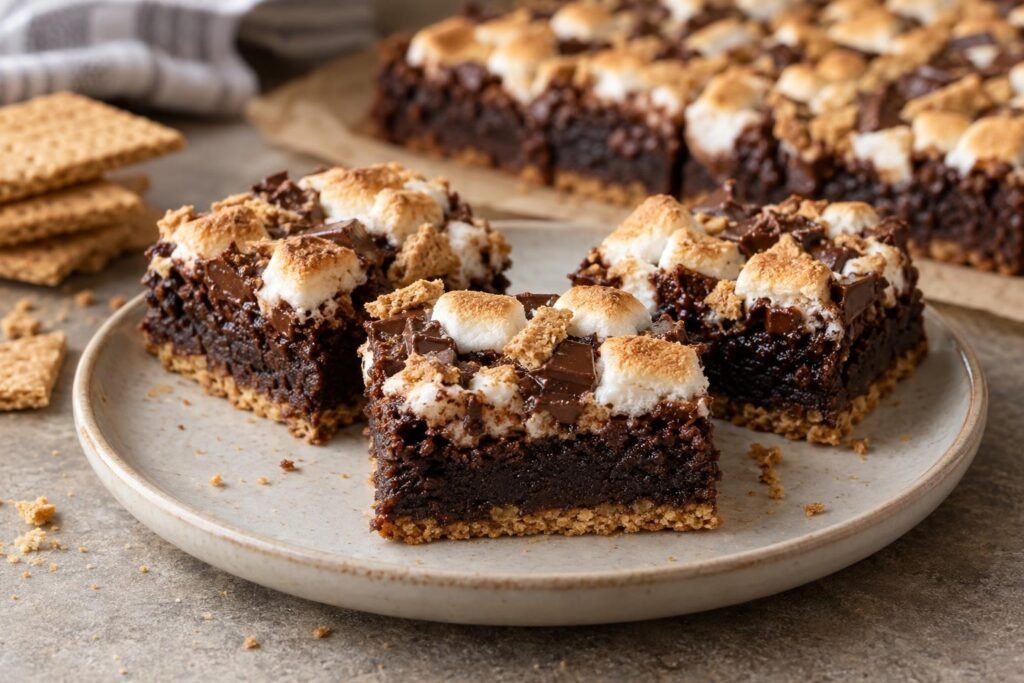
Toasted marshmallows, melted chocolate, and buttery graham crackers give these smores brownies the full campfire treatment, while the center stays dense, dark, and properly fudgy. Each square has a crisp crumb base, a rich chocolate layer, and a sticky golden top, so the familiar s’mores flavors remain distinct instead of disappearing into one uniformly sweet bar.
I build the graham crust first so it can set before the wet brownie batter goes on top. Melted chocolate and cocoa provide depth without requiring excess flour, while restrained mixing keeps the crumb compact rather than cakey. The brownies are ready when the edges look firm and a tester from the center carries thick, moist crumbs, not shiny liquid batter. A full cooling period is essential because warm chocolate, butter, and sugar cannot hold a sharp cut.

Why You’ll Love these Ridiculously Delicious Brownies
- A brief prebake firms the graham cracker crust, preventing the brownie batter from soaking into it and blurring the layers.
- Melted bittersweet chocolate supplies cocoa solids and cocoa butter, giving the brownie center a dense texture that remains fudgy after cooling.
- Dutch-process cocoa strengthens the chocolate flavor without adding more melted fat, which keeps the bars rich but structurally sliceable.
- The marshmallows are added only after the brownie is fully baked, so they toast without dissolving into the batter or concealing an underdone center.
- Two hours of room-temperature cooling followed by one hour of chilling allows the butter, chocolate, and sugar matrix to set for clean, defined squares.
Ingredient Notes for Smores Brownies with Fudgy Centers
- Graham cracker crumbs: Finely crushed crumbs pack into a cohesive base and expose enough surface area to absorb the melted butter. Crush whole crackers until no large flakes remain, or the crust may crumble during slicing.
- Unsalted butter: Butter binds the crust and supplies most of the brownie’s fat. Melt it gently and avoid vigorous boiling, which drives off water and can alter the batter’s consistency.
- Bittersweet chocolate: Chocolate containing about 60 to 70 percent cacao balances the sweet crust and marshmallows. Chop it evenly so it melts before the butter becomes excessively hot.
- Granulated and light brown sugars: Granulated sugar supports the brownie’s thin top crust, while brown sugar contributes moisture and a subtle caramel note. Break apart any firm brown sugar lumps before mixing.
- Eggs: Large room-temperature eggs emulsify the butter, chocolate, and sugar while providing enough protein to set the center. Eggs that are very cold can thicken the melted chocolate prematurely.
- Dutch-process cocoa powder: This cocoa reinforces the dark chocolate flavor and color. Natural cocoa may be used at the same weight because the formula contains no chemical leavener, although its flavor will be sharper and its color lighter.
- All-purpose flour: A modest amount provides structure without turning the brownies cakey. Weigh it when possible, then fold only until the last dry streaks disappear.
- Mini marshmallows: Their small size creates even coverage and quick browning. Separate any pieces stuck together before topping so bare patches do not scorch under the broiler.
- Chocolate and graham topping: Chopped chocolate melts between the marshmallows, while broken graham pieces preserve a little crunch. Keep both pieces small enough that the finished slab can be sliced without dragging the topping.
A Few Baking Tips
- Use a light-colored metal pan with straight sides. Glass retains heat and dark metal absorbs it quickly, either of which can overbake the edges before the thick center reaches the correct crumb.
- Keep the graham crust compact and level rather than pushing it up the sides. A flat base supports the brownie evenly and prevents fragile crust ledges from breaking during removal.
- Check doneness through an open area rather than piercing a melted chocolate pocket. Thick, pasty crumbs indicate a fudgy but baked center; glossy batter coating the tester indicates underbaking.
- Do not walk away once the broiler is on. Rotate the pan instead of extending the broiling time when one area colors faster, and remove it before every marshmallow becomes uniformly dark.
- For the cleanest slices, chill the slab and use a hot, completely dry knife. A wet blade can make the marshmallow topping slippery, while a cold blade drags set chocolate through the brownie crumb.
Ingredients for Smores Brownies
- 240 g fine graham cracker crumbs (About 2 1/2 cups, with no large pieces)
- 50 g granulated sugar (For the graham cracker crust)
- 1/4 teaspoon fine salt (For the graham cracker crust)
- 113 g unsalted butter (Melted, for the graham cracker crust)
- 226 g unsalted butter (Cubed, for the brownie batter)
- 255 g bittersweet chocolate (60 to 70 percent cacao, finely chopped)
- 300 g granulated sugar (For the brownie batter)
- 100 g light brown sugar (Packed and free of hard lumps)
- 4 large eggs (At room temperature)
- 2 teaspoons pure vanilla extract (For aroma and rounded chocolate flavor)
- 125 g all-purpose flour (About 1 cup, weighed for accuracy)
- 45 g Dutch-process cocoa powder (Sifted if lumpy)
- 3/4 teaspoon fine salt (For the brownie batter)
- 200 g mini marshmallows (Separated if stuck together)
- 85 g bittersweet chocolate (Coarsely chopped for the topping)
- 60 g graham crackers (Broken into small bite-size pieces for the topping)
How to Make Smores Brownies
- STEP 1). Prepare the pan and press the graham crust Heat the oven to 350°F with a rack in the center. Line a 9 by 13-inch light-colored metal pan with heavy-duty foil, leaving handles on two sides, and grease the foil lightly. Combine the graham crumbs, 50 g granulated sugar, and 1/4 teaspoon salt in a bowl. Stir in 113 g melted butter until every crumb looks evenly damp. Press the mixture firmly across the bottom with a flat measuring cup, paying particular attention to the corners and edges.
- STEP 2). Prebake the crust Bake the crust for 8 minutes, until it smells toasted and the surface appears dry and slightly darker around the perimeter. The base will still feel somewhat soft while hot, so do not press or disturb it. Transfer the pan to a wire rack while preparing the brownie batter, but leave the oven set to 350°F. This short prebake sets the butter and sugar around the crumbs, helping the crust remain distinct beneath the moist chocolate layer.
- STEP 3). Melt the butter and chocolate gently Place 226 g cubed butter and 255 g finely chopped bittersweet chocolate in a medium heatproof bowl. Set the bowl over a saucepan containing about 1 inch of barely simmering water, making sure the bowl does not touch the water. Stir with a dry silicone spatula until mostly melted, then remove the bowl and continue stirring until completely smooth. Cool for 5 minutes; the mixture should remain fluid and warm, not hot enough to cook the eggs.
- STEP 4). Mix the sugars and eggs without over-aerating In a large bowl, whisk the 300 g granulated sugar, brown sugar, eggs, and vanilla for 60 to 90 seconds. Stop when the mixture is cohesive, slightly thickened, and free of visible egg-white strands. It does not need to become pale or voluminous because excessive aeration creates a lighter, cakier crumb. Pour in the warm chocolate mixture gradually while whisking steadily, then scrape the bowl and mix until the batter looks glossy, dark, and evenly emulsified.
- STEP 5). Fold the dry ingredients into the batter Sift the flour, cocoa powder, and 3/4 teaspoon salt directly over the chocolate mixture. Fold with a flexible spatula, sweeping along the bottom and sides to capture hidden pockets of flour. Stop as soon as the batter is uniform and no dry streaks remain, usually 25 to 35 folds. Properly mixed batter will be thick but pourable and will fall from the spatula in broad ribbons. Continued mixing develops gluten and makes the cooled brownies tougher and less fudgy.
- STEP 6). Bake until the center has moist crumbs Pour the batter over the warm crust and spread it level without pressing into the crumbs. Bake at 350°F for 27 to 31 minutes, rotating the pan once after 20 minutes if the oven browns unevenly. The edges should look set and slightly raised, while the center should no longer ripple when the pan is nudged. Insert a toothpick into the brownie layer near the center; it should emerge with thick, moist crumbs. Shiny liquid batter means the brownies need another 2 to 3 minutes.
- STEP 7). Add and toast the s’mores topping Remove the fully baked brownies and immediately scatter the chopped chocolate evenly over the surface, followed by the mini marshmallows and graham cracker pieces. Set the oven to broil and position the pan about 8 inches below the heating element. Broil for 30 to 90 seconds, watching continuously and rotating the pan if needed. Remove it as soon as the marshmallows puff and develop patchy golden-brown tops. Broilers work quickly, and deeply browned marshmallows can become bitter before the rest of the topping colors.
- STEP 8). Cool, chill, and cut clean squares Place the pan on a wire rack and cool for 2 hours without covering it; trapped steam would soften the graham topping. Refrigerate the uncovered pan for 1 hour, until the brownie layer feels firm and the chocolate topping has set. Use the foil handles to lift the slab onto a cutting board, then peel away the foil. Cut into 24 squares with a thin sharp knife, wiping and warming the blade under hot water, then drying it thoroughly, between cuts. Let chilled bars stand briefly before serving.
Storage and Freezing
- Room-temperature storage: Keep the cut brownies in a single layer in an airtight container for up to 2 days. Separate stacked layers with parchment to protect the marshmallow topping.
- Refrigerated storage: Refrigerate airtight for up to 5 days. Let the bars stand at room temperature for 20 to 30 minutes before serving so the brownie center softens.
- Freezing: Freeze fully cooled individual bars on a tray, then wrap them tightly and place them in a freezer-safe container for up to 1 month. The toasted marshmallow surface may become slightly tackier after freezing.
- Thawing: Thaw the wrapped brownies in the refrigerator overnight, then unwrap and bring them to room temperature before serving. Keeping them wrapped during thawing limits condensation on the chocolate.
Frequently Asked Questions
How do you tell when smores brownies are done?
The brownie edges should be set and slightly raised, while the center should look matte rather than wet and should not ripple when the pan is moved. Test before adding the marshmallow topping.
A toothpick inserted near the center should carry several thick, moist chocolate crumbs. A coating of shiny, fluid batter indicates the center is still raw and needs another 2 to 3 minutes.
Why are my s’mores brownies cakey instead of fudgy?
Cakey brownies usually result from excess flour, prolonged whisking, or overbaking. Weigh the flour and whisk the eggs only until cohesive rather than beating them into a pale, highly aerated foam.
Begin checking at 27 minutes. The center should be baked enough to produce moist crumbs, but it should not reach the completely dry toothpick stage associated with cake.
What chocolate works best in a smores brownies recipe?
Bittersweet chocolate containing about 60 to 70 percent cacao balances the sweet marshmallows and graham crust. Chocolate with a much higher cacao percentage can make the brownie firmer and more bitter.
Use a bar-style baking chocolate rather than relying on chocolate chips in the batter. Chopped chocolate melts smoothly with butter, while many chips are formulated to retain their shape.
Can I substitute natural cocoa for Dutch-process cocoa?
Natural cocoa can replace the Dutch-process cocoa at the same weight in this formula because the brownies do not depend on baking soda or another acid-sensitive chemical leavener.
Expect a lighter color and a sharper, fruitier cocoa flavor. Sift either type if it contains hard lumps, since dry cocoa pockets are difficult to disperse once the flour has been folded into the batter.
When should smores brownies be cut for clean squares?
Cut the brownies only after 2 hours of room-temperature cooling and 1 hour of refrigeration. This gives the melted chocolate and butter time to set while the crust becomes firm enough to support the slab.
Lift the chilled brownie out with the foil handles. Use a thin, hot, dry knife and clean it between cuts so sticky marshmallow and melted chocolate do not drag across each square.
More Ridiculously Delicious Brownies & Bars
- Salted Caramel Fudgy Brownies with a Rich Chocolate Center
- Peanut Butter Swirl Brownies with a Fudgy Center
- Pistachio Chocolate Brownies with Fudgy Centers
- Brown Butter Brownies with Fudgy Centers
- Raspberry Swirl Brownies with Fudgy Chocolate Centers
Smores Brownies with Fudgy Centers
Ingredients
Equipment
Method
- Heat the oven to 350°F with a rack in the center. Line a 9 by 13-inch light-colored metal pan with heavy-duty foil, leaving handles on two sides, and grease the foil lightly. Combine the graham crumbs, 50 g granulated sugar, and 1/4 teaspoon salt in a bowl. Stir in 113 g melted butter until every crumb looks evenly damp. Press the mixture firmly across the bottom with a flat measuring cup, paying particular attention to the corners and edges.
- Bake the crust for 8 minutes, until it smells toasted and the surface appears dry and slightly darker around the perimeter. The base will still feel somewhat soft while hot, so do not press or disturb it. Transfer the pan to a wire rack while preparing the brownie batter, but leave the oven set to 350°F. This short prebake sets the butter and sugar around the crumbs, helping the crust remain distinct beneath the moist chocolate layer.
- Place 226 g cubed butter and 255 g finely chopped bittersweet chocolate in a medium heatproof bowl. Set the bowl over a saucepan containing about 1 inch of barely simmering water, making sure the bowl does not touch the water. Stir with a dry silicone spatula until mostly melted, then remove the bowl and continue stirring until completely smooth. Cool for 5 minutes; the mixture should remain fluid and warm, not hot enough to cook the eggs.
- In a large bowl, whisk the 300 g granulated sugar, brown sugar, eggs, and vanilla for 60 to 90 seconds. Stop when the mixture is cohesive, slightly thickened, and free of visible egg-white strands. It does not need to become pale or voluminous because excessive aeration creates a lighter, cakier crumb. Pour in the warm chocolate mixture gradually while whisking steadily, then scrape the bowl and mix until the batter looks glossy, dark, and evenly emulsified.
- Sift the flour, cocoa powder, and 3/4 teaspoon salt directly over the chocolate mixture. Fold with a flexible spatula, sweeping along the bottom and sides to capture hidden pockets of flour. Stop as soon as the batter is uniform and no dry streaks remain, usually 25 to 35 folds. Properly mixed batter will be thick but pourable and will fall from the spatula in broad ribbons. Continued mixing develops gluten and makes the cooled brownies tougher and less fudgy.
- Pour the batter over the warm crust and spread it level without pressing into the crumbs. Bake at 350°F for 27 to 31 minutes, rotating the pan once after 20 minutes if the oven browns unevenly. The edges should look set and slightly raised, while the center should no longer ripple when the pan is nudged. Insert a toothpick into the brownie layer near the center; it should emerge with thick, moist crumbs. Shiny liquid batter means the brownies need another 2 to 3 minutes.
- Remove the fully baked brownies and immediately scatter the chopped chocolate evenly over the surface, followed by the mini marshmallows and graham cracker pieces. Set the oven to broil and position the pan about 8 inches below the heating element. Broil for 30 to 90 seconds, watching continuously and rotating the pan if needed. Remove it as soon as the marshmallows puff and develop patchy golden-brown tops. Broilers work quickly, and deeply browned marshmallows can become bitter before the rest of the topping colors.
- Place the pan on a wire rack and cool for 2 hours without covering it; trapped steam would soften the graham topping. Refrigerate the uncovered pan for 1 hour, until the brownie layer feels firm and the chocolate topping has set. Use the foil handles to lift the slab onto a cutting board, then peel away the foil. Cut into 24 squares with a thin sharp knife, wiping and warming the blade under hot water, then drying it thoroughly, between cuts. Let chilled bars stand briefly before serving.
Notes
- Use a light-colored metal pan with straight sides. Glass retains heat and dark metal absorbs it quickly, either of which can overbake the edges before the thick center reaches the correct crumb.
- Keep the graham crust compact and level rather than pushing it up the sides. A flat base supports the brownie evenly and prevents fragile crust ledges from breaking during removal.
- Check doneness through an open area rather than piercing a melted chocolate pocket. Thick, pasty crumbs indicate a fudgy but baked center; glossy batter coating the tester indicates underbaking.
- Do not walk away once the broiler is on. Rotate the pan instead of extending the broiling time when one area colors faster, and remove it before every marshmallow becomes uniformly dark.
- For the cleanest slices, chill the slab and use a hot, completely dry knife. A wet blade can make the marshmallow topping slippery, while a cold blade drags set chocolate through the brownie crumb.