
Table of Contents
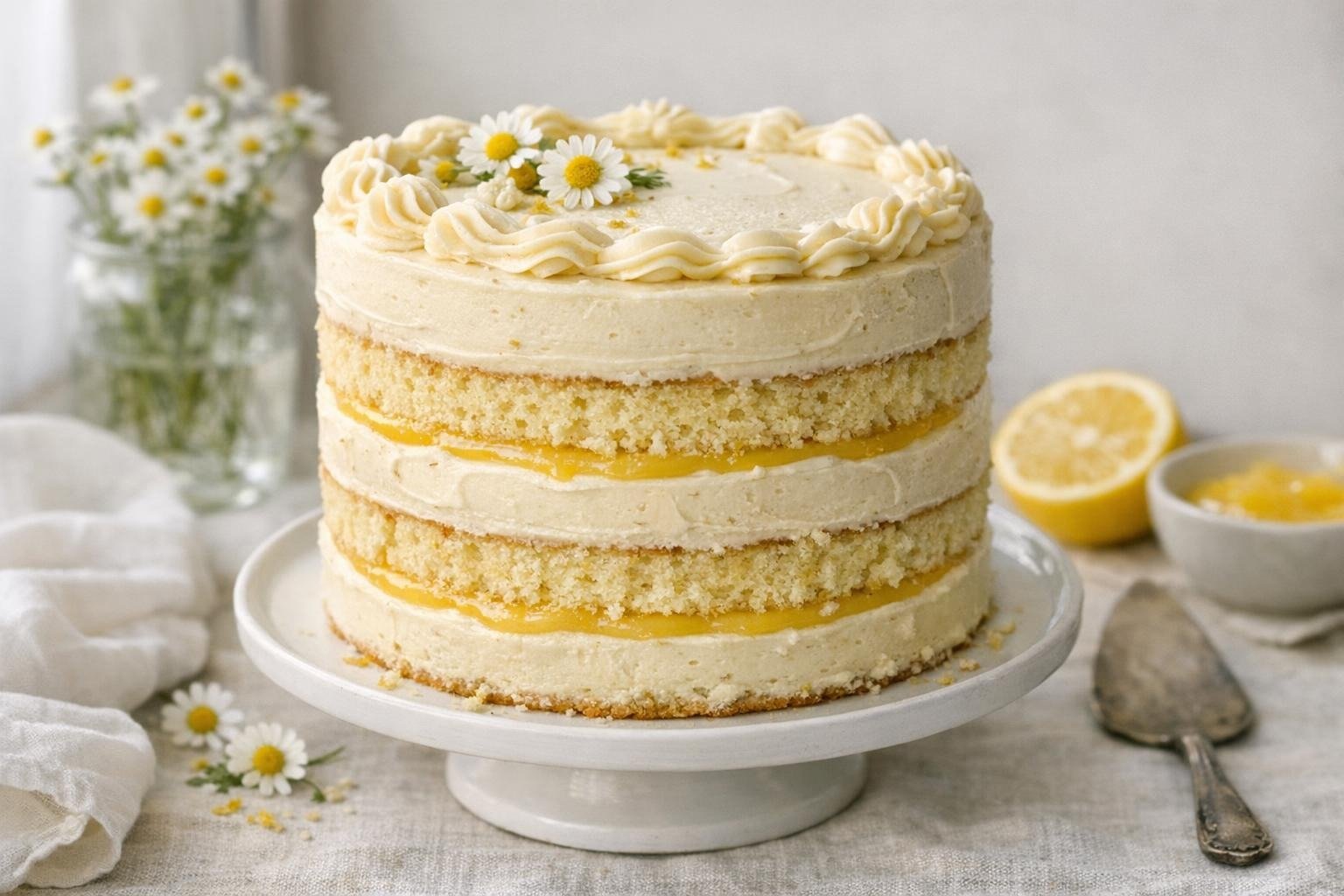
There’s something enchanting about slicing into a lemon chamomile layer cake recipe: each soft layer is golden and plush, infused with gentle chamomile and zingy lemon, and stacked tall with vibrant lemon curd and silky chamomile buttercream. The aroma is like walking into a sun-drenched bakery, floral and citrus twining together with every inhale. I infuse both the cake batter and the frosting with chamomile tea (from real tea bags, not extract) to coax out that mellow, delicate flavor that actually lingers in the crumb. The lemon keeps things lively, bringing tang to every bite. If you want layers that bake up with a velvety crumb and no dry edges, creaming the butter until it’s truly pale is key, it traps extra air for a lighter cake. This is the cake I crave for birthdays and sunny brunches alike, and I have a feeling you’ll fall in love with every fragrant, pillowy forkful.
Why You’ll Frickin’ Love This Lemon Chamomile Layer Cake Recipe
- Chamomile tea with real lemon: Steeping chamomile tea right in the milk pulls out its floral aroma, while the lemon juice and zest add zestiness and prevent the flavor from fading into the background.
- Velvety cake texture: Thoroughly creamed butter and sugar build a plush, airy crumb that holds up to layering and filling, so you get sturdy yet soft slices every time.
- Silky meringue buttercream: Swiss meringue buttercream whipped with chamomile-infused butter gives a creamy finish and a flavor that lingers, never feeling greasy or overly sweet.
- Tangy lemon curd punch: Homemade lemon curd between the layers provides sharp, sunny contrast to the mellow cake and rounds out the flavor for every bite.
- Dreamy, stackable structure: The formula produces flat, sturdy layers for easy assembling and smooth decorating, no doming, crumbling, or collapsing, just beautiful slices exactly as promised.
Ingredient Notes for Lemon Chamomile Layer Cake
- Cake flour: Produces a finer, tender crumb that’s key for layer cakes. Measure correctly by weight for the best texture.
- Unsalted butter: Creamed thoroughly with sugar to create a light, fluffy structure. Use at cool room temperature for even aeration.
- Granulated sugar: Aids structure and sweetness while helping butter cream up extra light.
- Eggs: Provide structure and moisture. Add one at a time on low speed to prevent curdling.
- Whole milk: Infused with chamomile tea bags. Full-fat milk carries the tea’s flavor and keeps the crumb plush.
- Fresh lemon zest and juice: Brightens every component and gives natural tang. Always zest before juicing.
- Chamomile tea bags: Used for both infused milk in the batter and melted butter in the Swiss meringue buttercream.
- Lemon curd: Homemade for bold, fresh flavor. Must be completely cooled before layering to keep structure intact.
- Swiss meringue buttercream: The whipped texture is stable, silky, and pipes beautifully. Let ingredients reach room temp for a flawless emulsion.
- Kosher salt: Balances the sweetness and keeps the floral notes from overwhelming the cake.
Baking Tips Worth Knowing
- Don’t rush the tea steep: Give chamomile a full 15 minutes in hot milk for pronounced floral flavor. Shorter steeps mean a flat, indistinct cake.
- Cream butter until fluffy: The mixture should be pale and almost doubled in volume. Proper aeration gives your cake loft and softness, don’t undermine with under-creamed butter.
- Work quickly when assembling: Lemon curd can slip if the cake or filling gets too warm. Have everything chilled and ready before stacking.
- Smooth the sides in chilled intervals: If the buttercream gets too soft, chill the cake for 10 minutes, then resume smoothing. This keeps edges crisp and straight.
- Let flavors settle: Chill the assembled cake for at least an hour before serving, which intensifies the chamomile and lemon, giving you fuller flavor in each slice.
How I Stack and Decorate This Lemon Chamomile Layer Cake
Stacking and decorating a lemon chamomile layer cake is all about balancing structural integrity with gorgeous, soft finishes. Here’s how I approach it:
- Level those layers: After cooling, use a long serrated knife to trim any slight dome from each cake layer. You’ll get picture-perfect, even stacks and avoid any wobbly construction.
- Build a buttercream dam: Pipe a thick ring of chamomile Swiss meringue buttercream around the edge of each layer before adding lemon curd. This helps prevent the curd from oozing out under the weight of the cake.
- Chill after crumb-coating: Once you’ve applied a thin crumb coat, chill the cake for 20-30 minutes to set the buttercream and lock in crumbs. This makes the final finish effortless.
- Smooth sides with a bench scraper: Use a bench scraper for even pressure and long, smooth passes to create those sharp, clean sides you see in bakery cakes.
- Decorate with restraint: A few fresh chamomile flowers or candied lemon slices on top add elegance without overpowering the soft look of the cake.
With these habits, you’ll stack a cake as sturdy as it is dreamy, with every bite delivering both visual and textural wow.
Ingredients for Lemon Chamomile Layer Cake
- 360 grams cake flour (sifted)
- 2 teaspoons baking powder (level)
- 0.5 teaspoon baking soda (level)
- 0.75 teaspoon kosher salt
- 240 ml whole milk (see notes on steeping)
- 3 bags chamomile tea (for milk infusion)
- 226 grams unsalted butter (softened)
- 350 grams granulated sugar
- 4 large eggs (room temperature)
- 60 ml fresh lemon juice
- 2 tablespoons lemon zest (packed)
- 1 teaspoon vanilla extract
Ingredients for Chamomile Swiss Meringue Buttercream
- 135 g large egg whites (approximately 4 large egg whites)
- 225 g granulated sugar
- 380 g unsalted butter (80 g for tea infusion, 300 g remaining)
- 2 chamomile tea bags (for frosting infusion)
- ½ teaspoon vanilla extract
- ⅛ teaspoon fine sea salt
Ingredients for Homemade Lemon Curd
- 100 g fresh lemon juice (for homemade lemon curd, strained)
- 125 g granulated sugar (for homemade lemon curd)
- 100 g large whole eggs (for homemade lemon curd, approximately 2 eggs without shells)
- 40 g large egg yolks (for homemade lemon curd, approximately 2 yolks)
- 70 g unsalted butter (for homemade lemon curd, cold and cubed)
- 1 tsp finely grated lemon zest (for homemade lemon curd)
How to Make Lemon Chamomile Layer Cake
- STEP 1). Steep chamomile milk and prep pans Position a rack in the center of the oven and preheat to 165°C (325°F). Grease three 8-inch (20 cm) round cake pans, line their bottoms with parchment, and lightly grease the parchment. Heat the 240 ml milk until steaming but not boiling; add the three cake-infusion chamomile tea bags, cover, and steep 15 minutes. Remove the bags, cool the milk completely, and measure the remaining milk. If evaporation reduced its volume, top up with plain whole milk to 240 ml before mixing the cake batter.
- STEP 2). Mix dry ingredients In a large bowl, whisk together cake flour, baking powder, baking soda, and salt until very well combined and lump-free. Set aside to ensure even distribution of leaveners and prevent overmixing later.
- STEP 3). Cream butter, sugar, and lemon zest In a stand mixer fitted with the paddle attachment, beat the softened unsalted butter, granulated sugar, and lemon zest on medium speed for 3-4 minutes. Mixture should turn noticeably paler, fluffy, and almost look like whipped cream. Scrape bowl at least once for even aeration.
- STEP 4). Add eggs one at a time Add eggs one at a time, mixing on low and scraping the bowl between each addition. Allow each egg to fully incorporate for a smooth, homogenous batter. Mix in vanilla extract after the last egg until just combined to maintain aeration.
- STEP 5). Alternate dry ingredients and chamomile milk With mixer on low, add one-third of the dry mixture, followed by half the cooled chamomile milk and half the lemon juice. Alternate dry and wet additions, ending with the dry. Mix only until batter is mostly smooth with no flour pockets; do not overmix to maintain tenderness.
- STEP 6). Divide batter and bake Divide the finished batter evenly among the three prepared 8-inch pans, using a scale so they bake at a similar rate. Smooth the surfaces and tap each pan lightly to settle large air pockets. Bake at 165°C (325°F) for approximately 22 to 28 minutes, checking the earliest pan first. The centers should spring back gently and a skewer inserted away from the edge should show a few moist crumbs rather than wet batter. Avoid opening the oven repeatedly, as the tender layers can sink before setting.
- STEP 7). Cool cakes completely Let cakes cool in their pans for 10 minutes, then run a thin spatula around the edge and invert onto wire racks. Carefully remove parchment, flip top-side up, and cool completely, this prevents excess moisture and keeps the crumb intact for stacking.
- STEP 8). Make the chamomile Swiss meringue buttercream. Set aside 80 g from the measured 380 g unsalted butter. Melt that portion gently, remove from the heat, and steep the 2 chamomile tea bags in it for 15 minutes. Strain out the tea, then let the infused butter cool and re-solidify until soft and pliable, approximately 18 to 21°C (64 to 70°F). Keep the remaining 300 g butter at the same temperature.
- In a clean, heatproof mixer bowl, combine 135 g egg whites and 225 g granulated sugar. Set the bowl over gently simmering water and whisk continuously until the mixture reaches 71°C (160°F) and the sugar has fully dissolved. Remove from the heat and whip with the whisk attachment until thick and glossy and the bowl is no longer warm.
- Switch to the paddle attachment and gradually incorporate all 380 g butter, including the softened chamomile-infused portion. Continue beating until the buttercream becomes smooth, silky, and fluffy, even if it briefly looks curdled. Add ½ teaspoon vanilla extract and ⅛ teaspoon fine sea salt, then mix until evenly combined. Reserve the finished buttercream for the filling dams, thin crumb coat, exterior frosting, and decoration.
- STEP 9). Cook and chill the homemade lemon curd Whisk 100 g strained lemon juice, 125 g sugar, 100 g whole eggs, 40 g egg yolks, and the teaspoon of lemon zest together in a heavy saucepan. Cook over medium-low heat, stirring constantly with a heatproof spatula, until the curd visibly thickens and reaches approximately 77 to 82°C (170 to 180°F); do not let it boil vigorously or the eggs may scramble. Remove from heat, strain through a fine-mesh sieve into a clean bowl, and whisk in 70 g cold cubed butter until smooth. Cover with food-safe wrap touching the surface, cool promptly, and refrigerate until fully cold and spreadable before assembling the cake. The formula makes more than 200 g, allowing an adequate filling for two layers.
- STEP 10). Assemble and stack layers Level the completely cooled cake layers if necessary. Place the first layer on a sturdy cake board and pipe a continuous ring of cold, spreadable chamomile buttercream around its edge. Spoon roughly half of the chilled curd inside the ring, stopping short of the dam so it cannot escape. Place the second layer on top, repeat with the remaining curd and another buttercream dam, then add the third cake layer top-side down. Check that the stack is centered and straight before coating it; if the frosting or filling softens, chill the assembly until firm.
- STEP 11). Crumb coat and chill Spread a thin, even layer of the prepared chamomile Swiss meringue buttercream over the top and sides of the assembled cake with an offset spatula, catching loose crumbs without dragging the cake layers. Use a bench scraper to level the exterior, then refrigerate the cake for 20 to 30 minutes until the crumb coat is firm to a light touch. Keep the remaining frosting covered at a cool, pliable temperature for the final finish, and gently rebeat if it has become stiff.
- STEP 12). Finish frosting and decorate Apply the remaining chamomile Swiss meringue buttercream to the chilled cake in even passes, smoothing the sides with a bench scraper and finishing the top with an offset spatula. If the frosting begins to soften, refrigerate briefly before continuing rather than overworking it. For decoration, use only ingredients explicitly verified to be food-grade and edible; candied lemon peel is a safer option than unidentified flowers. Refrigerate the finished cake until stable, then allow slices to lose their refrigerator chill before serving so the buttercream has a creamy texture.
Storage and Freezing
- Refrigerate assembled cake, covered, for up to 4 days. Let slices come to cool room temperature before serving for best texture and flavor.
- For longer storage, wrap individual layers (unfilled, unfrosted) tightly in plastic and freeze up to 2 months.
- Thaw overnight in the refrigerator before assembling.
- Do not freeze completed cake with meringue buttercream for best texture; defrosted Swiss meringue can become grainy or leak moisture.
Frequently Asked Questions
How do I infuse real chamomile flavor into the cake without it tasting medicinal?
The most effective way to infuse chamomile is by steeping tea bags in steaming milk, then cooling it completely before adding to the batter. This brings out the floral notes without bitterness.
Taste the milk before using, it should smell gently floral and taste mellow, not sharp or grassy. If the milk flavor is weak, extend the steeping time or use an extra tea bag. Avoid extracts unless they’re high quality and specifically made for baking, as most commercial extracts can impart odd or overpowering notes.
What’s the trick to getting level, fluffy cake layers for stacking?
Start by measuring dry ingredients by weight for accuracy, and cream the butter and sugar until very light, this stage builds critical air into the cake. Mix wet and dry ingredients alternately, ending with dry to avoid overmixing.
Bake in parchment-lined pans and test for doneness with a cake tester or toothpick: you want a few moist crumbs, not wet batter or dryness. If needed, trim layers with a serrated knife once cool. Let the cakes fully cool before assembly to prevent sliding or melting.
Can you make lemon curd and buttercream ahead of time for this cake?
Both the lemon curd and chamomile Swiss meringue buttercream can be prepared up to 2-3 days ahead. Store the curd in an airtight container in the fridge and bring it to cool room temperature before spreading.
Store Swiss meringue buttercream in an airtight container in the refrigerator, when ready to use, allow it to reach room temperature and re-whip until silky smooth. If chilling separates the buttercream, a quick warm-up over a water bath followed by whipping can restore its texture.
How do I keep the lemon curd from oozing out the sides when stacking?
To prevent lemon curd from squeezing out under the cake's weight, pipe a thick buttercream dam around the cake’s edge before adding curd. Chill each completed layer for 10-15 minutes before stacking the next to help set the buttercream.
Only use a thin layer of lemon curd per tier, excessive filling can cause structural slips. Make sure your curd is fully chilled and set before use, and always finish with the flattest cake layer on top for balanced staking and clean decorating.
What are some elegant ways to decorate a lemon chamomile layer cake?
For a classic, understated look, swirl the top with an offset spatula and finish with a few edible chamomile blossoms or petite lemon zest curls. Candied lemon slices add a beautiful translucent effect and reinforce the cake’s flavor theme.
For extra wow at special events, press a few dried chamomile flowers or thin slices of candied lemon along the base or top rim. If you want a minimalist finish, just a dusting of powdered sugar makes the soft colors pop and gives a bakery-style vibe.
More Ridiculously Delicious Cakes
- Lemon Lavender Celebration Cake Recipe
- Lemon Layer Cake with Soft, Bright Citrus Layers
- Vintage Lemon Heart Cake
- Lemon Poppy Seed Coffee Cake with Soft, Tender Crumb
- Raspberry Lemon Coffee Cake with Soft, Tender Crumb
Lemon Chamomile Layer Cake Recipe
Ingredients
Equipment
Method
- Position a rack in the center of the oven and preheat to 165°C (325°F). Grease three 8-inch (20 cm) round cake pans, line their bottoms with parchment, and lightly grease the parchment. Heat the 240 ml milk until steaming but not boiling; add the three cake-infusion chamomile tea bags, cover, and steep 15 minutes. Remove the bags, cool the milk completely, and measure the remaining milk. If evaporation reduced its volume, top up with plain whole milk to 240 ml before mixing the cake batter.
- In a large bowl, whisk together cake flour, baking powder, baking soda, and salt until very well combined and lump-free. Set aside to ensure even distribution of leaveners and prevent overmixing later.
- In a stand mixer fitted with the paddle attachment, beat the softened unsalted butter, granulated sugar, and lemon zest on medium speed for 3-4 minutes. Mixture should turn noticeably paler, fluffy, and almost look like whipped cream. Scrape bowl at least once for even aeration.
- Add eggs one at a time, mixing on low and scraping the bowl between each addition. Allow each egg to fully incorporate for a smooth, homogenous batter. Mix in vanilla extract after the last egg until just combined to maintain aeration.
- With mixer on low, add one-third of the dry mixture, followed by half the cooled chamomile milk and half the lemon juice. Alternate dry and wet additions, ending with the dry. Mix only until batter is mostly smooth with no flour pockets; do not overmix to maintain tenderness.
- Divide the finished batter evenly among the three prepared 8-inch pans, using a scale so they bake at a similar rate. Smooth the surfaces and tap each pan lightly to settle large air pockets. Bake at 165°C (325°F) for approximately 22 to 28 minutes, checking the earliest pan first. The centers should spring back gently and a skewer inserted away from the edge should show a few moist crumbs rather than wet batter. Avoid opening the oven repeatedly, as the tender layers can sink before setting.
- Let cakes cool in their pans for 10 minutes, then run a thin spatula around the edge and invert onto wire racks. Carefully remove parchment, flip top-side up, and cool completely, this prevents excess moisture and keeps the crumb intact for stacking.
- Set aside 80 g from the measured 380 g unsalted butter. Melt that portion gently, remove from the heat, and steep the 2 chamomile tea bags in it for 15 minutes. Strain out the tea, then let the infused butter cool and re-solidify until soft and pliable, approximately 18 to 21°C (64 to 70°F). Keep the remaining 300 g butter at the same temperature.In a clean, heatproof mixer bowl, combine 135 g egg whites and 225 g granulated sugar. Set the bowl over gently simmering water and whisk continuously until the mixture reaches 71°C (160°F) and the sugar has fully dissolved. Remove from the heat and whip with the whisk attachment until thick and glossy and the bowl is no longer warm.Switch to the paddle attachment and gradually incorporate all 380 g butter, including the softened chamomile-infused portion. Continue beating until the buttercream becomes smooth, silky, and fluffy, even if it briefly looks curdled. Add ½ teaspoon vanilla extract and ⅛ teaspoon fine sea salt, then mix until evenly combined. Reserve the finished buttercream for the filling dams, thin crumb coat, exterior frosting, and decoration.
- Whisk 100 g strained lemon juice, 125 g sugar, 100 g whole eggs, 40 g egg yolks, and the teaspoon of lemon zest together in a heavy saucepan. Cook over medium-low heat, stirring constantly with a heatproof spatula, until the curd visibly thickens and reaches approximately 77 to 82°C (170 to 180°F); do not let it boil vigorously or the eggs may scramble. Remove from heat, strain through a fine-mesh sieve into a clean bowl, and whisk in 70 g cold cubed butter until smooth. Cover with food-safe wrap touching the surface, cool promptly, and refrigerate until fully cold and spreadable before assembling the cake. The formula makes more than 200 g, allowing an adequate filling for two layers.
- Level the completely cooled cake layers if necessary. Place the first layer on a sturdy cake board and pipe a continuous ring of cold, spreadable chamomile buttercream around its edge. Spoon roughly half of the chilled curd inside the ring, stopping short of the dam so it cannot escape. Place the second layer on top, repeat with the remaining curd and another buttercream dam, then add the third cake layer top-side down. Check that the stack is centered and straight before coating it; if the frosting or filling softens, chill the assembly until firm.
- Spread a thin, even layer of the prepared chamomile Swiss meringue buttercream over the top and sides of the assembled cake with an offset spatula, catching loose crumbs without dragging the cake layers. Use a bench scraper to level the exterior, then refrigerate the cake for 20 to 30 minutes until the crumb coat is firm to a light touch. Keep the remaining frosting covered at a cool, pliable temperature for the final finish, and gently rebeat if it has become stiff.
- Apply the remaining chamomile Swiss meringue buttercream to the chilled cake in even passes, smoothing the sides with a bench scraper and finishing the top with an offset spatula. If the frosting begins to soften, refrigerate briefly before continuing rather than overworking it. For decoration, use only ingredients explicitly verified to be food-grade and edible; candied lemon peel is a safer option than unidentified flowers. Refrigerate the finished cake until stable, then allow slices to lose their refrigerator chill before serving so the buttercream has a creamy texture.
Notes
- Don’t rush the tea steep: Give chamomile a full 15 minutes in hot milk for pronounced floral flavor. Shorter steeps mean a flat, indistinct cake.
- Cream butter until fluffy: The mixture should be pale and almost doubled in volume. Proper aeration gives your cake loft and softness, don’t undermine with under-creamed butter.
- Work quickly when assembling: Lemon curd can slip if the cake or filling gets too warm. Have everything chilled and ready before stacking.
- Smooth the sides in chilled intervals: If the buttercream gets too soft, chill the cake for 10 minutes, then resume smoothing. This keeps edges crisp and straight.
- Let flavors settle: Chill the assembled cake for at least an hour before serving, which intensifies the chamomile and lemon, giving you fuller flavor in each slice.