Table of Contents
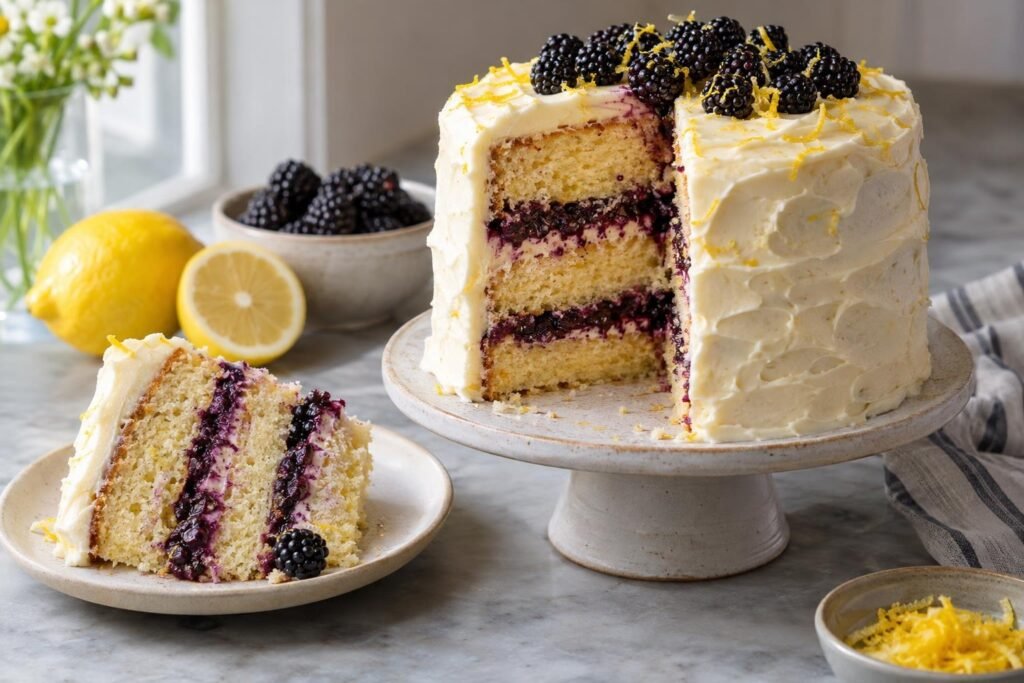
Bright lemon zest perfumes every soft, buttery layer, while a jewel-toned blackberry filling brings concentrated berry flavor and a pleasantly tart finish. This blackberry lemon layer cake balances that bold fruit with tangy cream cheese frosting, giving each slice distinct bands of golden cake, deep purple compote, and creamy frosting without letting any one component take over.
I build the lemon flavor into the cake with zest, juice, and buttermilk rather than relying on extract. The blackberry filling is cooked until a spatula drawn across the pan leaves a brief trail, which keeps it from soaking into the crumb or squeezing out during assembly. A piped frosting dam, a chilled crumb coat, and cold block-style cream cheese provide the control needed for clean, bakery-style layers.

What Makes this Lemon Cake So Ridiculously Good
- Rubbing lemon zest into the sugar releases its aromatic oils before mixing, distributing citrus flavor more evenly than simply stirring zest into the finished batter.
- Butter provides flavor and structure, while a measured amount of neutral oil keeps the refrigerated cake layers tender after the frosting has set.
- Buttermilk and lemon juice supply acidity, moisture, and tang that complement the blackberries without making the cake taste sharply sour.
- Cornstarch thickens the blackberry filling enough to stay between the layers, while briefly boiling the mixture removes its raw starch taste.
- A firm lemon cream cheese frosting dam contains the fruit filling, and a chilled crumb coat stabilizes the tall cake before final decorating.
Ingredient Notes for Bakery-Style Blackberry Lemon Layer Cake
- All-purpose flour: Its moderate protein level gives the layers enough strength to support compote and frosting without producing a chewy crumb. Weigh it rather than packing it into a measuring cup.
- Baking powder: This supplies the primary leavening. Make sure it is fresh because the batter is divided among three relatively shallow pans and needs a prompt, even rise.
- Unsalted butter: Softened butter traps air during creaming and supplies rich dairy flavor. It should yield to a fingertip but remain cool enough to hold its shape.
- Neutral oil: Oil stays fluid when chilled, helping the lemon cake remain tender after refrigeration. Choose a mild oil such as canola, sunflower, or grapeseed.
- Granulated sugar and lemon zest: Rubbing these together breaks open the zest’s oil-filled cells. Use only the yellow outer peel because the white pith tastes bitter.
- Eggs: Room-temperature eggs emulsify more readily with the creamed fat. Add them gradually so the batter remains smooth rather than greasy or curdled.
- Buttermilk and lemon juice: These contribute moisture, acidity, and citrus flavor. Bring the buttermilk to room temperature and combine it with the juice only shortly before mixing.
- Blackberries: Fresh or frozen blackberries work in the cooked filling. Frozen fruit should go directly into the saucepan without thawing, although it may require another minute or two to reduce.
- Cornstarch: Mixing cornstarch with cold water before cooking prevents dry lumps. The filling must reach a full simmer to activate its thickening power.
- Block-style cream cheese: Full-fat cream cheese sold in solid blocks makes a firmer frosting than spreadable tub varieties. Keep it cold and mix it in last to limit softening.
- Confectioners’ sugar: This sweetens and stabilizes the frosting. Sifting it removes hard lumps that would otherwise show on the cake’s final surface.
A Few Good Things to Know
- Weigh the finished batter as you divide it. Equal batter portions bake at the same rate and produce a level stack that needs less corrective trimming.
- Make the blackberry filling first and spread it in a shallow container. Increasing its surface area releases heat faster, but it still must be fully cold before it touches frosting.
- If the cake layers feel delicate after cooling, wrap them individually and chill for 30 to 45 minutes. Cool cake releases fewer crumbs and is easier to level cleanly.
- Keep the filling within the piped frosting dam. Pressing compote to the edge creates slippery seams that can bulge once the upper layers add weight.
- Cream cheese frosting softens with heat and excessive mixing. If it loses its peak, refrigerate the bowl for 10 to 15 minutes, then stir briefly by hand instead of adding more sugar.
Ingredients for Blackberry Lemon Layer Cake
- 500 g blackberries (Fresh or frozen, for the filling)
- 100 g granulated sugar (For the blackberry filling)
- 20 g fresh lemon juice (For the blackberry filling)
- 18 g cornstarch (For thickening the filling)
- 20 g cold water (For the cornstarch slurry)
- 360 g all-purpose flour (For the lemon cake)
- 12 g baking powder (About 1 tablespoon)
- 5 g fine sea salt (For the lemon cake)
- 360 g granulated sugar (For the lemon cake)
- 12 g finely grated lemon zest (From about 2 large lemons)
- 170 g unsalted butter (Softened to about 18 to 20°C)
- 80 g neutral oil (Such as canola, sunflower, or grapeseed oil)
- 4 large eggs (About 200 g without shells, at room temperature)
- 300 g buttermilk (At room temperature)
- 45 g fresh lemon juice (For the lemon cake)
- 10 g vanilla extract (For the lemon cake)
- 300 g unsalted butter (Softened to about 18 to 20°C, for the frosting)
- 550 g confectioners’ sugar (Sifted)
- 2 g fine sea salt (For the frosting)
- 6 g finely grated lemon zest (For the frosting)
- 15 g fresh lemon juice (For the frosting)
- 5 g vanilla extract (For the frosting)
- 450 g full-fat block-style cream cheese (Cold, cut into 8 pieces)
- 125 g fresh blackberries (Dry and unblemished, for decorating)
- 1 tsp finely grated lemon zest (For the final garnish)
How to Make Blackberry Lemon Layer Cake
- STEP 1). Cook and chill the blackberry filling Combine the blackberries, 100 g granulated sugar, and 20 g lemon juice in a medium heavy-bottomed saucepan. Cook over medium heat for 5 to 7 minutes, stirring and crushing about half the berries, until the juices simmer. Whisk the cornstarch with the cold water, stir it into the fruit, and boil for 1 full minute. The filling should look glossy, and a spatula drawn across the pan should leave a trail briefly. Transfer it to a shallow bowl, cover the surface, and refrigerate until completely cold.
- STEP 2). Prepare the pans and preheat the oven Position a rack in the center of the oven and preheat to 175°C. Lightly grease three 8-inch round cake pans, line the bottoms with parchment rounds, and grease the parchment. Leave the pan sides only lightly coated so the batter can climb evenly. Set the pans on a large work surface and confirm they sit level. Preparing all three before mixing matters because the activated batter should be divided and baked promptly rather than waiting in the bowl.
- STEP 3). Combine the dry and liquid mixtures Whisk the flour, baking powder, and 5 g salt in a medium bowl for at least 30 seconds to distribute the leavener. In a separate jug, whisk the room-temperature buttermilk, 45 g lemon juice, and 10 g vanilla until uniform. The dairy may look slightly thickened after the juice is added, which is expected. Keep both mixtures beside the mixer so they can be incorporated without delays or prolonged mixing once the flour begins hydrating.
- STEP 4). Cream the butter, sugar, zest, and oil Place 360 g granulated sugar and 12 g lemon zest in the stand mixer bowl and rub them together with your fingertips until the sugar feels damp and smells strongly of lemon. Add 170 g softened butter and beat with the paddle on medium speed for 3 to 4 minutes, scraping twice, until pale and fluffy. With the mixer running on medium-low, drizzle in the oil over 30 seconds. Continue mixing until the emulsion looks smooth, creamy, and free of visible oil.
- STEP 5). Add the eggs and finish the batter Beat the eggs together briefly, then add them to the creamed mixture in four additions on medium-low speed, mixing until each portion disappears before adding the next. Scrape the bowl and paddle. On low speed, add the flour mixture in three portions, alternating with the buttermilk mixture in two portions, beginning and ending with flour. Stop when only a few flour streaks remain, then fold with a spatula until smooth. The finished batter should be thick, glossy, and evenly emulsified, not whipped or runny.
- STEP 6). Divide and bake the lemon cake layers Divide the batter evenly among the prepared pans, using approximately 550 g per pan, and smooth the surfaces with a small offset spatula. Bake all three pans on the center rack for 24 to 29 minutes, rotating their positions after 18 minutes if the oven browns unevenly. The layers are done when their centers spring back, the edges begin pulling from the pans, and a tester shows moist crumbs but no wet batter. An optional center temperature is approximately 96 to 98°C.
- STEP 7). Cool and level the cake layers Set the pans on wire racks and cool the cakes in their pans for 15 minutes. Run a thin spatula around each edge, invert onto the racks, remove the parchment, and turn the layers upright. Let them cool completely for about 90 minutes before trimming or frosting because residual warmth will loosen the cream cheese frosting. If the tops are domed, use a long serrated knife to remove only the raised portion, keeping each layer as level and equally thick as possible.
- STEP 8). Mix the lemon cream cheese frosting Beat 300 g softened butter with the paddle on medium speed for 2 minutes until smooth. Add the sifted confectioners’ sugar in four additions on low speed, followed by 2 g salt, 6 g lemon zest, 15 g lemon juice, and 5 g vanilla. Beat on medium for 2 minutes, then scrape thoroughly. Add the cold cream cheese one piece at a time on low speed, mixing only until incorporated. Stop when the frosting is smooth and holds a firm curved peak, since overbeating warms and loosens it.
- STEP 9). Fill and crumb-coat the cake Place one cake layer on an 8-inch cake board or serving plate. Fill a piping bag with about 250 g frosting and pipe a 1/2-inch-high dam around the outer edge. Spread half of the cold blackberry filling inside the dam without crossing it. Repeat with the second cake layer, another dam, and the remaining filling, then add the final layer cut-side down. Apply a thin frosting coat over the top and sides, trapping loose crumbs, and refrigerate the cake uncovered for 30 minutes.
- STEP 10). Finish, decorate, and slice the cake Cover the chilled cake with the remaining frosting, using an offset spatula for the top and a bench scraper for the sides. Avoid repeatedly smoothing once the frosting warms; refrigerate it for 10 minutes if it becomes glossy or slack. Arrange the 125 g fresh blackberries around the top edge and scatter over the final teaspoon of lemon zest. Chill the decorated cake for at least 30 minutes to stabilize the layers. For clean slices, use a hot, dry chef’s knife and wipe it between cuts.
Storage and Freezing
- Refrigerate the assembled cake in a covered cake carrier for up to 4 days because the cream cheese frosting and fruit filling are perishable.
- Keep the cake at room temperature for no longer than 2 hours. For the best crumb and frosting texture, let refrigerated slices stand for 20 to 30 minutes before serving.
- Freeze individual slices on a parchment-lined tray until firm, then wrap each slice tightly and place it in an airtight container for up to 2 months.
- Thaw wrapped slices overnight in the refrigerator. Unwrap them after thawing to prevent condensation from marking the frosting, then bring them toward cool room temperature before serving.
- Freeze unfrosted cake layers, wrapped twice while completely cool, for up to 2 months.
- Thaw them overnight in the refrigerator before leveling and assembling.
Frequently Asked Questions
Why is my blackberry filling running out of the cake?
Warm or undercooked compote remains too fluid to support stacked layers. Boil the cornstarch-thickened filling for a full minute, then chill it until it is cold and spoonable rather than pourable.
Keep the filling inside a continuous frosting dam and avoid overfilling the layers. If the dam has gaps or the compote reaches the cake’s edge, pressure from the upper layers can force it outward.
How do I keep lemon layer cake moist after refrigeration?
The combination of butter, neutral oil, buttermilk, and sugar helps this cake retain moisture when chilled. Accurate flour measurement and stopping the bake when a tester has moist crumbs are equally important because excess flour or overbaking creates a dry crumb.
Store the finished cake in a covered carrier rather than uncovered in the refrigerator. Let each slice stand for 20 to 30 minutes before serving so the butter softens and the crumb regains its tender texture.
What makes cream cheese frosting become soft or runny?
Spreadable cream cheese, warm ingredients, excessive beating, and extra liquid can all weaken cream cheese frosting. This method builds structure with whipped butter and confectioners’ sugar before cold block-style cream cheese is mixed in briefly.
If the frosting looks glossy and no longer holds a curved peak, stop mixing and refrigerate it for 10 to 15 minutes. Stir gently with a spatula before use rather than whipping more air and warmth into it.
Can I use frozen blackberries in the cake filling?
Frozen blackberries work directly from the freezer because the filling is cooked. Add them to the saucepan without thawing, which prevents losing flavorful juice on a cutting board or in a strainer.
They may take an additional minute or two to release their liquid and reach a simmer. Judge the filling by its glossy appearance and brief spatula trail, not only by the clock, then chill it completely before assembly.
How do you decorate blackberry lemon layer cake neatly?
Start with fully cooled, level layers and use a cake board that matches the cake’s diameter. A cold crumb coat traps loose particles, while a bench scraper held vertically against a rotating cake creates straighter sides.
Add only dry, unblemished blackberries after the final frosting coat. Wet berries can bleed onto the frosting, so wash them in advance and dry them thoroughly. A little fresh lemon zest adds color without weighing down the cake.
More Ridiculously Delicious Cakes
- Blueberry Lemon Snack Cake for an Everyday Pan Cake
- Raspberry Lemon Coffee Cake with Soft, Tender Crumb
- Lemon Poppy Seed Coffee Cake with Soft, Tender Crumb
- Lemon Olive Oil Bundt Cake with a Tender Crumb
- Black Forest Layer Cake with Soft, Tender Crumb
Bakery-Style Blackberry Lemon Layer Cake
Ingredients
Equipment
Method
- Combine the blackberries, 100 g granulated sugar, and 20 g lemon juice in a medium heavy-bottomed saucepan. Cook over medium heat for 5 to 7 minutes, stirring and crushing about half the berries, until the juices simmer. Whisk the cornstarch with the cold water, stir it into the fruit, and boil for 1 full minute. The filling should look glossy, and a spatula drawn across the pan should leave a trail briefly. Transfer it to a shallow bowl, cover the surface, and refrigerate until completely cold.
- Position a rack in the center of the oven and preheat to 175°C. Lightly grease three 8-inch round cake pans, line the bottoms with parchment rounds, and grease the parchment. Leave the pan sides only lightly coated so the batter can climb evenly. Set the pans on a large work surface and confirm they sit level. Preparing all three before mixing matters because the activated batter should be divided and baked promptly rather than waiting in the bowl.
- Whisk the flour, baking powder, and 5 g salt in a medium bowl for at least 30 seconds to distribute the leavener. In a separate jug, whisk the room-temperature buttermilk, 45 g lemon juice, and 10 g vanilla until uniform. The dairy may look slightly thickened after the juice is added, which is expected. Keep both mixtures beside the mixer so they can be incorporated without delays or prolonged mixing once the flour begins hydrating.
- Place 360 g granulated sugar and 12 g lemon zest in the stand mixer bowl and rub them together with your fingertips until the sugar feels damp and smells strongly of lemon. Add 170 g softened butter and beat with the paddle on medium speed for 3 to 4 minutes, scraping twice, until pale and fluffy. With the mixer running on medium-low, drizzle in the oil over 30 seconds. Continue mixing until the emulsion looks smooth, creamy, and free of visible oil.
- Beat the eggs together briefly, then add them to the creamed mixture in four additions on medium-low speed, mixing until each portion disappears before adding the next. Scrape the bowl and paddle. On low speed, add the flour mixture in three portions, alternating with the buttermilk mixture in two portions, beginning and ending with flour. Stop when only a few flour streaks remain, then fold with a spatula until smooth. The finished batter should be thick, glossy, and evenly emulsified, not whipped or runny.
- Divide the batter evenly among the prepared pans, using approximately 550 g per pan, and smooth the surfaces with a small offset spatula. Bake all three pans on the center rack for 24 to 29 minutes, rotating their positions after 18 minutes if the oven browns unevenly. The layers are done when their centers spring back, the edges begin pulling from the pans, and a tester shows moist crumbs but no wet batter. An optional center temperature is approximately 96 to 98°C.
- Set the pans on wire racks and cool the cakes in their pans for 15 minutes. Run a thin spatula around each edge, invert onto the racks, remove the parchment, and turn the layers upright. Let them cool completely for about 90 minutes before trimming or frosting because residual warmth will loosen the cream cheese frosting. If the tops are domed, use a long serrated knife to remove only the raised portion, keeping each layer as level and equally thick as possible.
- Beat 300 g softened butter with the paddle on medium speed for 2 minutes until smooth. Add the sifted confectioners’ sugar in four additions on low speed, followed by 2 g salt, 6 g lemon zest, 15 g lemon juice, and 5 g vanilla. Beat on medium for 2 minutes, then scrape thoroughly. Add the cold cream cheese one piece at a time on low speed, mixing only until incorporated. Stop when the frosting is smooth and holds a firm curved peak, since overbeating warms and loosens it.
- Place one cake layer on an 8-inch cake board or serving plate. Fill a piping bag with about 250 g frosting and pipe a 1/2-inch-high dam around the outer edge. Spread half of the cold blackberry filling inside the dam without crossing it. Repeat with the second cake layer, another dam, and the remaining filling, then add the final layer cut-side down. Apply a thin frosting coat over the top and sides, trapping loose crumbs, and refrigerate the cake uncovered for 30 minutes.
- Cover the chilled cake with the remaining frosting, using an offset spatula for the top and a bench scraper for the sides. Avoid repeatedly smoothing once the frosting warms; refrigerate it for 10 minutes if it becomes glossy or slack. Arrange the 125 g fresh blackberries around the top edge and scatter over the final teaspoon of lemon zest. Chill the decorated cake for at least 30 minutes to stabilize the layers. For clean slices, use a hot, dry chef’s knife and wipe it between cuts.
Notes
- Weigh the finished batter as you divide it. Equal batter portions bake at the same rate and produce a level stack that needs less corrective trimming.
- Make the blackberry filling first and spread it in a shallow container. Increasing its surface area releases heat faster, but it still must be fully cold before it touches frosting.
- If the cake layers feel delicate after cooling, wrap them individually and chill for 30 to 45 minutes. Cool cake releases fewer crumbs and is easier to level cleanly.
- Keep the filling within the piped frosting dam. Pressing compote to the edge creates slippery seams that can bulge once the upper layers add weight.
- Cream cheese frosting softens with heat and excessive mixing. If it loses its peak, refrigerate the bowl for 10 to 15 minutes, then stir briefly by hand instead of adding more sugar.