

Table of Contents
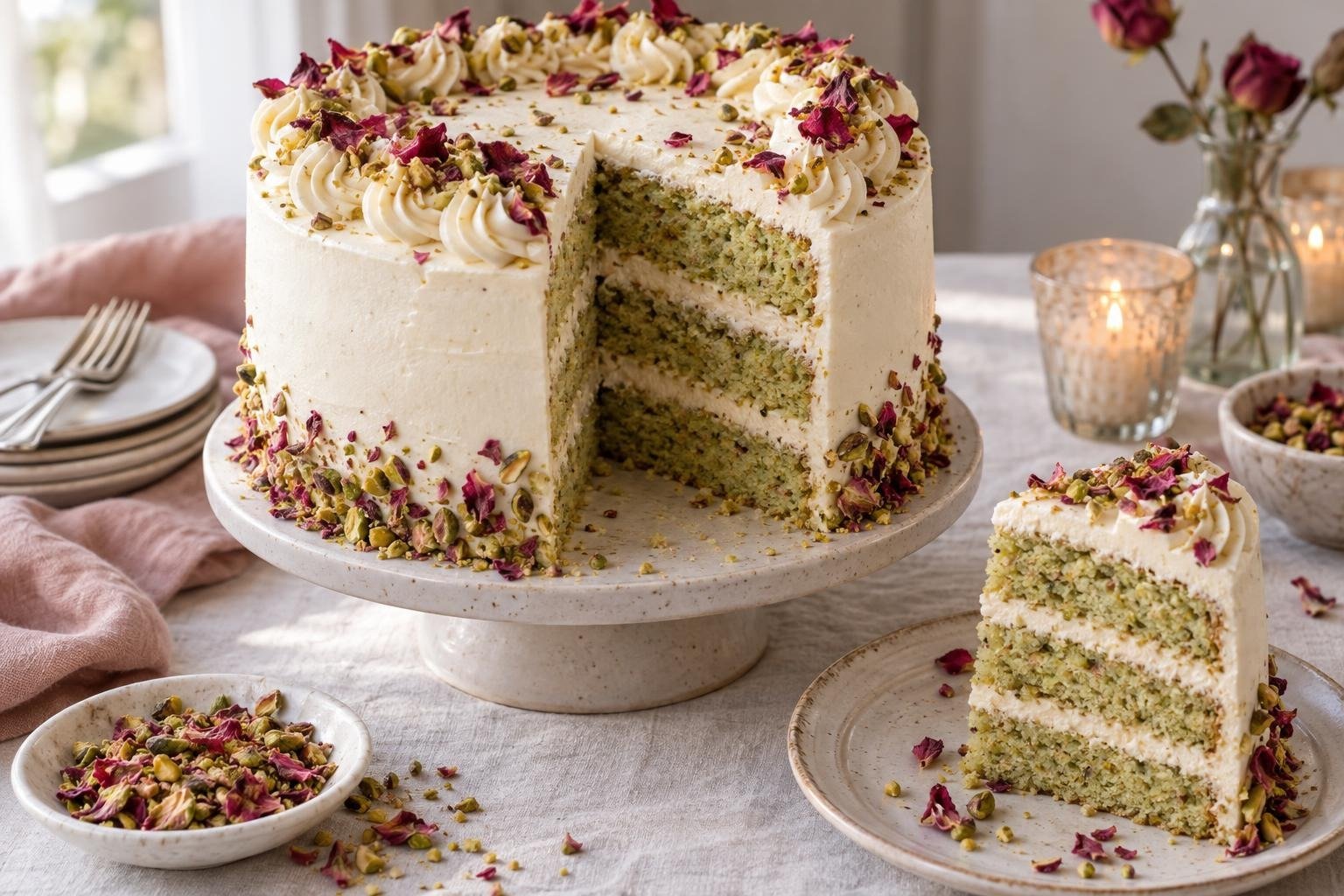
Pistachio and rose are such a beautiful pairing, but I’ve found that a little restraint with the rose water makes all the difference. This pistachio rose anniversary cake recipe has soft, nutty cake layers made with finely ground pistachios, a delicate rose syrup, and silky Swiss meringue buttercream. I like letting the pistachio flavor come through first, with just a hint of rose in the background rather than anything too floral. Brushing the layers with syrup keeps the cake moist without making it soggy, and the buttercream is wonderfully smooth without being overly sweet. For the decoration, I keep things fairly simple with chopped pistachios and deep pink rose petals. The contrast of green and pink is gorgeous, and there’s no need for complicated piping when the ingredients already look this pretty. It’s a romantic cake that feels especially fitting for an anniversary celebration.
Why This Pistachio Cake Recipe Frickin’ Works
- Plenty of pistachio flavor without a heavy crumb: I grind the pistachios with a little of the cake flour to keep them from turning into a greasy paste. This gives the cake a fine, even texture while letting that rich, nutty pistachio flavor come through in every slice.
- Butter for flavor, oil for softness: Using both butter and neutral oil gives the cake a rich, buttery taste while keeping the layers tender, even after they’ve been refrigerated. That’s especially helpful for a celebration cake that needs time to chill before serving.
- Sour cream keeps the layers moist: Sour cream adds richness and a subtle tang, while the eggs help give the cake enough structure for stacking. The result is a soft, tender crumb that doesn’t fall apart when you slice it.
- Just the right amount of rose: Rose water can easily overpower a dessert, so I divide it between the syrup and buttercream. This gives the cake a delicate floral flavor that complements the pistachios without making it taste like perfume.
- Silky buttercream without excessive sweetness: Swiss meringue buttercream is one of my favorite choices for a cake like this. It’s smooth, light on the palate, and much less sugary than traditional American buttercream, while still giving the cake clean edges and a beautiful finish.
Ingredient Notes for Pistachio Rose Anniversary Cake
- Unsalted pistachios: Use shelled, unsalted pistachios so the salt level remains controlled. Grinding them with flour limits clumping and preserves small particles that make the cake visibly and meaningfully pistachio-rich.
- Cake flour: Its lower protein content helps offset the structure contributed by the ground nuts. Weigh it rather than packing it into a cup, since excess flour will make these layers dense and difficult to soak evenly.
- Unsalted butter and neutral oil: Butter provides flavor and traps air during creaming, while oil stays fluid when chilled. That combination gives the cake enough structure for stacking without producing a hard refrigerated crumb.
- Sour cream: Full-fat sour cream adds moisture, fat, and gentle acidity. Bring it to room temperature so it emulsifies smoothly instead of chilling and tightening the butter mixture.
- Whole milk: Milk loosens the batter and supplies water for starch gelatinization. Room-temperature milk incorporates more evenly and helps prevent the batter from curdling.
- Rose water: Use culinary rose water rather than rose extract or cosmetic floral water. Brands differ in intensity, so measure carefully and avoid adding an unmeasured splash that could overwhelm the pistachio.
- Egg whites: Weigh the whites for the Swiss meringue buttercream because egg sizes vary. Keep every trace of yolk and grease out of the bowl so the meringue can reach a firm, glossy peak.
- Buttercream butter: The butter should be pliable but cool, around 18 to 20°C. Butter that is greasy or partially melted will make the finished frosting loose and difficult to smooth.
- Dried rose petals: Purchase food-grade culinary petals intended for eating. Florist roses may be treated with chemicals and are not an appropriate decoration.
- Vanilla and almond extracts: Vanilla rounds out the floral notes, while a small amount of almond extract reinforces the pistachio aroma. Too much almond extract would disguise the flavor of the actual nuts.
Baking Tips Worth Knowing
- Stop processing the pistachios while they still look powdery. A shiny mass means the nut oils have been released, and that paste will create heavy, uneven pockets in the cake.
- Weigh the batter into the pans rather than judging by sight. Even layers bake at the same rate and produce a level anniversary cake that needs less trimming.
- If the cake tops are browning while the centers remain fluid, check the actual oven temperature with an oven thermometer. Do not increase baking time blindly in an overheated oven.
- Swiss meringue buttercream may look curdled while the butter is being incorporated. Continue beating if the bowl feels cool; if it feels warm and the frosting is soupy, chill it for 10 minutes before whipping again.
- Apply rose syrup with a pastry brush in several light passes. Dumping it onto the cake can saturate the center while leaving the perimeter dry and structurally weak.
Ingredients for Pistachio Rose Anniversary Cake
- 180 g shelled unsalted pistachios (For the cake; cool, dry, and free from shells)
- 300 g cake flour (Divided during grinding and mixing)
- 10 g baking powder (About 2 1/2 teaspoons)
- 3 g baking soda (About 1/2 teaspoon)
- 5 g fine sea salt (About 3/4 teaspoon)
- 170 g unsalted butter (For the cake, softened to 18 to 20°C)
- 350 g granulated sugar (For the cake)
- 60 g neutral vegetable oil (Such as canola, sunflower, or grapeseed oil)
- 4 large eggs (Room temperature, about 200g without shells)
- 10 g pure vanilla extract (For the cake)
- 1 g almond extract (About 1/4 teaspoon)
- 240 g full-fat sour cream (Room temperature)
- 180 g whole milk (Room temperature)
- 100 g granulated sugar (For the rose syrup)
- 100 g water (For the rose syrup)
- 10 g culinary rose water (For the syrup)
- 200 g egg whites (For the buttercream, from about 6 large eggs)
- 350 g granulated sugar (For the buttercream)
- 454 g unsalted butter (For the buttercream, cut into tablespoons and softened to 18 to 20°C)
- 5 g culinary rose water (For the buttercream)
- 5 g pure vanilla extract (For the buttercream)
- 1 g fine sea salt (For the buttercream)
- 30 g shelled unsalted pistachios (Finely chopped for decorating)
- 3 g dried culinary rose petals (Crush lightly and remove any tough stems)
How to Make Pistachio Rose Anniversary Cake
- STEP 1). Prepare the pans and preheat the oven Set an oven rack in the center and preheat the oven to 175°C. Grease three 8-inch round cake pans, line the bottoms with parchment, and lightly grease the parchment. Dust the sides with a small amount of cake flour and tap out the excess. Set the butter, eggs, sour cream, and milk out before mixing so they reach room temperature. Evenly tempered ingredients form a smoother emulsion and help the layers rise without greasy or rubbery patches.
- STEP 2). Grind the pistachios and combine the dry ingredients Place the 180g pistachios and 40g of the measured cake flour in a food processor. Pulse in one-second bursts until the nuts resemble fine, slightly irregular sand, stopping before they become damp or pasty. Transfer the mixture to a large bowl. Sift in the remaining 260g cake flour, baking powder, baking soda, and salt, then whisk thoroughly for 30 seconds. Break apart any oily pistachio clumps with your fingertips so the nuts disperse evenly through the batter.
- STEP 3). Cream the butter and build the cake emulsion In a stand mixer fitted with the paddle, beat the 170g butter and 350g sugar on medium speed for 3 to 4 minutes, scraping the bowl halfway through, until pale, fluffy, and increased in volume. With the mixer running on medium-low, stream in the oil and mix until glossy. Add the eggs one at a time, mixing for about 20 seconds after each and scraping as needed. Mix in the vanilla and almond extracts; the mixture should look thick and emulsified, not separated or greasy.
- STEP 4). Finish and divide the pistachio batter Whisk the sour cream and milk together until smooth. With the mixer on low, add one-third of the pistachio flour mixture, followed by half of the milk mixture. Repeat, finishing with the final third of dry ingredients. Stop as soon as only a few flour streaks remain, then fold with a spatula, scraping the bottom where dry pockets hide. Divide the batter evenly among the prepared pans, about 575g per pan, and smooth the tops without pressing out the incorporated air.
- STEP 5). Bake and cool the cake layers Bake all three pans on the center rack for 25 to 30 minutes, rotating their positions after 20 minutes only if the oven browns unevenly. The cakes are done when the centers spring back lightly, the edges begin to pull from the pans, and a skewer shows moist crumbs but no wet batter. Cool in the pans for 15 minutes. Run a thin knife around the edges, invert onto racks, remove the parchment, and cool completely for at least 75 minutes before leveling or brushing.
- STEP 6). Cook and cool the rose syrup While the cakes cool, combine the 100g sugar and 100g water in a small saucepan. Bring to a gentle boil over medium heat, stirring only until the sugar dissolves, then simmer for 2 minutes. Remove from the heat and cool for 10 minutes before stirring in the 10g rose water, which protects its volatile floral aroma from prolonged heat. Transfer the syrup to a heatproof container and cool completely. It should remain thin enough to soak into the cake rather than glaze the surface.
- STEP 7). Prepare the rose Swiss meringue buttercream Combine the egg whites and 350g sugar in the clean mixer bowl. Set it over a saucepan containing 2.5cm of barely simmering water, keeping the bowl above the water, and whisk constantly until the mixture reaches 71°C and feels smooth between two fingers. Whip with the whisk on high for 8 to 12 minutes, until glossy stiff peaks form and the bowl cools below 32°C. Add the 454g butter gradually on medium speed, then beat in the rose water, vanilla, and salt until silky.
- STEP 8). Level, soak, and fill the layers Use a serrated knife to remove any domed tops once the cakes are completely cool. Place the first layer cut side up on an 8-inch cake board and brush it evenly with about 35g rose syrup, stopping before liquid pools at the edges. Spread 180g buttercream over the layer in an even 6mm thickness. Repeat with the second cake, syrup, and buttercream. Brush the cut side of the final layer with another 35g syrup, then place it brushed side down for a flat, crumb-free top.
- STEP 9). Crumb coat and finish the buttercream Apply a thin layer of buttercream over the top and sides with an offset spatula, filling gaps between the cakes as you work. Scrape the coating smooth with a bench scraper, then refrigerate the cake uncovered for 20 minutes until the surface feels firm but not frozen. Cover the chilled cake with most of the remaining buttercream, reserving about 150g for piping. Smooth the sides on a turntable and draw excess frosting inward across the top to create a clean, level edge.
- STEP 10). Decorate, chill, and slice the cake Transfer the reserved buttercream to a piping bag fitted with an open-star tip and pipe evenly spaced rosettes around the top edge. Sprinkle the chopped pistachios and dried culinary rose petals over the rosettes and around the base, pressing lightly where needed so they adhere. Refrigerate the assembled cake for at least 30 minutes to stabilize the layers. Before serving, let it stand at room temperature for 45 to 60 minutes, then cut with a warm, dry knife, wiping the blade between slices.
Storage and Freezing
- Refrigeration: Store the assembled cake in a covered cake carrier or tall airtight container for up to 4 days. Keep it away from strongly aromatic foods because buttercream absorbs odors.
- Room temperature: Keep the cake out for no longer than 4 hours in a cool room. Return leftovers to the refrigerator promptly.
- Freezing cake layers: Wrap completely cooled, unsoaked layers twice in plastic wrap and once in foil, then freeze for up to 2 months.
- Freezing slices: Freeze individual slices until firm, wrap them securely, and store in an airtight container for up to 1 month. Delicate rose petals may darken after thawing.
- Thawing: Thaw wrapped cake layers overnight in the refrigerator.
- Thaw assembled slices in the refrigerator for several hours, then unwrap to limit condensation on the buttercream.
- Serving: Bring refrigerated cake to room temperature for 45 to 60 minutes so the buttercream softens and the pistachio crumb regains its tender texture.
Frequently Asked Questions
What does pistachio rose anniversary cake taste like?
The cake has a buttery, roasted-nut character from pistachios ground directly into the crumb. Sour cream keeps the layers tender, while a tiny amount of almond extract strengthens the pistachio aroma without turning the cake into an almond dessert.
Rose appears as a light fragrance in the syrup and buttercream rather than a heavy perfume. Vanilla and butter round out the floral note, and the lightly salted cake prevents the finished slice from tasting flat or excessively sweet.
How do I stop rose cake from tasting soapy?
Measure culinary rose water by weight and divide it exactly as directed. Adding it after the syrup comes off the heat preserves the aroma, so a large quantity is unnecessary. Rose extract is much more concentrated and should not be used in the same amount.
Taste the finished syrup only after it has cooled because warm vapor can make the rose seem stronger. Avoid adding extra rose water to the buttercream before the vanilla and butter have been fully incorporated.
Why did my pistachio cake layers sink in the middle?
Sunken centers usually indicate that the cake structure had not set before the pans left the oven. Look for a resilient center, slight separation at the edges, and moist crumbs rather than liquid batter on a skewer.
Overprocessed pistachios can also release excess oil and weigh down the batter. Pulse them with flour, mix only until the final dry streaks disappear, and avoid opening the oven during the first 20 minutes of baking.
Can I prepare this pistachio rose anniversary cake ahead of time?
The unsoaked cake layers may be baked up to two days ahead, wrapped airtight, and refrigerated, or frozen for up to two months. Prepare the rose syrup up to one week ahead and refrigerate it in a sealed container.
The fully assembled cake is best decorated one day before serving. Refrigerate it in a covered carrier, then allow 45 to 60 minutes at room temperature before slicing so the buttercream and crumb soften properly.
How do you get smooth buttercream and clean slices on a layer cake?
Start with a cold, firm crumb coat and buttercream that spreads without looking shiny or runny. Hold the bench scraper upright against the turntable, rotate the cake steadily, and fill visible low spots before making another smoothing pass.
Chill the finished cake for at least 30 minutes before cutting. Dip a long knife in hot water, dry it completely, make one firm downward cut, and wipe the blade clean before cutting the next slice.
More Ridiculously Delicious Cakes
- Bakery-Style Chocolate Raspberry Anniversary Cake with a Moist, Tender Crumb
- Strawberry Rhubarb Coffee Cake with Soft, Tender Crumb
- Raspberry Chocolate Roll Cake with a Tender Chocolate Sponge
- Cinnamon Streusel Coffee Cake with a Soft Sour Cream Crumb
- Chocolate Streusel Coffee Cake with Soft, Tender Crumb
Pistachio Rose Anniversary Cake
Ingredients
Equipment
Method
- Set an oven rack in the center and preheat the oven to 175°C. Grease three 8-inch round cake pans, line the bottoms with parchment, and lightly grease the parchment. Dust the sides with a small amount of cake flour and tap out the excess. Set the butter, eggs, sour cream, and milk out before mixing so they reach room temperature. Evenly tempered ingredients form a smoother emulsion and help the layers rise without greasy or rubbery patches.
- Place the 180g pistachios and 40g of the measured cake flour in a food processor. Pulse in one-second bursts until the nuts resemble fine, slightly irregular sand, stopping before they become damp or pasty. Transfer the mixture to a large bowl. Sift in the remaining 260g cake flour, baking powder, baking soda, and salt, then whisk thoroughly for 30 seconds. Break apart any oily pistachio clumps with your fingertips so the nuts disperse evenly through the batter.
- In a stand mixer fitted with the paddle, beat the 170g butter and 350g sugar on medium speed for 3 to 4 minutes, scraping the bowl halfway through, until pale, fluffy, and increased in volume. With the mixer running on medium-low, stream in the oil and mix until glossy. Add the eggs one at a time, mixing for about 20 seconds after each and scraping as needed. Mix in the vanilla and almond extracts; the mixture should look thick and emulsified, not separated or greasy.
- Whisk the sour cream and milk together until smooth. With the mixer on low, add one-third of the pistachio flour mixture, followed by half of the milk mixture. Repeat, finishing with the final third of dry ingredients. Stop as soon as only a few flour streaks remain, then fold with a spatula, scraping the bottom where dry pockets hide. Divide the batter evenly among the prepared pans, about 575g per pan, and smooth the tops without pressing out the incorporated air.
- Bake all three pans on the center rack for 25 to 30 minutes, rotating their positions after 20 minutes only if the oven browns unevenly. The cakes are done when the centers spring back lightly, the edges begin to pull from the pans, and a skewer shows moist crumbs but no wet batter. Cool in the pans for 15 minutes. Run a thin knife around the edges, invert onto racks, remove the parchment, and cool completely for at least 75 minutes before leveling or brushing.
- While the cakes cool, combine the 100g sugar and 100g water in a small saucepan. Bring to a gentle boil over medium heat, stirring only until the sugar dissolves, then simmer for 2 minutes. Remove from the heat and cool for 10 minutes before stirring in the 10g rose water, which protects its volatile floral aroma from prolonged heat. Transfer the syrup to a heatproof container and cool completely. It should remain thin enough to soak into the cake rather than glaze the surface.
- Combine the egg whites and 350g sugar in the clean mixer bowl. Set it over a saucepan containing 2.5cm of barely simmering water, keeping the bowl above the water, and whisk constantly until the mixture reaches 71°C and feels smooth between two fingers. Whip with the whisk on high for 8 to 12 minutes, until glossy stiff peaks form and the bowl cools below 32°C. Add the 454g butter gradually on medium speed, then beat in the rose water, vanilla, and salt until silky.
- Use a serrated knife to remove any domed tops once the cakes are completely cool. Place the first layer cut side up on an 8-inch cake board and brush it evenly with about 35g rose syrup, stopping before liquid pools at the edges. Spread 180g buttercream over the layer in an even 6mm thickness. Repeat with the second cake, syrup, and buttercream. Brush the cut side of the final layer with another 35g syrup, then place it brushed side down for a flat, crumb-free top.
- Apply a thin layer of buttercream over the top and sides with an offset spatula, filling gaps between the cakes as you work. Scrape the coating smooth with a bench scraper, then refrigerate the cake uncovered for 20 minutes until the surface feels firm but not frozen. Cover the chilled cake with most of the remaining buttercream, reserving about 150g for piping. Smooth the sides on a turntable and draw excess frosting inward across the top to create a clean, level edge.
- Transfer the reserved buttercream to a piping bag fitted with an open-star tip and pipe evenly spaced rosettes around the top edge. Sprinkle the chopped pistachios and dried culinary rose petals over the rosettes and around the base, pressing lightly where needed so they adhere. Refrigerate the assembled cake for at least 30 minutes to stabilize the layers. Before serving, let it stand at room temperature for 45 to 60 minutes, then cut with a warm, dry knife, wiping the blade between slices.
Notes
- Stop processing the pistachios while they still look powdery. A shiny mass means the nut oils have been released, and that paste will create heavy, uneven pockets in the cake.
- Weigh the batter into the pans rather than judging by sight. Even layers bake at the same rate and produce a level anniversary cake that needs less trimming.
- If the cake tops are browning while the centers remain fluid, check the actual oven temperature with an oven thermometer. Do not increase baking time blindly in an overheated oven.
- Swiss meringue buttercream may look curdled while the butter is being incorporated. Continue beating if the bowl feels cool; if it feels warm and the frosting is soupy, chill it for 10 minutes before whipping again.
- Apply rose syrup with a pastry brush in several light passes. Dumping it onto the cake can saturate the center while leaving the perimeter dry and structurally weak.



