
Table of Contents
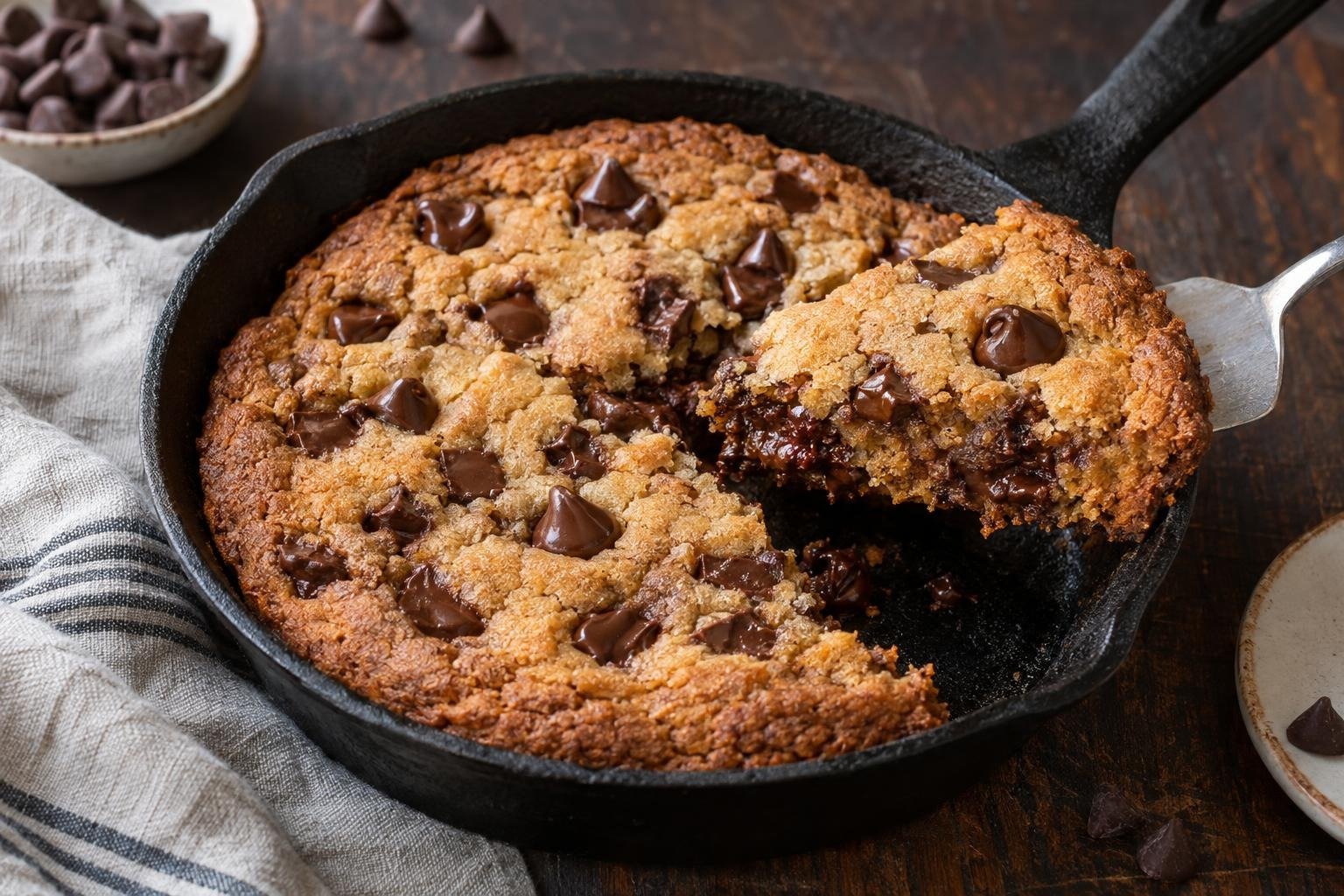
Crisp, buttery edges give way to a soft brown sugar middle and a molten pocket of semisweet chocolate in this small-batch chocolate chip skillet cookie. Chopped chocolate forms the gooey center, so the indulgent texture does not depend on leaving the surrounding dough raw. The 6 1/2-inch skillet produces four satisfying wedges without committing anyone to a week’s worth of cookies.
I use cooled melted butter for concentrated flavor and minimal equipment, then keep the finished dough between 21 and 24°C before it enters the skillet. That temperature range controls spread while allowing the dough to settle into the pan evenly. Watch the dough rather than the molten chocolate for doneness: the perimeter should be golden and raised, while the center surface should look matte, softly puffed, and free from wet batter.
Why You’ll Love these Ridiculously Delicious Chocolate Cookies
- A 6 1/2-inch cast-iron skillet gives this quantity of dough enough depth for a soft center while exposing plenty of perimeter for crisp, caramelized edges.
- Cooled melted butter hydrates the flour evenly without warming the dough so much that it turns greasy or spreads into a thin, dense layer.
- Brown sugar supplies moisture and chew, while a smaller amount of granulated sugar encourages surface crispness and edge browning.
- The chopped chocolate is enclosed between two layers of dough, creating a molten center while allowing the egg-containing cookie dough to bake until safely set.
- A 20-minute cooling period lets carryover heat finish the center and gives the starches and melted sugar time to firm enough for clean wedges.
Ingredient Notes for Small-Batch Chocolate Chip Skillet Cookie with a Gooey Chocolate Center
- Unsalted butter: Melted butter contributes rich flavor and a dense, chewy crumb. Cool it to 32 to 35°C before mixing so it does not overheat the yolk or produce loose, oily dough.
- Brown sugar: Packed light brown sugar provides moisture, molasses flavor, and chew. Dark brown sugar may be used for a deeper molasses note, although the baked cookie will look slightly darker and remain softer.
- Granulated sugar: This lower-moisture sugar supports crisp edges and helps the top develop fine cracks. Do not replace all of it with brown sugar if you want the specified edge texture.
- Egg yolk: One large yolk supplies enough protein and emulsifiers to bind this small quantity of dough without adding the excess water that a whole egg would contribute. Weigh 18 grams for the most consistent result.
- All-purpose flour: Flour provides the starch and protein needed for a sliceable cookie. Measure by weight and stop mixing as soon as the last dry streaks disappear to avoid a tough result.
- Baking soda: A small amount promotes browning and controls the cookie’s spread. More baking soda can make this shallow skillet cookie overly dark, thin, or alkaline tasting.
- Semisweet chocolate chips: Chips hold distinct pockets in the dough and on top. Reserve a small portion for the surface so the finished cookie visibly signals where the chocolate is.
- Chopped semisweet chocolate: A 55 to 65 percent cacao bar melts more fluidly than chips, which produces the gooey center. Chop it into small pieces so the layer can be enclosed without leaving large gaps in the dough.
A Few Good Things to Know
- Measure the skillet across its top edge. A much larger pan makes the cookie thin and quick to overbake, while a smaller pan requires additional baking time and delays center setting.
- Let the melted butter cool before mixing, but do not wait until it resolidifies. Fluid, moderately warm butter blends smoothly with the sugars without producing greasy dough.
- Check the finished dough temperature before shaping. Dough above 24°C spreads faster and can leave an oily ring around the edge; a brief chill restores control.
- Keep the chopped center chocolate away from the skillet wall and fully cover it with dough. Exposed chocolate can burn against hot cast iron or glue the cookie to the pan.
- Remove the cookie when the center dough is matte and puffed, not when the chocolate stops looking molten. Waiting for the chocolate to firm in the oven will overbake the cookie.
Ingredients for Small-Batch Chocolate Chip Skillet Cookie
- 5 g unsalted butter (Softened, for greasing the skillet)
- 60 g unsalted butter (Melted and cooled to 32 to 35°C)
- 50 g packed light brown sugar (Break up any firm lumps before mixing)
- 25 g granulated sugar
- 18 g large egg yolk (From 1 large egg, at room temperature)
- 1 tsp pure vanilla extract
- 80 g all-purpose flour (Weighed, not packed into a measuring cup)
- 1/4 tsp baking soda
- 1/4 tsp fine sea salt
- 50 g semisweet chocolate chips (Divide 40 grams for the dough and 10 grams for the top)
- 30 g semisweet chocolate (Use a 55 to 65 percent cacao bar, finely chopped for the center)
How to Make Small-Batch Chocolate Chip Skillet Cookie
- STEP 1). Prepare the oven and skillet Position a rack in the center of the oven and preheat to 350°F or 175°C. Use the 5 grams of softened butter to coat the bottom and sides of a room-temperature 6 1/2-inch cast-iron skillet. Do not preheat the skillet because a hot pan would melt the dough’s fat on contact and overbrown the bottom before the center sets. Place the prepared skillet on a heat-safe surface while you mix the dough.
- STEP 2). Build the butter and sugar mixture Place the 60 grams of melted butter, brown sugar, and granulated sugar in a medium bowl. Whisk for 45 to 60 seconds, until the mixture looks glossy and cohesive rather than separated or oily. Add the egg yolk and vanilla, then whisk for another 30 seconds until slightly thickened and smooth. The butter mixture should be warm but not hot; aim for 32 to 35°C before adding the yolk so the emulsion remains stable.
- STEP 3). Mix and temperature-check the dough Add the flour, baking soda, and salt to the butter mixture. Fold with a flexible spatula just until only a few flour streaks remain, then fold in 40 grams of the chocolate chips until no dry pockets are visible. The dough should be soft, cohesive, and between 21 and 24°C. If it is warmer than 24°C or looks shiny with loose butter, refrigerate it for 5 to 10 minutes before shaping to limit excess spread.
- STEP 4). Layer the dough around the chocolate center Press about two-thirds of the dough evenly into the prepared skillet, using your fingertips or the back of a spoon to form a level base. Scatter the chopped chocolate over the dough, keeping it about 1/2 inch from the skillet wall so it cannot leak and scorch. Flatten pieces of the remaining dough between your fingers, arrange them over the chocolate, and gently seal the joins. Press the reserved 10 grams of chocolate chips into the top without burying them.
- STEP 5). Bake, set, and portion the cookie Bake the skillet cookie for 15 to 18 minutes. It is ready when the outer 1 inch is raised and golden, the center surface is softly puffed and matte, and no area of dough looks wet or fluid. The enclosed chocolate will remain molten, so judge the surrounding dough rather than that filling. Transfer the hot skillet to a wire rack and cool for 20 minutes. Use oven mitts because cast iron stays hot, then cut directly in the skillet into four wedges and serve warm.
Storage and Freezing
- Room temperature: Cool completely, then cover the skillet tightly or transfer wedges to an airtight container. Store for up to 2 days.
- Refrigeration: Keep airtight for up to 5 days.
- Refrigeration firms the butter and chocolate, so warm individual wedges before serving.
- Freezing: Wrap completely cooled wedges individually, place them in a freezer-safe container, and freeze for up to 2 months.
- Thawing and serving: Thaw wrapped wedges at room temperature for 1 to 2 hours. Reheat unwrapped on a baking sheet at 300°F or 150°C for 5 to 7 minutes, just until the chocolate softens.
Frequently Asked Questions
Why will my small-batch chocolate chip skillet cookie not set?
An unset skillet cookie usually comes from using the wrong pan size, baking in an oven that is not fully preheated, or judging doneness by the molten chocolate rather than the dough. A pan smaller than 6 1/2 inches creates a thicker center that needs longer to bake.
Continue baking until the center surface is matte and softly puffed, with no glossy, liquid-looking dough. Let it rest for the full 20 minutes because hot sugar, butter, and starch remain fragile until carryover heat and cooling help the structure set.
What skillet size is best for a small-batch skillet cookie?
A 6 1/2-inch cast-iron skillet provides the intended balance of crisp perimeter and soft center for this dough quantity. Measure across the skillet’s upper rim rather than the cooking surface, since cookware dimensions are normally based on the top diameter.
An 8-inch skillet spreads the dough into a thinner layer that will bake faster and lose much of the gooey-center contrast. A smaller skillet makes the cookie deeper, so the exterior may brown before the center dough is fully baked.
Can you make small-batch chocolate chip skillet cookie ahead?
The assembled cookie can be covered and refrigerated in its skillet for up to 24 hours before baking. Let the cast-iron skillet stand at room temperature for about 20 minutes while the oven preheats, which reduces the temperature difference and promotes more even baking.
Cold dough may need an additional 1 to 3 minutes in the oven. Bake until the edges are golden and the center dough is matte and puffed. Avoid moving a refrigerator-cold skillet directly into a very hot oven.
How do I know when a skillet cookie is done without overbaking it?
Look for a raised, golden perimeter and a center surface that has lost its wet shine. The middle may feel soft when gently pressed, but it should not ripple like batter. Fine cracks around the edge are another useful sign that the cookie’s structure has formed.
Remember that the chopped chocolate layer remains fluid while hot and is not evidence of raw dough. Remove the skillet once the dough is set, then allow 20 minutes of cooling so carryover heat can finish the center without drying the edges.
Which ingredient substitutions work in this small-batch chocolate chip skillet cookie?
Dark brown sugar can replace light brown sugar by weight, producing a deeper molasses flavor, darker color, and slightly softer texture. Bittersweet chocolate within the stated 55 to 65 percent cacao range can replace semisweet chocolate if a less sweet center is preferred.
Chocolate chips may replace the chopped center chocolate, although stabilizers help chips retain their shape, so the filling will be less fluid. Whole eggs, liquid sweeteners, gluten-free flour blends, and spreadable butter products are not direct exchanges in this moisture-sensitive small-batch formula.
More Ridiculously Delicious Cookies
- Small-Batch Double Chocolate Cookies with Soft, Chewy Centers
- Fudgy Chocolate Crinkle Cookies with Crackled Sugar Tops
- Thick Brown Butter Chocolate Chunk Cookies with Chewy Centers
- Chewy Cranberry White Chocolate Cookies with Soft, Chewy Centers
- Small-Batch Lemon Cookies with Soft, Chewy Centers
Small-Batch Chocolate Chip Skillet Cookie with a Gooey Chocolate Center
Ingredients
Equipment
Method
- Position a rack in the center of the oven and preheat to 350°F or 175°C. Use the 5 grams of softened butter to coat the bottom and sides of a room-temperature 6 1/2-inch cast-iron skillet. Do not preheat the skillet because a hot pan would melt the dough’s fat on contact and overbrown the bottom before the center sets. Place the prepared skillet on a heat-safe surface while you mix the dough.
- Place the 60 grams of melted butter, brown sugar, and granulated sugar in a medium bowl. Whisk for 45 to 60 seconds, until the mixture looks glossy and cohesive rather than separated or oily. Add the egg yolk and vanilla, then whisk for another 30 seconds until slightly thickened and smooth. The butter mixture should be warm but not hot; aim for 32 to 35°C before adding the yolk so the emulsion remains stable.
- Add the flour, baking soda, and salt to the butter mixture. Fold with a flexible spatula just until only a few flour streaks remain, then fold in 40 grams of the chocolate chips until no dry pockets are visible. The dough should be soft, cohesive, and between 21 and 24°C. If it is warmer than 24°C or looks shiny with loose butter, refrigerate it for 5 to 10 minutes before shaping to limit excess spread.
- Press about two-thirds of the dough evenly into the prepared skillet, using your fingertips or the back of a spoon to form a level base. Scatter the chopped chocolate over the dough, keeping it about 1/2 inch from the skillet wall so it cannot leak and scorch. Flatten pieces of the remaining dough between your fingers, arrange them over the chocolate, and gently seal the joins. Press the reserved 10 grams of chocolate chips into the top without burying them.
- Bake the skillet cookie for 15 to 18 minutes. It is ready when the outer 1 inch is raised and golden, the center surface is softly puffed and matte, and no area of dough looks wet or fluid. The enclosed chocolate will remain molten, so judge the surrounding dough rather than that filling. Transfer the hot skillet to a wire rack and cool for 20 minutes. Use oven mitts because cast iron stays hot, then cut directly in the skillet into four wedges and serve warm.
Notes
- Measure the skillet across its top edge. A much larger pan makes the cookie thin and quick to overbake, while a smaller pan requires additional baking time and delays center setting.
- Let the melted butter cool before mixing, but do not wait until it resolidifies. Fluid, moderately warm butter blends smoothly with the sugars without producing greasy dough.
- Check the finished dough temperature before shaping. Dough above 24°C spreads faster and can leave an oily ring around the edge; a brief chill restores control.
- Keep the chopped center chocolate away from the skillet wall and fully cover it with dough. Exposed chocolate can burn against hot cast iron or glue the cookie to the pan.
- Remove the cookie when the center dough is matte and puffed, not when the chocolate stops looking molten. Waiting for the chocolate to firm in the oven will overbake the cookie.