Go Back
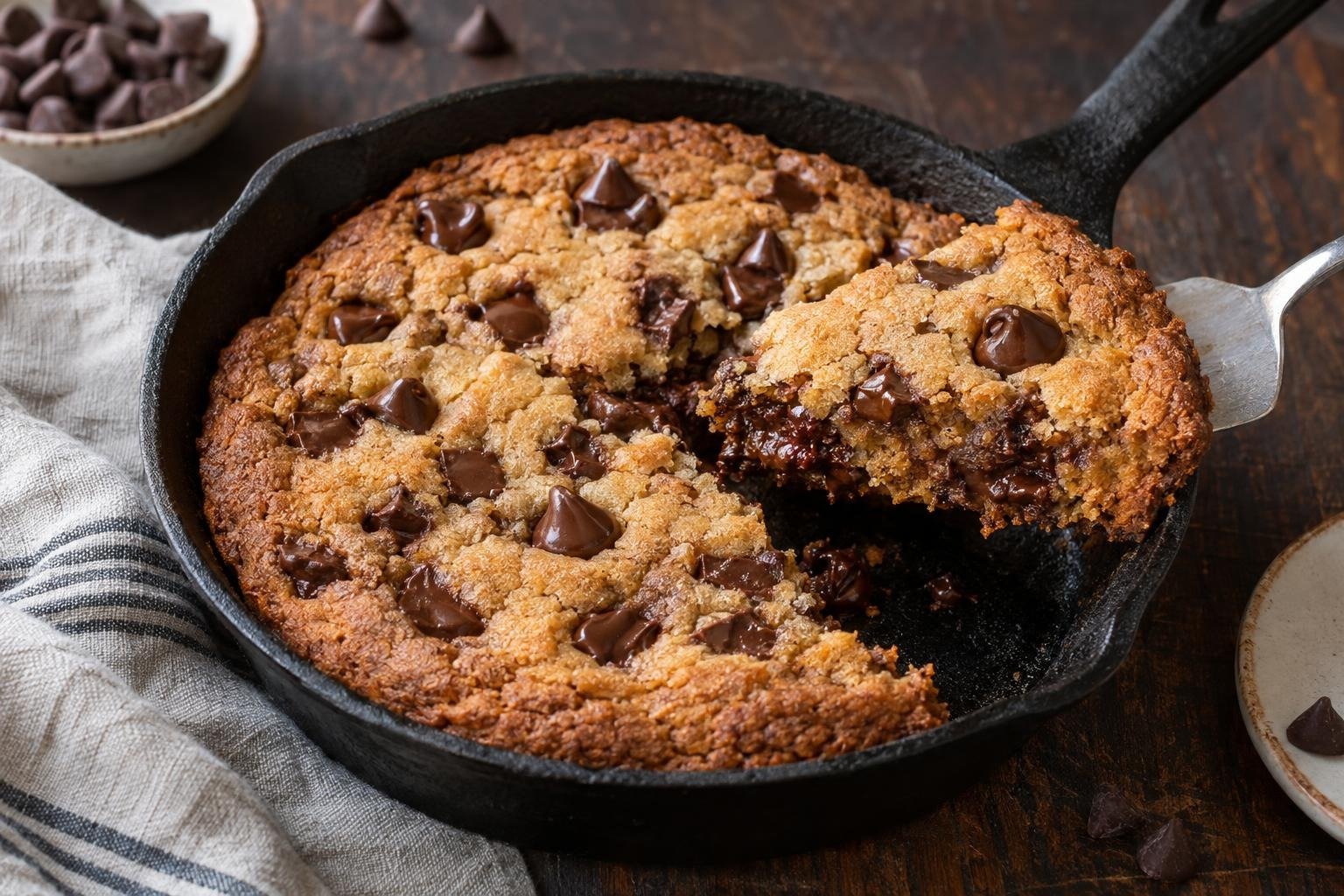
Small-batch chocolate chip skillet cookie with crisp edges and a gooey semisweet chocolate center

Small-Batch Chocolate Chip Skillet Cookie with a Gooey Chocolate Center

A warm small-batch chocolate chip skillet cookie baked in a 6 1/2-inch cast-iron skillet, with crisp golden edges, a soft but fully set interior, and chopped semisweet chocolate sealed through the center. It makes four dessert-size wedges.
Prep Time 20 minutes
Cook Time 18 minutes
Cooling 20 minutes
Total Time 58 minutes
Servings: 4 wedges
Course: Dessert
Cuisine: American
Calories: 380

Ingredients
  

  • 5 g unsalted butter Softened, for greasing the skillet
  • 60 g unsalted butter Melted and cooled to 32 to 35°C
  • 50 g packed light brown sugar Break up any firm lumps before mixing
  • 25 g granulated sugar
  • 18 g large egg yolk From 1 large egg, at room temperature
  • 1 tsp pure vanilla extract
  • 80 g all-purpose flour Weighed, not packed into a measuring cup
  • 1/4 tsp baking soda
  • 1/4 tsp fine sea salt
  • 50 g semisweet chocolate chips Divide 40 grams for the dough and 10 grams for the top
  • 30 g semisweet chocolate Use a 55 to 65 percent cacao bar, finely chopped for the center

Equipment

  • 6 1/2-inch cast-iron skillet, measured across the top
  • Digital kitchen scale
  • Small heatproof mixing bowl
  • Medium mixing bowl
  • Whisk and flexible silicone spatula
  • Instant-read thermometer, optional but useful for checking butter and dough temperature
  • Wire cooling rack and heat-safe oven mitts

Method
 

  1. Position a rack in the center of the oven and preheat to 350°F or 175°C. Use the 5 grams of softened butter to coat the bottom and sides of a room-temperature 6 1/2-inch cast-iron skillet. Do not preheat the skillet because a hot pan would melt the dough’s fat on contact and overbrown the bottom before the center sets. Place the prepared skillet on a heat-safe surface while you mix the dough.
  2. Place the 60 grams of melted butter, brown sugar, and granulated sugar in a medium bowl. Whisk for 45 to 60 seconds, until the mixture looks glossy and cohesive rather than separated or oily. Add the egg yolk and vanilla, then whisk for another 30 seconds until slightly thickened and smooth. The butter mixture should be warm but not hot; aim for 32 to 35°C before adding the yolk so the emulsion remains stable.
  3. Add the flour, baking soda, and salt to the butter mixture. Fold with a flexible spatula just until only a few flour streaks remain, then fold in 40 grams of the chocolate chips until no dry pockets are visible. The dough should be soft, cohesive, and between 21 and 24°C. If it is warmer than 24°C or looks shiny with loose butter, refrigerate it for 5 to 10 minutes before shaping to limit excess spread.
  4. Press about two-thirds of the dough evenly into the prepared skillet, using your fingertips or the back of a spoon to form a level base. Scatter the chopped chocolate over the dough, keeping it about 1/2 inch from the skillet wall so it cannot leak and scorch. Flatten pieces of the remaining dough between your fingers, arrange them over the chocolate, and gently seal the joins. Press the reserved 10 grams of chocolate chips into the top without burying them.
  5. Bake the skillet cookie for 15 to 18 minutes. It is ready when the outer 1 inch is raised and golden, the center surface is softly puffed and matte, and no area of dough looks wet or fluid. The enclosed chocolate will remain molten, so judge the surrounding dough rather than that filling. Transfer the hot skillet to a wire rack and cool for 20 minutes. Use oven mitts because cast iron stays hot, then cut directly in the skillet into four wedges and serve warm.
Notes

  • Measure the skillet across its top edge. A much larger pan makes the cookie thin and quick to overbake, while a smaller pan requires additional baking time and delays center setting.
  • Let the melted butter cool before mixing, but do not wait until it resolidifies. Fluid, moderately warm butter blends smoothly with the sugars without producing greasy dough.
  • Check the finished dough temperature before shaping. Dough above 24°C spreads faster and can leave an oily ring around the edge; a brief chill restores control.
  • Keep the chopped center chocolate away from the skillet wall and fully cover it with dough. Exposed chocolate can burn against hot cast iron or glue the cookie to the pan.
  • Remove the cookie when the center dough is matte and puffed, not when the chocolate stops looking molten. Waiting for the chocolate to firm in the oven will overbake the cookie.