Table of Contents
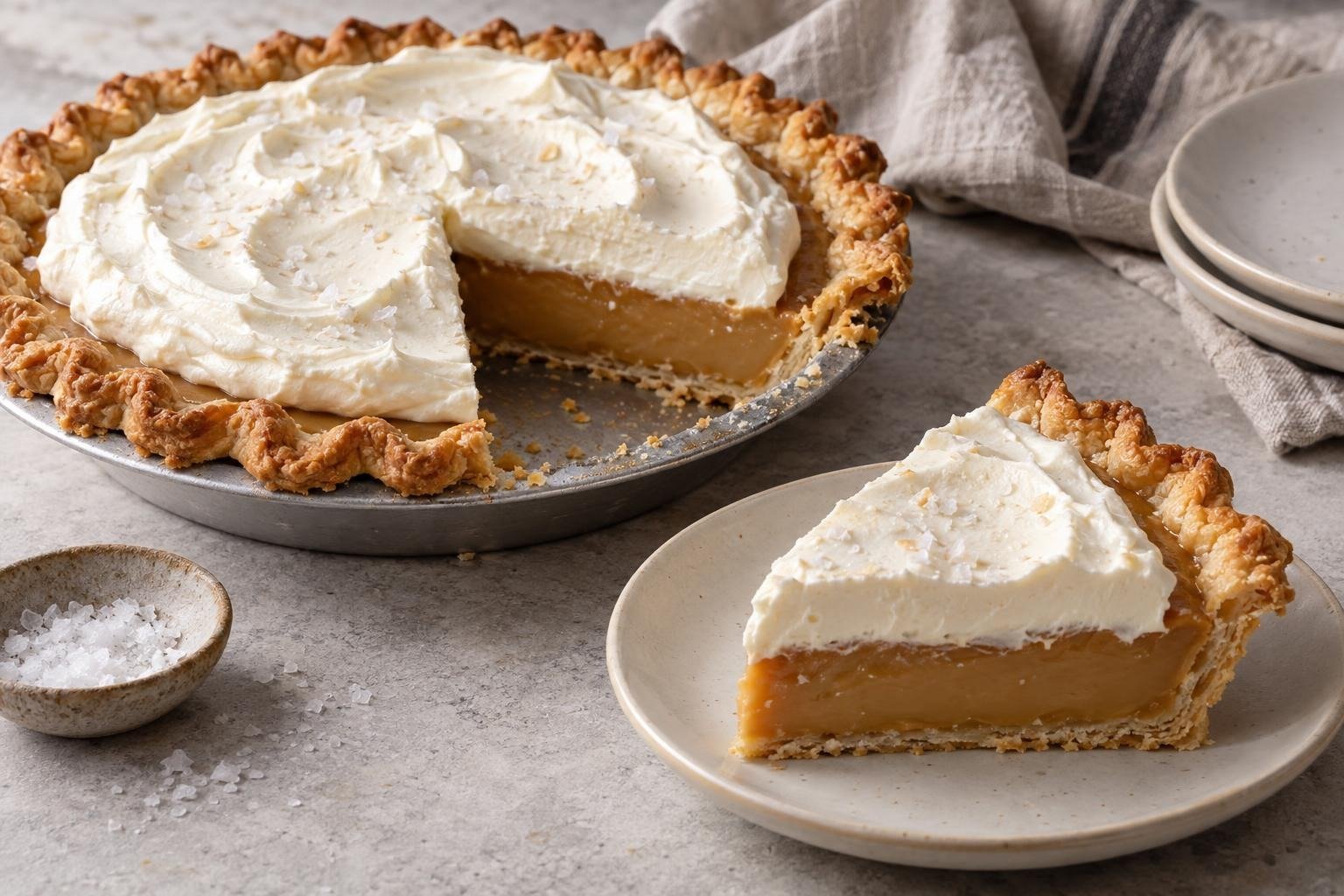
Deep amber caramel, buttery golden pastry, and cool vanilla whipped cream give this salted caramel cream pie a proper contrast of bitter-sweet, salty, crisp, and creamy. The filling is smooth but deliberately firm enough to hold a clean slice, while the fully baked shell supplies the flaky structure needed beneath a moisture-rich custard.
I cook the caramel until it reaches a dark copper color, then loosen it gradually with warm cream and milk before incorporating the egg yolk and cornstarch mixture. The important cues are visual and tactile: evenly golden pastry, caramel that smells toasted rather than scorched, custard that produces slow bursting bubbles, and a thoroughly chilled filling that feels firm when the plate is nudged.
Why This Pie Is Ridiculously Delicious
- A high proportion of cold butter creates distinct pastry layers, while minimal mixing prevents excess gluten from making the shell tough.
- Blind baking the weighted crust first, then finishing it uncovered, develops an evenly golden shell instead of leaving pale, damp pastry beneath the filling.
- A thin egg white coating sets inside the hot shell and creates an additional barrier against moisture from the caramel custard.
- Egg yolks provide richness and emulsification, while cornstarch allows the caramel filling to set into neat slices without becoming rubbery.
- Dark caramel, fine sea salt, unsweetened pastry, and lightly sweetened whipped cream keep the completed pie balanced rather than cloying.
Ingredient Notes for Salted Caramel Cream Pie with Golden Pastry
- All-purpose flour: Its moderate protein level provides enough structure for rolling and slicing without making the pastry excessively chewy. Weigh it rather than packing it into a cup, which can add too much flour.
- Unsalted butter: Cold butter supplies flavor and flaky layers in the pastry. Keep the cubes distinct during mixing; fully blended butter produces a crumbly, less layered shell.
- Egg white: A very thin coating sets during the final bake and helps isolate the crisp pastry from the custard. Thick puddles can cook into visible white patches, so brush sparingly.
- Granulated sugar: The filling sugar is caramelized until dark copper. Color matters because pale caramel tastes simply sweet, while black or smoking caramel will make the entire filling harsh.
- Heavy cream: Cream softens the caramel and provides fat for a rounded, silky filling. It is also used cold in the topping, where that fat must remain chilled to hold air.
- Whole milk: Milk lightens the filling and supplies the water needed for cornstarch gelatinization. Lower-fat milk would reduce richness and alter the intended balance, so whole milk is specified.
- Egg yolks and cornstarch: Yolks emulsify fat and add body, while cornstarch creates the primary sliceable structure. Boiling the finished custard briefly is necessary to remove a raw starch flavor.
- Fine and flaky salt: Fine salt dissolves evenly throughout the caramel custard. Flaky salt stays on the whipped cream as a delicate finishing contrast, so it should be applied shortly before serving.
- Vanilla extract: Vanilla rounds out caramel's sharper toasted notes. Add the filling vanilla after cooking so its aroma is not driven off by prolonged heat.
Baking Tips Worth Knowing
- Keep the butter visibly cold while making the pastry. If it begins to smear or shine, refrigerate the mixture for 10 minutes before adding water.
- Fill the lined shell with weights all the way to the rim. A shallow layer weighs down the base but does little to stop the pastry walls from slumping.
- Judge caramel primarily by color and aroma. Remove it at dark copper because residual heat continues cooking the sugar as the warm dairy is added.
- Whisk the custard continuously once it returns to the saucepan. Cornstarch thickens first along the bottom and corners, where neglected custard can scorch or form lumps.
- Do not rush the six-hour chill. A warm or partially set filling can look thick in the pan but spread once the first slice is removed.
Ingredients for Salted Caramel Cream Pie
- 190 g all-purpose flour (For the golden pastry, plus a small amount for rolling)
- 15 g granulated sugar (For the pastry)
- 3 g fine sea salt (For the pastry)
- 115 g unsalted butter (Cold and cut into 1/2-inch cubes)
- 45 g ice water (Add only enough to bring the pastry together)
- 1 large egg white (Lightly beaten for sealing the pastry; excess may remain)
- 200 g granulated sugar (For the caramel filling)
- 60 g water (For the wet caramel)
- 240 g heavy cream (Warmed before it is added to the caramel)
- 360 g whole milk (Divided into 240 g for warming and 120 g for the yolk mixture)
- 5 large egg yolks (Approximately 90 g, at room temperature)
- 45 g cornstarch (Whisk thoroughly with the cold milk and yolks)
- 4 g fine sea salt (For seasoning the caramel filling)
- 30 g unsalted butter (Cut into small pieces)
- 10 mL pure vanilla extract (Approximately 2 teaspoons, for the filling)
- 300 g heavy cream (Cold, for the whipped topping)
- 25 g powdered sugar (Sift if lumpy)
- 5 mL pure vanilla extract (Approximately 1 teaspoon, for the whipped topping)
- 1 g flaky sea salt (For finishing the assembled pie)
How to Make Salted Caramel Cream Pie
- STEP 1). Make and chill the pastry dough Combine the flour, sugar, and fine sea salt in a food processor and pulse briefly. Add the cold butter and pulse until most pieces are pea-size, with a few slightly larger flakes remaining. Drizzle in 40 g ice water and pulse just until damp clumps form when squeezed; add the remaining water only if dry flour persists. Turn the mixture onto the counter, press it into a 1-inch-thick disk without kneading, wrap tightly, and refrigerate for 60 minutes.
- STEP 2). Roll and line the pie plate Lightly flour the counter and roll the chilled dough from the center outward into a 12-inch circle about 1/8 inch thick, rotating it frequently to prevent sticking. Transfer it to a 9-inch deep-dish metal pie plate without stretching the dough. Press it gently against the base and sides, trim the overhang to 1 inch, fold it under, and crimp the rim. Refrigerate the lined plate for 30 minutes while heating the oven to 375°F, or 190°C.
- STEP 3). Blind bake the weighted shell Set the chilled pie plate on a rimmed baking sheet. Line the pastry with crumpled parchment or heavy-duty foil, pressing it into the corners, then fill completely with pie weights so the sides remain supported. Bake on the lower-middle oven rack for 20 minutes, until the rim looks dry and lightly golden. Lift out the liner and weights carefully. If the base has puffed, press it down gently with the back of a spoon rather than puncturing the pastry.
- STEP 4). Seal and finish baking the pastry Brush the exposed base and sides with a very thin layer of beaten egg white, avoiding puddles around the edge. Return the shell to the 375°F, or 190°C, oven and bake for 14 to 18 minutes. The base should look matte and golden, and the crimped edge should be a deeper golden brown. Cool the shell completely in its plate on a wire rack for 45 to 60 minutes. Keep the shell in the plate for filling and slicing.
- STEP 5). Cook the dark caramel base Combine the 200 g granulated sugar and water in a medium heavy-bottomed saucepan. Cook over medium heat without stirring, swirling the pan only after the syrup begins coloring. Meanwhile, warm 240 g cream and 240 g milk in a separate saucepan or microwave-safe jug until steaming but not boiling. When the caramel is dark copper and smells toasted, remove it from the heat. Slowly add the warm dairy while whisking carefully, then return the pan to low heat and stir until any hardened caramel dissolves.
- STEP 6). Thicken and finish the caramel custard Whisk the yolks, cornstarch, fine sea salt, and remaining 120 g cold milk in a large heatproof bowl until completely smooth. Gradually whisk in about one-third of the hot caramel mixture, then whisk the tempered yolk mixture back into the saucepan. Cook over medium-low heat, whisking constantly and reaching into the corners, until the custard thickens and produces slow bubbles. Continue cooking for 60 to 90 seconds. Remove from the heat, whisk in the butter and vanilla, then pass the custard through a fine-mesh sieve.
- STEP 7). Fill and thoroughly chill the pie Pour the hot caramel custard into the completely cooled pastry shell and smooth the surface with a small offset spatula. Let it stand at room temperature for 20 minutes so intense heat does not warm the refrigerator, but do not leave the dairy custard out longer. Press plastic wrap directly onto the surface to prevent a skin. Refrigerate the pie on a level shelf for at least 6 hours, preferably overnight, until the center feels firm and barely moves when the plate is nudged.
- STEP 8). Whip, garnish, and slice Place the cold topping cream, powdered sugar, and vanilla in a chilled mixing bowl. Whip on medium speed until the whisk leaves defined tracks and the cream holds medium peaks with gently curling tips, about 2 to 3 minutes. Spread or pipe the cream over the cold filling and scatter the flaky salt evenly on top. Chill for 20 minutes before cutting. For clean servings, use a sharp knife wiped between cuts and support each slice with a thin pie server.
Storage and Freezing
- Refrigeration: Cover the assembled pie without crushing the whipped cream and refrigerate for up to 3 days. Keep it chilled except during slicing and serving.
- Freezing: Freezing is not recommended because the cornstarch custard may release water after thawing, and whipped cream can become grainy.
- Serving: Serve cold or let individual slices stand for 10 minutes. Add flaky salt shortly before serving so it retains its delicate texture.
Frequently Asked Questions
How do you avoid a soggy bottom in salted caramel cream pie?
Bake the shell until its base is fully golden, not merely dry or pale. Pie weights should support the sides during the first bake, after which the uncovered shell needs enough oven time to develop crisp structure.
The thin egg white coating adds a moisture barrier between pastry and custard. Just as importantly, cool the shell completely before filling it and keep the baked shell in its metal pie plate.
Why did my salted caramel filling fail to set?
The custard may not have reached a full, slow bubble or remained there long enough to activate the cornstarch. Once thickened, it should be cooked for another 60 to 90 seconds while whisking continuously.
A warm pie will also appear loose even when the custard was cooked correctly. Give it at least six uninterrupted hours in the refrigerator before slicing, and confirm that the center barely moves when nudged.
How long should salted caramel cream pie cool before serving?
The pastry shell needs 45 to 60 minutes on a rack before it is filled. After cooking, let the filled pie stand for 20 minutes, cover its surface, and refrigerate it for at least six hours.
Overnight chilling is convenient when the schedule allows. Once the whipped topping is added, another 20 minutes in the refrigerator helps it settle and makes neat slices easier to lift.
What ingredient substitutions work in this salted caramel cream pie recipe?
This formula depends on heavy cream, whole milk, egg yolks, and cornstarch working together, so lower-fat dairy and alternative starches are not direct replacements. They can change the custard's thickening temperature, richness, and final slicing texture.
Fine table salt may replace fine sea salt by equal weight, although volume measurements vary with crystal size. Keep flaky salt for the surface because it provides texture without dissolving immediately.
Can I make salted caramel cream pie ahead of time?
Preparing the pie one day ahead suits the required chilling schedule. Bake the shell, cook the filling, assemble the pie, and refrigerate it overnight with plastic wrap touching the custard surface.
Whip and apply the cream on serving day for the freshest appearance. The completed pie remains suitable for up to three refrigerated days, although the pastry gradually loses crispness as it absorbs moisture from the filling.
More Ridiculously Delicious Pies & Tarts
- Chocolate Cream Pie with Silky Chocolate Filling
- Peanut Butter Cream Pie with Golden Pastry
- Coconut Cream Pie with Golden Pastry
- Strawberry Cream Pie with Golden Pastry
- Banana Cream Pie with Golden Pastry
- Buttermilk Pie with Golden Pastry
Salted Caramel Cream Pie with Golden Pastry
Ingredients
Equipment
Method
- Combine the flour, sugar, and fine sea salt in a food processor and pulse briefly. Add the cold butter and pulse until most pieces are pea-size, with a few slightly larger flakes remaining. Drizzle in 40 g ice water and pulse just until damp clumps form when squeezed; add the remaining water only if dry flour persists. Turn the mixture onto the counter, press it into a 1-inch-thick disk without kneading, wrap tightly, and refrigerate for 60 minutes.
- Lightly flour the counter and roll the chilled dough from the center outward into a 12-inch circle about 1/8 inch thick, rotating it frequently to prevent sticking. Transfer it to a 9-inch deep-dish metal pie plate without stretching the dough. Press it gently against the base and sides, trim the overhang to 1 inch, fold it under, and crimp the rim. Refrigerate the lined plate for 30 minutes while heating the oven to 375°F, or 190°C.
- Set the chilled pie plate on a rimmed baking sheet. Line the pastry with crumpled parchment or heavy-duty foil, pressing it into the corners, then fill completely with pie weights so the sides remain supported. Bake on the lower-middle oven rack for 20 minutes, until the rim looks dry and lightly golden. Lift out the liner and weights carefully. If the base has puffed, press it down gently with the back of a spoon rather than puncturing the pastry.
- Brush the exposed base and sides with a very thin layer of beaten egg white, avoiding puddles around the edge. Return the shell to the 375°F, or 190°C, oven and bake for 14 to 18 minutes. The base should look matte and golden, and the crimped edge should be a deeper golden brown. Cool the shell completely in its plate on a wire rack for 45 to 60 minutes. Keep the shell in the plate for filling and slicing.
- Combine the 200 g granulated sugar and water in a medium heavy-bottomed saucepan. Cook over medium heat without stirring, swirling the pan only after the syrup begins coloring. Meanwhile, warm 240 g cream and 240 g milk in a separate saucepan or microwave-safe jug until steaming but not boiling. When the caramel is dark copper and smells toasted, remove it from the heat. Slowly add the warm dairy while whisking carefully, then return the pan to low heat and stir until any hardened caramel dissolves.
- Whisk the yolks, cornstarch, fine sea salt, and remaining 120 g cold milk in a large heatproof bowl until completely smooth. Gradually whisk in about one-third of the hot caramel mixture, then whisk the tempered yolk mixture back into the saucepan. Cook over medium-low heat, whisking constantly and reaching into the corners, until the custard thickens and produces slow bubbles. Continue cooking for 60 to 90 seconds. Remove from the heat, whisk in the butter and vanilla, then pass the custard through a fine-mesh sieve.
- Pour the hot caramel custard into the completely cooled pastry shell and smooth the surface with a small offset spatula. Let it stand at room temperature for 20 minutes so intense heat does not warm the refrigerator, but do not leave the dairy custard out longer. Press plastic wrap directly onto the surface to prevent a skin. Refrigerate the pie on a level shelf for at least 6 hours, preferably overnight, until the center feels firm and barely moves when the plate is nudged.
- Place the cold topping cream, powdered sugar, and vanilla in a chilled mixing bowl. Whip on medium speed until the whisk leaves defined tracks and the cream holds medium peaks with gently curling tips, about 2 to 3 minutes. Spread or pipe the cream over the cold filling and scatter the flaky salt evenly on top. Chill for 20 minutes before cutting. For clean servings, use a sharp knife wiped between cuts and support each slice with a thin pie server.
Notes
- Keep the butter visibly cold while making the pastry. If it begins to smear or shine, refrigerate the mixture for 10 minutes before adding water.
- Fill the lined shell with weights all the way to the rim. A shallow layer weighs down the base but does little to stop the pastry walls from slumping.
- Judge caramel primarily by color and aroma. Remove it at dark copper because residual heat continues cooking the sugar as the warm dairy is added.
- Whisk the custard continuously once it returns to the saucepan. Cornstarch thickens first along the bottom and corners, where neglected custard can scorch or form lumps.
- Do not rush the six-hour chill. A warm or partially set filling can look thick in the pan but spread once the first slice is removed.