Combine the flour, sugar, and fine sea salt in a food processor and pulse briefly. Add the cold butter and pulse until most pieces are pea-size, with a few slightly larger flakes remaining. Drizzle in 40 g ice water and pulse just until damp clumps form when squeezed; add the remaining water only if dry flour persists. Turn the mixture onto the counter, press it into a 1-inch-thick disk without kneading, wrap tightly, and refrigerate for 60 minutes.
Lightly flour the counter and roll the chilled dough from the center outward into a 12-inch circle about 1/8 inch thick, rotating it frequently to prevent sticking. Transfer it to a 9-inch deep-dish metal pie plate without stretching the dough. Press it gently against the base and sides, trim the overhang to 1 inch, fold it under, and crimp the rim. Refrigerate the lined plate for 30 minutes while heating the oven to 375°F, or 190°C.
Set the chilled pie plate on a rimmed baking sheet. Line the pastry with crumpled parchment or heavy-duty foil, pressing it into the corners, then fill completely with pie weights so the sides remain supported. Bake on the lower-middle oven rack for 20 minutes, until the rim looks dry and lightly golden. Lift out the liner and weights carefully. If the base has puffed, press it down gently with the back of a spoon rather than puncturing the pastry.
Brush the exposed base and sides with a very thin layer of beaten egg white, avoiding puddles around the edge. Return the shell to the 375°F, or 190°C, oven and bake for 14 to 18 minutes. The base should look matte and golden, and the crimped edge should be a deeper golden brown. Cool the shell completely in its plate on a wire rack for 45 to 60 minutes. Keep the shell in the plate for filling and slicing.
Combine the 200 g granulated sugar and water in a medium heavy-bottomed saucepan. Cook over medium heat without stirring, swirling the pan only after the syrup begins coloring. Meanwhile, warm 240 g cream and 240 g milk in a separate saucepan or microwave-safe jug until steaming but not boiling. When the caramel is dark copper and smells toasted, remove it from the heat. Slowly add the warm dairy while whisking carefully, then return the pan to low heat and stir until any hardened caramel dissolves.
Whisk the yolks, cornstarch, fine sea salt, and remaining 120 g cold milk in a large heatproof bowl until completely smooth. Gradually whisk in about one-third of the hot caramel mixture, then whisk the tempered yolk mixture back into the saucepan. Cook over medium-low heat, whisking constantly and reaching into the corners, until the custard thickens and produces slow bubbles. Continue cooking for 60 to 90 seconds. Remove from the heat, whisk in the butter and vanilla, then pass the custard through a fine-mesh sieve.
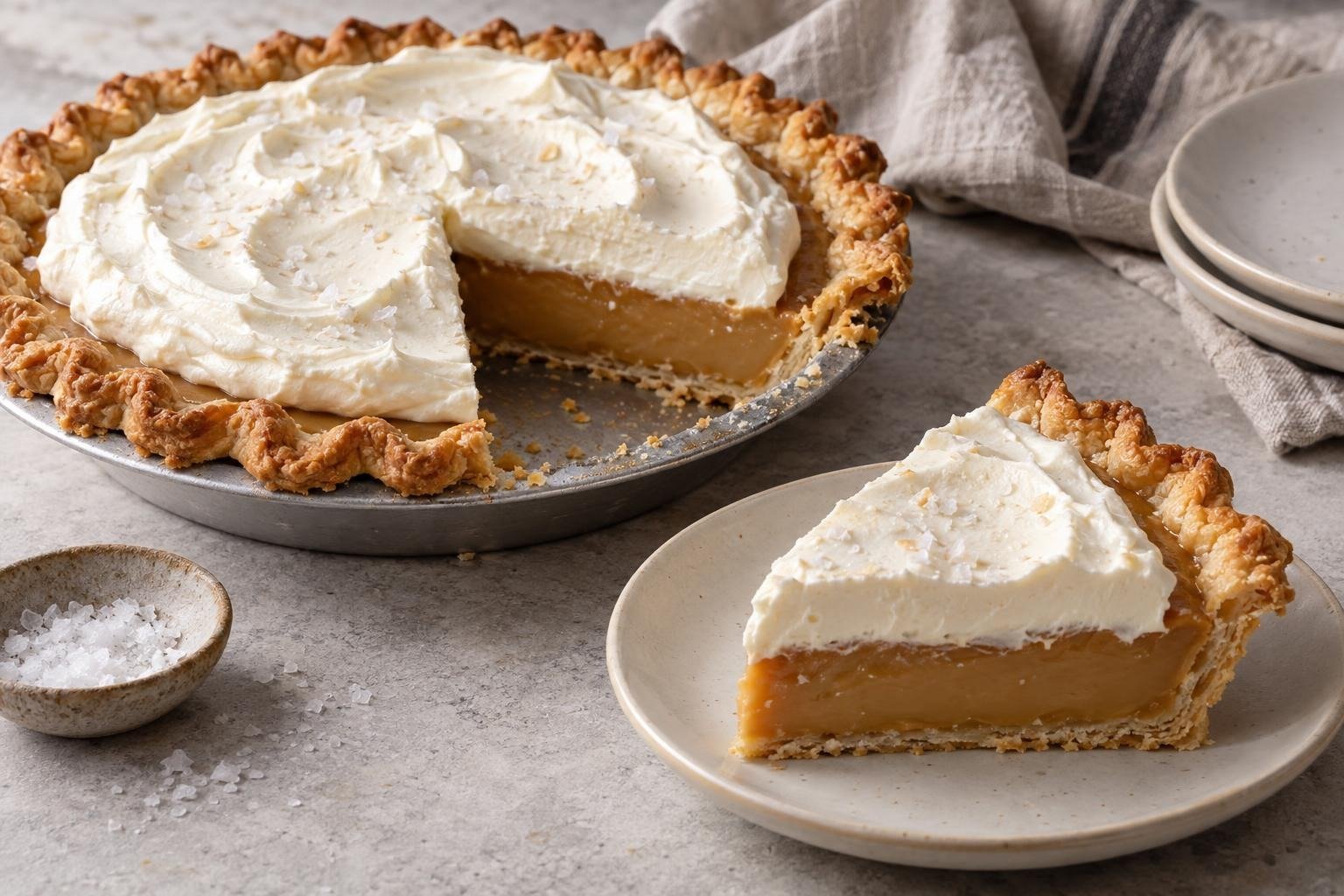
Pour the hot caramel custard into the completely cooled pastry shell and smooth the surface with a small offset spatula. Let it stand at room temperature for 20 minutes so intense heat does not warm the refrigerator, but do not leave the dairy custard out longer. Press plastic wrap directly onto the surface to prevent a skin. Refrigerate the pie on a level shelf for at least 6 hours, preferably overnight, until the center feels firm and barely moves when the plate is nudged.
Place the cold topping cream, powdered sugar, and vanilla in a chilled mixing bowl. Whip on medium speed until the whisk leaves defined tracks and the cream holds medium peaks with gently curling tips, about 2 to 3 minutes. Spread or pipe the cream over the cold filling and scatter the flaky salt evenly on top. Chill for 20 minutes before cutting. For clean servings, use a sharp knife wiped between cuts and support each slice with a thin pie server.