Table of Contents
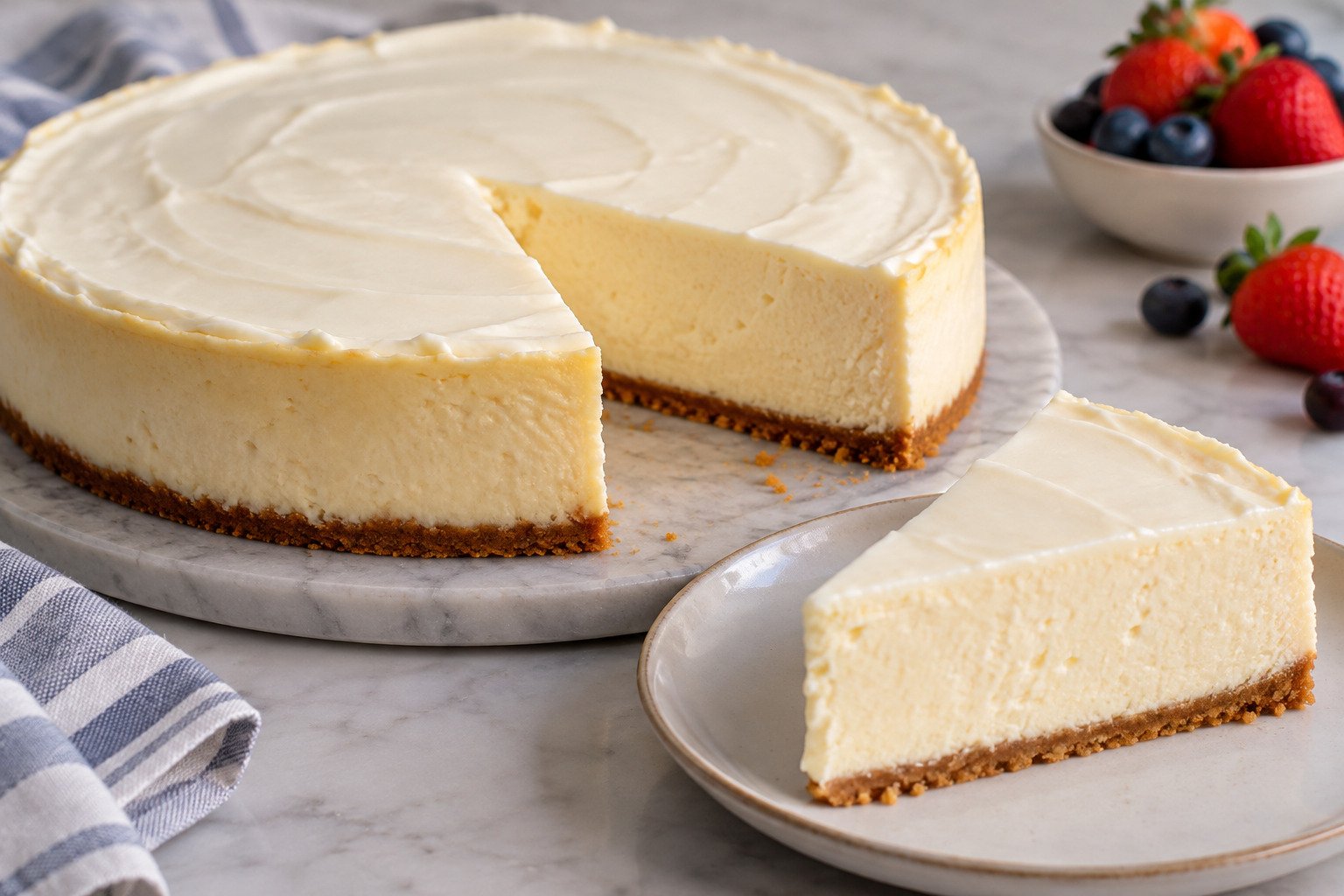
A snowy sour cream finish gives way to a pale, velvety filling and a crisp, buttery graham crust in this sour cream cheesecake. The flavor is gently tangy rather than aggressively sweet, with vanilla and fresh lemon zest sharpening the richness. Once thoroughly chilled, each slice holds a clean edge while the center remains creamy and smooth on the tongue.
I keep the mixer on low speed because cheesecake needs a uniform emulsion, not a cloud of trapped air waiting to puff and collapse. Room-temperature cream cheese blends without stubborn lumps, cornstarch gives the filling just enough structure, and a water bath moderates the heat around the pan. The important cues are a satin-smooth batter, set outer edges, a coordinated wobble in the center, and a slow cooling schedule before the eight-hour chill.
Why You’ll Frickin’ Love this Cheesecake
- Full-fat cream cheese and sour cream create a filling with enough fat for a creamy mouthfeel while retaining the pleasant acidity expected from a sour cream cheesecake.
- Low-speed mixing combines the batter without incorporating excessive air, reducing dramatic rising, sinking, and cracking during cooling.
- A small amount of cornstarch binds free moisture and reinforces the egg-set structure without turning the chilled filling firm or cakey.
- The hot-water bath buffers direct oven heat, helping the edges and center bake at a more even rate while protecting the delicate egg and dairy emulsion.
- A thin baked sour cream topping gives the cheesecake a distinct tangy finish, while gradual cooling and an eight-hour chill allow the filling to set completely before slicing.
Ingredient Notes for Ultra-Creamy Sour Cream Cheesecake
- Full-fat cream cheese: Block-style cream cheese supplies the fat, protein, and structure needed for a sliceable filling. Bring it to 68 to 72°F before mixing so it becomes smooth without prolonged beating. Whipped cream cheese is too aerated for this formula.
- Full-fat sour cream: Sour cream loosens the filling, moderates sweetness, and contributes lactic acidity. It also forms the creamy top layer. Stir it smooth before measuring, and avoid low-fat versions because their extra water can soften the set.
- Granulated sugar: Sugar sweetens the filling and delays egg-protein coagulation, which supports a creamy texture. Scraping the bowl after combining it with the cream cheese prevents dense, less-sweet streaks along the bottom.
- Eggs: Whole eggs set the cheesecake as their proteins coagulate in the oven. Use room-temperature eggs and add them individually on low speed so the batter stays emulsified without becoming excessively aerated.
- Cornstarch: This small quantity manages moisture and provides insurance against an overly soft center. Sifting it over the sugar prevents dry starch pockets that would otherwise leave chalky specks in the filling.
- Graham cracker crust: Fine, evenly crushed crumbs pack more securely than coarse pieces. Melted butter coats the crumbs and firms when chilled, while a little sugar encourages cohesion and browning during the brief pre-bake.
- Vanilla and lemon zest: Vanilla rounds out the cultured dairy flavor, while lemon zest adds aromatic brightness without introducing enough juice to change the filling's moisture balance.
My Tips for the Best Results
- Temperature matters more than extra mixing. If the cream cheese still feels cool and rigid, give it more time at room temperature rather than beating it aggressively and filling the batter with air.
- Check the springform pan for leaks before beginning. The foil protects against minor seepage, but a pan with a loose or distorted base should not sit directly in the water bath.
- Judge doneness by the movement of the center, not by surface color. A properly baked cheesecake can remain pale, and waiting for the entire surface to become rigid usually produces dry, grainy edges.
- Do not skip the staged cooling period. Moving the hot cheesecake directly from the oven to a cold refrigerator causes rapid contraction, encourages cracks, and can create condensation across the sour cream topping.
- For polished slices, chill overnight and warm the knife in hot water before every cut. Dry the blade completely so water does not drag across the creamy filling or soften the graham crust.
Ingredients for Ultra-Creamy Sour Cream Cheesecake
- 200 g finely crushed graham cracker crumbs (about 2 cups)
- 30 g granulated sugar (for the crust)
- 85 g unsalted butter (melted and slightly cooled)
- 904 g full-fat block cream cheese (four 8-ounce blocks, softened to 68 to 72°F)
- 250 g granulated sugar (for the filling)
- 16 g cornstarch (sifted)
- 0.25 tsp fine salt
- 240 g full-fat sour cream (for the filling, at room temperature)
- 1.5 tsp pure vanilla extract (for the filling)
- 1 tsp finely grated lemon zest (zest only, with no white pith)
- 4 large eggs (at room temperature)
- 240 g full-fat sour cream (for the topping, at room temperature)
- 25 g granulated sugar (for the topping)
- 0.5 tsp pure vanilla extract (for the topping)
How to Make Ultra-Creamy Sour Cream Cheesecake
- STEP 1). Prepare the pan and preheat the oven Position a rack in the lower-middle of the oven and preheat to 350°F. Lightly grease the base and sides of a 9-inch springform pan. Wrap the outside in two wide layers of heavy-duty aluminum foil, bringing the foil well above the base seam without tearing it. Set the wrapped pan aside while you heat a kettle of water for the later water bath.
- STEP 2). Mix and pre-bake the graham crust Combine the graham cracker crumbs and 30 g sugar in a medium bowl, breaking up any coarse pieces with your fingers. Stir in the melted butter until every crumb looks evenly moistened and the mixture holds when squeezed. Press it firmly across the pan base using a flat measuring cup. Bake for 10 minutes, then transfer the pan to a wire rack. Reduce the oven to 325°F.
- STEP 3). Blend the cream cheese mixture on low speed Place the softened cream cheese in the bowl of a stand mixer fitted with the paddle. Mix on low speed for 60 to 90 seconds, stopping twice to scrape the bowl and paddle, until smooth with no firm lumps. Whisk the 250 g sugar, cornstarch, and salt together, then add them gradually. Continue mixing on low for about 1 minute, just until uniformly creamy rather than fluffy.
- STEP 4). Finish the filling without incorporating excess air Add the 240 g sour cream, 1 1/2 teaspoons vanilla, and lemon zest to the cream cheese mixture. Mix on low only until the streaks disappear, then scrape the bowl thoroughly. Add the eggs one at a time, mixing for 15 to 20 seconds after each and stopping as soon as it disappears. Fold the batter several times with a spatula; it should look glossy, thick, and pourable, without a cap of foam.
- STEP 5). Assemble the cheesecake and water bath Pour the filling over the warm or cooled crust and smooth the surface with a spatula. Tap the pan gently against the counter two or three times to release large air pockets. Place it inside a large roasting pan, transfer both pans to the oven rack, and carefully pour hot water into the roasting pan until it reaches about halfway up the springform pan. Avoid splashing water into the batter or foil.
- STEP 6). Bake until the edges set and the center wobbles Bake at 325°F for 60 to 70 minutes without opening the oven during the first 55 minutes. The outer 2 inches should look set and slightly puffed, while a 3-inch area in the center should wobble together like soft gelatin when the roasting pan is nudged. It should not ripple like liquid or show wet batter. If the center is still fluid, continue baking in 5-minute intervals before adding the topping.
- STEP 7). Add the sour cream topping and cool gradually Whisk the topping sour cream, 25 g sugar, and 1/2 teaspoon vanilla in a medium bowl until smooth. Carefully slide out the oven rack and spread the mixture over the set cheesecake without pressing down. Bake for 10 minutes, then turn off the oven, prop the door open about 2 inches, and leave the cheesecake inside for 1 hour. This gradual temperature change limits contraction that can split the surface.
- STEP 8). Cool, chill, release, and slice Lift the springform pan from the water bath, remove the foil, and place the cheesecake on a wire rack for 1 hour. Run a thin knife around the edge while it is still slightly warm, but keep the pan attached. Cover without touching the surface and refrigerate for at least 8 hours. Release the pan, transfer the cold cheesecake to a serving plate, and cut 12 slices with a hot, dry knife, wiping it between cuts.
Storage and Freezing
- Refrigeration: Cover the fully chilled cheesecake or place individual slices in airtight containers.
- Refrigerate for up to 5 days and return leftovers to the refrigerator within 2 hours of serving.
- Freezing: Freeze the thoroughly chilled cheesecake whole or in individual slices for up to 1 month. Wrap it securely in plastic wrap and foil, protecting the sour cream surface from pressure.
- Thawing: Thaw wrapped cheesecake overnight in the refrigerator. Unwrap it after thawing so condensation collects on the wrapping rather than the topping.
- Serving: For clean cuts and a firm but creamy texture, slice directly from the refrigerator. Let individual slices stand for 10 to 15 minutes before eating if a softer mouthfeel is preferred.
Frequently Asked Questions
How do you tell when sour cream cheesecake is done?
The outer 2 inches should appear set and slightly puffed, while the center 3 inches should move as one soft, gelatin-like area when the roasting pan is gently nudged. A fluid ripple means the filling needs more oven time.
Do not wait for the middle to become rigid. Residual heat continues setting the eggs during the gradual cooling period, and the filling firms further as its fat chills.
Why did my sour cream cheesecake crack after baking?
Cracks commonly follow excessive mixing, overbaking, or a sudden temperature change. Air incorporated at high mixer speed expands in the oven and collapses later, while an overbaked filling contracts more forcefully as it cools.
Keep the mixer on low, remove the cheesecake when its center still wobbles, and use the one-hour oven cooling period. Running a knife around the warm edge also prevents the filling from pulling against the pan as it contracts.
How long should sour cream cheesecake chill before slicing?
Allow at least 8 hours of refrigerator time after the two-hour gradual cooling process. An overnight chill is especially practical because the filling, sour cream topping, and butter-rich crust all have enough time to become stable.
Cutting earlier can produce a soft center that clings to the knife and slumps on the plate. Chilling does not correct raw batter, however, so confirm the coordinated center wobble before removing the cheesecake from the oven.
What causes lumpy cheesecake filling?
Cream cheese that is too cold resists blending and breaks into small firm pieces. Softening the blocks to 68 to 72°F allows the fat phase to mix smoothly with sugar and sour cream before the eggs are introduced.
Scrape the bowl and paddle repeatedly during the first mixing stage. Once the eggs are added, do not try to beat out remaining lumps at high speed because that adds air and increases the risk of an uneven rise.
Can I bake this cheesecake without a water bath?
Direct oven heat makes the edges cook faster than the center, so omitting the water bath increases the likelihood of dry edges, a steeply puffed rim, and surface cracking. The formula is designed around the gentler heat provided by hot water.
If water leaking through the pan is the concern, use two intact layers of heavy-duty foil and pour the water only halfway up the pan. Keep the foil smooth around the base so accidental punctures are easy to spot.
More Ridiculously Delicious Cheesecakes
- No-Bake Oreo Cheesecake with a Creamy Filling and Cookie Crust
- Creamy Vanilla Cheesecake with a Buttery Cookie Crust
- Blueberry Cheesecake with a Creamy Filling
- Basque Burnt Cheesecake with a Creamy Center
- Small-Batch Cheesecake in a Loaf Pan with a Smooth Filling
Ultra-Creamy Sour Cream Cheesecake
Ingredients
Equipment
Method
- Position a rack in the lower-middle of the oven and preheat to 350°F. Lightly grease the base and sides of a 9-inch springform pan. Wrap the outside in two wide layers of heavy-duty aluminum foil, bringing the foil well above the base seam without tearing it. Set the wrapped pan aside while you heat a kettle of water for the later water bath.
- Combine the graham cracker crumbs and 30 g sugar in a medium bowl, breaking up any coarse pieces with your fingers. Stir in the melted butter until every crumb looks evenly moistened and the mixture holds when squeezed. Press it firmly across the pan base using a flat measuring cup. Bake for 10 minutes, then transfer the pan to a wire rack. Reduce the oven to 325°F.
- Place the softened cream cheese in the bowl of a stand mixer fitted with the paddle. Mix on low speed for 60 to 90 seconds, stopping twice to scrape the bowl and paddle, until smooth with no firm lumps. Whisk the 250 g sugar, cornstarch, and salt together, then add them gradually. Continue mixing on low for about 1 minute, just until uniformly creamy rather than fluffy.
- Add the 240 g sour cream, 1 1/2 teaspoons vanilla, and lemon zest to the cream cheese mixture. Mix on low only until the streaks disappear, then scrape the bowl thoroughly. Add the eggs one at a time, mixing for 15 to 20 seconds after each and stopping as soon as it disappears. Fold the batter several times with a spatula; it should look glossy, thick, and pourable, without a cap of foam.
- Pour the filling over the warm or cooled crust and smooth the surface with a spatula. Tap the pan gently against the counter two or three times to release large air pockets. Place it inside a large roasting pan, transfer both pans to the oven rack, and carefully pour hot water into the roasting pan until it reaches about halfway up the springform pan. Avoid splashing water into the batter or foil.
- Bake at 325°F for 60 to 70 minutes without opening the oven during the first 55 minutes. The outer 2 inches should look set and slightly puffed, while a 3-inch area in the center should wobble together like soft gelatin when the roasting pan is nudged. It should not ripple like liquid or show wet batter. If the center is still fluid, continue baking in 5-minute intervals before adding the topping.
- Whisk the topping sour cream, 25 g sugar, and 1/2 teaspoon vanilla in a medium bowl until smooth. Carefully slide out the oven rack and spread the mixture over the set cheesecake without pressing down. Bake for 10 minutes, then turn off the oven, prop the door open about 2 inches, and leave the cheesecake inside for 1 hour. This gradual temperature change limits contraction that can split the surface.
- Lift the springform pan from the water bath, remove the foil, and place the cheesecake on a wire rack for 1 hour. Run a thin knife around the edge while it is still slightly warm, but keep the pan attached. Cover without touching the surface and refrigerate for at least 8 hours. Release the pan, transfer the cold cheesecake to a serving plate, and cut 12 slices with a hot, dry knife, wiping it between cuts.
Notes
- Temperature matters more than extra mixing. If the cream cheese still feels cool and rigid, give it more time at room temperature rather than beating it aggressively and filling the batter with air.
- Check the springform pan for leaks before beginning. The foil protects against minor seepage, but a pan with a loose or distorted base should not sit directly in the water bath.
- Judge doneness by the movement of the center, not by surface color. A properly baked cheesecake can remain pale, and waiting for the entire surface to become rigid usually produces dry, grainy edges.
- Do not skip the staged cooling period. Moving the hot cheesecake directly from the oven to a cold refrigerator causes rapid contraction, encourages cracks, and can create condensation across the sour cream topping.
- For polished slices, chill overnight and warm the knife in hot water before every cut. Dry the blade completely so water does not drag across the creamy filling or soften the graham crust.