Position a rack in the lower-middle of the oven and preheat to 350°F. Lightly grease the base and sides of a 9-inch springform pan. Wrap the outside in two wide layers of heavy-duty aluminum foil, bringing the foil well above the base seam without tearing it. Set the wrapped pan aside while you heat a kettle of water for the later water bath.
Combine the graham cracker crumbs and 30 g sugar in a medium bowl, breaking up any coarse pieces with your fingers. Stir in the melted butter until every crumb looks evenly moistened and the mixture holds when squeezed. Press it firmly across the pan base using a flat measuring cup. Bake for 10 minutes, then transfer the pan to a wire rack. Reduce the oven to 325°F.
Place the softened cream cheese in the bowl of a stand mixer fitted with the paddle. Mix on low speed for 60 to 90 seconds, stopping twice to scrape the bowl and paddle, until smooth with no firm lumps. Whisk the 250 g sugar, cornstarch, and salt together, then add them gradually. Continue mixing on low for about 1 minute, just until uniformly creamy rather than fluffy.
Add the 240 g sour cream, 1 1/2 teaspoons vanilla, and lemon zest to the cream cheese mixture. Mix on low only until the streaks disappear, then scrape the bowl thoroughly. Add the eggs one at a time, mixing for 15 to 20 seconds after each and stopping as soon as it disappears. Fold the batter several times with a spatula; it should look glossy, thick, and pourable, without a cap of foam.
Pour the filling over the warm or cooled crust and smooth the surface with a spatula. Tap the pan gently against the counter two or three times to release large air pockets. Place it inside a large roasting pan, transfer both pans to the oven rack, and carefully pour hot water into the roasting pan until it reaches about halfway up the springform pan. Avoid splashing water into the batter or foil.
Bake at 325°F for 60 to 70 minutes without opening the oven during the first 55 minutes. The outer 2 inches should look set and slightly puffed, while a 3-inch area in the center should wobble together like soft gelatin when the roasting pan is nudged. It should not ripple like liquid or show wet batter. If the center is still fluid, continue baking in 5-minute intervals before adding the topping.
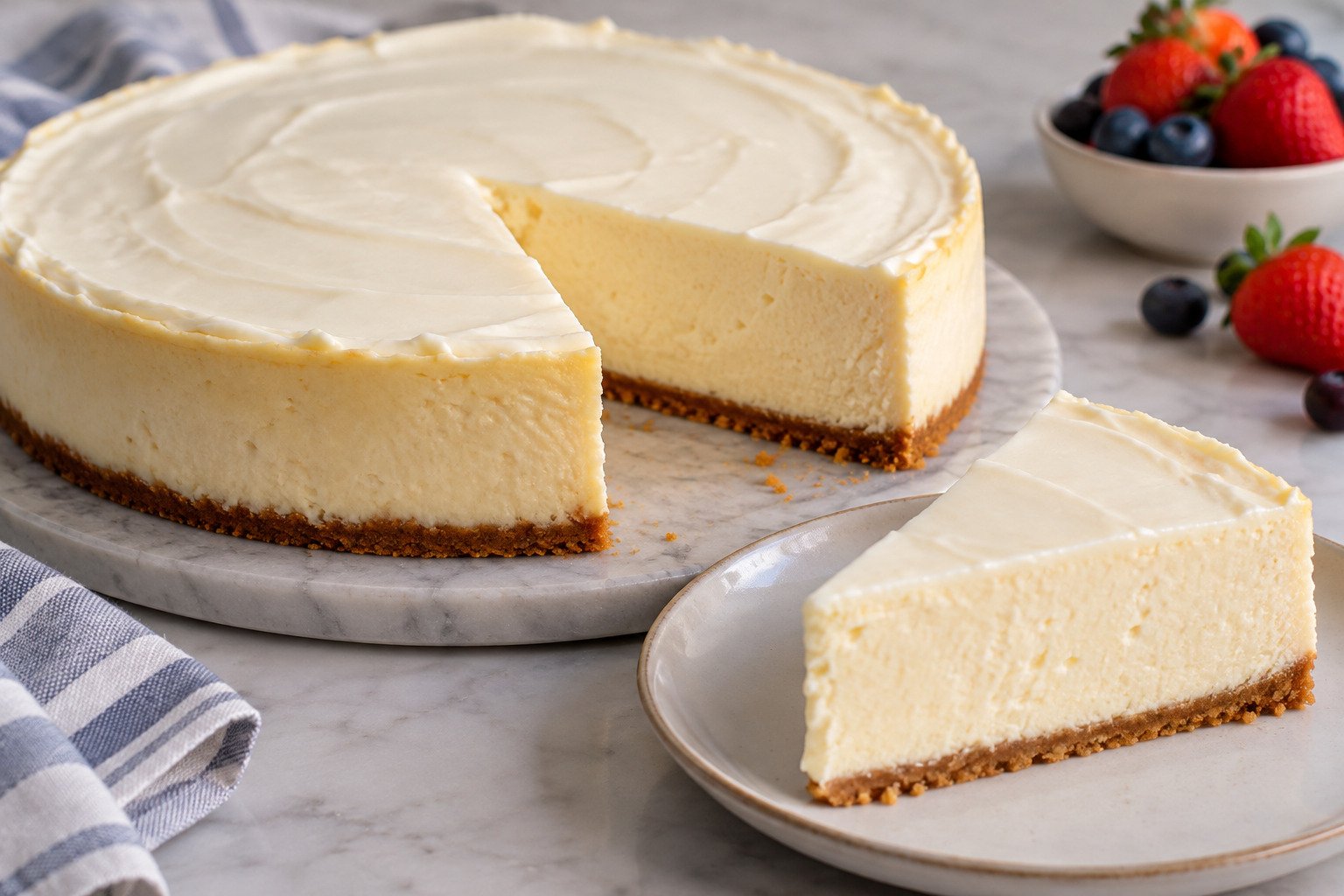
Whisk the topping sour cream, 25 g sugar, and 1/2 teaspoon vanilla in a medium bowl until smooth. Carefully slide out the oven rack and spread the mixture over the set cheesecake without pressing down. Bake for 10 minutes, then turn off the oven, prop the door open about 2 inches, and leave the cheesecake inside for 1 hour. This gradual temperature change limits contraction that can split the surface.
Lift the springform pan from the water bath, remove the foil, and place the cheesecake on a wire rack for 1 hour. Run a thin knife around the edge while it is still slightly warm, but keep the pan attached. Cover without touching the surface and refrigerate for at least 8 hours. Release the pan, transfer the cold cheesecake to a serving plate, and cut 12 slices with a hot, dry knife, wiping it between cuts.