Table of Contents
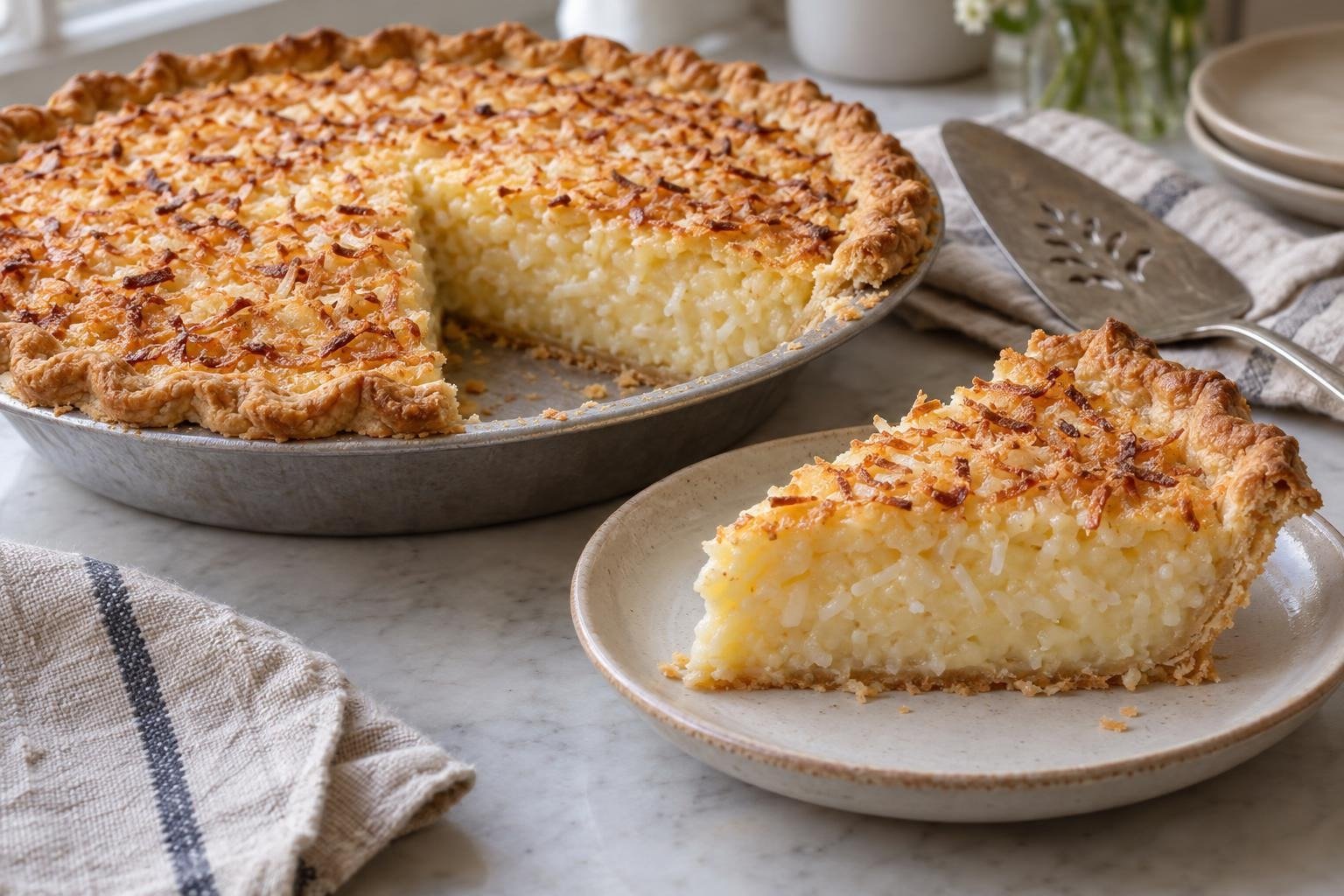
Golden pastry, creamy vanilla custard, and tender shreds of coconut give this coconut custard pie its old-fashioned charm without the dreaded soggy bottom. The filling is softly set rather than stiff, so each chilled slice holds a clean shape while remaining smooth on the fork. Sweetened shredded coconut rises slightly as the pie bakes, creating a lightly toasted surface over the pale, delicate custard.
I fully blind-bake the butter crust on a preheated sheet pan, then seal it with egg white before adding the warm custard mixture. That sequence matters because liquid custard gives raw pastry very little chance to become crisp. For the filling endpoint, I look for set edges and a small center that wobbles as one unit without rippling. The pie then needs a full four-hour cooling period so the egg proteins finish setting before slicing.
This Is Why You’ll Love this Coconut Pie
- A fully blind-baked pastry shell develops color and structure before it meets the liquid filling, which directly addresses how to avoid a soggy bottom in coconut custard pie.
- A thin egg-white coating seals small cracks and creates a moisture barrier without making the pastry noticeably eggy.
- Cornstarch reinforces the egg custard just enough for clean slices while preserving a creamy texture rather than turning the filling firm or bouncy.
- Warming the milk and cream dissolves the sugar efficiently and shortens the filling's time in the oven, helping the custard set before the crust becomes too dark.
- A four-hour cooling period lets the custard finish setting gradually, making the pie easier to cut without forcing the filling to become overbaked.
Ingredient Notes for Coconut Custard Pie with a Tender Pastry Crust
- All-purpose flour: Its moderate protein content gives the crust enough strength to hold the custard without making it tough. Weigh it rather than packing it into a measuring cup.
- Unsalted butter: Cold butter creates tender, flaky pockets as its water turns to steam. Cut it into cubes and keep it refrigerated until mixing.
- Ice water: Add only enough to make the dough hold when squeezed. Excess water develops more gluten and can cause shrinkage or toughness.
- Egg white: A thin coating baked onto the blind-baked shell seals the pastry against the wet custard. Whisk it only until fluid, not foamy.
- Whole eggs: Eggs provide the main setting structure. Use large eggs at room temperature so they combine smoothly with the warm dairy.
- Whole milk and heavy cream: Milk keeps the custard light while cream supplies enough fat for a rounded, silky mouthfeel. Heat them only until steaming.
- Cornstarch: This starch supports sliceability and reduces the risk of watery custard. Whisk it thoroughly into the sugar before adding liquid to prevent lumps.
- Sweetened shredded coconut: Sweetened coconut stays tender during baking and contributes to the formula's sugar level. Separate any compacted clumps before folding it into the custard.
- Vanilla and coconut extracts: Vanilla rounds out the egg custard, while a small amount of coconut extract strengthens the coconut aroma without overwhelming it.
- Fine sea salt: Salt balances the sugar and sharpens the dairy, vanilla, and coconut flavors. Fine crystals disperse evenly through both crust and filling.
A Few Good Things to Know
- Keep the dough cold but pliable. If it cracks heavily while rolling, let it stand for 3 to 5 minutes; if it feels greasy or floppy, chill it again before lining the plate.
- Fill the blind-baking parchment all the way to the crust's upper edge. Partial weighting allows the sides to slump before their structure has set.
- Do not skip the uncovered second bake after removing the weights. The base must look dry and show early golden color before the liquid custard is added.
- Whisk the eggs gently rather than vigorously. Excess air produces bubbles and a foamy surface instead of the smooth, close-textured custard this pie needs.
- Take the pie out while the center still has a controlled wobble. Waiting until it becomes completely rigid in the oven can produce cracks, curdled edges, or clear droplets on the surface.
Ingredients for Coconut Custard Pie
- 190 g all-purpose flour (For the pastry crust, plus a small amount for rolling)
- 12 g granulated sugar (For the pastry crust)
- 3 g fine sea salt (For the pastry crust)
- 115 g unsalted butter (Cold and cut into 1/2-inch cubes)
- 45 g ice water (Add gradually; all of it may not be needed)
- 1 large egg white (Whisked until fluid, for sealing the crust)
- 150 g granulated sugar (For the custard filling)
- 16 g cornstarch (Whisk into the sugar before adding the eggs)
- 2 g fine sea salt (For the custard filling)
- 4 large eggs (At room temperature)
- 360 g whole milk (Gently heated with the cream)
- 120 g heavy cream (At least 35 percent milk fat)
- 10 g pure vanilla extract (About 2 teaspoons)
- 2 g coconut extract (About 1/2 teaspoon)
- 100 g sweetened shredded coconut (Loosen compacted shreds before using)
How to Make Coconut Custard Pie
- STEP 1). Mix and chill the pastry dough Combine the flour, sugar, and salt in a food processor and pulse briefly. Add the cold butter and pulse until most pieces resemble small peas, with a few flatter pieces remaining. Drizzle in 35 g of the ice water and pulse just until damp clumps form, adding the remaining water only if the dough stays powdery when squeezed. Turn it onto the counter, press it into a 1-inch-thick disk, wrap, and refrigerate for 60 minutes.
- STEP 2). Roll and fit the pastry shell Lightly flour the counter and roll the chilled dough into a 12-inch circle about 1/8 inch thick, rotating it frequently to prevent sticking. Transfer it to a 9-inch metal pie plate without stretching the dough. Ease it firmly into the bottom corners, trim the overhang to 1 inch, fold it under, and crimp the rim. Refrigerate the lined plate for 30 minutes, until the butter is firm and the pastry no longer feels soft.
- STEP 3). Fully blind-bake the crust Set an oven rack in the lower third, place a rimmed baking sheet on it, and heat the oven to 400°F. Line the chilled shell with crumpled parchment and fill it to the rim with pie weights. Set the plate on the hot sheet and bake for 20 minutes. Lift out the parchment and weights, then bake for 8 to 10 minutes more, until the bottom looks dry and pale golden rather than raw or translucent.
- STEP 4). Seal the pastry with egg white Use a pastry brush to apply a thin, even coating of whisked egg white over the hot crust's bottom and inner sides, avoiding puddles. Return the shell to the oven for 2 minutes, until the coating looks dry and slightly glossy. Remove the pie plate to a heatproof surface and reduce the oven to 350°F, leaving the baking sheet inside so it stays hot enough to encourage continued browning underneath.
- STEP 5). Prepare and temper the coconut custard Heat the milk and cream in a medium saucepan over medium-low heat until steaming and tiny bubbles appear around the edge, about 4 to 6 minutes; do not boil. In a heatproof bowl, whisk the sugar, cornstarch, and salt thoroughly, then whisk in the four eggs without incorporating excess foam. Slowly add the hot dairy while whisking constantly. Stir in both extracts, strain the mixture through a fine-mesh sieve, and fold in the loosened shredded coconut.
- STEP 6). Fill and bake until gently set Pour the warm filling into the warm pastry shell and distribute the coconut evenly with a fork if it gathers in one area. Carefully return the pie to the hot sheet pan in the 350°F oven. Bake for 38 to 44 minutes, shielding the rim with foil if it darkens too quickly. The outer filling should be set, while the center 2 inches wobble together without liquid ripples. An instant-read thermometer inserted near the center should register about 175°F.
- STEP 7). Cool completely before slicing Transfer the pie plate to a wire rack and leave it undisturbed at room temperature for 2 hours. The center will continue setting as residual heat dissipates, so cutting now would release warm, loose custard. Refrigerate the uncovered pie for another 2 hours, then cover it once fully cold. For tidy portions, wipe a thin sharp knife between cuts and lift each slice with a narrow pie server, supporting the tender pastry base.
Storage and Freezing
- Storage: Cover the fully cooled coconut custard pie and refrigerate it for up to 4 days. Do not leave the egg-and-dairy custard at room temperature for more than 2 hours.
- Freezing: Freezing is not recommended because thawed custard can release water and develop a grainy texture, while the pastry absorbs that moisture.
- Serving: Serve chilled for the cleanest slices, or let individual slices stand at room temperature for 10 to 15 minutes for a softer, creamier texture.
Frequently Asked Questions
How do you avoid a soggy bottom in coconut custard pie?
Fully blind-bake the shell on a preheated metal sheet pan until its base looks dry and lightly golden. Removing the weights and continuing to bake is essential because the covered pastry cannot brown properly.
Brush the hot shell lightly with egg white and bake it for another 2 minutes. This sets a thin protein barrier between the crisp pastry and liquid custard.
How do I know when coconut custard pie is done?
The edges should appear set and slightly puffed, while the center 2 inches wobble together when the plate is nudged. A liquid ripple moving beneath the surface means the eggs have not set sufficiently.
For an additional check, the center should reach about 175°F. Remove the pie before the middle becomes rigid because carryover heat continues cooking the custard.
How long should coconut custard pie cool before slicing?
Allow at least 4 hours in total: 2 hours on a wire rack followed by 2 hours in the refrigerator. The room-temperature stage releases heat gradually, and refrigeration firms the fat and custard structure.
Cutting sooner can make a properly baked center look underdone because the warm egg network is still delicate. Overnight chilling also works well for advance preparation.
What kind of coconut works best in coconut custard pie?
Sweetened shredded coconut suits this formula because it remains tender and supplies part of the filling's intended sweetness. Loosen compressed shreds before stirring them into the custard so they distribute instead of forming dense clumps.
Unsweetened coconut is not a direct exchange here. It absorbs moisture differently and would require adjustments to both sugar and liquid, which can change the set.
Why did my coconut custard pie crack or become watery?
Cracks, grainy edges, and clear droplets usually indicate excessive heat or baking time. Egg proteins tighten and squeeze out moisture when the custard is baked until completely firm rather than removed with a gentle central wobble.
Watery slices can also result from cutting the pie warm. Give it the complete cooling and chilling schedule before judging the set, and keep leftovers refrigerated.
More Ridiculously Delicious Pies & Tarts
- Coffee Custard Pie with Smooth Coffee Custard
- Classic Pecan Pie with Gooey Brown Sugar Filling
- Sour Cherry Pie with Lattice Crust and Juicy Filling
- Peanut Butter Cream Pie with Golden Pastry
- Strawberry Cream Pie with Golden Pastry
Coconut Custard Pie with a Tender Pastry Crust
Ingredients
Equipment
Method
- Combine the flour, sugar, and salt in a food processor and pulse briefly. Add the cold butter and pulse until most pieces resemble small peas, with a few flatter pieces remaining. Drizzle in 35 g of the ice water and pulse just until damp clumps form, adding the remaining water only if the dough stays powdery when squeezed. Turn it onto the counter, press it into a 1-inch-thick disk, wrap, and refrigerate for 60 minutes.
- Lightly flour the counter and roll the chilled dough into a 12-inch circle about 1/8 inch thick, rotating it frequently to prevent sticking. Transfer it to a 9-inch metal pie plate without stretching the dough. Ease it firmly into the bottom corners, trim the overhang to 1 inch, fold it under, and crimp the rim. Refrigerate the lined plate for 30 minutes, until the butter is firm and the pastry no longer feels soft.
- Set an oven rack in the lower third, place a rimmed baking sheet on it, and heat the oven to 400°F. Line the chilled shell with crumpled parchment and fill it to the rim with pie weights. Set the plate on the hot sheet and bake for 20 minutes. Lift out the parchment and weights, then bake for 8 to 10 minutes more, until the bottom looks dry and pale golden rather than raw or translucent.
- Use a pastry brush to apply a thin, even coating of whisked egg white over the hot crust's bottom and inner sides, avoiding puddles. Return the shell to the oven for 2 minutes, until the coating looks dry and slightly glossy. Remove the pie plate to a heatproof surface and reduce the oven to 350°F, leaving the baking sheet inside so it stays hot enough to encourage continued browning underneath.
- Heat the milk and cream in a medium saucepan over medium-low heat until steaming and tiny bubbles appear around the edge, about 4 to 6 minutes; do not boil. In a heatproof bowl, whisk the sugar, cornstarch, and salt thoroughly, then whisk in the four eggs without incorporating excess foam. Slowly add the hot dairy while whisking constantly. Stir in both extracts, strain the mixture through a fine-mesh sieve, and fold in the loosened shredded coconut.
- Pour the warm filling into the warm pastry shell and distribute the coconut evenly with a fork if it gathers in one area. Carefully return the pie to the hot sheet pan in the 350°F oven. Bake for 38 to 44 minutes, shielding the rim with foil if it darkens too quickly. The outer filling should be set, while the center 2 inches wobble together without liquid ripples. An instant-read thermometer inserted near the center should register about 175°F.
- Transfer the pie plate to a wire rack and leave it undisturbed at room temperature for 2 hours. The center will continue setting as residual heat dissipates, so cutting now would release warm, loose custard. Refrigerate the uncovered pie for another 2 hours, then cover it once fully cold. For tidy portions, wipe a thin sharp knife between cuts and lift each slice with a narrow pie server, supporting the tender pastry base.
Notes
- Keep the dough cold but pliable. If it cracks heavily while rolling, let it stand for 3 to 5 minutes; if it feels greasy or floppy, chill it again before lining the plate.
- Fill the blind-baking parchment all the way to the crust's upper edge. Partial weighting allows the sides to slump before their structure has set.
- Do not skip the uncovered second bake after removing the weights. The base must look dry and show early golden color before the liquid custard is added.
- Whisk the eggs gently rather than vigorously. Excess air produces bubbles and a foamy surface instead of the smooth, close-textured custard this pie needs.
- Take the pie out while the center still has a controlled wobble. Waiting until it becomes completely rigid in the oven can produce cracks, curdled edges, or clear droplets on the surface.