Table of Contents
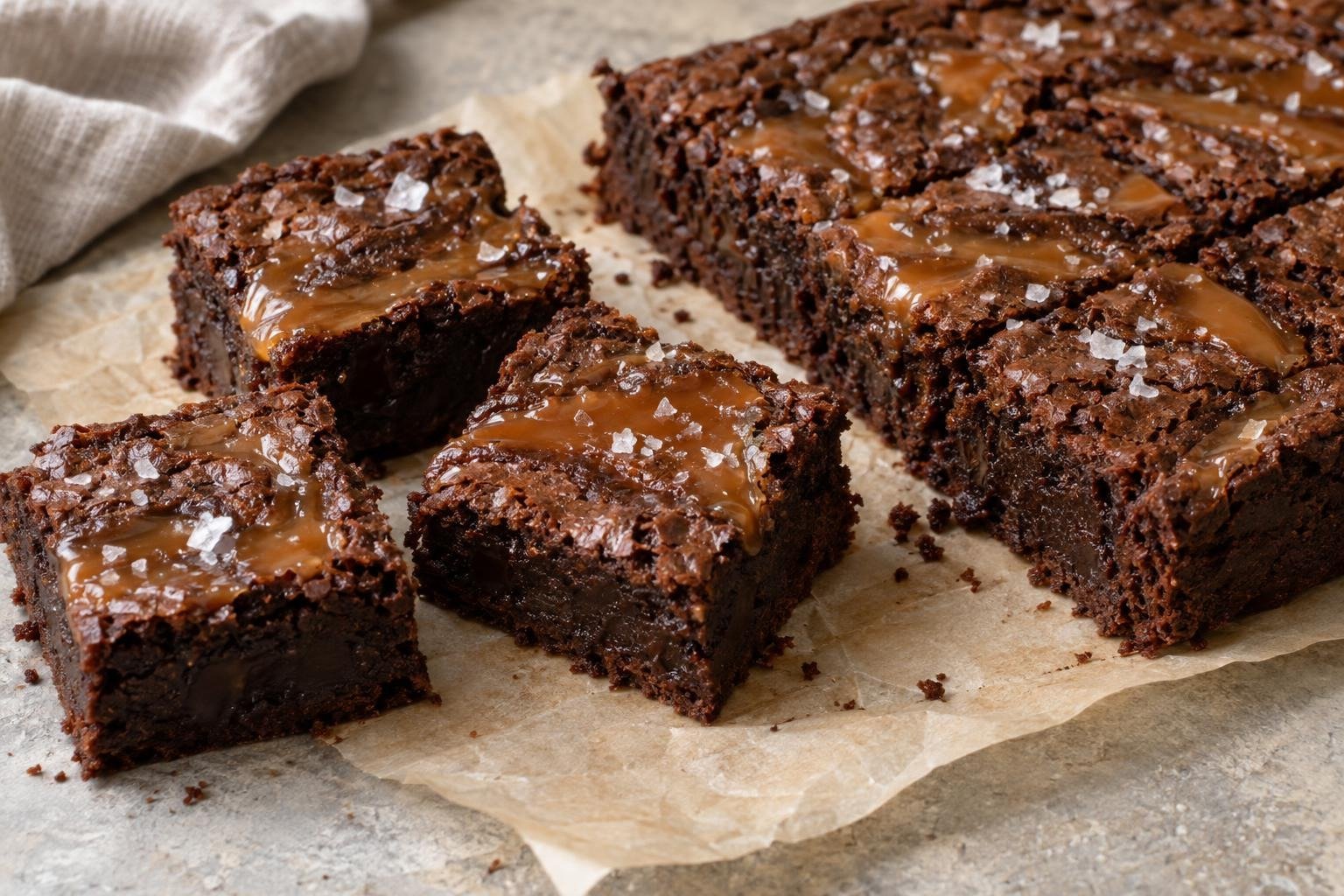
Glossy pockets of amber caramel, a dark chocolate center, and a light crunch of flaky salt give these salted caramel fudgy brownies their sweet, bitter, and salty contrast. The brownie base stays dense rather than cakey because melted chocolate and butter supply most of the structure and richness, while a restrained amount of flour keeps the cooled crumb soft and cohesive.
I cook the caramel first so it has time to become thick and spoonable before it meets the batter. For the brownies, I whisk the eggs and sugar only until smooth instead of aerating them into a foam, then fold in the dry ingredients just until the flour disappears. The bars are ready when the edges look set, the center no longer sloshes, and a toothpick catches moist fudgy crumbs rather than shiny raw batter.
Why These Chocolate Brownies Frickin’ Work
- A from-scratch caramel made with cream and butter cools to a thick consistency that can be layered without immediately dissolving into the brownie batter.
- Melted dark chocolate and Dutch-process cocoa provide complementary chocolate flavors, with the chocolate contributing fat and density while cocoa deepens the roasted notes.
- Three eggs give the brownies enough protein to set into neat squares without pushing the crumb toward a light, cakey texture.
- Minimal whisking after the eggs are added limits excess aeration, and gentle folding after the flour goes in prevents a tough or puffy result.
- Layering and lightly swirling the caramel preserves distinct pockets, while complete cooling and brief chilling stabilize both the chocolate crumb and caramel for cleaner cuts.
Ingredient Notes for Salted Caramel Fudgy Brownies with a Rich Chocolate Center
- Granulated sugar: Sugar forms the caramel and sweetens the brownie base. For the caramel, keep the saucepan sides clean because stray crystals can encourage the syrup to seize or turn grainy.
- Heavy cream: Warm cream loosens the cooked sugar into a sauce. Adding it gradually limits the temperature shock, although the mixture will still bubble vigorously and should be handled with care.
- Unsalted butter: Butter softens the caramel and provides the primary fat in the brownie. Unsalted butter lets the measured fine and flaky salts control the final seasoning.
- Dark chocolate: Chocolate in the 60 to 70 percent cacao range produces a rich center without making the brownies excessively bitter. Chop it finely so it melts evenly with the butter.
- Dutch-process cocoa powder: This alkalized cocoa has a dark color and rounded flavor that complement the caramel. Sifting it with the flour removes dry pockets that would otherwise require excessive mixing.
- Eggs: Room-temperature eggs blend more readily into the chocolate mixture. They provide water, emulsifiers, and protein, allowing the high-fat batter to become smooth and set during baking.
- Flaky sea salt: Large, delicate crystals create localized bursts of salt instead of uniformly salting the whole surface. Add them before baking so they adhere, but avoid crushing them into the batter.
Expert Baking Tips
- Use a light-colored metal pan for predictable edge setting. Dark metal can brown the perimeter before the rich center has finished baking, while a glass dish changes how slowly heat reaches the batter.
- Watch the caramel’s color rather than relying only on the clock. Remove it at deep amber; pale caramel tastes mainly sweet, while smoking or very dark syrup can become unpleasantly bitter.
- Let the caramel thicken before layering it. Warm, runny caramel spreads into the batter and loses definition, whereas cold, rigid caramel is difficult to swirl and may remain in heavy clumps.
- Stop swirling after three or four broad passes. Excessive marbling blends the caramel into the chocolate and disturbs the batter enough to make the top uneven.
- For clean slices, cool the slab fully and chill it briefly rather than cutting it warm. Heat and wipe the knife between every cut so caramel and fudgy crumbs do not drag across the next square.
Ingredients for Salted Caramel Fudgy Brownies
- 150 g granulated sugar (3/4 cup, for the caramel)
- 45 g unsalted butter (3 tablespoons, cut into pieces, for the caramel)
- 90 g heavy cream (6 tablespoons, warmed, for the caramel)
- 3 g fine sea salt (1/2 teaspoon, for the caramel)
- 170 g unsalted butter (3/4 cup, cubed, for the brownie batter)
- 170 g dark chocolate (6 ounces, 60 to 70 percent cacao, finely chopped)
- 250 g granulated sugar (1 1/4 cups, for the brownie batter)
- 3 large eggs (at room temperature)
- 10 g pure vanilla extract (2 teaspoons)
- 2 g instant espresso powder (1 teaspoon)
- 95 g all-purpose flour (3/4 cup, measured by weight)
- 35 g Dutch-process cocoa powder (1/3 cup)
- 3 g fine sea salt (1/2 teaspoon, for the brownie batter)
- 1 g flaky sea salt (about 1/4 teaspoon, for finishing)
How to Make Salted Caramel Fudgy Brownies
- STEP 1). Prepare the pan and warm the cream Heat the oven to 350°F with a rack in the center. Lightly grease a 9-inch square light-colored metal pan, then line it with two crossing parchment strips, leaving enough overhang to lift the brownies later. Set the pan on a heatproof surface. Warm the heavy cream in a heatproof jug until steaming but not boiling, about 20 to 30 seconds in a microwave, and keep it close to the stove for the caramel.
- STEP 2). Cook and cool the salted caramel Place the caramel sugar in a small heavy-bottomed saucepan over medium heat. Cook without stirring, swirling the pan gently once the edges liquefy, until all the sugar has melted and turned a deep amber, 6 to 9 minutes. Remove the pan from the heat and gradually whisk in the warm cream, keeping your hands clear of the vigorous steam. Whisk in the caramel butter and fine sea salt until smooth. Transfer to a bowl and refrigerate for 25 to 30 minutes, stirring once, until thick but still spoonable.
- STEP 3). Melt the butter and dark chocolate Combine the brownie butter and chopped dark chocolate in a medium heatproof bowl. Microwave in 20-second intervals at half power, stirring thoroughly after each interval, until the mixture is almost melted. Continue stirring off the heat until completely smooth so residual heat finishes the job without scorching the chocolate. Let it stand for about 5 minutes; it should remain fluid but feel only slightly warm before it is combined with the eggs.
- STEP 4). Mix the fudgy brownie batter In a large bowl, whisk the brownie sugar, eggs, vanilla, and espresso powder for 60 to 90 seconds, stopping when the mixture is smooth, slightly thickened, and evenly blended but not pale or foamy. Slowly whisk in the warm chocolate mixture until glossy and uniform. Sift the flour, cocoa powder, and fine sea salt directly over the bowl. Fold with a silicone spatula, scraping the bottom and sides, just until no dry flour remains; prolonged mixing can make the cooled brownies firmer.
- STEP 5). Layer, swirl, and bake the brownies Spread about two-thirds of the brownie batter evenly in the prepared pan, reaching fully into the corners. Drop half of the thickened caramel over it in small spoonfuls. Cover with the remaining batter, then add the remaining caramel in spaced dollops. Drag a skewer through the layers only three or four times to create broad ribbons without blending them together. Sprinkle with flaky sea salt. Bake for 31 to 36 minutes, until the edges are set, the center does not slosh, and a toothpick finds moist crumbs but no glossy liquid batter.
- STEP 6). Cool, chill, and cut clean squares Set the pan on a wire rack and cool the brownies completely in the pan for at least 2 hours; the center continues setting as the chocolate and caramel cool. Refrigerate the covered pan for 30 minutes to firm the layers before cutting. Lift the slab out with the parchment and peel the paper away. Use a large sharp knife to divide it into 16 squares, wiping and warming the blade under hot water, then drying it thoroughly, between cuts. Let the squares lose their refrigerator chill before serving.
Storage and Freezing
- Room temperature: Keep the fully cooled brownies in an airtight container for up to 2 days. Place parchment between layers to protect the caramel surface.
- Refrigeration: Store covered for up to 5 days. Let individual squares stand at room temperature for 20 to 30 minutes before serving so the chocolate center softens.
- Freezing: Wrap uncut portions or individual squares tightly, place them in a freezer-safe container, and freeze for up to 2 months.
- Thawing: Unwrap and thaw in the refrigerator overnight, then bring the brownies to room temperature before serving. This limits condensation on the caramel surface.
Frequently Asked Questions
How can you tell when salted caramel fudgy brownies are done?
Look for set edges and a center that has lost its liquid wobble but still appears softer than the perimeter. A toothpick inserted away from a caramel pocket should emerge with several moist, dark crumbs.
Glossy streaks of raw batter indicate that the center needs more time. Melted caramel may coat the toothpick, so check a second spot before deciding; a fudgy crumb should be damp and cohesive, not fluid.
Why does the caramel sink or disappear into the brownie batter?
Caramel is most likely to sink when it is still warm and runny, or when it is stirred too thoroughly into the batter. Cool it until thick enough to hold a spoon mark before assembling the layers.
Use spaced dollops and only a few broad passes with a skewer. Some caramel will naturally soften into the brownie, but restrained swirling leaves visible amber pockets instead of producing one uniformly sweet chocolate layer.
What ingredient substitutions work in this salted caramel brownie recipe?
Semisweet chocolate around 60 percent cacao can replace a darker bar within the specified 60 to 70 percent range. The brownies will taste slightly sweeter at the lower end, but the fat and cocoa solids remain suitable for the formula.
The espresso powder may be omitted if needed; it reinforces chocolate flavor but does not provide meaningful structure. Keep the heavy cream, butter, sugar, eggs, flour, and cocoa unchanged because they control the caramel consistency and brownie set.
Which method cuts salted caramel fudgy brownies cleanly?
Complete cooling is essential because warm chocolate and caramel smear under pressure. Chill the pan for about 30 minutes, lift out the entire slab, and use a large sharp knife rather than sawing with a serrated blade.
Warm the knife under hot water, dry it completely, and press straight down. Wipe and rewarm it after each cut. Allow the finished squares to return toward room temperature for the best soft, fudgy texture.
Should the salted caramel be made ahead of the brownie batter?
Preparing the caramel first gives it the 25 to 30 minutes it needs to become thick and spoonable. That cooling period fits naturally into the schedule while the oven heats and the chocolate mixture is prepared.
Caramel made farther ahead can be refrigerated in an airtight container, but it may become too firm to layer. Let it stand at room temperature until it can be scooped, without reheating it until runny.
More Ridiculously Delicious Brownies & Bars
- Brown Butter Brownies with Fudgy Centers
- Bakery-Style Fudgy Brownies
- Brown Butter Blondies with Chewy Centers
- Classic Lemon Bars with a Buttery Shortbread Crust
- Peanut Butter Swirl Brownies with a Fudgy Center
- Pistachio Chocolate Brownies with Fudgy Centers
- Smores Brownies with Fudgy Centers
- White Chocolate Raspberry Blondies with Homemade Texture
Salted Caramel Fudgy Brownies with a Rich Chocolate Center
Ingredients
Equipment
Method
- Heat the oven to 350°F with a rack in the center. Lightly grease a 9-inch square light-colored metal pan, then line it with two crossing parchment strips, leaving enough overhang to lift the brownies later. Set the pan on a heatproof surface. Warm the heavy cream in a heatproof jug until steaming but not boiling, about 20 to 30 seconds in a microwave, and keep it close to the stove for the caramel.
- Place the caramel sugar in a small heavy-bottomed saucepan over medium heat. Cook without stirring, swirling the pan gently once the edges liquefy, until all the sugar has melted and turned a deep amber, 6 to 9 minutes. Remove the pan from the heat and gradually whisk in the warm cream, keeping your hands clear of the vigorous steam. Whisk in the caramel butter and fine sea salt until smooth. Transfer to a bowl and refrigerate for 25 to 30 minutes, stirring once, until thick but still spoonable.
- Combine the brownie butter and chopped dark chocolate in a medium heatproof bowl. Microwave in 20-second intervals at half power, stirring thoroughly after each interval, until the mixture is almost melted. Continue stirring off the heat until completely smooth so residual heat finishes the job without scorching the chocolate. Let it stand for about 5 minutes; it should remain fluid but feel only slightly warm before it is combined with the eggs.
- In a large bowl, whisk the brownie sugar, eggs, vanilla, and espresso powder for 60 to 90 seconds, stopping when the mixture is smooth, slightly thickened, and evenly blended but not pale or foamy. Slowly whisk in the warm chocolate mixture until glossy and uniform. Sift the flour, cocoa powder, and fine sea salt directly over the bowl. Fold with a silicone spatula, scraping the bottom and sides, just until no dry flour remains; prolonged mixing can make the cooled brownies firmer.
- Spread about two-thirds of the brownie batter evenly in the prepared pan, reaching fully into the corners. Drop half of the thickened caramel over it in small spoonfuls. Cover with the remaining batter, then add the remaining caramel in spaced dollops. Drag a skewer through the layers only three or four times to create broad ribbons without blending them together. Sprinkle with flaky sea salt. Bake for 31 to 36 minutes, until the edges are set, the center does not slosh, and a toothpick finds moist crumbs but no glossy liquid batter.
- Set the pan on a wire rack and cool the brownies completely in the pan for at least 2 hours; the center continues setting as the chocolate and caramel cool. Refrigerate the covered pan for 30 minutes to firm the layers before cutting. Lift the slab out with the parchment and peel the paper away. Use a large sharp knife to divide it into 16 squares, wiping and warming the blade under hot water, then drying it thoroughly, between cuts. Let the squares lose their refrigerator chill before serving.
Notes
- Use a light-colored metal pan for predictable edge setting. Dark metal can brown the perimeter before the rich center has finished baking, while a glass dish changes how slowly heat reaches the batter.
- Watch the caramel’s color rather than relying only on the clock. Remove it at deep amber; pale caramel tastes mainly sweet, while smoking or very dark syrup can become unpleasantly bitter.
- Let the caramel thicken before layering it. Warm, runny caramel spreads into the batter and loses definition, whereas cold, rigid caramel is difficult to swirl and may remain in heavy clumps.
- Stop swirling after three or four broad passes. Excessive marbling blends the caramel into the chocolate and disturbs the batter enough to make the top uneven.
- For clean slices, cool the slab fully and chill it briefly rather than cutting it warm. Heat and wipe the knife between every cut so caramel and fudgy crumbs do not drag across the next square.