Table of Contents
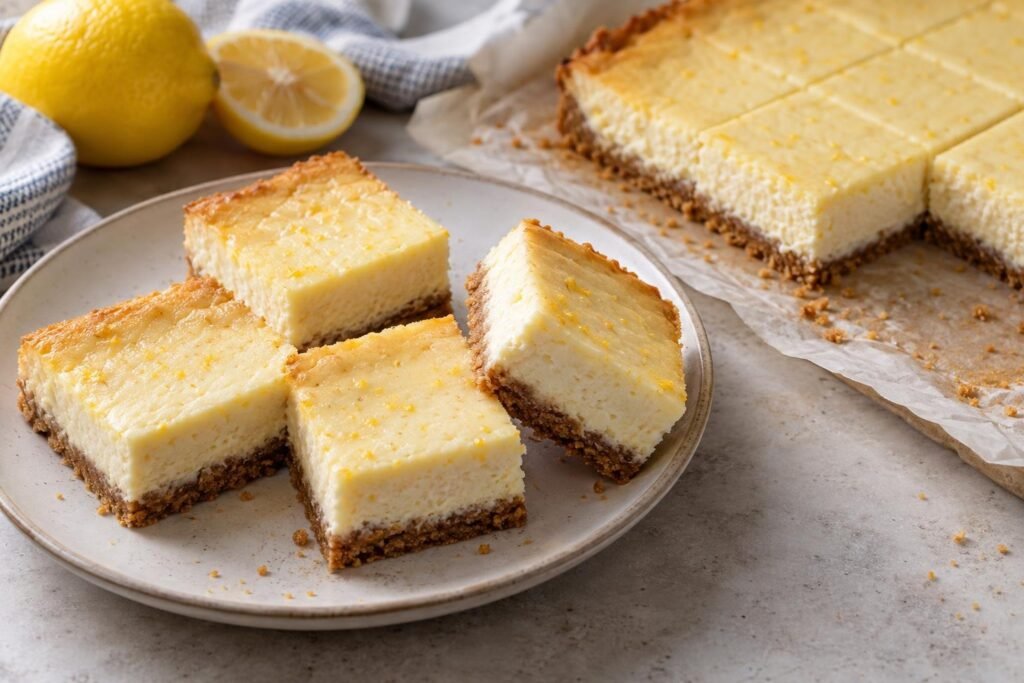
A buttery graham crust snaps gently beneath a dense, satin-smooth layer scented with lemon zest and vanilla. These cheesecake bars have the richness of classic baked cheesecake in a tidy square format, with enough citrus to brighten the cream cheese without turning the filling sharp, wet, or curdled.
I use a deep 9-inch square metal pan so the filling has room to bake gradually without becoming thin or rubbery. Room-temperature dairy, low-speed mixing, and a slight wobble at the center are the important cues. After a slow room-temperature cool and a full six-hour chill, the filling becomes firm enough to lift, portion, and cut cleanly without losing its creamy texture.

Why This Recipe Is Deliciously Ridiculous
- A 3-to-1 ratio of cream cheese to sour cream produces a substantial filling that remains creamy rather than loose or mousse-like.
- Cornstarch binds a small amount of free moisture, helping the chilled cheesecake squares hold defined edges without making the filling floury.
- Fresh lemon zest provides concentrated citrus aroma, while a restrained amount of juice keeps excess acid and water out of the filling.
- Low-speed mixing limits incorporated air, reducing dramatic rising, sinking, and cracks during cooling.
- A deep metal pan, moderate oven temperature, gradual cooling, and six-hour chill create an evenly baked slab that lifts and slices neatly.
Ingredient Notes for Creamy Vanilla Cheesecake Bars with Lemon Zest
- Graham cracker crumbs: Finely ground crumbs pack into a cohesive crust with fewer weak spots. Crush whole crackers until the texture resembles coarse sand, without leaving large shards that make slicing ragged.
- Unsalted butter: Melted butter coats the crumbs and firms when chilled. Unsalted butter lets me control the seasoning, while cooling it slightly prevents the brown sugar from melting into greasy pockets.
- Full-fat brick cream cheese: Use dense, foil-wrapped cream cheese rather than whipped or tub-style spread. Bringing it to about 21°C before mixing allows the lumps to smooth out without prolonged beating and excess air.
- Granulated sugar: Sugar sweetens the filling and softens the cream cheese proteins. It must be mixed until evenly dispersed, but vigorous whipping is unnecessary and can aerate the batter.
- Sour cream: Full-fat sour cream adds moisture and lactic tang while relaxing the dense cream cheese structure. Bring it to room temperature so it blends smoothly instead of tightening the cream cheese.
- Eggs: Eggs provide the protein structure that sets the bars. Room-temperature eggs incorporate quickly on low speed, limiting the amount of air beaten into the filling.
- Cornstarch: This small quantity manages moisture and reinforces clean slices after chilling. Sifting it over the sugar prevents dry starch pockets in the finished cheesecake.
- Lemon and vanilla: Finely grated zest supplies aromatic citrus oils, while a tablespoon of juice brightens the dairy. Vanilla rounds out the acidity without masking the cream cheese flavor.
My Baking Tips
- Use a light-colored metal pan with straight sides. Glass heats and cools more slowly, while dark metal can brown the crust and edges before the center finishes setting.
- Check the pan depth before mixing. A shallow pan can overflow or produce thin bars, while a 2-inch-deep pan comfortably holds this crust and filling.
- Scrape the mixer bowl after every major addition. Cool, dense cream cheese often hides near the bottom and can leave pale lumps if the batter is poured without a final hand fold.
- Judge doneness by the movement of the center rather than browning. A broad liquid wave needs more baking, but a small unified wobble will set during cooling and chilling.
- For the cleanest cheesecake squares, keep the slab refrigerated until the cutting board and hot-water setup are ready. A warm knife helps only when it is wiped dry between every cut.
Ingredients for Creamy Vanilla Cheesecake Bars with Lemon Zest
- 200 g graham cracker crumbs (about 2 cups, finely ground)
- 25 g light brown sugar (packed)
- 1/4 teaspoon fine salt (divided between crust and filling)
- 85 g unsalted butter (melted and cooled slightly)
- 680 g full-fat brick cream cheese (softened to about 21°C)
- 170 g granulated sugar
- 12 g cornstarch (about 1 1/2 tablespoons, sifted)
- 120 g full-fat sour cream (at room temperature)
- 1 tablespoon finely grated lemon zest (from about 1 large lemon)
- 1 tablespoon fresh lemon juice (strained)
- 2 teaspoons pure vanilla extract
- 3 large eggs (about 150 g without shells, at room temperature)
How to Make Creamy Vanilla Cheesecake Bars with Lemon Zest
- STEP 1). Prepare the oven, pan, and ingredients Heat the oven to 350°F with a rack in the middle. Lightly grease a 9-inch square metal pan at least 2 inches deep, then line it with two crossing strips of parchment, leaving handles on every side. Set the cream cheese, sour cream, and eggs out until they are close to 21°C; evenly tempered ingredients blend with less mixing. Keep the filling ingredients nearby while you prepare the crust.
- STEP 2). Mix and prebake the graham crust Combine the graham crumbs, brown sugar, and 1/8 teaspoon of the salt in a medium bowl. Stir in the melted butter until every crumb looks evenly moistened and the mixture holds together when squeezed. Press it firmly across the pan with the flat bottom of a measuring cup, paying attention to the corners. Bake for 10 minutes, until fragrant and slightly darker at the edges, then cool on a rack while lowering the oven to 325°F.
- STEP 3). Smooth the cream cheese base Place the softened cream cheese in the bowl of a stand mixer fitted with the paddle. Mix on low speed for about 60 seconds, scrape the bowl and paddle, then mix just until smooth. Whisk the granulated sugar, cornstarch, and remaining 1/8 teaspoon salt together before adding them. Mix on low for 60 to 90 seconds, stopping once to scrape thoroughly. The base should look creamy and uniform, not fluffy or visibly aerated.
- STEP 4). Finish the filling without overmixing Add the room-temperature sour cream, lemon zest, lemon juice, and vanilla to the cream cheese mixture. Blend on low only until no white streaks remain, then scrape the bowl. Add the eggs one at a time, mixing for 15 to 20 seconds after each and scraping after the second egg. Stop as soon as the final egg disappears. Fold the batter several times with a spatula to catch any dense mixture at the bottom without whipping in bubbles.
- STEP 5). Bake until the center retains a controlled wobble Pour the filling over the warm or cooled crust and spread it level with the spatula. Tap the pan gently on a folded towel two or three times to release large air pockets. Bake at 325°F for 34 to 38 minutes. The outer 2 inches should look set and slightly puffed, while the center should wobble as one small area when nudged, not ripple like liquid. An instant-read thermometer inserted near the center should register about 150 to 155°F.
- STEP 6). Cool gradually and chill until fully set Place the pan on a wire rack away from drafts and let the cheesecake cool at room temperature for about 90 minutes. The center will settle and finish firming as residual heat moves through the filling. Once the pan no longer feels warm, cover it without touching the surface and refrigerate for at least 6 hours, preferably overnight. Do not lift or slice the bars early; the chilled fat and set egg proteins provide the structure needed for clean edges.
- STEP 7). Lift and cut clean cheesecake squares Run a thin knife along any unlined edges, then use the parchment handles to lift the cold cheesecake onto a cutting board. For 16 bars, mark four equal sections in each direction before cutting. Dip a large sharp knife in hot water, wipe it completely dry, and press straight down through the cheesecake and crust. Clean and rewarm the blade after every cut. Let the sliced bars stand for 10 to 15 minutes before serving for the creamiest texture.
Storage and Freezing
- Refrigeration: Arrange the cheesecake bars in a single layer in an airtight container and refrigerate for up to 5 days. Place parchment between layers only if stacking is necessary.
- Freezing: Freeze fully chilled, individually wrapped bars for up to 2 months. Wrap each piece in plastic, then place the wrapped bars in a freezer-safe container to prevent drying and absorbed odors.
- Thawing: Transfer wrapped bars to the refrigerator and thaw overnight. Unwrap them after thawing so condensation does not collect directly on the cheesecake surface.
- Serving: For a creamy but stable texture, let refrigerated bars stand at room temperature for 10 to 15 minutes. Do not leave them unrefrigerated for more than 2 hours.
Frequently Asked Questions
How long should cheesecake bars chill before cutting?
These cheesecake bars need at least 6 hours in the refrigerator after they have cooled for about 90 minutes at room temperature. Overnight chilling is convenient when the serving schedule allows it.
Cutting sooner leaves the cream cheese fat soft and the custard structure fragile. A properly chilled slab should lift without bowing, and the knife should leave a smooth face rather than dragging wet filling.
Why did my cheesecake bars crack or sink in the middle?
Excess air is a common cause because bubbles expand in the oven and collapse as the cheesecake cools. Mix on low speed, keep the paddle rather than a whisk attached, and stop as soon as each egg is incorporated.
Overbaking can also cause cracking and sinking. Remove the pan when the edges are set but the center still moves as one small, controlled wobble. A fully rigid center in the oven is likely overcooked.
What size pan is best for thick cheesecake squares?
A 9-inch square metal pan at least 2 inches deep gives this formula a substantial cream cheese layer without crowding the rim. Straight sides also make the chilled slab easier to lift and divide evenly.
An 8-inch pan is too small for the stated baking time and depth, while a larger pan produces thinner bars that bake faster. Changing the dimensions requires a separate doneness assessment rather than relying on the timing here.
Can I make these cheesecake bars ahead of serving?
Preparing them one day ahead works particularly well because the full overnight chill gives the filling time to become evenly firm. Bake, cool, cover, and refrigerate the slab in its pan before slicing close to serving time.
For the neatest presentation, avoid cutting warm bars for advance storage. Keep the cheesecake whole and cold, then use a hot, thoroughly dried knife for each cut.
How do you cut cheesecake bars cleanly without damaging the crust?
Lift the thoroughly chilled slab onto a cutting board and mark equal portions before making the first cut. Use a large, sharp knife that reaches across each bar so you can press straight down rather than saw through the filling.
Dip the blade in hot water, dry it completely, and clean it after every cut. The dry, warm blade glides through the creamy layer, while firm downward pressure divides the graham crust with fewer loose crumbs.
More Sweet Treats to Fall in Love With
- Chocolate No-Bake Cheesecake Bars with a Creamy Filling
- Strawberry Pretzel Cheesecake Bars with Clean Slices
- Creamy Chocolate Chip Cheesecake Bars
- Pistachio No-Bake Cheesecake Bars with a Nutty Cookie Crust
- Strawberry No-Bake Cheesecake Bars with a Creamy Berry Layer
Creamy Vanilla Cheesecake Bars with Lemon Zest
Ingredients
Equipment
Method
- Heat the oven to 350°F with a rack in the middle. Lightly grease a 9-inch square metal pan at least 2 inches deep, then line it with two crossing strips of parchment, leaving handles on every side. Set the cream cheese, sour cream, and eggs out until they are close to 21°C; evenly tempered ingredients blend with less mixing. Keep the filling ingredients nearby while you prepare the crust.
- Combine the graham crumbs, brown sugar, and 1/8 teaspoon of the salt in a medium bowl. Stir in the melted butter until every crumb looks evenly moistened and the mixture holds together when squeezed. Press it firmly across the pan with the flat bottom of a measuring cup, paying attention to the corners. Bake for 10 minutes, until fragrant and slightly darker at the edges, then cool on a rack while lowering the oven to 325°F.
- Place the softened cream cheese in the bowl of a stand mixer fitted with the paddle. Mix on low speed for about 60 seconds, scrape the bowl and paddle, then mix just until smooth. Whisk the granulated sugar, cornstarch, and remaining 1/8 teaspoon salt together before adding them. Mix on low for 60 to 90 seconds, stopping once to scrape thoroughly. The base should look creamy and uniform, not fluffy or visibly aerated.
- Add the room-temperature sour cream, lemon zest, lemon juice, and vanilla to the cream cheese mixture. Blend on low only until no white streaks remain, then scrape the bowl. Add the eggs one at a time, mixing for 15 to 20 seconds after each and scraping after the second egg. Stop as soon as the final egg disappears. Fold the batter several times with a spatula to catch any dense mixture at the bottom without whipping in bubbles.
- Pour the filling over the warm or cooled crust and spread it level with the spatula. Tap the pan gently on a folded towel two or three times to release large air pockets. Bake at 325°F for 34 to 38 minutes. The outer 2 inches should look set and slightly puffed, while the center should wobble as one small area when nudged, not ripple like liquid. An instant-read thermometer inserted near the center should register about 150 to 155°F.
- Place the pan on a wire rack away from drafts and let the cheesecake cool at room temperature for about 90 minutes. The center will settle and finish firming as residual heat moves through the filling. Once the pan no longer feels warm, cover it without touching the surface and refrigerate for at least 6 hours, preferably overnight. Do not lift or slice the bars early; the chilled fat and set egg proteins provide the structure needed for clean edges.
- Run a thin knife along any unlined edges, then use the parchment handles to lift the cold cheesecake onto a cutting board. For 16 bars, mark four equal sections in each direction before cutting. Dip a large sharp knife in hot water, wipe it completely dry, and press straight down through the cheesecake and crust. Clean and rewarm the blade after every cut. Let the sliced bars stand for 10 to 15 minutes before serving for the creamiest texture.
Notes
- Use a light-colored metal pan with straight sides. Glass heats and cools more slowly, while dark metal can brown the crust and edges before the center finishes setting.
- Check the pan depth before mixing. A shallow pan can overflow or produce thin bars, while a 2-inch-deep pan comfortably holds this crust and filling.
- Scrape the mixer bowl after every major addition. Cool, dense cream cheese often hides near the bottom and can leave pale lumps if the batter is poured without a final hand fold.
- Judge doneness by the movement of the center rather than browning. A broad liquid wave needs more baking, but a small unified wobble will set during cooling and chilling.
- For the cleanest cheesecake squares, keep the slab refrigerated until the cutting board and hot-water setup are ready. A warm knife helps only when it is wiped dry between every cut.