Table of Contents
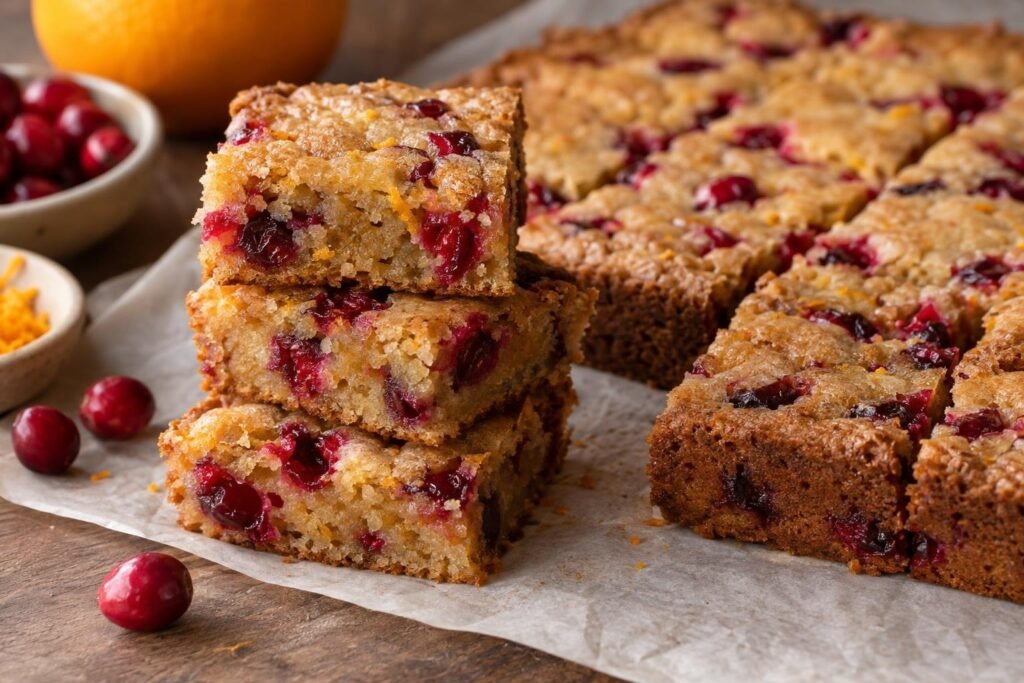
Buttery brown sugar centers, lightly crisp golden edges, fragrant orange zest, and sharp pockets of cranberry give these cranberry orange blondies their holiday-ready character. The crumb is dense and chewy rather than cakey, with enough structure to hold the fruit without losing that soft blondie texture. Fresh or frozen cranberries both work, so the bars fit peak cranberry season while remaining practical whenever frozen fruit is available.
I use melted butter for chewiness, rub the orange zest into the sugars to release its aromatic oils, and fold the cranberries into a deliberately thick batter. The important cue is not a perfectly clean toothpick, which usually means the blondies have gone too far. I pull the pan when the edges are set and golden, the center no longer looks liquid, and a tester brings up moist crumbs without glossy raw batter. A full two-hour cooling period then sets the crumb for tidy slices.

Why You’ll Love this Ridiculously Delicious Tart
- Melted butter coats the flour efficiently and encourages a dense, chewy crumb instead of the aerated texture produced by creaming softened butter.
- Brown sugar supplies moisture and molasses flavor, while a smaller amount of granulated sugar helps the top and edges set with a delicate crust.
- Rubbing orange zest into the sugars releases its fragrant oils before wet ingredients dilute them, giving the blondies a clear citrus aroma without excess juice.
- A modest amount of baking powder prevents the fruit-laden batter from becoming heavy while preserving the compact texture expected from blondies.
- The thick batter suspends whole cranberries, and complete cooling allows the butter and dissolved sugars to firm enough for clean, stable slices.
Ingredient Notes for Cranberry Orange Blondies with Tart Cranberries
- Unsalted butter: Melted butter supplies richness and promotes a dense, chewy center. Cool it until warm rather than hot so it does not overheat the eggs or make the batter greasy.
- Brown and granulated sugars: Light brown sugar provides moisture and caramel flavor. Granulated sugar supports a lightly crisp surface and firmer edges, so both sugars have a distinct structural role.
- Orange zest: Use only the finely grated orange layer because the white pith tastes bitter. Rubbing the zest into the sugars releases aromatic oils and distributes them more evenly than simply stirring zest into finished batter.
- Eggs: Whole eggs bind the fat and sugar while supplying enough protein to set the center. Room-temperature eggs blend more smoothly into the melted butter mixture and reduce the risk of a separated batter.
- All-purpose flour: Flour gives the bars enough structure to support the cranberries. Measure by weight when possible and stop folding as soon as the last dry streaks disappear to limit gluten development.
- Cranberries: Fresh or frozen cranberries provide acidity that balances the sweet, buttery base. Keep frozen berries frozen until folding so they release less color and moisture into the batter.
Baking Tips Worth Knowing
- Use a light-colored metal pan for predictable edge and center baking. Glass retains heat longer, while a dark pan can brown the perimeter before the middle is properly set.
- Zest the oranges directly over the sugar bowl so the fragrant oils land in the recipe rather than on a cutting board. Stop grating as soon as the white pith appears.
- If using frozen cranberries, do not thaw them. Thawed berries release juice early, which can streak the batter and create gummy pockets around the fruit.
- Check doneness in a section without a cranberry. Piercing fruit can coat the tester with juice and make a properly baked center look raw.
- For the cleanest cuts, let the slab cool completely, then chill it for 20 minutes before slicing. Use a thin, sharp knife and clean it after every cut.
Ingredients for Cranberry Orange Blondies
- 1 cup unsalted butter (226 g, melted and cooled until warm)
- 1 3/4 cups packed light brown sugar (350 g)
- 1/2 cup granulated sugar (100 g)
- 2 tablespoons finely grated orange zest (From about 2 medium oranges, avoiding the white pith)
- 3 large eggs (At room temperature)
- 2 teaspoons pure vanilla extract (For depth and rounded flavor)
- 2 1/2 cups all-purpose flour (300 g, spooned and leveled if not weighed)
- 1 teaspoon baking powder (Level measure)
- 3/4 teaspoon fine sea salt (Distributes evenly through the batter)
- 2 1/2 cups fresh or frozen cranberries (250 g; keep frozen cranberries frozen until needed)
How to Make Cranberry Orange Blondies
- STEP 1). Prepare the pan and heat the oven Position a rack in the center of the oven and heat it to 350°F. Lightly grease a 9 x 13 inch light-colored metal pan, then line the bottom and two long sides with parchment, leaving handles for lifting. Grease the exposed short sides. A metal pan conducts heat efficiently enough to set the center before the edges become hard; avoid placing it on a sheet pan, which can slow bottom browning.
- STEP 2). Melt and cool the butter Melt the butter in a small saucepan over low heat or in a microwave-safe bowl in short intervals. Pour it into a large mixing bowl and let it cool for 8 to 10 minutes, until warm and fluid but no longer hot. Cooling protects the eggs from coagulating and helps the butter combine smoothly with the sugars. Use this pause to measure the remaining ingredients and finely grate the orange zest.
- STEP 3). Rub the zest into the sugars Add the brown sugar, granulated sugar, and orange zest to the warm butter. Use clean fingertips to rub the zest through the sugars for about 30 seconds, breaking apart any brown sugar lumps as the mixture becomes fragrant. Whisk for 60 to 90 seconds, until evenly blended and glossy. The sugar will not fully dissolve, but there should be no dry pockets or visible pools of separated butter around the bowl.
- STEP 4). Whisk in the eggs and vanilla Add the eggs one at a time, whisking thoroughly after each addition until the mixture looks smooth before adding the next. Whisk in the vanilla, then continue for about 30 seconds, stopping when the batter is cohesive, slightly thickened, and glossy. Do not aggressively whip for several minutes because excess aeration can push the texture toward cakey. Scrape the bottom and sides of the bowl with a flexible spatula to catch any unmixed butter.
- STEP 5). Fold the dry ingredients and cranberries In a medium bowl, whisk the flour, baking powder, and salt for 30 seconds. Add the dry mixture to the wet ingredients and fold with a flexible spatula until only a few narrow flour streaks remain. Add the fresh or still-frozen cranberries and fold just until evenly distributed and no dry flour is visible. The finished batter should be thick, glossy, and scoopable rather than pourable; overmixing at this point can make the cooled edges tough.
- STEP 6). Spread and bake until set Transfer the batter to the prepared pan and spread it into an even layer, pressing it carefully into the corners without crushing the cranberries. Smooth the surface with the spatula. Bake for 29 to 34 minutes, rotating the pan once after 22 minutes. The edges should be golden and set, while the center looks matte rather than wet and gives only a slight wobble. A tester inserted away from a cranberry should show moist crumbs, never glossy raw batter.
- STEP 7). Cool, lift, and cut cleanly Set the pan on a wire rack and cool the blondies completely for at least 2 hours. Do not lift them while warm because the buttery center is still setting and may bend or tear. Run a thin knife along the unlined sides, use the parchment handles to transfer the slab to a board, and peel away the paper. For 24 bars, cut into 4 rows by 6 columns with a sharp knife, wiping the blade clean between cuts.
Storage and Freezing
- Storage: Keep completely cooled blondies in an airtight container at room temperature for up to 2 days, or refrigerate for up to 5 days. Place parchment between stacked layers to protect the moist surfaces.
- Freezing: Wrap individual bars tightly and place them in a freezer-safe container or bag for up to 2 months.
- Thawing: Unwrap and thaw the bars at room temperature for 1 to 2 hours so condensation does not collect against their surfaces.
- Serving: Serve at room temperature for the softest center. Refrigerated bars may be left out for about 20 minutes before serving.
Frequently Asked Questions
How do you tell when cranberry orange blondies are done?
The edges should appear set and lightly golden, while the center should look matte and show only a slight wobble when the pan is nudged. Insert a tester into the blondie crumb rather than through a cranberry.
Moist crumbs indicate a properly baked center. Glossy batter means the bars need another 2 to 3 minutes, while a completely dry tester and deeply browned edges suggest they have baked past their softest stage.
Why are my cranberry orange blondies cakey instead of chewy?
A cakey texture commonly comes from excess flour, vigorous whisking after the eggs are added, or baking longer than necessary. Weighing the flour and mixing only until the dry streaks disappear helps preserve the compact crumb.
The batter should be thick and glossy without looking fluffy. Remove the pan when the center has set but still carries moist crumbs, then cool it fully so the buttery crumb firms without drying out.
What is the best way to cut cranberry orange blondies cleanly?
Cool the blondies in the pan for at least 2 hours before lifting the slab with the parchment handles. Warm blondies are structurally fragile, and cranberry pockets can drag through a center that has not finished setting.
For especially sharp edges, chill the cooled slab for 20 minutes. Cut with a thin, sharp chef's knife using firm downward strokes, wiping the blade clean between every cut rather than sawing back and forth.
Should frozen cranberries be thawed before adding them to blondie batter?
Frozen cranberries should go into the batter directly from the freezer. Thawing softens their skins and releases liquid, which can create red streaks, damp pockets, and uneven moisture around the fruit.
Fold the frozen berries in only after most of the flour has been incorporated. The chilled fruit may make the batter firmer, but the same visual doneness cues apply and the baking window already accommodates either fresh or frozen cranberries.
What ingredient substitutions work in this cranberry orange blondies recipe?
Fresh and frozen cranberries are interchangeable by weight because the frozen berries are used without thawing. Fine sea salt can be replaced with the same volume of table salt, although coarser salts should be weighed or adjusted carefully.
Other changes to the butter, sugars, eggs, flour, or leavening are not direct substitutions in this formula. Those ingredients control spread, moisture, protein setting, and chewiness, so changing them can produce greasy, dry, or cakey bars.
More Ridiculously Delicious Brownies & Bars
- Maple Pecan Blondies with Homemade Texture
- White Chocolate Raspberry Blondies with Homemade Texture
- Brown Butter Blondies with Chewy Centers
- Coconut Chocolate Brownies with Toasted Coconut
- Smores Brownies with Fudgy Centers
Cranberry Orange Blondies with Tart Cranberries
Ingredients
Equipment
Method
- Position a rack in the center of the oven and heat it to 350°F. Lightly grease a 9 x 13 inch light-colored metal pan, then line the bottom and two long sides with parchment, leaving handles for lifting. Grease the exposed short sides. A metal pan conducts heat efficiently enough to set the center before the edges become hard; avoid placing it on a sheet pan, which can slow bottom browning.
- Melt the butter in a small saucepan over low heat or in a microwave-safe bowl in short intervals. Pour it into a large mixing bowl and let it cool for 8 to 10 minutes, until warm and fluid but no longer hot. Cooling protects the eggs from coagulating and helps the butter combine smoothly with the sugars. Use this pause to measure the remaining ingredients and finely grate the orange zest.
- Add the brown sugar, granulated sugar, and orange zest to the warm butter. Use clean fingertips to rub the zest through the sugars for about 30 seconds, breaking apart any brown sugar lumps as the mixture becomes fragrant. Whisk for 60 to 90 seconds, until evenly blended and glossy. The sugar will not fully dissolve, but there should be no dry pockets or visible pools of separated butter around the bowl.
- Add the eggs one at a time, whisking thoroughly after each addition until the mixture looks smooth before adding the next. Whisk in the vanilla, then continue for about 30 seconds, stopping when the batter is cohesive, slightly thickened, and glossy. Do not aggressively whip for several minutes because excess aeration can push the texture toward cakey. Scrape the bottom and sides of the bowl with a flexible spatula to catch any unmixed butter.
- In a medium bowl, whisk the flour, baking powder, and salt for 30 seconds. Add the dry mixture to the wet ingredients and fold with a flexible spatula until only a few narrow flour streaks remain. Add the fresh or still-frozen cranberries and fold just until evenly distributed and no dry flour is visible. The finished batter should be thick, glossy, and scoopable rather than pourable; overmixing at this point can make the cooled edges tough.
- Transfer the batter to the prepared pan and spread it into an even layer, pressing it carefully into the corners without crushing the cranberries. Smooth the surface with the spatula. Bake for 29 to 34 minutes, rotating the pan once after 22 minutes. The edges should be golden and set, while the center looks matte rather than wet and gives only a slight wobble. A tester inserted away from a cranberry should show moist crumbs, never glossy raw batter.
- Set the pan on a wire rack and cool the blondies completely for at least 2 hours. Do not lift them while warm because the buttery center is still setting and may bend or tear. Run a thin knife along the unlined sides, use the parchment handles to transfer the slab to a board, and peel away the paper. For 24 bars, cut into 4 rows by 6 columns with a sharp knife, wiping the blade clean between cuts.
Notes
- Use a light-colored metal pan for predictable edge and center baking. Glass retains heat longer, while a dark pan can brown the perimeter before the middle is properly set.
- Zest the oranges directly over the sugar bowl so the fragrant oils land in the recipe rather than on a cutting board. Stop grating as soon as the white pith appears.
- If using frozen cranberries, do not thaw them. Thawed berries release juice early, which can streak the batter and create gummy pockets around the fruit.
- Check doneness in a section without a cranberry. Piercing fruit can coat the tester with juice and make a properly baked center look raw.
- For the cleanest cuts, let the slab cool completely, then chill it for 20 minutes before slicing. Use a thin, sharp knife and clean it after every cut.