Table of Contents
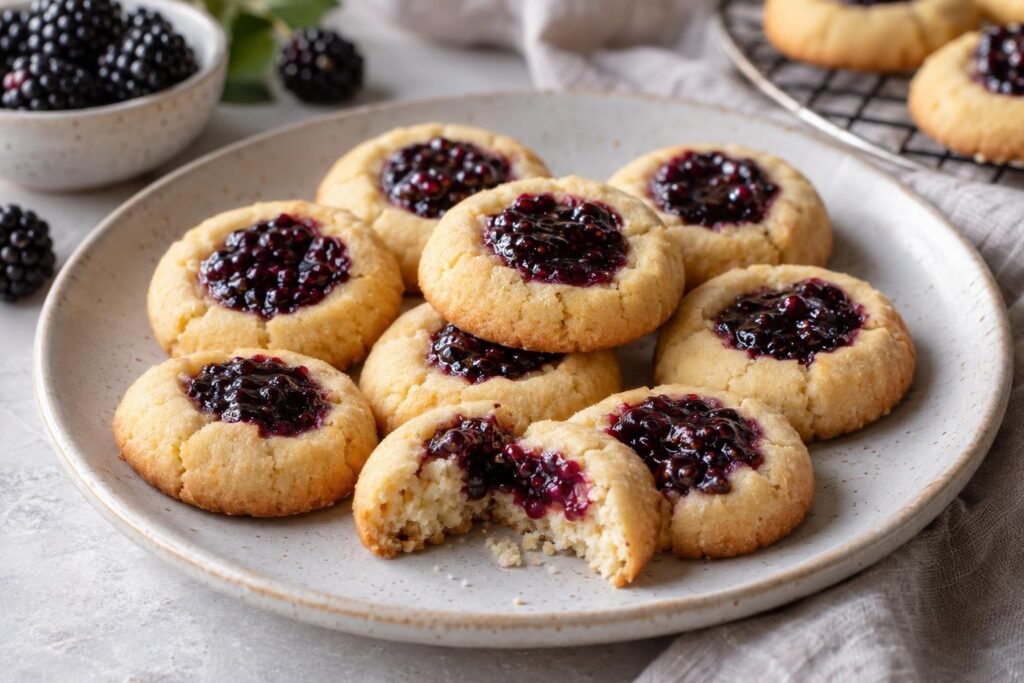
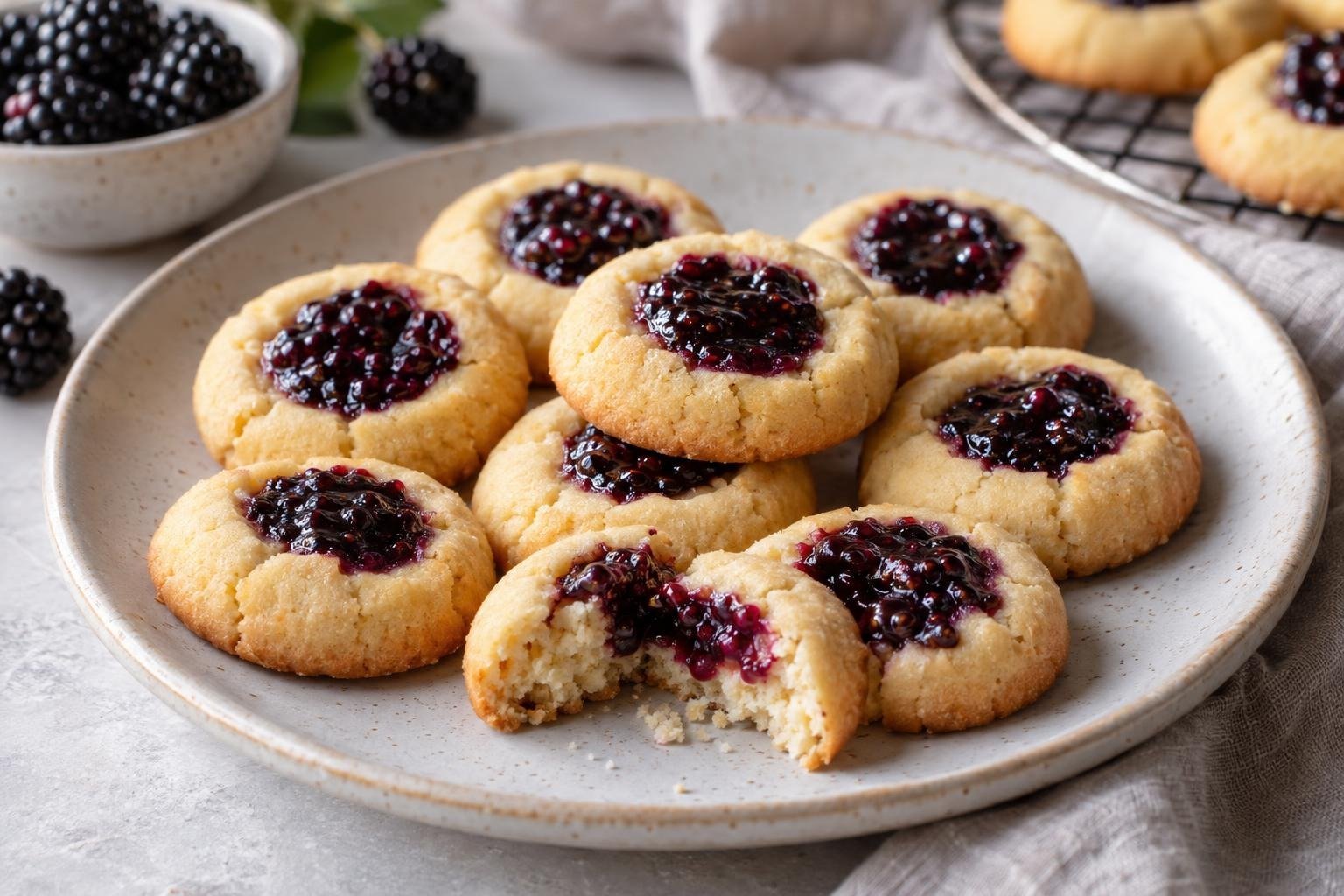
Buttery edges give way to tender, fine-crumbed centers, while glossy blackberry preserves add a tart, concentrated berry finish. These blackberry thumbprint cookies keep their neat round shape because the dough contains just enough cornstarch to limit spread without making the cookies dry or chalky. Each indentation holds one level teaspoon of preserves, which creates a generous berry center that stays inside the cookie rather than bubbling onto the pan.
I portion the dough by weight, press the indentation while the dough is still pliable, and chill the shaped cookies before filling. Those details matter: cool dough spreads slowly, a gradual press prevents deep cracks, and thick preserves remain neatly contained. Look for pale tops, matte surfaces, and narrow golden edges at the end of baking. The blackberry filling may bubble gently around the perimeter, but it should not boil vigorously or sink into the cookie.
What Makes these Cookies Deliciously Ridiculous
- Twenty-two gram dough portions produce evenly sized cookies with enough thickness to support a defined blackberry center.
- Softened butter at 18 to 20°C creams smoothly without becoming greasy, helping the cookies hold their shape in the oven.
- Cornstarch reduces gluten development and absorbs some free moisture, creating a tender crumb while controlling spread.
- Pressing the wells before chilling allows the pliable dough to compress without developing large cracks around the edges.
- One level teaspoon of thick blackberry preserves fills each measured cavity without creating a mound that can boil over.
Ingredient Notes for Blackberry Thumbprint Cookies with Tart Berry Jam
- Unsalted butter: Butter provides flavor, structure, and tenderness. It should feel cool and pliable at 18 to 20°C, not shiny, oily, or partly melted. Properly softened butter holds fine air pockets during mixing and produces cleaner cookie edges.
- Granulated sugar: Fine granulated sugar sweetens the dough and helps the edges become lightly crisp. Cream it only until the butter looks smooth and slightly aerated; excessive whipping can encourage spreading and distort the indentations.
- Egg yolk: One large yolk supplies fat, protein, and emulsifiers without adding the extra water found in a whole egg. It binds the dough while preserving the rich, short texture expected from thumbprint cookies.
- All-purpose flour: Flour supplies the cookie structure. Weigh it for accuracy, and mix only until the last dry streaks disappear. Extra flour can make the dough crumbly and cause the rims to crack when pressed.
- Cornstarch: Cornstarch softens the flour structure and limits spread. It also gives the baked cookies a fine, delicate crumb, but it must be whisked evenly into the flour so no powdery pockets remain.
- Blackberry preserves: Use thick preserves or jam rather than a runny fruit sauce. Stir until smooth before measuring, but do not warm it. A loose or warm filling can boil rapidly, soak into the dough, and escape the indentation.
Expert Baking Tips
- Measure each dough portion at 22 grams. Uneven portions bake at different rates, and larger cookies require deeper wells that are more likely to hold underbaked dough beneath the preserves.
- If the dough splits into wide cracks when pressed, let that portion stand at room temperature for 2 to 3 minutes. A slightly pliable surface compresses more cleanly than very cold, rigid dough.
- Keep the indentation about 6 mm above the cookie base. Pressing too deeply creates a thin floor that can leak preserves or stick to the parchment after baking.
- Use cool, thick preserves and level each teaspoon. A rounded spoonful forms a high central mound that can boil over before the cookie edges are fully baked.
- Bake one tray at a time on the center rack. This gives the butter-rich dough even heat and makes the pale-top, golden-edge doneness cues easier to judge.
Ingredients for Blackberry Thumbprint Cookies
- 170 g unsalted butter (3/4 cup; softened to 18 to 20°C)
- 100 g granulated sugar (1/2 cup)
- 1 large egg yolk (at room temperature)
- 1 tsp pure vanilla extract (5 ml)
- 240 g all-purpose flour (2 cups, measured by weight)
- 20 g cornstarch (2 tablespoons plus 2 teaspoons)
- 2 g fine sea salt (1/3 teaspoon)
- 120 g thick blackberry preserves (about 1/3 cup plus 2 tablespoons; stir until smooth but do not warm)
How to Make Blackberry Thumbprint Cookies
- STEP 1). Prepare the pans and dry ingredients Line two light-colored rimmed baking sheets with parchment paper. In a medium bowl, whisk the all-purpose flour, cornstarch, and salt for 30 seconds, breaking up every visible lump. Set the mixture beside the mixer. Stir the blackberry preserves until evenly smooth, then keep them at room temperature without heating. Properly mixed dry ingredients prevent cornstarch pockets, while cool, thick preserves are less likely to soak into the dough or boil over during baking.
- STEP 2). Cream the butter and sugar Place the softened butter and granulated sugar in the bowl of a stand mixer fitted with the paddle attachment. Mix on medium-low speed for 2 minutes, stopping once to scrape the bowl and paddle. The mixture should look smooth, creamy, and slightly lighter, but not fluffy or warm. Add the egg yolk and vanilla, then mix on low for 30 to 45 seconds until fully emulsified. Scrape the bowl again; no streaks of yolk should remain.
- STEP 3). Form and chill the dough Add the flour mixture to the butter mixture in two additions, mixing on the lowest speed for about 15 seconds after each. Stop when only a few dry streaks remain, then fold with a flexible spatula until the dough forms soft, cohesive clumps. It should hold together when pressed without feeling sticky or greasy. Cover the bowl and refrigerate the dough for 30 minutes, until it feels cool and firm enough to portion but remains pliable when rolled.
- STEP 4). Portion and press the indentations Divide the chilled dough into 24 portions of 22 grams each. Roll every portion between your palms just until smooth, then arrange 12 balls on each prepared baking sheet with about 5 cm between them. Using a rounded 1/2-teaspoon measure or a 2 cm-wide utensil handle, press gradually into the center of each ball, stopping about 6 mm above the bottom. Widen the well to roughly 2 cm. Gently pinch closed any prominent rim cracks while the dough is still pliable.
- STEP 5). Chill, fill, and bake Refrigerate both trays of shaped cookies for 20 minutes. Meanwhile, position a rack in the center of the oven and preheat to 175°C. If the wells have risen during chilling, redefine them gently without pressing through the base. Spoon one level teaspoon, about 5 grams, of blackberry preserves into each cavity, keeping the filling level rather than mounded. Bake one sheet at a time for 14 to 16 minutes, until the tops are matte and the narrow edges are light golden.
- STEP 6). Cool and transfer the cookies Set the hot baking sheet on a heat-safe surface and leave the cookies undisturbed for 10 minutes. The preserves may bubble gently at the edges when the tray leaves the oven, but they will thicken as they cool. Use a thin spatula to transfer the cookies to a wire rack, keeping them level so the warm centers do not shift. Cool for at least 35 additional minutes before serving or storing; the bases should feel firm and the jam should no longer flow.
Storage and Freezing
- Storage: Keep fully cooled blackberry thumbprint cookies in a single layer in an airtight container at room temperature for up to 4 days. Place parchment between layers if stacking is necessary.
- Freezing baked cookies: Freeze the cooled cookies on a tray until firm, then transfer them to an airtight freezer container with parchment between layers.
- Freeze for up to 2 months.
- Freezing shaped dough: Freeze the indented, unfilled dough portions until solid, then store airtight for up to 2 months.
- Thaw overnight in the refrigerator, redefine the wells if needed, fill, and bake as directed.
- Thawing and serving: Thaw baked cookies in their closed container at room temperature for 1 to 2 hours. Opening the container too early can allow condensation to soften the cookie surfaces.
Frequently Asked Questions
How much filling goes into blackberry thumbprint cookies?
Use one level teaspoon, approximately 5 grams, of thick blackberry preserves for each 22-gram dough portion. The filling should sit level with or slightly below the rim rather than forming a rounded mound.
Overfilling causes the preserves to boil up the sides before the cookie structure sets. If your indentation is noticeably smaller than 2 cm wide, reduce the filling slightly instead of forcing in the full amount.
Why do blackberry thumbprint cookies crack around the indentation?
Small hairline cracks are normal, but deep splits usually mean the dough is too cold, too dry, or pressed too quickly. Make the indentation immediately after rolling each portion, while its surface is smooth and pliable.
Press in stages rather than pushing to full depth at once. If the dough crumbles, allow it to soften for 2 to 3 minutes and pinch the cracks closed before chilling. Avoid adding extra flour during shaping.
What keeps the blackberry preserves from boiling over?
Thick, cool preserves, a measured cavity, and controlled filling are the main safeguards. Stir the preserves until smooth without warming them, and add only one level teaspoon after the shaped dough has chilled.
The filling may bubble gently around its perimeter near the end of baking. Vigorous bubbling or jam running onto the parchment indicates overfilling, overly thin preserves, or an indentation that was too shallow.
Can I substitute another ingredient in this blackberry thumbprint cookies recipe?
Another thick fruit preserve can replace the blackberry preserves in the same weight, although the flavor will change. Avoid loose fruit sauce, syrup, or jelly that becomes very fluid when heated because it can soak into the dough or spill.
The egg yolk and cornstarch should not be omitted without reformulating the dough. A whole egg adds substantially more water, while removing the cornstarch changes tenderness and spread control.
How far ahead can blackberry thumbprint cookies be prepared?
The finished cookies can be baked up to 2 days before serving and held airtight at room temperature. Cool them completely before packing so trapped steam does not soften the crumb or make the jam surface sticky.
For a longer schedule, freeze either the fully baked cookies or the shaped, unfilled dough. Thaw frozen dough overnight in the refrigerator, add the preserves just before baking, and follow the original visual doneness cues.
More Ridiculously Delicious Cookies
- Strawberry Jam Thumbprint Cookies with Jam-Filled Centers
- Chewy Cranberry White Chocolate Cookies with Soft, Chewy Centers
- Small-Batch Lemon Cookies with Soft, Chewy Centers
- Chewy Salted Caramel Cookies with Soft, Chewy Centers
- Bakery-Style Pistachio Cookies with Crisp Edges
Blackberry Thumbprint Cookies with Tart Berry Jam
Ingredients
Equipment
Method
- Line two light-colored rimmed baking sheets with parchment paper. In a medium bowl, whisk the all-purpose flour, cornstarch, and salt for 30 seconds, breaking up every visible lump. Set the mixture beside the mixer. Stir the blackberry preserves until evenly smooth, then keep them at room temperature without heating. Properly mixed dry ingredients prevent cornstarch pockets, while cool, thick preserves are less likely to soak into the dough or boil over during baking.
- Place the softened butter and granulated sugar in the bowl of a stand mixer fitted with the paddle attachment. Mix on medium-low speed for 2 minutes, stopping once to scrape the bowl and paddle. The mixture should look smooth, creamy, and slightly lighter, but not fluffy or warm. Add the egg yolk and vanilla, then mix on low for 30 to 45 seconds until fully emulsified. Scrape the bowl again; no streaks of yolk should remain.
- Add the flour mixture to the butter mixture in two additions, mixing on the lowest speed for about 15 seconds after each. Stop when only a few dry streaks remain, then fold with a flexible spatula until the dough forms soft, cohesive clumps. It should hold together when pressed without feeling sticky or greasy. Cover the bowl and refrigerate the dough for 30 minutes, until it feels cool and firm enough to portion but remains pliable when rolled.
- Divide the chilled dough into 24 portions of 22 grams each. Roll every portion between your palms just until smooth, then arrange 12 balls on each prepared baking sheet with about 5 cm between them. Using a rounded 1/2-teaspoon measure or a 2 cm-wide utensil handle, press gradually into the center of each ball, stopping about 6 mm above the bottom. Widen the well to roughly 2 cm. Gently pinch closed any prominent rim cracks while the dough is still pliable.
- Refrigerate both trays of shaped cookies for 20 minutes. Meanwhile, position a rack in the center of the oven and preheat to 175°C. If the wells have risen during chilling, redefine them gently without pressing through the base. Spoon one level teaspoon, about 5 grams, of blackberry preserves into each cavity, keeping the filling level rather than mounded. Bake one sheet at a time for 14 to 16 minutes, until the tops are matte and the narrow edges are light golden.
- Set the hot baking sheet on a heat-safe surface and leave the cookies undisturbed for 10 minutes. The preserves may bubble gently at the edges when the tray leaves the oven, but they will thicken as they cool. Use a thin spatula to transfer the cookies to a wire rack, keeping them level so the warm centers do not shift. Cool for at least 35 additional minutes before serving or storing; the bases should feel firm and the jam should no longer flow.
Notes
- Measure each dough portion at 22 grams. Uneven portions bake at different rates, and larger cookies require deeper wells that are more likely to hold underbaked dough beneath the preserves.
- If the dough splits into wide cracks when pressed, let that portion stand at room temperature for 2 to 3 minutes. A slightly pliable surface compresses more cleanly than very cold, rigid dough.
- Keep the indentation about 6 mm above the cookie base. Pressing too deeply creates a thin floor that can leak preserves or stick to the parchment after baking.
- Use cool, thick preserves and level each teaspoon. A rounded spoonful forms a high central mound that can boil over before the cookie edges are fully baked.
- Bake one tray at a time on the center rack. This gives the butter-rich dough even heat and makes the pale-top, golden-edge doneness cues easier to judge.