Table of Contents
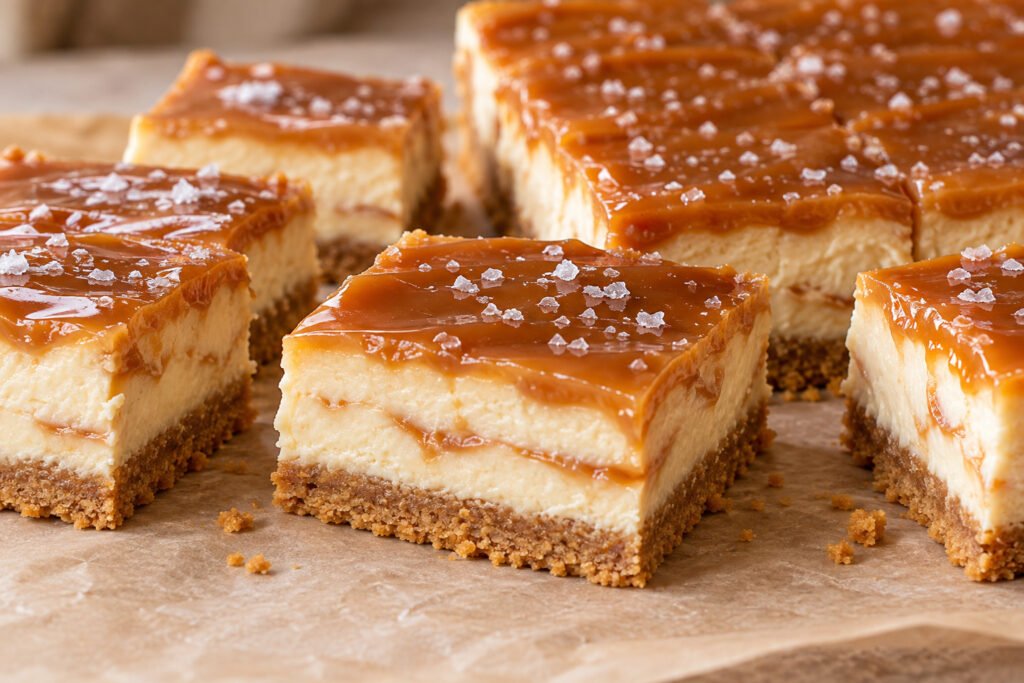
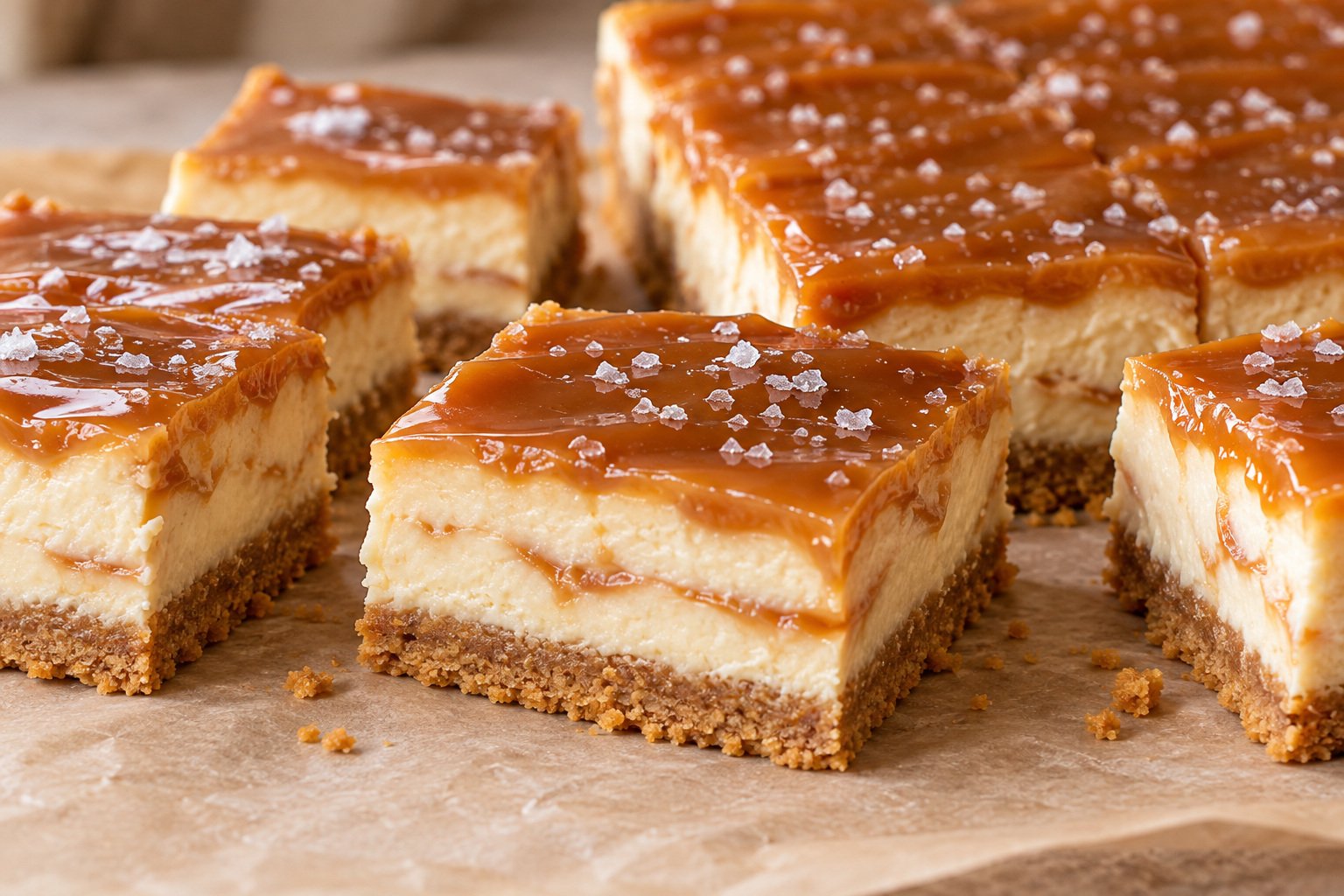
Cool, velvety filling, buttery graham crumbs, and glossy caramel give these salted caramel no-bake cheesecake bars a lush contrast without making them cloying. The cheesecake layer holds a clean edge when sliced but softens pleasantly on the tongue, while fine sea salt sharpens the browned-sugar flavor. A few flakes of salt on top keep the caramel from tasting like one long sugar note.
I use full-fat block cream cheese for structure, whipped cream for lightness, and powdered gelatin for a reliable refrigerator set. The important cues are practical: the caramel must cool until fluid but not hot, the cream should reach medium peaks, and the assembled cheesecake needs at least six uninterrupted hours in the refrigerator. When properly set, the center feels firm under light pressure and a chilled test slice keeps defined layers.
Why This Recipe Frickin’ Works
- A 9-inch square pan gives the crust and filling enough depth for substantial bars without requiring an excessively long setting time.
- Full-fat block cream cheese supplies concentrated milk protein and fat, creating a thick base that can support whipped cream and caramel.
- One packet of powdered gelatin stabilizes the filling while preserving a creamy mouthfeel rather than producing a bouncy gel.
- Medium-peak whipped cream adds volume but remains flexible enough to fold into the cream cheese without leaving dry clumps.
- Cooling the caramel before assembly protects the whipped filling, while the six-hour chill allows the gelatin and dairy fat to set completely.
Ingredient Notes for Salted Caramel No-Bake Cheesecake Bars with a Creamy Filling
- Graham cracker crumbs: Finely ground crumbs pack into a cohesive base with fewer loose edges. Digestive biscuit crumbs may be used at the same weight because their dry, crisp texture performs a similar structural role.
- Unsalted butter: Melted butter coats the crumbs and firms as the crust chills. Dividing the butter between the crust and caramel keeps the salt level under direct control.
- Full-fat block cream cheese: Brick-style cream cheese has less free moisture than spreadable tubs. Bring it to cool room temperature so it blends smoothly without needing excessive beating.
- Heavy whipping cream: Cold cream traps air more effectively. One portion is whipped for the filling, while a smaller portion is warmed before it enters the hot caramel.
- Powdered gelatin: Gelatin provides the setting strength required for clean bars. Bloom it fully in cold water, then melt it gently because boiling can weaken its performance.
- Confectioners' sugar: The fine particles dissolve readily in the cream cheese and help thicken the filling without leaving a gritty texture.
- Granulated sugar and sea salt: Granulated sugar forms the caramel, and fine sea salt disperses evenly through it. Flaky salt is reserved for the surface, where its intermittent crunch is noticeable.
A Few Good Things to Know
- Use cream cheese that yields slightly when pressed but does not feel warm or oily. Cold cream cheese stays lumpy, while overheated cream cheese makes the filling unnecessarily loose.
- Watch the caramel rather than relying only on time. Pale amber tastes mostly sweet, while very dark brown caramel can become bitter before the cream is added.
- If the dissolved gelatin begins to thicken before incorporation, warm it for about 5 seconds. Pouring rubbery gelatin into the filling creates firm threads that cannot be mixed smooth.
- Reserve a level refrigerator shelf before assembly. A tilted pan produces uneven bars, and repeated movement interrupts the filling while it is developing its set.
- For sharp portions, chill the caramel-topped slab before cutting and dry the warmed knife every time. Water left on the blade can streak the creamy filling.
Ingredients for Salted Caramel No-Bake Cheesecake Bars
- 250 g finely ground graham cracker crumbs (about 2 1/2 cups)
- 100 g unsalted butter (melted, for the crust)
- 25 g light brown sugar (packed)
- 150 g granulated sugar (for the caramel)
- 45 ml water (for the caramel)
- 90 ml heavy whipping cream (warmed, for the caramel)
- 42 g unsalted butter (cut into pieces, for the caramel)
- 3 g fine sea salt (about 1/2 teaspoon)
- 45 ml cold water (for blooming the gelatin)
- 7 g unflavored powdered gelatin (1 standard packet)
- 680 g full-fat block cream cheese (softened to cool room temperature)
- 120 g confectioners' sugar (sifted)
- 10 ml vanilla extract (2 teaspoons)
- 300 ml heavy whipping cream (cold, for the filling)
- 1 g flaky sea salt (for finishing)
How to Make Salted Caramel No-Bake Cheesecake Bars
- STEP 1). Make and cool the salted caramel Place the granulated sugar and 45 ml water in a medium heavy-bottomed saucepan, stirring only until evenly moistened. Cook over medium heat for 8 to 12 minutes without stirring, swirling the pan gently once the edges color. When the syrup is a deep amber and smells toasted, remove it from the heat. Carefully whisk in the warm cream, followed by the 42 g butter and fine sea salt. Transfer to a heatproof jug and cool for 35 to 45 minutes, until fluid and no longer warm.
- STEP 2). Line the pan and compact the crust Line a 9-inch square metal pan with two crossing strips of parchment, leaving enough overhang to lift the cheesecake later. Combine the graham cracker crumbs, melted 100 g butter, and brown sugar in a bowl until every crumb looks evenly damp and the mixture holds when squeezed. Tip it into the pan and press it into a level, tightly compacted layer using the flat bottom of a measuring cup. Refrigerate the crust for at least 20 minutes while preparing the filling.
- STEP 3). Bloom and dissolve the gelatin Pour the 45 ml cold water into a small microwave-safe bowl and sprinkle the powdered gelatin evenly over the surface rather than dumping it in one spot. Leave it undisturbed for 5 minutes, until the granules absorb the water and form a thick, wrinkled gel. Heat in 5-second microwave intervals, swirling between each, just until completely liquid and clear. Do not let it boil. Set it aside briefly while mixing the cream cheese, but use it while still fluid.
- STEP 4). Mix the cream cheese base and incorporate the gelatin Beat the softened cream cheese, sifted confectioners' sugar, and vanilla in a large bowl with a paddle attachment or hand mixer on medium-low speed for 2 to 3 minutes. Stop and scrape the bowl twice, mixing until smooth with no visible cream cheese lumps. Stir 2 tablespoons of this mixture into the liquid gelatin to equalize their temperatures, then stream the gelatin mixture back into the bowl on low speed. Mix for 30 seconds, scraping thoroughly so no gelatin settles along the bottom.
- STEP 5). Whip and fold the cream into the filling In a clean chilled bowl, whip the cold 300 ml heavy cream on medium speed for 2 to 4 minutes, until it forms medium peaks that stand with slightly curved tips. Avoid stiff, grainy peaks because they are difficult to fold evenly. Fold one-third of the whipped cream into the cream cheese base with a flexible spatula to lighten it. Add the remainder in two portions, folding from the bottom upward until the filling is uniform, airy, and free from white streaks.
- STEP 6). Layer the filling and caramel Spread half of the cheesecake filling over the chilled crust with an offset spatula, pushing it firmly into the corners. Drizzle 80 g of the cooled salted caramel over the filling, keeping it about 1/2 inch from the pan edges. Add the remaining filling in spoonfuls and smooth the surface without stirring deeply into the caramel layer. Tap the pan gently on the counter two or three times to release large air pockets, then cover without allowing the wrap to touch the filling.
- STEP 7). Chill until fully set and add the topping Refrigerate the covered pan on a level shelf for at least 6 hours, preferably overnight. The cheesecake is set when the center feels firm under gentle fingertip pressure, the surface does not ripple as the pan moves, and a small chilled corner cut holds a clean vertical edge. Stir the remaining caramel until spreadable, warming it for only a few seconds if necessary. Spread it over the cold cheesecake, sprinkle with flaky sea salt, and chill for 20 minutes to firm the topping.
- STEP 8). Lift, portion, and serve the bars Run a thin knife along any uncovered pan edges, then use the parchment overhang to lift the cold cheesecake onto a cutting board. For 16 even bars, mark four rows in each direction before cutting. Warm a large chef's knife under hot water, wipe it completely dry, and press straight down through each portion. Clean and rewarm the blade between cuts to preserve the distinct crust, filling, and caramel layers. Serve cool, allowing 5 minutes at room temperature for the creamiest texture.
Storage and Freezing
- Refrigeration: Store the bars in a single layer in a tightly covered container for up to 4 days. Keep them cold until shortly before serving because the filling softens as it warms.
- Freezing: Freeze undecorated or fully assembled bars on a parchment-lined tray until firm, then wrap each bar and place it in an airtight container for up to 1 month.
- Thawing: Unwrap the frozen bars and thaw them in a covered container in the refrigerator overnight.
- Thawing at room temperature can cause condensation and soften the crust.
- Serving: For the creamiest texture with defined layers, serve the bars about 5 minutes after removing them from the refrigerator.
Frequently Asked Questions
How long do salted caramel no-bake cheesecake bars need to chill?
The assembled cheesecake requires at least 6 hours in the refrigerator, and an overnight chill is convenient when the bars are needed for an event. The gelatin must hydrate and the dairy fat must become fully firm throughout the center, not just around the pan edges.
After spreading on the remaining caramel, chill the slab for another 20 minutes. This short final chill keeps the topping from dragging into the filling when the bars are cut.
How can you tell when no-bake cheesecake bars are set?
A properly set slab looks level and matte, does not ripple when the pan is moved gently, and feels firm under light fingertip pressure at the center. The edges alone are not a reliable guide because they become cold before the middle.
For additional confirmation, cut a narrow piece from one corner with a clean knife. The filling should retain a vertical edge without flowing, although its texture should still look creamy rather than rubbery.
Why did my no-bake cheesecake filling turn lumpy?
Cream cheese that is too cold commonly leaves small lumps because its firm fat does not blend readily with the sugar. Gelatin can create firmer strands if it cools and starts setting before it is dispersed through the base.
Use softened block cream cheese and scrape the bowl during mixing. Temper the melted gelatin with a little cream cheese mixture before streaming it into the main bowl, then fold in the whipped cream only after the base is smooth.
What ingredient substitutions work in salted caramel no-bake cheesecake bars?
Digestive biscuit crumbs may replace the graham cracker crumbs at the same weight because both are dry, crisp biscuits that bind with melted butter. Full-fat block cream cheese should remain unchanged because spreadable or reduced-fat products contain more moisture and may weaken the set.
This formula depends on powdered gelatin for its structure, so it should not be exchanged measure for measure with sheet gelatin, agar, or starch. Those ingredients hydrate and set differently and require reformulation.
Why is the salted caramel too firm or too runny for topping?
Caramel thickens significantly as it cools, so refrigerator-cold sauce may be too firm to spread and warm sauce may flow over the sides. The ideal consistency is fluid enough to move under an offset spatula but cool enough that it does not soften the cheesecake.
Warm firm caramel in very short intervals and stir before reassessing it. If it is still warm after preparation, leave it at room temperature until it flows slowly from a spoon before using it in or on the filling.
More Ridiculously Delicious Desserts to Try
- Caramel Apple Cheesecake with Creamy Filling
- Strawberry No-Bake Cheesecake Bars with a Creamy Berry Layer
- Blueberry Lemon No-Bake Cheesecake Bars with a Creamy Filling
- Pistachio No-Bake Cheesecake Bars with a Nutty Cookie Crust
- Lemon No-Bake Cheesecake Bars with Tangy Citrus Filling
Salted Caramel No-Bake Cheesecake Bars with a Creamy Filling
Ingredients
Equipment
Method
- Place the granulated sugar and 45 ml water in a medium heavy-bottomed saucepan, stirring only until evenly moistened. Cook over medium heat for 8 to 12 minutes without stirring, swirling the pan gently once the edges color. When the syrup is a deep amber and smells toasted, remove it from the heat. Carefully whisk in the warm cream, followed by the 42 g butter and fine sea salt. Transfer to a heatproof jug and cool for 35 to 45 minutes, until fluid and no longer warm.
- Line a 9-inch square metal pan with two crossing strips of parchment, leaving enough overhang to lift the cheesecake later. Combine the graham cracker crumbs, melted 100 g butter, and brown sugar in a bowl until every crumb looks evenly damp and the mixture holds when squeezed. Tip it into the pan and press it into a level, tightly compacted layer using the flat bottom of a measuring cup. Refrigerate the crust for at least 20 minutes while preparing the filling.
- Pour the 45 ml cold water into a small microwave-safe bowl and sprinkle the powdered gelatin evenly over the surface rather than dumping it in one spot. Leave it undisturbed for 5 minutes, until the granules absorb the water and form a thick, wrinkled gel. Heat in 5-second microwave intervals, swirling between each, just until completely liquid and clear. Do not let it boil. Set it aside briefly while mixing the cream cheese, but use it while still fluid.
- Beat the softened cream cheese, sifted confectioners' sugar, and vanilla in a large bowl with a paddle attachment or hand mixer on medium-low speed for 2 to 3 minutes. Stop and scrape the bowl twice, mixing until smooth with no visible cream cheese lumps. Stir 2 tablespoons of this mixture into the liquid gelatin to equalize their temperatures, then stream the gelatin mixture back into the bowl on low speed. Mix for 30 seconds, scraping thoroughly so no gelatin settles along the bottom.
- In a clean chilled bowl, whip the cold 300 ml heavy cream on medium speed for 2 to 4 minutes, until it forms medium peaks that stand with slightly curved tips. Avoid stiff, grainy peaks because they are difficult to fold evenly. Fold one-third of the whipped cream into the cream cheese base with a flexible spatula to lighten it. Add the remainder in two portions, folding from the bottom upward until the filling is uniform, airy, and free from white streaks.
- Spread half of the cheesecake filling over the chilled crust with an offset spatula, pushing it firmly into the corners. Drizzle 80 g of the cooled salted caramel over the filling, keeping it about 1/2 inch from the pan edges. Add the remaining filling in spoonfuls and smooth the surface without stirring deeply into the caramel layer. Tap the pan gently on the counter two or three times to release large air pockets, then cover without allowing the wrap to touch the filling.
- Refrigerate the covered pan on a level shelf for at least 6 hours, preferably overnight. The cheesecake is set when the center feels firm under gentle fingertip pressure, the surface does not ripple as the pan moves, and a small chilled corner cut holds a clean vertical edge. Stir the remaining caramel until spreadable, warming it for only a few seconds if necessary. Spread it over the cold cheesecake, sprinkle with flaky sea salt, and chill for 20 minutes to firm the topping.
- Run a thin knife along any uncovered pan edges, then use the parchment overhang to lift the cold cheesecake onto a cutting board. For 16 even bars, mark four rows in each direction before cutting. Warm a large chef's knife under hot water, wipe it completely dry, and press straight down through each portion. Clean and rewarm the blade between cuts to preserve the distinct crust, filling, and caramel layers. Serve cool, allowing 5 minutes at room temperature for the creamiest texture.
Notes
- Use cream cheese that yields slightly when pressed but does not feel warm or oily. Cold cream cheese stays lumpy, while overheated cream cheese makes the filling unnecessarily loose.
- Watch the caramel rather than relying only on time. Pale amber tastes mostly sweet, while very dark brown caramel can become bitter before the cream is added.
- If the dissolved gelatin begins to thicken before incorporation, warm it for about 5 seconds. Pouring rubbery gelatin into the filling creates firm threads that cannot be mixed smooth.
- Reserve a level refrigerator shelf before assembly. A tilted pan produces uneven bars, and repeated movement interrupts the filling while it is developing its set.
- For sharp portions, chill the caramel-topped slab before cutting and dry the warmed knife every time. Water left on the blade can streak the creamy filling.