Table of Contents
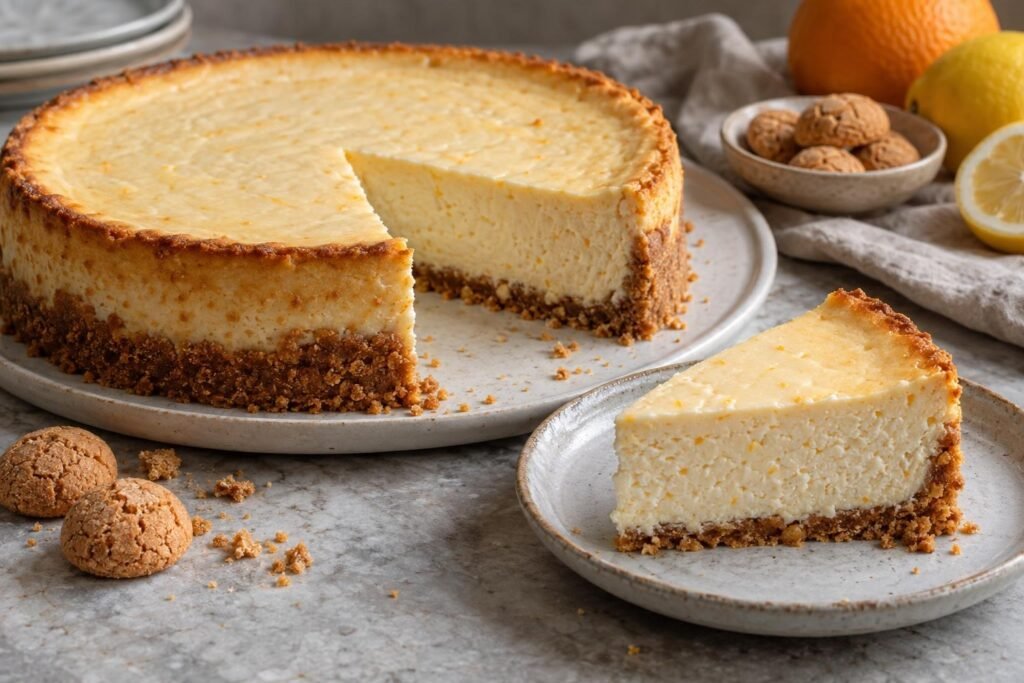
A golden amaretti crust, delicate citrus aroma, and dense yet creamy filling give this ricotta cheesecake its distinctly Italian character. Whole-milk ricotta keeps the flavor milky and slightly tangy, while cream cheese supplies enough fat and structure for clean slices without burying the ricotta under a heavy New York-style texture.
I smooth the ricotta before mixing it with softened cream cheese, then keep the mixer on low once the eggs enter. That limits excess air, which can inflate the cheesecake and encourage cracking as it cools. The baked center should wobble as one cohesive section rather than ripple like liquid, followed by gradual oven cooling and at least eight hours of chilling for a properly set filling.

What Makes this Cheesecake So Ridiculously Good
- A three-to-two ratio of ricotta to cream cheese preserves the ricotta’s fresh dairy flavor while providing enough fat and emulsifiers for a smooth, sliceable filling.
- Processing the drained ricotta before mixing breaks down its larger curds without requiring prolonged beating after the eggs are added.
- Cornstarch binds some of the ricotta’s remaining moisture, helping the cheesecake set cleanly without becoming firm or floury.
- Low-speed mixing and a moderate 325°F oven limit incorporated air and sudden expansion, two common causes of puffing, sinking, and cracking.
- A hot water bath, gradual oven cooling, and an eight-hour chill manage temperature changes while giving the egg proteins and dairy fats time to form a stable, creamy set.
Ingredient Notes for Creamy Ricotta Cheesecake
- Whole-milk ricotta: Use thick, full-fat ricotta rather than a watery or reduced-fat style. Draining removes loose whey that could make the center weep or require excessive baking.
- Full-fat brick cream cheese: Brick-style cream cheese contributes fat, body, and emulsifiers. Bring it to 65 to 70°F so it blends smoothly with the ricotta without stubborn lumps.
- Amaretti cookies: Crisp amaretti cookies make a fragrant almond crust that distinguishes this cheesecake from a standard graham-cracker version. Grind them finely so the crust compacts without large gaps.
- Eggs and egg yolk: Whole eggs set the filling, while the additional yolk enriches its texture. Room-temperature eggs combine faster, reducing the amount of mixing needed.
- Cornstarch: This small quantity controls free moisture from the ricotta and improves slicing. Whisking it into the sugar disperses it evenly and prevents chalky pockets.
- Lemon and orange: Finely grated zest perfumes the dairy filling without thinning it. Lemon juice adds restrained acidity, so measure it rather than squeezing directly over the bowl.
- Sour cream: Full-fat sour cream loosens the blended cheeses and adds gentle tang while preserving a rich, cohesive texture. Bring it to room temperature before mixing.
My Baking Tips
- Measure ricotta after purchasing the full 24-ounce amount, then drain it as directed. If visible whey continues collecting after 30 minutes, allow another 10 to 15 minutes rather than compensating with extra cornstarch.
- Avoid high mixer speed, especially after adding the eggs. A foamy batter can rise above the pan’s rim, crack during cooling, or leave an oddly airy layer near the surface.
- Pour boiling water into the roasting pan only after it is on the oven rack. This reduces splashing, protects the crust from leaks, and makes the heavy setup safer to handle.
- Judge doneness by the combination of a set perimeter, cohesive center wobble, and a 150 to 155°F internal temperature. A center that sloshes, ripples, or looks wet requires additional baking in 5-minute intervals.
- Plan the serving schedule backward. The cheesecake needs two hours of gradual cooling plus at least eight hours of refrigeration, so baking it the day before serving gives the filling enough time to firm for clean slices.
Ingredients for Creamy Ricotta Cheesecake
- 180 g (about 2 cups) crisp amaretti cookie crumbs (Ground finely in a food processor)
- 85 g (6 tablespoons) unsalted butter (Melted and cooled slightly)
- 1/8 teaspoon fine sea salt (For the crust)
- 680 g (24 ounces) whole-milk ricotta (Drained in a fine-mesh strainer for 30 minutes)
- 454 g (16 ounces) full-fat brick cream cheese (Softened to 65 to 70°F and cut into pieces)
- 250 g (1 1/4 cups) granulated sugar (Divided as directed)
- 16 g (2 tablespoons) cornstarch (Leveled)
- 1/4 teaspoon fine sea salt (For the filling)
- 4 large eggs (At room temperature)
- 1 large egg yolk (At room temperature)
- 120 g (1/2 cup) full-fat sour cream (At room temperature)
- 2 teaspoons pure vanilla extract
- 2 teaspoons finely grated lemon zest (From about 1 medium lemon)
- 1 teaspoon finely grated orange zest (From about 1/2 medium orange)
- 1 tablespoon fresh lemon juice (Strained to remove seeds and pulp)
How to Make Creamy Ricotta Cheesecake
- STEP 1). Drain the ricotta and temper the dairy Set a fine-mesh strainer over a bowl, add the ricotta, and let it drain for 30 minutes while the cream cheese, eggs, yolk, and sour cream approach room temperature. Gently stir the ricotta once, but do not press it through the mesh. Discard the collected whey. Properly drained ricotta should look thick and spoonable rather than surrounded by liquid, while the cream cheese should yield easily when pressed without feeling warm or oily.
- STEP 2). Prepare the oven, pan, and water bath Position a rack in the lower-middle third of the oven and heat it to 350°F. Lightly grease a 9-inch springform pan, then wrap its base and sides with three wide layers of heavy-duty foil, keeping the seams above the anticipated water line. Set the wrapped pan inside a large roasting pan. Bring about 6 cups of water to a boil and reserve it for baking; do not add it to the roasting pan yet.
- STEP 3). Mix and bake the amaretti crust Combine the finely ground amaretti crumbs, melted butter, and 1/8 teaspoon salt in a bowl until every crumb is evenly moistened. Press the mixture firmly across the springform base and about 1 inch up the sides, using a flat-bottomed measuring cup to eliminate loose pockets. Bake at 350°F for 10 minutes, until fragrant and slightly darker at the edges. Transfer the pan to a rack, reduce the oven to 325°F, and cool the crust while preparing the filling.
- STEP 4). Smooth the ricotta and build the cheese base Place the drained ricotta and 50 g of the measured sugar in a food processor. Process for 45 to 60 seconds, scraping once, until the curds are substantially smoother but the mixture is not foamy. In a stand mixer fitted with the paddle, beat the softened cream cheese on low for 60 seconds. Add the ricotta mixture and mix on low just until uniform, stopping to scrape the bowl and paddle so no firm cream cheese remains at the bottom.
- STEP 5). Finish the filling at low speed Whisk the remaining 200 g sugar with the cornstarch and 1/4 teaspoon salt, then add it to the cheese mixture in three additions on low speed. Mix in the sour cream, vanilla, lemon zest, orange zest, and lemon juice until combined. Add the eggs one at a time, followed by the yolk, mixing only until each yellow streak disappears. Scrape the bowl thoroughly and fold the batter twice by hand; it should be smooth, thick, and pourable, not whipped or frothy.
- STEP 6). Fill the pan and bake in the water bath Pour the filling over the cooled crust and smooth the surface with a spatula. Tap the pan gently on the counter two or three times to release large air pockets. Place the roasting pan in the 325°F oven, then carefully pour in enough boiling water to reach about 1 inch up the springform pan. Bake for 75 to 90 minutes, until the outer 2 1/2 inches are set and the center wobbles together without a liquid ripple. An instant-read thermometer inserted near the center should register 150 to 155°F.
- STEP 7). Cool the cheesecake gradually Turn off the oven, prop the door open about 2 inches with a wooden spoon, and leave the cheesecake in its water bath for 60 minutes. Remove the roasting pan carefully, lift out the springform pan, and discard the foil, watching for trapped hot water. Run a thin knife around the upper edge to release any filling attached to the pan. Set the cheesecake on a wire rack for another 60 minutes, until the pan feels only slightly warm before refrigeration.
- STEP 8). Chill, unmold, and slice cleanly Cover the cooled pan without touching the cheesecake’s surface and refrigerate it for at least 8 hours, preferably overnight. To unmold, release the springform latch and lift away the ring; leave the cheesecake on its base for safer handling. For neat servings, dip a thin-bladed knife in hot water, wipe it dry, and cut straight down through the chilled filling and crust. Clean and rewarm the blade between slices, then let portions stand for 15 minutes before serving.
Storage and Freezing
- Refrigeration: Cover the cheesecake or place slices in an airtight container and refrigerate for up to 4 days. Keep it cold except during slicing and serving.
- Freezing: Freeze the fully chilled cheesecake whole or in individual slices for up to 1 month. Wrap it tightly in plastic wrap, followed by foil, and place slices in an airtight container to prevent freezer odors.
- Thawing: Unwrap the foil but leave the plastic in place, then thaw in the refrigerator overnight. Remove the plastic after thawing so condensation does not drip onto the surface.
- Serving: For the creamiest texture, let refrigerated slices stand at room temperature for about 15 minutes. Do not leave the cheesecake unrefrigerated for more than 2 hours.
Frequently Asked Questions
How can you tell when ricotta cheesecake is done?
The outer 2 1/2 inches should appear set and slightly puffed, while the center should wobble as one cohesive section when the pan is nudged. It should not slosh, form liquid waves, or show a glossy pool of uncooked batter.
For an additional check, insert an instant-read thermometer near the center without touching the crust. A reading of 150 to 155°F indicates that the filling has set sufficiently and will continue firming during gradual cooling.
Why did my ricotta cheesecake turn grainy?
Graininess can come from coarse ricotta curds, cold cream cheese, or overbaked egg proteins. Drain and process the ricotta as directed, and soften brick cream cheese to 65 to 70°F so the two cheeses blend without prolonged beating.
Remove the cheesecake while its center still has a controlled wobble. Baking until the entire surface feels rigid drives out moisture and tightens the proteins, creating a dry or curdled mouthfeel after chilling.
How long should ricotta cheesecake chill before slicing?
A minimum of eight hours in the refrigerator gives the filling enough time to cool completely and develop a stable slice. The cheesecake may seem set after a few hours, but its center can still be soft enough to drag beneath the knife.
Overnight chilling is the most practical serving schedule. Bake it the previous day, complete the gradual two-hour cooling process, refrigerate overnight, and slice shortly before serving.
What causes a baked ricotta cheesecake to crack?
Cracks usually follow excess aeration, overbaking, or abrupt temperature changes. Keep the mixer on low once the eggs enter, bake in the hot water bath, and stop when the perimeter is set but the center still wobbles cohesively.
The one-hour rest in the turned-off oven allows the filling to contract gradually. Running a thin knife around the upper edge afterward also prevents the cheesecake from pulling against the pan as it continues cooling.
Can I make ricotta cheesecake without a water bath?
This formula is designed for the gentle, humid heat of a water bath. Omitting it would expose the edges to stronger heat before the center sets, increasing the likelihood of a dry perimeter, excessive browning, or surface cracks.
Wrap the springform pan securely in heavy-duty foil and add boiling water only after the roasting pan reaches the oven rack. That method provides controlled heat while minimizing splashing and leakage.
More Ridiculously Delicious Cheesecakes
- Strawberry Cheesecake with a Creamy Filling
- Cranberry Cheesecake with a Smooth Cheesecake Filling
- Pumpkin Cheesecake with Gingersnap Crust and a Smooth Filling
- Caramel Apple Cheesecake with Creamy Filling
- Eggnog Cheesecake with a Smooth Cheesecake Filling
Creamy Ricotta Cheesecake
Ingredients
Equipment
Method
- Set a fine-mesh strainer over a bowl, add the ricotta, and let it drain for 30 minutes while the cream cheese, eggs, yolk, and sour cream approach room temperature. Gently stir the ricotta once, but do not press it through the mesh. Discard the collected whey. Properly drained ricotta should look thick and spoonable rather than surrounded by liquid, while the cream cheese should yield easily when pressed without feeling warm or oily.
- Position a rack in the lower-middle third of the oven and heat it to 350°F. Lightly grease a 9-inch springform pan, then wrap its base and sides with three wide layers of heavy-duty foil, keeping the seams above the anticipated water line. Set the wrapped pan inside a large roasting pan. Bring about 6 cups of water to a boil and reserve it for baking; do not add it to the roasting pan yet.
- Combine the finely ground amaretti crumbs, melted butter, and 1/8 teaspoon salt in a bowl until every crumb is evenly moistened. Press the mixture firmly across the springform base and about 1 inch up the sides, using a flat-bottomed measuring cup to eliminate loose pockets. Bake at 350°F for 10 minutes, until fragrant and slightly darker at the edges. Transfer the pan to a rack, reduce the oven to 325°F, and cool the crust while preparing the filling.
- Place the drained ricotta and 50 g of the measured sugar in a food processor. Process for 45 to 60 seconds, scraping once, until the curds are substantially smoother but the mixture is not foamy. In a stand mixer fitted with the paddle, beat the softened cream cheese on low for 60 seconds. Add the ricotta mixture and mix on low just until uniform, stopping to scrape the bowl and paddle so no firm cream cheese remains at the bottom.
- Whisk the remaining 200 g sugar with the cornstarch and 1/4 teaspoon salt, then add it to the cheese mixture in three additions on low speed. Mix in the sour cream, vanilla, lemon zest, orange zest, and lemon juice until combined. Add the eggs one at a time, followed by the yolk, mixing only until each yellow streak disappears. Scrape the bowl thoroughly and fold the batter twice by hand; it should be smooth, thick, and pourable, not whipped or frothy.
- Pour the filling over the cooled crust and smooth the surface with a spatula. Tap the pan gently on the counter two or three times to release large air pockets. Place the roasting pan in the 325°F oven, then carefully pour in enough boiling water to reach about 1 inch up the springform pan. Bake for 75 to 90 minutes, until the outer 2 1/2 inches are set and the center wobbles together without a liquid ripple. An instant-read thermometer inserted near the center should register 150 to 155°F.
- Turn off the oven, prop the door open about 2 inches with a wooden spoon, and leave the cheesecake in its water bath for 60 minutes. Remove the roasting pan carefully, lift out the springform pan, and discard the foil, watching for trapped hot water. Run a thin knife around the upper edge to release any filling attached to the pan. Set the cheesecake on a wire rack for another 60 minutes, until the pan feels only slightly warm before refrigeration.
- Cover the cooled pan without touching the cheesecake’s surface and refrigerate it for at least 8 hours, preferably overnight. To unmold, release the springform latch and lift away the ring; leave the cheesecake on its base for safer handling. For neat servings, dip a thin-bladed knife in hot water, wipe it dry, and cut straight down through the chilled filling and crust. Clean and rewarm the blade between slices, then let portions stand for 15 minutes before serving.
Notes
- Measure ricotta after purchasing the full 24-ounce amount, then drain it as directed. If visible whey continues collecting after 30 minutes, allow another 10 to 15 minutes rather than compensating with extra cornstarch.
- Avoid high mixer speed, especially after adding the eggs. A foamy batter can rise above the pan’s rim, crack during cooling, or leave an oddly airy layer near the surface.
- Pour boiling water into the roasting pan only after it is on the oven rack. This reduces splashing, protects the crust from leaks, and makes the heavy setup safer to handle.
- Judge doneness by the combination of a set perimeter, cohesive center wobble, and a 150 to 155°F internal temperature. A center that sloshes, ripples, or looks wet requires additional baking in 5-minute intervals.
- Plan the serving schedule backward. The cheesecake needs two hours of gradual cooling plus at least eight hours of refrigeration, so baking it the day before serving gives the filling enough time to firm for clean slices.