Table of Contents
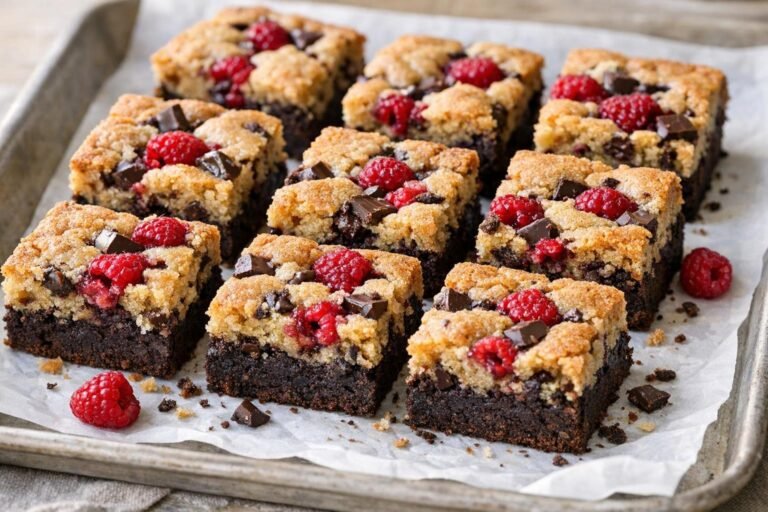
Glossy pockets of melted chocolate, golden cookie ridges, and a dark, fudgy base give these brookies their proper split personality. The brownie layer stays dense and moist, while the chocolate chip cookie layer develops crisp edges and a chewy center. Every square delivers cocoa depth, caramel notes from brown sugar, and enough textural contrast to keep this mashup from feeling like an indecisive tray bake.
I use melted butter and chocolate in the brownie batter for density, then make a thicker cookie dough that can sit on top without sinking. Leaving narrow gaps between pieces of cookie dough exposes the brownie, helping steam escape and giving you an accurate place to check doneness. The brookies are ready when the cookie dough looks set and lightly golden while a tester in an exposed central brownie section collects moist crumbs, not shiny batter.

Why These Cookies Turn Out So Good
- The 9 x 13-inch metal pan gives both layers enough surface area to bake through before the edges become dry or overly firm.
- Melted chocolate and cocoa powder give the brownie layer concentrated flavor and a fudgy structure without relying on an underbaked center.
- Cornstarch softens the cookie dough, while one egg plus one yolk supplies enough protein and emulsifying power to keep the top chewy rather than cakey.
- Briefly chilling the cookie dough reduces spreading, so it remains a distinct top layer instead of dissolving into the brownie batter.
- Small gaps in the cookie topping promote even heat flow and create exposed brownie areas where doneness can be checked without confusing melted chocolate chips with raw batter.
Ingredient Notes for Brookies with Brownie and Cookie Layers
- Unsalted butter: Butter appears in both layers, providing flavor and controlling tenderness. Melt the brownie portion with the chocolate, but soften the cookie portion until pliable and cool, not greasy or partially melted.
- Dark chocolate: Chopped semisweet or bittersweet chocolate adds cocoa butter and dissolved cocoa solids, which create a denser, smoother brownie than cocoa alone. Use chocolate containing roughly 55 to 70 percent cacao.
- Unsweetened cocoa powder: Cocoa intensifies the brownie flavor and absorbs moisture. Natural or Dutch-process cocoa works here because the brownie layer does not depend on baking soda for its structure.
- Granulated and brown sugars: Granulated sugar supports the brownie crust and crisp cookie edges. Light brown sugar holds extra moisture in the cookie layer and contributes caramel flavor through its molasses.
- Eggs and egg yolk: Room-temperature eggs blend more readily into the brownie emulsion. The extra yolk in the cookie dough increases richness and chew without adding the excess water found in another whole egg.
- All-purpose flour: Weigh the flour when possible and mix only until the dry streaks disappear. Too much flour or prolonged mixing makes the brownie firm and the cookie topping bready.
- Cornstarch: A small amount limits gluten development in the cookie dough and helps the topping remain tender. It is part of the texture balance and should not be omitted without expecting a firmer cookie layer.
- Chocolate chips: Semisweet chips keep their shape and make the two layers visually distinct. Bittersweet chips can be used at the same weight for a less sweet finish.
A Few Good Things to Know
- Use a light-colored metal pan. Dark pans can brown the cookie edges before the central brownie is set, while glass heats and cools more slowly and may extend the baking schedule.
- Keep the cookie butter softened but cool. If it looks glossy or leaves an oily film in the bowl, chill it briefly before mixing so the topping does not spread into a thin, hard sheet.
- Flatten the cookie dough into pieces of similar thickness. Large mounds remain doughy after the exposed brownie is done, while very thin pieces become crisp before the center sets.
- Check the brownie through an exposed channel rather than through a cookie patch. Melted chocolate on a toothpick can resemble wet batter, but raw batter looks glossy and fluid rather than crumbly.
- For especially tidy squares, cool the slab fully, refrigerate it for 20 to 30 minutes, and then slice with a warm, dry knife. Let the cut bars return to room temperature before serving.
Ingredients for Brookies
- 170 g (3/4 cup) unsalted butter (For the brownie layer, cut into pieces)
- 113 g (4 oz) semisweet or bittersweet chocolate (For the brownie layer, finely chopped)
- 250 g (1 1/4 cups) granulated sugar (For the brownie layer)
- 2 large eggs (For the brownie layer, at room temperature)
- 2 tsp pure vanilla extract (For the brownie layer)
- 65 g (3/4 cup) unsweetened cocoa powder (Natural or Dutch-process, sifted)
- 95 g (3/4 cup) all-purpose flour (For the brownie layer)
- 1/2 tsp fine sea salt (For the brownie layer)
- 170 g (3/4 cup) unsalted butter (For the cookie layer, softened to about 18 to 20°C)
- 150 g (3/4 cup packed) light brown sugar (For the cookie layer)
- 75 g (6 tbsp) granulated sugar (For the cookie layer)
- 1 large egg (For the cookie layer, at room temperature)
- 1 large egg yolk (For the cookie layer, at room temperature)
- 2 tsp pure vanilla extract (For the cookie layer)
- 220 g (1 3/4 cups) all-purpose flour (For the cookie layer)
- 8 g (1 tbsp) cornstarch (For the cookie layer)
- 1/2 tsp baking soda (For the cookie layer)
- 1/2 tsp fine sea salt (For the cookie layer)
- 170 g (1 cup) semisweet chocolate chips (For the cookie layer)
How to Make Brookies
- STEP 1). Prepare the pan and preheat the oven Position a rack in the center of the oven and preheat to 175°C or 350°F. Lightly grease a 9 x 13-inch light-colored metal pan, then line the bottom and long sides with parchment, leaving enough overhang to lift the slab later. Grease the exposed short sides. A metal pan conducts heat more predictably than glass, which helps the central brownie set before the perimeter becomes hard.
- STEP 2). Mix and chill the cookie dough In a large bowl, beat the softened cookie-layer butter, brown sugar, and granulated sugar with a hand mixer on medium speed for 2 minutes, until creamy and slightly aerated but not fluffy. Beat in the egg, yolk, and vanilla until smooth. Whisk the flour, cornstarch, baking soda, and salt separately, then mix them into the butter mixture on low just until no dry flour remains. Fold in the chocolate chips and refrigerate the dough for 15 minutes.
- STEP 3). Melt the brownie chocolate and butter Place the brownie-layer butter and chopped chocolate in a medium heatproof bowl. Set it over a saucepan containing about 2.5 cm or 1 inch of barely simmering water, keeping the bowl above the water. Stir until approximately three-quarters melted, then remove from the heat and continue stirring until completely smooth. Let the mixture stand for 5 minutes. Cooling it briefly prevents the eggs from heating too quickly and helps preserve a stable, glossy batter.
- STEP 4). Finish the brownie batter Whisk the granulated sugar into the warm chocolate mixture. Add the eggs one at a time, whisking vigorously for about 30 seconds after each, then whisk in the vanilla until the batter looks smooth and slightly thickened. Sift the cocoa powder, flour, and salt directly over the bowl. Fold with a flexible spatula, scraping the bottom and sides, just until the final flour streak disappears. The batter should fall from the spatula in thick, glossy ribbons.
- STEP 5). Build the brownie and cookie layers Scrape the brownie batter into the prepared pan and spread it into an even layer, taking care to reach the corners. Remove the cookie dough from the refrigerator and flatten portions about the size of a heaped tablespoon into rough 1 cm-thick pieces. Arrange them closely over the batter, leaving narrow channels of brownie visible between the pieces. Do not press the dough into the batter. The exposed spaces allow heat and steam to move through the thicker top layer.
- STEP 6). Bake and check both layers Bake for 32 to 36 minutes, rotating the pan from front to back after about 22 minutes if your oven browns unevenly. The cookie layer should have pale golden centers, deeper golden edges, and a dry, set surface. Insert a toothpick into an exposed brownie area near the center, avoiding chocolate chips. It should emerge with several moist crumbs but no shiny liquid batter. If the cookie top darkens early, loosely cover the pan with foil for the remaining time.
- STEP 7). Cool, lift, and cut cleanly Set the pan on a wire rack and cool the brookies completely in the pan for at least 2 hours. The center continues setting as the melted fats cool, so cutting sooner can produce compressed, messy layers even when fully baked. Run a thin knife along the unlined edges, lift the slab out using the parchment, and place it on a cutting board. Use a long sharp knife to cut 24 bars, wiping the blade clean between cuts for distinct layers.
Storage and Freezing
- Storage: Keep completely cooled brookies in an airtight container at room temperature for up to 3 days. Place parchment between layers to protect the cookie tops.
- Refrigeration: Refrigerate for up to 6 days if the room is warm. Bring the bars to room temperature before serving so the brownie layer regains its softer texture.
- Freezing: Wrap individual bars tightly and freeze them in an airtight container for up to 2 months.
- Thawing: Unwrap and thaw at room temperature for 1 to 2 hours. Briefly warming a thawed bar at 150°C or 300°F for 4 to 5 minutes softens the chocolate without rebaking the center.
Frequently Asked Questions
How do you tell when brookies are done without overbaking the cookie layer?
Look for two separate sets of cues. The cookie dough should be lightly golden around its edges, pale but set in the center, and no longer look wet or glossy on top.
Test an exposed brownie channel near the middle with a toothpick. Moist, dark crumbs are appropriate, but streaks of fluid batter mean the pan needs another 2 to 3 minutes. Avoid testing directly through a chocolate chip.
Why do brookies bake unevenly in the center and around the edges?
The combined layers are thicker and contain different proportions of fat, sugar, flour, and water. Heat reaches the perimeter first, while the insulated center takes longer to set. Oversized cookie dough mounds make that difference more pronounced.
Use a metal 9 x 13-inch pan, keep the topping pieces evenly flattened, and leave narrow brownie channels between them. Rotating the pan once can also correct front-to-back hot spots without repeatedly opening the oven.
What brookies ingredient substitutions work in this recipe?
Bittersweet chocolate can replace semisweet chocolate by weight in both layers, producing a less sweet and more cocoa-forward bar. Either natural or Dutch-process cocoa is suitable because the brownie batter does not use chemical leavening.
Butter, eggs, and cornstarch each control the structure and moisture balance, so direct replacements are not built into this formula. Changing those ingredients may alter spreading, layer definition, and baking time.
Should brookies be refrigerated before cutting?
A full 2-hour cooling period at room temperature is usually sufficient because the butter and chocolate need time to become firm again. Cutting while the slab is warm can drag soft brownie into the cookie layer and make the center appear less baked than it is.
For sharper bakery-style edges, refrigerate the cooled slab for 20 to 30 minutes before slicing. Avoid prolonged chilling before serving because cold brownie crumb tastes firmer and less fudgy.
Can I prepare the brownie and cookie layers ahead of time?
The cookie dough can be covered and refrigerated for up to 24 hours. Let it soften for about 10 minutes if it becomes too firm to flatten, but keep it cool enough to hold its shape.
Prepare the brownie batter shortly before assembly because extended standing allows it to thicken and can make spreading difficult. For the most practical schedule, make the cookie dough first, then mix the brownie while the dough completes its short chill.
Brookies with Brownie and Cookie Layers
Ingredients
Equipment
Method
- Position a rack in the center of the oven and preheat to 175°C or 350°F. Lightly grease a 9 x 13-inch light-colored metal pan, then line the bottom and long sides with parchment, leaving enough overhang to lift the slab later. Grease the exposed short sides. A metal pan conducts heat more predictably than glass, which helps the central brownie set before the perimeter becomes hard.
- In a large bowl, beat the softened cookie-layer butter, brown sugar, and granulated sugar with a hand mixer on medium speed for 2 minutes, until creamy and slightly aerated but not fluffy. Beat in the egg, yolk, and vanilla until smooth. Whisk the flour, cornstarch, baking soda, and salt separately, then mix them into the butter mixture on low just until no dry flour remains. Fold in the chocolate chips and refrigerate the dough for 15 minutes.
- Place the brownie-layer butter and chopped chocolate in a medium heatproof bowl. Set it over a saucepan containing about 2.5 cm or 1 inch of barely simmering water, keeping the bowl above the water. Stir until approximately three-quarters melted, then remove from the heat and continue stirring until completely smooth. Let the mixture stand for 5 minutes. Cooling it briefly prevents the eggs from heating too quickly and helps preserve a stable, glossy batter.
- Whisk the granulated sugar into the warm chocolate mixture. Add the eggs one at a time, whisking vigorously for about 30 seconds after each, then whisk in the vanilla until the batter looks smooth and slightly thickened. Sift the cocoa powder, flour, and salt directly over the bowl. Fold with a flexible spatula, scraping the bottom and sides, just until the final flour streak disappears. The batter should fall from the spatula in thick, glossy ribbons.
- Scrape the brownie batter into the prepared pan and spread it into an even layer, taking care to reach the corners. Remove the cookie dough from the refrigerator and flatten portions about the size of a heaped tablespoon into rough 1 cm-thick pieces. Arrange them closely over the batter, leaving narrow channels of brownie visible between the pieces. Do not press the dough into the batter. The exposed spaces allow heat and steam to move through the thicker top layer.
- Bake for 32 to 36 minutes, rotating the pan from front to back after about 22 minutes if your oven browns unevenly. The cookie layer should have pale golden centers, deeper golden edges, and a dry, set surface. Insert a toothpick into an exposed brownie area near the center, avoiding chocolate chips. It should emerge with several moist crumbs but no shiny liquid batter. If the cookie top darkens early, loosely cover the pan with foil for the remaining time.
- Set the pan on a wire rack and cool the brookies completely in the pan for at least 2 hours. The center continues setting as the melted fats cool, so cutting sooner can produce compressed, messy layers even when fully baked. Run a thin knife along the unlined edges, lift the slab out using the parchment, and place it on a cutting board. Use a long sharp knife to cut 24 bars, wiping the blade clean between cuts for distinct layers.
Notes
- Use a light-colored metal pan. Dark pans can brown the cookie edges before the central brownie is set, while glass heats and cools more slowly and may extend the baking schedule.
- Keep the cookie butter softened but cool. If it looks glossy or leaves an oily film in the bowl, chill it briefly before mixing so the topping does not spread into a thin, hard sheet.
- Flatten the cookie dough into pieces of similar thickness. Large mounds remain doughy after the exposed brownie is done, while very thin pieces become crisp before the center sets.
- For especially tidy squares, cool the slab fully, refrigerate it for 20 to 30 minutes, and then slice with a warm, dry knife. Let the cut bars return to room temperature before serving.