Table of Contents
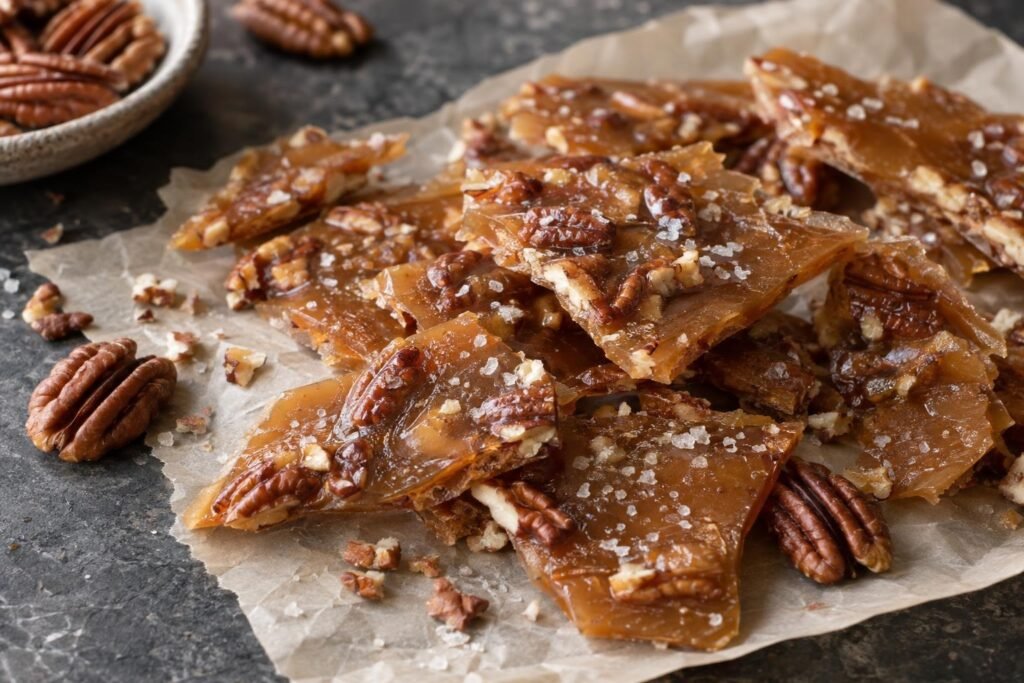
A deep caramel aroma, crisp snap, and buttery roasted-nut finish make this salted toffee with toasted pecans an especially satisfying homemade confection. The pecans bring earthy flavor and crunch, while flaky salt cuts through the rich butter and caramelized sugar without making the candy taste overtly salty.
I cook the butter and sugar steadily to the hard-crack stage, watching both the thermometer and the color rather than relying on time alone. Light corn syrup limits unwanted crystallization, gentle stirring keeps the butter emulsified, and a silicone-lined rimmed pan contains the dangerously hot mixture. Once the surface turns glossy and the bubbles become smaller and slower, the finished temperature confirms that enough water has cooked away for a crisp set.

Why This Recipe Turns Out So Good
- A near-equal ratio of butter to granulated sugar creates classic butter toffee with enough fat for richness and enough concentrated sugar for a firm snap.
- A small amount of light corn syrup interferes with the formation of large sugar crystals, helping the cooked toffee remain smooth rather than grainy.
- Toasting the pecans before assembly removes excess moisture and develops their roasted flavor, so they stay crisp inside the finished candy.
- Cooking to 300 to 305°F reaches the hard-crack stage, where sufficient water has evaporated for the cooled toffee to break cleanly instead of bending or sticking.
- Flaky salt is added after pouring, where it remains perceptible on the surface and balances the caramelized sugar without disrupting the candy syrup.
Ingredient Notes for Salted Toffee with Toasted Pecans for Homemade Candy
- Unsalted butter: Butter supplies milk solids for browned flavor and fat for a tender, buttery bite. Cut it into even pieces so it melts at the same rate as the sugar mixture heats. Unsalted butter allows precise control over the final salt level.
- Granulated sugar: This becomes the structural glass of the candy once it reaches hard-crack temperature. Keep stray sugar crystals off the saucepan walls because they can encourage the entire batch to crystallize.
- Light corn syrup: This invert-sugar-rich syrup helps control crystallization while the toffee boils. Measure it by weight or coat the measuring spoon lightly with neutral oil so the full amount releases.
- Pecans: Toasting drives off moisture and intensifies the nuts' buttery flavor. Cool them briefly before chopping so residual steam does not soften the candy or make the pieces oily.
- Vanilla extract: Vanilla rounds out the browned butter and caramel notes. It contains volatile alcohol and a little water, so it must be stirred in off the heat with care because the toffee will bubble vigorously.
- Baking soda: A small amount aerates the hot syrup and makes the finished candy slightly less dense without turning it foamy. Measure accurately because too much creates an alkaline aftertaste.
- Fine and flaky salt: Fine salt dissolves throughout the candy for balanced seasoning, while flaky salt remains on the surface for distinct savory bursts. Sprinkle the flakes while the toffee is still tacky.
My Tips for the Best Results
- Check the candy thermometer in boiling water before starting. It should read close to 212°F at sea level, although elevation changes the expected boiling point. Account for the observed difference when judging the final candy temperature.
- Use medium heat rather than rushing the boil. Excessive heat can brown the milk solids before enough water evaporates and may cause the butter emulsion to separate.
- Keep all tools completely dry once cooking begins. Even small droplets introduced late in the process can create sputtering and may encourage localized crystallization.
- Judge doneness by temperature plus appearance. Properly cooked toffee is deep amber with compact, slower bubbles; pale syrup at 300°F may indicate that the thermometer tip is touching the pan rather than reading the candy.
- Choose a dry day when possible and package the cooled pieces promptly. Hard-crack candy absorbs atmospheric moisture, which turns its exposed surface sticky even when it was cooked correctly.
Ingredients for Salted Toffee With Toasted Pecans
- 170 g pecan halves (about 1 1/2 cups)
- 227 g unsalted butter (1 cup, cut into 8 even pieces)
- 200 g granulated sugar (1 cup)
- 30 ml water (2 tablespoons)
- 21 g light corn syrup (1 tablespoon)
- 3 g fine sea salt (1/2 teaspoon)
- 5 ml pure vanilla extract (1 teaspoon)
- 1 g baking soda (1/4 teaspoon)
- 2 g flaky sea salt (about 1/2 teaspoon, for finishing)
How to Make Salted Toffee With Toasted Pecans
- STEP 1). Toast and chop the pecans Heat the oven to 350°F and spread the pecan halves in one layer on a small rimmed baking sheet. Toast for 7 to 9 minutes, stirring once halfway through, until the nuts smell distinctly roasted and their centers look slightly darker when broken. Transfer them immediately to a cool plate to stop residual cooking. Once comfortable to handle, chop them into pea-sized pieces, keeping some larger fragments for texture.
- STEP 2). Prepare the pan and measured additions Line a rimmed 9 x 13-inch quarter-sheet pan with a silicone baking mat and set it on a heatproof cooling rack. Scatter half of the chopped pecans evenly over the mat. Measure the vanilla and baking soda separately and place them beside the stove with the remaining pecans and flaky salt. Toffee moves quickly at the finish, so the pan, offset spatula, and additions must be ready before cooking begins.
- STEP 3). Melt the butter and dissolve the sugar Place the butter, granulated sugar, water, corn syrup, and fine sea salt in a heavy-bottomed 3-quart saucepan. Set the pan over medium-low heat and stir slowly with a heatproof spatula until the butter has melted and the mixture looks evenly combined, about 3 to 4 minutes. Avoid splashing sugar onto the saucepan walls. Increase the heat to medium once the mixture begins bubbling evenly around the edges.
- STEP 4). Cook the toffee to hard-crack stage Attach the candy thermometer without letting its tip touch the bottom of the saucepan. Cook over medium heat, stirring slowly and continuously across the base and corners, until the mixture reaches 300 to 305°F, about 10 to 15 minutes. It should become deep golden amber, with smaller, slower bubbles and a glossy, slightly thickened flow. If butter begins pooling at the edges, reduce the heat slightly and stir steadily until the mixture comes back together. Do not leave the boiling candy unattended.
- STEP 5). Add the flavorings and pour safely Remove the saucepan from the heat at 300 to 305°F. Wearing oven mitts, stir in the vanilla carefully, followed immediately by the baking soda, mixing just until the bubbling mixture looks uniform and slightly lighter, about 10 seconds. Pour the toffee over the prepared pecans in a controlled stream, directing it away from your hands. Use an offset spatula to spread it quickly into an even layer without scraping crystallized residue from the saucepan walls.
- STEP 6). Finish, cool, and break the toffee Immediately scatter the remaining toasted pecans and flaky salt over the hot toffee, pressing only loose pieces gently into the surface with the offset spatula. Leave the pan undisturbed on the cooling rack for at least 90 minutes, until the slab is completely cool, rigid, and no longer tacky. Lift the slab from the silicone mat and break it into 24 irregular pieces with clean, dry hands. Discard any soft or visibly greasy fragments rather than mixing them into storage.
Storage and Freezing
- Room temperature: Store completely cooled toffee in an airtight container for up to 2 weeks in a cool, dry cupboard. Separate layers with parchment and keep the container away from sunlight, steam, and the stove.
- Refrigeration: Refrigeration is not preferred because condensation can make the surface sticky. If the kitchen is very warm, refrigerate the airtight container for up to 3 weeks and let it return to room temperature before opening.
- Freezing: Freeze dry, fully set pieces between parchment layers in an airtight freezer container for up to 2 months.
- Thawing: Thaw the unopened container at room temperature for 2 to 3 hours. Keeping it sealed until the candy warms prevents condensation from collecting directly on the toffee.
- Serving: Serve at room temperature for the cleanest snap and fullest butter flavor. Set out only the quantity needed, especially in humid conditions.
Frequently Asked Questions
Why will my salted toffee with toasted pecans not set?
Soft, bendable, or sticky toffee usually did not reach the 300 to 305°F hard-crack range, or the thermometer gave an inaccurate reading. At a lower temperature, too much water remains in the syrup for it to form a rigid sugar glass.
Humidity can also soften properly cooked candy after cooling. Check the thermometer position, verify its reading in boiling water, and store the finished pieces promptly in an airtight container.
What temperature should pecan toffee reach for a crisp snap?
Cook the candy to 300 to 305°F, which is the hard-crack stage. The mixture should be deep amber and glossy, with bubbles that appear smaller and move more slowly than they did earlier in cooking.
Remove the pan from the heat as soon as it reaches that range because the heavy saucepan retains heat. Temperatures substantially above the target can produce an unpleasantly bitter, scorched flavor.
How far ahead can homemade salted pecan toffee be prepared?
This toffee can be prepared up to 2 weeks before serving when it is cooled fully and stored airtight at a stable, cool room temperature. Layer the pieces with parchment so the salted surfaces do not rub together or become greasy.
For a party, make and package it several days ahead, then open the container shortly before serving. Limiting exposure to humid air preserves its clean snap.
Should toasted pecan toffee be kept in the refrigerator?
A cool, dry cupboard is preferable because refrigerators contain moisture that may condense on the candy. That moisture dissolves a thin layer of sugar at the surface, causing a sticky finish even though the interior remains firm.
When the kitchen is very warm, use an airtight refrigerated container. Bring the sealed container to room temperature before opening it so condensation forms on the container rather than on the toffee.
Can I fix toffee that separates while it is cooking?
Early separation may come back together if you reduce the heat slightly and stir slowly but continuously across the saucepan base. The mixture should regain a glossy, uniform appearance as the water and fat return to an emulsion.
If a large pool of butter remains when the syrup reaches hard-crack temperature, pouring it will produce greasy, uneven candy. Avoid adding cold water late in cooking because hot sugar can sputter dangerously.
Salted Toffee with Toasted Pecans for Homemade Candy
Ingredients
Equipment
Method
- Heat the oven to 350°F and spread the pecan halves in one layer on a small rimmed baking sheet. Toast for 7 to 9 minutes, stirring once halfway through, until the nuts smell distinctly roasted and their centers look slightly darker when broken. Transfer them immediately to a cool plate to stop residual cooking. Once comfortable to handle, chop them into pea-sized pieces, keeping some larger fragments for texture.
- Line a rimmed 9 x 13-inch quarter-sheet pan with a silicone baking mat and set it on a heatproof cooling rack. Scatter half of the chopped pecans evenly over the mat. Measure the vanilla and baking soda separately and place them beside the stove with the remaining pecans and flaky salt. Toffee moves quickly at the finish, so the pan, offset spatula, and additions must be ready before cooking begins.
- Place the butter, granulated sugar, water, corn syrup, and fine sea salt in a heavy-bottomed 3-quart saucepan. Set the pan over medium-low heat and stir slowly with a heatproof spatula until the butter has melted and the mixture looks evenly combined, about 3 to 4 minutes. Avoid splashing sugar onto the saucepan walls. Increase the heat to medium once the mixture begins bubbling evenly around the edges.
- Attach the candy thermometer without letting its tip touch the bottom of the saucepan. Cook over medium heat, stirring slowly and continuously across the base and corners, until the mixture reaches 300 to 305°F, about 10 to 15 minutes. It should become deep golden amber, with smaller, slower bubbles and a glossy, slightly thickened flow. If butter begins pooling at the edges, reduce the heat slightly and stir steadily until the mixture comes back together. Do not leave the boiling candy unattended.
- Remove the saucepan from the heat at 300 to 305°F. Wearing oven mitts, stir in the vanilla carefully, followed immediately by the baking soda, mixing just until the bubbling mixture looks uniform and slightly lighter, about 10 seconds. Pour the toffee over the prepared pecans in a controlled stream, directing it away from your hands. Use an offset spatula to spread it quickly into an even layer without scraping crystallized residue from the saucepan walls.
- Immediately scatter the remaining toasted pecans and flaky salt over the hot toffee, pressing only loose pieces gently into the surface with the offset spatula. Leave the pan undisturbed on the cooling rack for at least 90 minutes, until the slab is completely cool, rigid, and no longer tacky. Lift the slab from the silicone mat and break it into 24 irregular pieces with clean, dry hands. Discard any soft or visibly greasy fragments rather than mixing them into storage.
Notes
- Check the candy thermometer in boiling water before starting. It should read close to 212°F at sea level, although elevation changes the expected boiling point. Account for the observed difference when judging the final candy temperature.
- Use medium heat rather than rushing the boil. Excessive heat can brown the milk solids before enough water evaporates and may cause the butter emulsion to separate.
- Keep all tools completely dry once cooking begins. Even small droplets introduced late in the process can create sputtering and may encourage localized crystallization.
- Judge doneness by temperature plus appearance. Properly cooked toffee is deep amber with compact, slower bubbles; pale syrup at 300°F may indicate that the thermometer tip is touching the pan rather than reading the candy.
- Choose a dry day when possible and package the cooled pieces promptly. Hard-crack candy absorbs atmospheric moisture, which turns its exposed surface sticky even when it was cooked correctly.