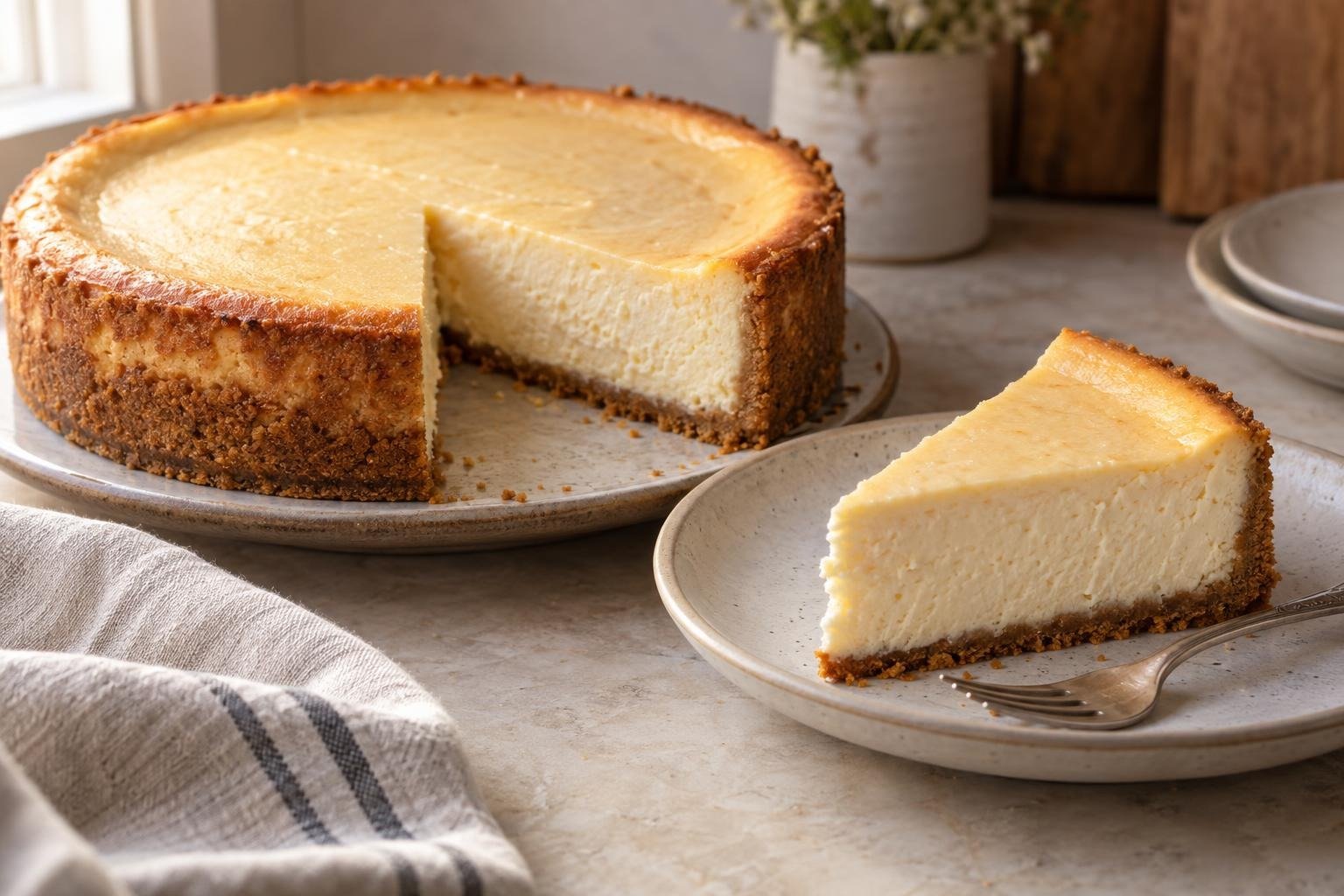
Position a rack in the lower third of the oven and preheat to 350°F. Lightly grease the base and sides of a 9-inch springform pan, then line the base with a parchment round. Set the pan on a heavy rimmed baking sheet to support it and catch any butter that escapes. Because this cheesecake is baked without a water bath, leave the outside of the pan unwrapped so dry oven heat can circulate evenly.
Combine the graham cracker crumbs, 30 g sugar, and melted butter in a medium bowl until every crumb looks evenly moistened and the mixture holds together when squeezed. Press it firmly across the pan base and about 1 inch up the sides, using a flat-bottomed measuring cup to compact it. Bake on the baking sheet for 10 minutes, until fragrant and slightly darker at the edges. Cool for 10 minutes while reducing the oven to 325°F.
Place the softened cream cheese in the bowl of a stand mixer fitted with the paddle attachment. Mix on low speed for 2 to 3 minutes, stopping twice to scrape the bowl, paddle, and dense mixture from the bottom. The cream cheese should become smooth and pliable without looking whipped. If using a hand mixer, keep it on its lowest setting and move slowly through the bowl rather than lifting the beaters and pulling air into the cheese.
Whisk the 250 g sugar, cornstarch, and salt together in a small bowl so the starch is evenly dispersed. Add this mixture to the cream cheese in three additions, mixing on low just until each addition disappears. Scrape the bowl thoroughly, then add the sour cream, vanilla, and lemon zest. Mix on low for about 30 seconds, stopping when the batter is glossy, uniform, and free of visible sour cream streaks rather than continuing until it becomes airy.
Crack the eggs into a separate bowl and break them up gently with a fork. With the mixer on its lowest speed, add the eggs in four portions, allowing each portion to blend almost completely before adding the next. Stop the mixer as soon as the final yellow streak disappears. Scrape the bowl and fold the batter five or six times with a flexible spatula, reaching the bottom to incorporate any dense cream cheese while releasing larger trapped air bubbles.
Pour the filling over the cooled crust and smooth the surface with the spatula. Tap the pan gently against the baking sheet two or three times, then pop any visible surface bubbles with a toothpick. Bake at 325°F for 80 to 90 minutes without opening the door during the first 70 minutes. The outer 2 inches should look set and slightly puffed, while the center 2 to 3 inches should tremble together like soft gelatin, not ripple like liquid batter. An instant-read thermometer inserted near the center should register about 150 to 155°F.
Switch off the oven, prop the door open about 2 inches with a wooden spoon, and leave the cheesecake inside for 1 hour. Transfer the pan, still on its baking sheet, to a wire rack and cool at room temperature for another hour. The surface will settle slightly as the filling contracts. Run a thin knife around the upper edge if it appears attached to the pan, but do not release the springform ring while the filling is warm and structurally delicate.
Cover the cooled pan without touching the cheesecake surface and refrigerate for at least 8 hours, preferably overnight. To unmold, release the springform clasp and lift away the ring; leave the cheesecake on the pan base unless transferring it to a flat platter with a wide spatula. For clean portions, dip a thin knife in hot water, wipe it dry, and cut straight down. Clean and rewarm the blade between slices, then let each slice stand for 15 minutes before serving.