Place the 300 g granulated sugar and water in a clean, heavy 3-quart saucepan. Cook over medium heat without stirring, swirling the pan only after the syrup begins coloring, until it reaches a deep amber color, about 8 to 12 minutes or 170 to 175°C. Remove from the heat. Slowly whisk in the warm cream, protecting your hands from the vigorous steam, then whisk in the 85 g butter and 5 g salt. Transfer to a heatproof bowl and cool until thick, glossy, and completely room temperature.
Set an oven rack in the center and heat the oven to 175°C. Grease three 8-inch round cake pans, line the bottoms with parchment rounds, then lightly grease the parchment. Leave the pan sides mostly free of excess grease so the batter can climb evenly. Confirm that the milk, sour cream, eggs, and cake butter are at room temperature. Set the prepared pans on the counter and have a digital scale ready so the finished batter can be divided evenly.
Whisk the cake flour, baking powder, and 4 g salt in a medium bowl for at least 30 seconds, breaking up any pockets of leavener. In a separate jug, whisk the whole milk and sour cream until smooth and pourable. Keeping the dry and liquid mixtures separate at this stage makes the final additions controlled and limits unnecessary gluten development. Scrape the bottom of the sour cream mixture because dense streaks tend to settle there.
Using a stand mixer fitted with the paddle, beat the 226 g cake butter, 250 g granulated sugar, and brown sugar on medium speed for 3 to 4 minutes. Stop and scrape the bowl and paddle halfway through. The mixture should look paler, slightly increased in volume, and fluffy rather than greasy. Add the eggs one at a time on medium-low speed, mixing until each disappears before adding the next. Mix in the 15 g vanilla, then scrape the bowl thoroughly.
Run the mixer on low and add one-third of the flour mixture, followed by half of the milk mixture. Repeat, then finish with the remaining flour. Mix only until most flour streaks disappear, about 15 seconds after the final addition. Remove the bowl and fold from the bottom with a flexible spatula until the batter is uniform. It should be thick, smooth, and scoopable, with no dry flour pockets or curdled-looking liquid around the edges.
Divide the batter evenly among the prepared pans, using the scale for layers of equal height, and smooth each surface with a small offset spatula. Bake all three pans on the center rack for 24 to 29 minutes, rotating their positions after 18 minutes only if the oven browns unevenly. The cakes are done when the centers spring back lightly, the edges begin pulling from the pans, and a tester shows moist crumbs but no wet batter.
Place the pans on wire racks and cool for 15 minutes. Run a thin offset spatula around each edge, invert the cakes onto the racks, remove the parchment, and turn them upright. Cool completely for about 90 minutes before trimming or wrapping; residual warmth will melt the filling. If the tops are domed, use a long serrated knife to remove only the raised portion. For easier assembly, chill the cooled layers for 20 to 30 minutes until firm but not frozen.
Beat the 454 g butter with the paddle on medium speed for 3 minutes, scraping once, until creamy and slightly lighter. Reduce the mixer to low and add the sifted confectioners’ sugar in four additions. Add 180 g completely cooled caramel, the 30 g cream, 5 g vanilla, and 1 g salt, then beat on medium for 2 minutes. Finish on low for 1 minute to reduce large air pockets. The frosting should hold a curved peak and spread without slumping.
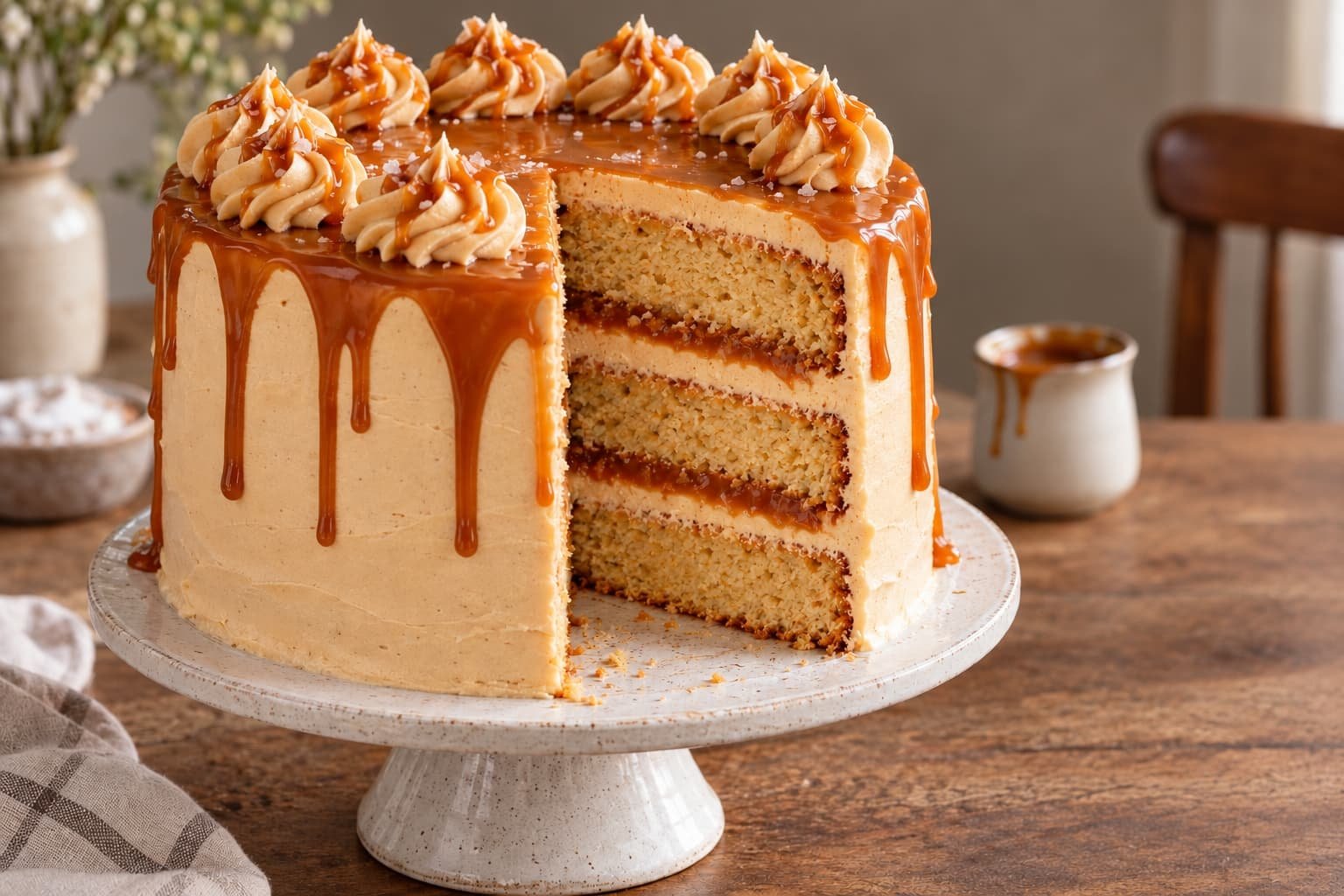
Place one cake layer on an 8-inch board or serving plate. Pipe a buttercream ring about 2 cm high around the edge, then spread 120 g cooled caramel inside the dam without covering it. Add the second layer and repeat with another 120 g caramel. Position the final layer cut-side down and check that the sides are vertical. Spread a thin buttercream coat over the top and sides, trapping loose crumbs, then refrigerate the cake for 30 minutes until the coating feels firm.
Cover the chilled cake with the remaining buttercream, smoothing the sides with a bench scraper and the top with an offset spatula. Chill for 20 minutes. Gently warm the remaining caramel just until it flows slowly from a spoon, keeping it below body temperature so it will not melt the frosting. Test one drip on the back, then add drips and a thin layer on top. Pipe buttercream swirls around the rim and let the cake stand for 30 minutes before cutting with a warm, dry knife.