Go Back
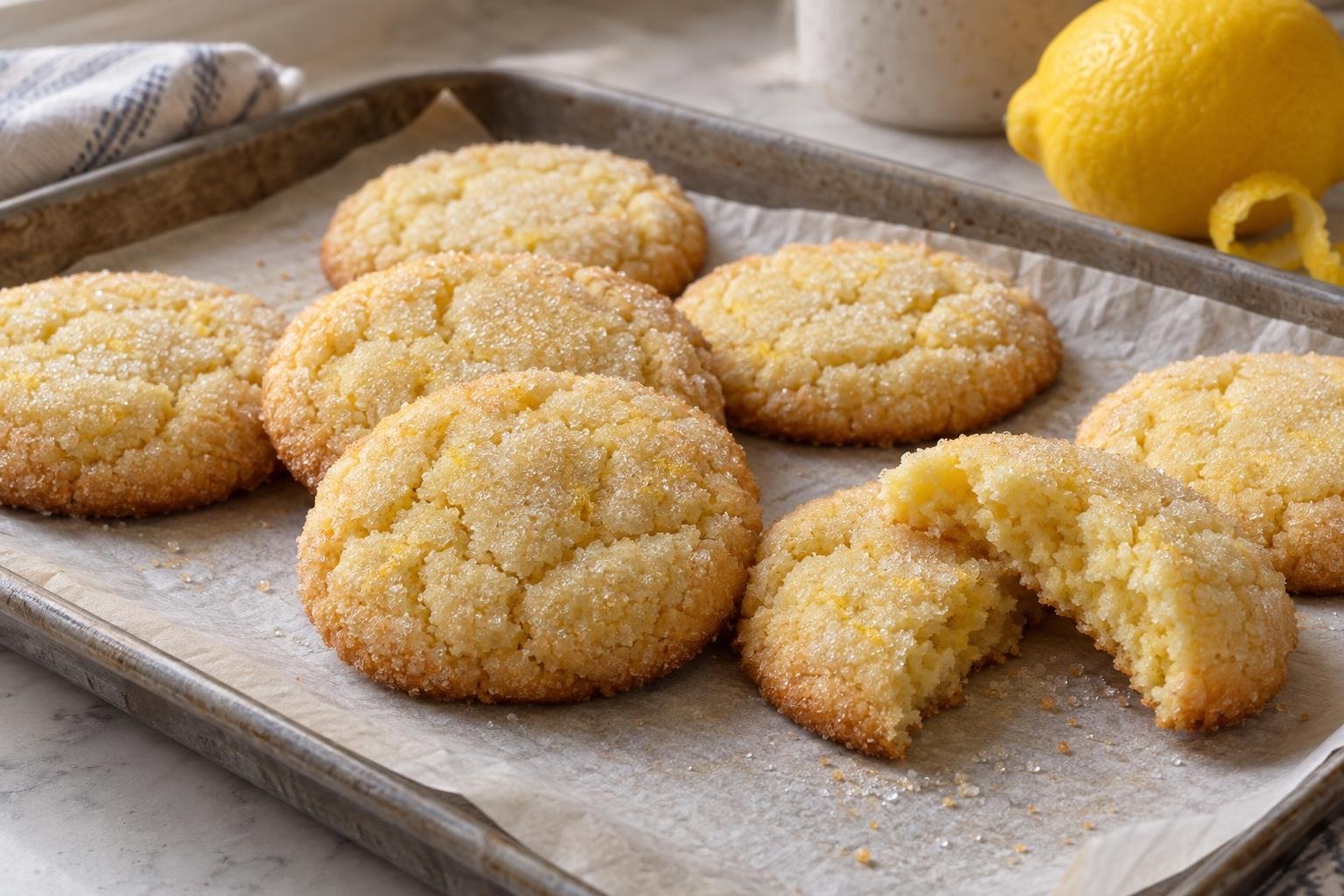
Small-batch lemon cookies with sugar-coated edges and soft, chewy centers on a parchment-lined baking sheet

Small-Batch Lemon Cookies with Soft, Chewy Centers

This from-scratch recipe makes eight sugar-crusted lemon cookies with fragrant zest, lightly crisp edges, and soft, chewy centers. The portioned dough can be refrigerated or frozen for make-ahead baking.
Prep Time 20 minutes
Cook Time 12 minutes
Cooling 1 hour
Total Time 1 hour 32 minutes
Servings: 8 cookies
Course: Dessert
Cuisine: American
Calories: 211

Ingredients
  

  • 130 g all-purpose flour about 1 cup plus 1 tablespoon, spooned and leveled if measured by volume
  • 8 g cornstarch 1 tablespoon
  • 1/4 teaspoon baking soda level measurement
  • 1/4 teaspoon fine salt use half this amount if using salted butter
  • 85 g unsalted butter 6 tablespoons, softened but still cool
  • 60 g granulated sugar for the cookie dough
  • 35 g light brown sugar about 3 tablespoons, firmly packed
  • 2 teaspoons finely grated lemon zest from about 1 medium lemon, yellow peel only
  • 1 large egg yolk about 18 g, at room temperature
  • 15 g fresh lemon juice 1 tablespoon, strained
  • 1/2 teaspoon pure vanilla extract rounds out the lemon flavor
  • 20 g granulated sugar about 1 tablespoon plus 2 teaspoons, for coating

Equipment

  • Digital kitchen scale or measuring cups and spoons
  • Large rimmed baking sheet, approximately 13 by 18 inches
  • Parchment paper
  • Medium mixing bowl
  • Large mixing bowl
  • Electric hand mixer or stand mixer fitted with the paddle attachment
  • Fine-mesh grater or microplane
  • Flexible silicone spatula
  • Small shallow bowl for coating sugar
  • Wire cooling rack

Method
 

  1. Line a large rimmed baking sheet with parchment paper. In a medium bowl, whisk the all-purpose flour, cornstarch, baking soda, and fine salt for about 30 seconds, breaking up every visible lump of cornstarch. Set this mixture aside. Keep the baking sheet at room temperature for now, and confirm there is enough refrigerator space for it before mixing the dough.
  2. Place the 60 g granulated sugar and lemon zest in a large mixing bowl. Rub them together with your fingertips for about 30 seconds, until the sugar feels slightly damp and smells strongly of lemon. Add the softened butter and brown sugar. Beat with an electric mixer on medium speed for 2 minutes, scraping the bowl once, until creamy, cohesive, and slightly lighter but not fluffy or warm.
  3. Add the room-temperature egg yolk and beat on medium-low speed for 30 seconds, stopping to scrape the bottom and sides of the bowl. Add the measured lemon juice and vanilla, then mix for another 20 to 30 seconds. The mixture should look smooth and creamy, although slight curdling from the acidic juice is harmless. Do not continue beating once the liquids are evenly incorporated.
  4. Add the dry ingredients and mix on low speed just until most flour disappears, about 20 seconds. Finish folding with a flexible spatula, scraping the bowl until no dry pockets remain; the dough should be soft but scoopable. Divide it into eight portions of about 48 g each and roll them gently into balls. Arrange them on the prepared sheet, cover without pressing the covering onto the dough, and refrigerate for 45 minutes.
  5. During the final 20 minutes of chilling, position a rack in the center of the oven and heat it to 350°F or 175°C. Put the remaining 20 g granulated sugar in a shallow bowl. Roll each cold dough ball in the sugar, covering the surface evenly, then return it to the lined sheet. Space the portions at least 3 inches apart and leave them rounded rather than flattening them.
  6. Bake the cookies on the center rack for 10 to 12 minutes, rotating the pan after 7 minutes if the oven browns unevenly. They are done when the edges are set and faintly golden, the tops have delicate cracks, and the centers remain pale and slightly puffed without glossy raw dough. Cool on the pan for 10 minutes, then transfer carefully to a wire rack and cool for at least 5 minutes before serving.
Notes

  • Grate the zest directly over the measured sugar so the bowl catches every aromatic oil released from the lemon peel.
  • If the butter looks shiny or partially melted, refrigerate it briefly before mixing. Warm butter cannot retain enough air and encourages excessive spread.
  • Use a scale to make eight 48 g portions. Equal dough balls finish baking together, which matters when the centers are intentionally removed while still pale.
  • Keep the dough balls covered during refrigeration. Exposed dough can develop a dry skin that prevents the cookies from spreading and cracking evenly.
  • Do not judge doneness by overall browning. These cookies should have set edges and pale centers; deep golden centers indicate a firmer, less chewy result.