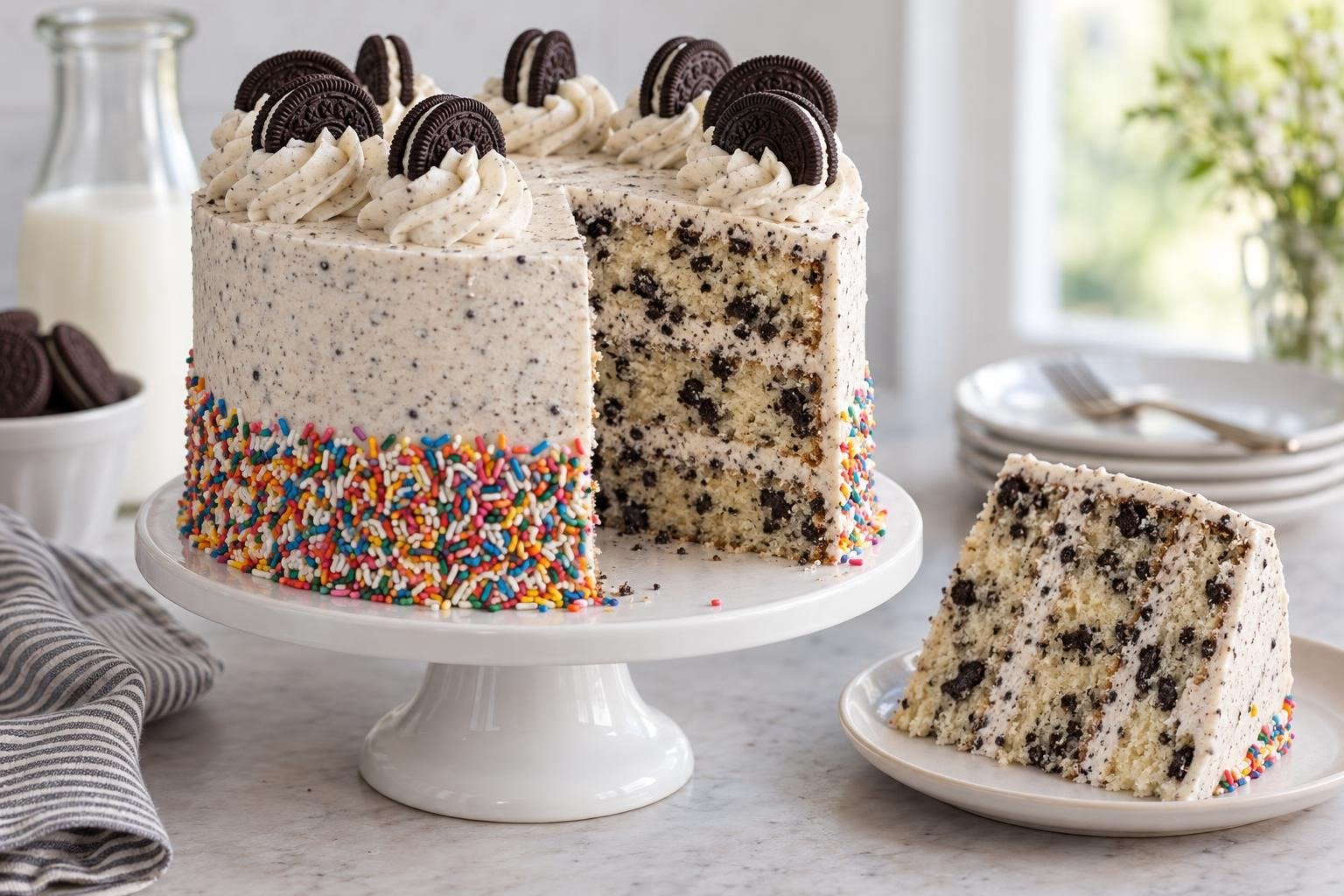
Position a rack in the center of the oven and heat it to 350°F. Grease three 8-inch round, 2-inch-deep cake pans, line the bottoms with parchment, and lightly grease the parchment. Break 240 g sandwich cookies into 1/4 to 1/2-inch pieces, keeping the cream intact; avoid powdering them because distinct pieces give the baked layers better contrast. Set the prepared pans on a digital scale so the finished batter can be divided evenly.
In the bowl of a stand mixer fitted with the paddle, combine the cake flour, 400 g sugar, baking powder, baking soda, and 6 g salt on low speed for 30 seconds. Add the softened cake butter a few pieces at a time, followed by the oil. Mix on low for 2 minutes, stopping once to scrape the bowl. The mixture should resemble evenly damp sand with no large butter lumps; this fat coating limits excess gluten once the liquids arrive.
Whisk the cake egg whites, whole eggs, buttermilk, and 15 g vanilla in a medium bowl until uniform. With the mixer running on low, add one-third of this mixture to the flour base and mix for 20 seconds. Repeat twice, scraping the bowl between additions. Increase to medium and mix for 30 seconds, just until the batter looks smooth, thick, and satiny. Fold in the coarse cookie pieces with a flexible spatula, reaching along the bottom without crushing them.
Divide the batter equally among the prepared pans, about 620 g per pan, and smooth the surfaces with an offset spatula. Bake all three on the center rack for 25 to 30 minutes, rotating their positions after 20 minutes only if the oven browns unevenly. The layers are done when the centers spring back under a light touch and a skewer finds moist crumbs but no wet batter. Avoid overbaking, which dries the exposed cookie edges and reduces flexibility during stacking.
Set the pans on wire racks and cool the cakes in them for 15 minutes. Run a thin knife around each edge, invert onto the racks, remove the parchment, and turn the layers upright. Let them cool completely for about 75 minutes; trapped warmth will melt the buttercream and make the stack slide. Once cool, wrap the layers individually and chill them for 30 minutes. Cool, slightly firm cake is easier to level and produces fewer crumbs during assembly.
Combine the buttercream egg whites and 360 g sugar in the clean mixer bowl. Set it over a saucepan holding 1 inch of barely simmering water, ensuring the bowl does not touch the water. Whisk constantly until the mixture reaches 160°F and feels smooth between two fingers, 6 to 9 minutes. Whip with the whisk on high until glossy, stiff, and cooled to about 75°F. Beat in the 510 g butter gradually, then add vanilla and salt. Reserve 250 g plain buttercream before folding fine cookie crumbs into the remainder.
Place the first chilled layer on an 8-inch cake board or flat serving plate, trimming only a pronounced dome with a serrated knife. Spread 260 g cookies and cream buttercream evenly to within 1/2 inch of the edge. Add the second layer, repeat the filling, and place the final layer upside down so its flat bottom becomes the top. Check the cake from several angles and nudge the layers into alignment. Refrigerate the stacked cake for 20 minutes before coating it.
Spread a thin coat of cookies and cream buttercream over the chilled top and sides, using an offset spatula to trap loose crumbs. Refrigerate for 20 minutes until the coating feels firm rather than sticky. Apply the remaining cookie buttercream in an even layer and smooth it with a bench scraper held vertically against the rotating cake. Use part of the reserved plain buttercream to sharpen the top edge. Press rainbow jimmies around the lower third while the outer frosting is still slightly tacky.
Transfer the remaining plain buttercream to a piping bag fitted with a large open-star tip. Pipe 16 evenly spaced swirls around the top border, then place one cookie half into each swirl. Refrigerate the decorated cake for at least 60 minutes to stabilize the layers. For the cleanest texture and flavor, remove it from the refrigerator 45 to 60 minutes before serving. Slice with a long knife warmed under hot water and wiped dry, cleaning the blade between cuts.