Position oven racks in the upper and lower thirds and heat the oven to 350°F (175°C). Grease three 8-inch by 2-inch round pans, line the bottoms with parchment, and lightly grease the parchment. Spread the whole hazelnuts on a small rimmed baking sheet and toast for 8 to 10 minutes, stirring once, until fragrant and lightly golden. Transfer them immediately to a cool plate, then chop only after they are completely cool.
Set a fine-mesh sieve over a large mixing bowl. Sift in the all-purpose flour, natural cocoa, baking soda, baking powder, and salt, then whisk in the hazelnut flour and granulated sugar for about 30 seconds. Break apart any compact pieces of hazelnut flour with your fingertips. The mixture should be evenly colored with no pale flour streaks or cocoa pockets, which prevents bitter lumps and uneven leavening in the finished layers.
In a medium bowl, whisk the eggs, sour cream, buttermilk, oil, and vanilla until smooth and fully emulsified. Pour the wet mixture into the dry ingredients and whisk gently from the center outward until only a few flour streaks remain. Add the hot coffee in two additions, whisking just until the batter is fluid, glossy, and uniform. Divide approximately 610 g batter into each prepared pan, then tap each pan twice on the counter to release large air bubbles.
Place the pans on the prepared oven racks with space around each one for airflow. Bake for 27 to 32 minutes, rotating the pans front to back and swapping rack positions after 20 minutes. The layers are done when their centers spring back lightly, the edges begin pulling from the pans, and a skewer reveals moist crumbs but no wet batter. If one layer finishes first, remove it rather than overbaking it while the others catch up.
Set the pans on wire racks and cool the cakes in their pans for 15 minutes. Run a thin spatula around each edge, invert onto the racks, remove the parchment, and turn the layers right side up. Cool completely for at least 75 minutes before leveling or wrapping. Warm cake compresses under frosting and releases steam, so the centers should feel fully room temperature rather than merely cool at the edges before assembly begins.
Place the softened butter in the bowl of a stand mixer fitted with the paddle. Beat on medium speed for 3 minutes, scraping once, until smooth and slightly lighter. Add the confectioners' sugar, cocoa, and salt in three additions on low speed. Mix in the chocolate hazelnut spread and vanilla, then drizzle in the cream. Beat on medium-low for 2 minutes until silky and spreadable, avoiding high speed because excess air bubbles make a smooth finish difficult.
Place the finely chopped semisweet chocolate in a heatproof bowl. Heat the heavy cream in a small saucepan over medium-low heat until steaming and bubbling only around the edge, then pour it over the chocolate. Rest for 2 minutes before stirring slowly from the center until glossy and completely smooth. Let the ganache cool for 15 to 25 minutes, stirring occasionally, until a spoonful forms a slow drip that holds briefly on the bowl rather than running like warm cream.
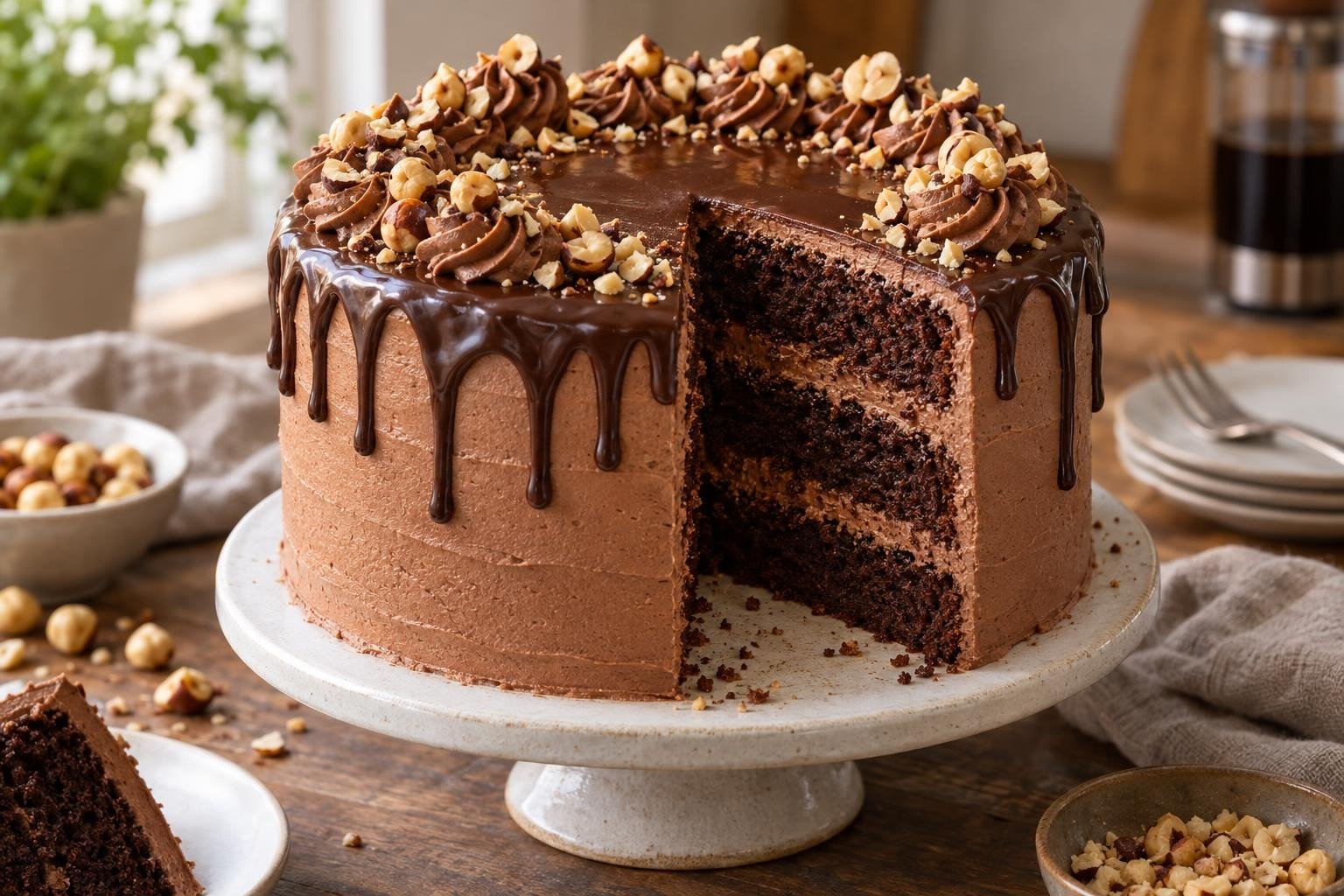
Use a long serrated knife to level any domed cake tops. Place one layer on an 8-inch cake board or serving plate and spread about 180 g buttercream evenly to the edge. Repeat with the second layer, then position the final layer cut side down. Cover the top and sides with a thin crumb coat, filling gaps between layers as you work. Refrigerate uncovered for 30 minutes, until the coating feels firm and traps loose crumbs beneath the final finish.
Reserve about 180 g buttercream for the top border, then cover the chilled cake with the remaining frosting. Smooth the sides with an icing scraper and the top with an offset spatula. Apply ganache around the cold upper edge with a piping bag, adding short test drips before filling the center. Pipe the reserved buttercream around the top and add the cooled chopped hazelnuts. Chill for 30 minutes to set, then temper at room temperature for 30 to 45 minutes before slicing.